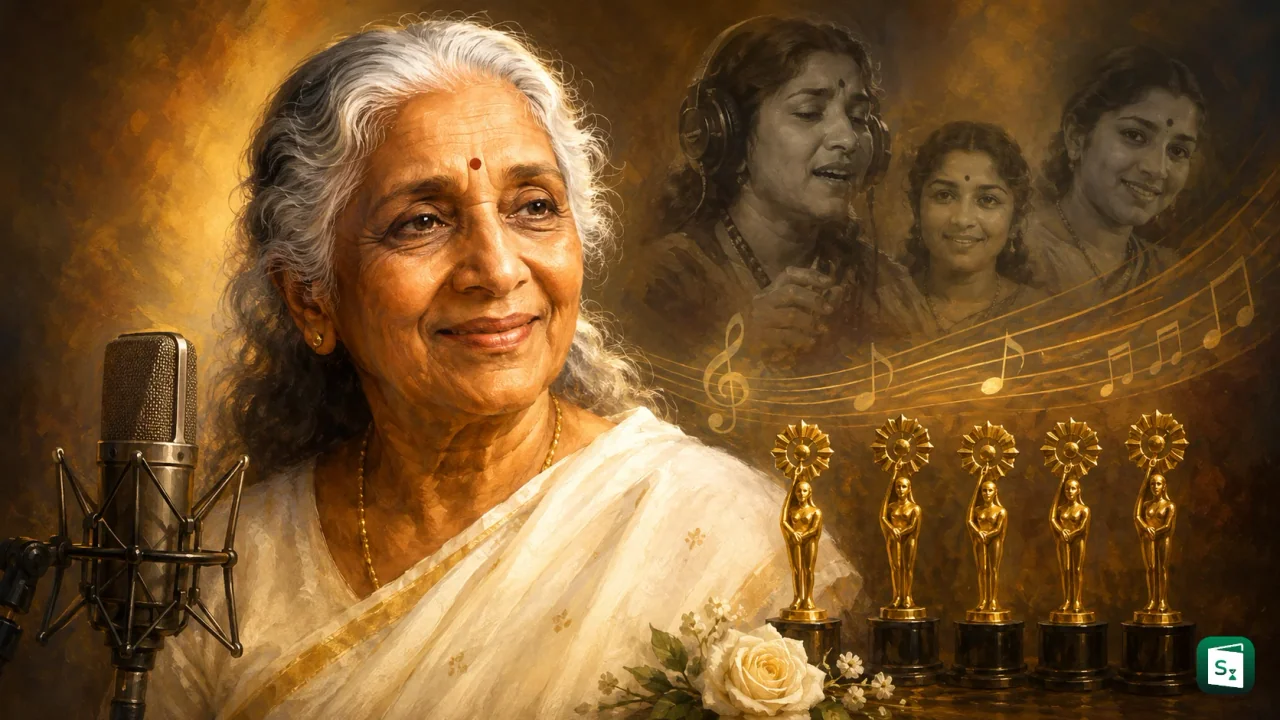
S Janaki, the legendary playback singer revered as the “Nightingale of South India”, died on 11 July 2026 at Apollo BGS Hospitals in Mysuru following a cardiac arrest. She was 88. With a career spanning over six decades and more than 48,000 songs recorded in over 20 languages, her passing marks the end of an extraordinary chapter in Indian film music.
Early Life and Entry into Music
Born Sistla Sreeramamurthy Janaki on 23 April 1938 in Pallapatla village in the Guntur district of Andhra Pradesh (then part of the Madras Presidency), Janaki was the daughter of Sistla Sreeramamurthy, an Ayurvedic doctor and teacher. She spent much of her childhood in Sircilla in present-day Telangana, where she first performed on stage at the age of nine. Her early musical training came from a Nadaswaram vidwan named Paidiswamy, though she never received formal classical training.
Her big break came through an All India Radio music competition in 1956, where she was recognised and the prize was presented by the then President, Dr Rajendra Prasad. This opened the door for her to work as a contract singer at AVM Studios in Chennai. She made her playback debut in 1957 with the Tamil film Vidhiyin Vilayattu at the age of 19. In a stunning display of versatility, she recorded songs in six different Indian languages within her very first year as a professional singer.
She married V. Ramprasad in 1959, who actively supported her career and accompanied her to recording sessions throughout his life. He died in 1997.
A Six-Decade Career Across Languages
Janaki went on to record over 48,000 songs across more than 20 Indian languages, including Telugu, Tamil, Kannada, Malayalam, Hindi, Sanskrit, Odia, Tulu, Urdu, Punjabi, Bengali, and Konkani. She also sang in foreign languages such as English, Japanese, German, and Sinhala. The language in which she recorded the most songs was Kannada, followed by Malayalam.
Her ability to modulate her voice to suit characters of any age, from a child to an elderly woman, earned her the title “Queen of Expression and Modulation”. She was the favourite singer of some of India’s most celebrated music composers.
Collaborations with Legendary Composers
Janaki worked with generations of composers across South Indian cinema. Her association with Ilaiyaraaja began with his debut film Annakkili (1976), for which she sang three songs that became instant hits. She won four Tamil Nadu state awards for songs composed by him. With M. S. Viswanathan, she delivered numerous hits throughout the 1960s and 1970s. In the 1990s, she worked with a young A. R. Rahman, singing iconic songs such as “Margazhi Thinkal Allava” from Sangamam, for which she won a Tamil Nadu State Film Award well into her fifth decade in the industry.
In Hindi cinema, composer Bappi Lahiri was impressed by a Hindi song she had recorded for a Tamil film and brought her to Bollywood, where she recorded duets with Kishore Kumar. Her notable Hindi songs include “Yaar Bina Chain Kahan Re” from Saaheb (1985) and “Dil Mein Ho Tum” from Satyamev Jayate (1987).
Retirement
Janaki announced her retirement from playback singing and stage performances in 2016 after a career of nearly 60 years. She chose the Malayalam lullaby “Amma Poovinum” from the film 10 Kalpanakal as her final song. She briefly came out of retirement in 2018 to sing for the Tamil film Pannaadi.
Four National Film Awards: A Rare Feat
Janaki won the National Film Award for Best Female Playback Singer four times, a feat achieved by only a handful of singers in Indian cinema. She was among the most decorated winners in the history of the award, which was instituted in 1968. The award carries a Rajat Kamal (Silver Lotus) and a cash prize.
| Year | Song | Film | Language |
|---|---|---|---|
| 1977 | ”Senthoora Poove” | 16 Vayathinile | Tamil |
| 1981 | ”Ettumanoorambalathil” | Oppol | Malayalam |
| 1984 | ”Vennello Godari Andam” | Sitaara | Telugu |
| 1992 | ”Inji Iduppazhagha” | Devar Magan | Tamil |
In addition to these four national honours, she received over 33 state film awards from the governments of Tamil Nadu, Kerala, Andhra Pradesh, Karnataka, and Odisha. Among her other major recognitions are the Kalaimamani award from the Government of Tamil Nadu (1986), an honorary doctorate from the University of Mysore (2009), the Rajyotsava Prashasti from the Government of Karnataka (2014), and the Filmfare Lifetime Achievement Award South (1997).
The Padma Bhushan That Was Declined
In 2013, the Government of India announced the Padma Bhushan, the country’s third-highest civilian award, for S Janaki. She publicly declined it, saying the recognition had come too late in her career. Having already sung for 55 years across multiple languages, she expressed that her contributions to Indian music deserved greater and timelier acknowledgement. She suggested that the Bharat Ratna, India’s highest civilian honour, would have been more appropriate for her lifetime of work.
Janaki also highlighted the long-standing neglect of artists from South India in the national awards system. “Why can’t the government recognise people’s contribution when they are alive?” she had asked in an interview. Her son, V. Muralikrishna, defended her stand, stating that the honour should have come much earlier given her extraordinary body of work.
Her principled refusal became as defining a part of her legacy as the awards she accepted. She joins a small list of noted Indians who have declined the Padma Bhushan, including historian Romila Thapar, journalist Nikhil Chakravarty, and former West Bengal Chief Minister Buddhadeb Bhattacharjee.
A Legacy That Transcends Generations
S Janaki’s voice was heard across six decades and countless films, from the 1950s golden era of South Indian cinema through the digital age. She was one of the few singers to have won state awards under all three of Tamil cinema’s most celebrated composers: M. S. Viswanathan, Ilaiyaraaja, and A. R. Rahman. Her duets with S. P. Balasubrahmanyam are often considered among the finest in Indian film music history.
She was widely admired not only for her vocal range but also for her humility. Her last concert was held in 2017 at the University of Mysore, the same venue where she had begun her stage career decades earlier. The news of her death drew tributes from across the political and film fraternity, including the President, the Prime Minister, Tamil Nadu Chief Minister Vijay, and actors Rajinikanth, Kamal Haasan, and Chiranjeevi.
She is survived by her son V. Muralikrishna and daughter-in-law Uma Muralikrishna, a Bharatanatyam dancer. Her husband predeceased her in 1997.
Key Takeaways
- S Janaki (1938-2026), known as the “Nightingale of South India”, recorded over 48,000 songs in more than 20 languages over a career spanning six decades.
- She won the National Film Award for Best Female Playback Singer four times: in 1977, 1981, 1984, and 1992.
- She also received over 33 State Film Awards and honours such as the Kalaimamani (1986), an honorary doctorate from the University of Mysore (2009), and the Rajyotsava Prashasti (2014).
- In 2013, she declined the Padma Bhushan, stating the recognition had come too late and that South Indian artists were often overlooked in national awards.
- She made her playback debut in 1957 with the Tamil film Vidhiyin Vilayattu and retired in 2016, briefly returning in 2018.
- She was among the most versatile playback singers in Indian cinema, known for her ability to modulate her voice for characters of any age.