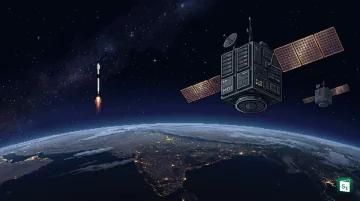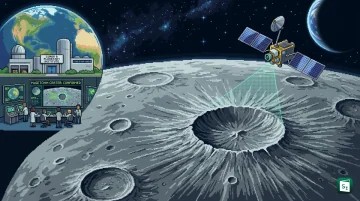
The ISRO has successfully launched the “EOS-05” Earth Observation Satellite (EOS) onboard the Geosynchronous Satellite Launch Vehicle (GSLV)-F17 from the Second Launch Pad of the Satish Dhawan Space Centre (SDSC) in Sriharikota. It is to be noted that the EOS-05 is the first Indian imaging satellite deployed from a geosynchronous orbit.
It aims to strengthen domestic Earth observation and imaging capabilities. The GSLV-F17 is a 51.7 m tall 3-stage rocket with a total liftoff mass of 420.5 tonnes. The launch vehicle successfully injected the 2,367 kg satellite into a Sub-Geosynchronous Transfer Orbit (Sub-GTO).
The IISc Bengaluru, has established the Foundation for Quantum Computing Innovation (FQCI) to function as the Quantum Computing Thematic Hub (QC T-Hub) under the National Quantum Mission (NQM). It is to be noted that the NQM is implemented by the Department of Science and Technology (DST).
FQCI is tasked with developing skilled manpower and promoting entrepreneurship in quantum technologies through 5 specialized programmes: Quantum Computing (QC) Rise, QC Bridge, QC Leap, QC Accel, and QC Quest.
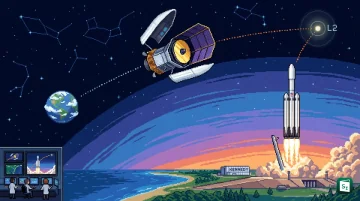
The NASA has successfully launched the “Nancy Grace Roman Space Telescope” onboard the SpaceX Falcon Heavy rocket from the Kennedy Space Center in Florida, USA. The project was developed at a cost of $4.3 billion.
The telescope is destined for the Lagrange Point 2 (L2) and has a primary lifespan of 5 years. It is to be noted that the telescope is named after Nancy Grace Roman, the first Chief of Astronomy of the NASA and the “Mother of Hubble”, making it the first NASA telescope named after a woman.
The Centre for Development of Telematics (C-DOT) has unveiled 14 indigenous quantum products during its 43rd Foundation Day celebrations in New Delhi. The products are developed in the areas of Quantum Key Distribution (QKD) and Post-Quantum Cryptography (PQC).
The newly launched QKD systems include “Q-AKSHAY CD” (a fibre-based system using Coherent One Way and Differential Phase Shift protocols in a compact 1U size) and “Q-AKSHAY MD” (based on the Measurement Device Independent protocol). The hardware components introduced include “C-SPD” (a Single-Photon Detector) and “C-RD” (a wideband Radio Frequency (RF) driver).
The encryptor lineup features “Q-SETU” (securing Layer 3 communications up to 80 Mbps), “Q-MAHASETU” (a commercial-grade Layer 2/3 encryptor up to 40 Gbps), “Q-VIKRAM” and “Q-PARAKRAM” (defence-grade Layer 2/3 encryptors up to 1 Gbps), and “Q-AMOGH” (a high-speed Layer 1 optical encryptor up to 200 Gbps).
For secure communications, C-DOT introduced “Q-DARSHAN” (a quantum-safe video Internet Protocol (IP) phone) and “Q-VACHAN” (an in-line node using National Institute of Standards and Technology (NIST) PQC algorithms). The network solutions include “Q-RAQSHAK” (for enterprise network protection), “Q-VAAYU” (a wireless point-to-point solution), and “Q-VAJRA1000” (a quantum-safe access node).
The Indian Pharmacopeia Commission (IPC), operating under the Ministry of Health and Family Welfare (MoHFW), has introduced 7 Indian Pharmacopoeia Nitrosamine Impurities Reference Standards to enhance the precise detection and quantification of carcinogenic impurities in pharmaceutical products.
The reference standards were officially launched during an interactive meeting titled “IP 2026: Perspectives, Suggestions, & Way Forward” organized by the IPC in Kolkata, West Bengal.
It is to be noted that nitrosamines are classified as highly potent genotoxic and carcinogenic compounds, which are substances capable of causing cancer or genetic mutations.
Sophie Adenot, an astronaut of the European Space Agency (ESA) from France, has conducted a mission to repair a communications system on the International Space Station (ISS).
With this, she becomes the first French woman to perform a spacewalk.
It is to be noted that she is also the second European woman to walk in space, following Samantha Cristoforetti of Italy who completed a spacewalk in 2022.
D-Propulse Aerospace Pvt Ltd has successfully demonstrated the first indigenously developed 5 kilo-Newton (kN) air-breathing Rotating Detonation Engine (RDE) of India, integrated with an aerospike nozzle. The demonstration was held at the DRDO test facility in Hyderabad.
It is to be noted that the test validated the Technology Readiness Level-5 (TRL-5), which marks a milestone in the advanced propulsion capabilities of the country.
Researchers Bhakta Bahadur Raskoti and Rita Ale have discovered a new Himalayan plant species named ‘Impatiens nimspurjai’ in the Myagdi district of Nepal.
The species is named to honour the Nirmal Purja, a Nepali mountaineer, for his contributions to mountaineering and high-altitude environmental conservation. It is to be noted that he achieved the distinction of climbing all 14 of the 8,000-metre peaks of the world in 2019.
India has unveiled “JAL-YAAN”, the first solar-integrated and self-powered mobile water purification van of the country, in Nagpur, Maharashtra. The vehicle was jointly developed by the CSIR-Central Salt and Marine Chemicals Research Institute (CSIR-CSMCRI) and Rite Water Solutions.
China has successfully completed the full-parameter testing of the world’s largest superconducting fusion magnet.
The magnet is designed to act as an “invisible magnetic cage” within the next-generation Burning Plasma Experimental Superconducting Tokamak (BEST) reactor.
OpenAI has introduced ChatGPT for Teens, a specialized version featuring parental controls and enhanced security measures to address risks associated with AI chatbots.
The platform automatically activates when a user is estimated to be under 18 years of age (or self-identifies their age as between 13 and 17 years).
SpaceX (Space Exploration Technologies Corporation) has launched two Falcon 9 rockets, setting a company record with the shortest launch gap of 38.5 minutes.
The first rocket carried 8 Globalstar satellites and was launched from the Canaveral Space Force Station in Florida, USA. The second rocket carried the classified United States Space Force (USSF)-366 mission for the USSF and was launched from the Vandenberg Space Force Base in California, USA.
The SPIRE Lab of the IISc Bengaluru, in collaboration with the AI and Robotics Technology Park (ARTPARK) and Google, has launched an open-source speech AI model named SraVaani.
The model is capable of recognizing 65 Indian languages and dialects. It has been released under a permissive Massachusetts Institute of Technology (MIT) licence on the Hugging Face platform.
Indian researchers led by Dr Shubhasis Haldar have developed a deep-learning AI framework named “ACSCeND” to identify hidden cancer stem-like cells (CSCs).
The framework was developed through a collaboration between the SN Bose National Centre for Basic Sciences (SNBNCBS) and Ashoka University.
Astrobase Space Technologies Pvt Ltd has unveiled “EVEREST”, the first privately developed 800 kilonewton (kN) Full-Flow Staged Combustion (FFSC) rocket engine of India, in Bengaluru. The engine is specifically designed for reusable medium-lift launch vehicles and advanced orbital missions.
It is to be noted that Astrobase completed sub-scale and turbopump tests during 2025 and 2026, with plans to produce around 20 engines and conduct full-scale hot-fire testing in 2026.
Anil Menon, an Indian-origin astronaut of the NASA, has successfully completed his inaugural spacewalk, designated as “US Spacewalk 96”, outside the International Space Station (ISS).
The Extravehicular Activity (EVA) lasted for 6 hours and 27 minutes, and was conducted alongside veteran NASA astronaut Jessica Meir. With this achievement, Menon joins Sunita Williams and Raja Chari in the group of Indian-origin astronauts who have performed spacewalks.
Union Minister Shivraj Singh Chouhan has unveiled ‘MA-104’, India’s first indigenous live attenuated vaccine against African Swine Fever (ASF). The vaccine is developed by the ICAR-National Institute of High Security Animal Diseases (ICAR-NIHSAD) in Bhopal.
It is to be noted that ASF is a highly contagious viral disease affecting both domestic and wild pigs, with a mortality rate of nearly 100%.
The Indian Council of Agricultural Research (ICAR) has developed India’s first fully annotated Telomere-to-Telomere (T2T) reference genome of the pigeonpea (Cajanus cajan L. Millsp.) variety ‘Asha’.
This genome has been approved as the global reference genome to facilitate the development of climate-resilient, high-yielding, and nutritionally enriched pigeonpea varieties.