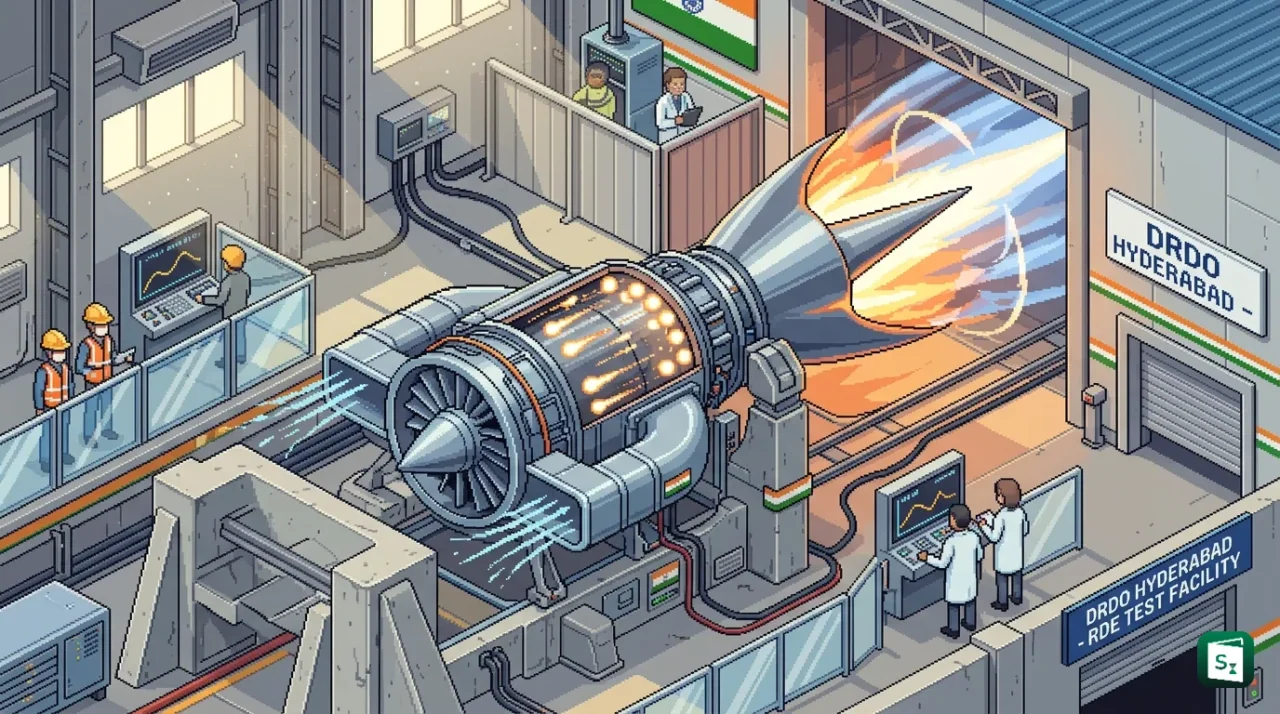
D-Propulse Aerospace Pvt Ltd successfully demonstrated India’s first indigenously developed 5 kilo-Newton (kN) air-breathing Rotating Detonation Engine (RDE) integrated with an aerospike nozzle at the Defence Research and Development Laboratory (DRDL) facility of the Defence Research and Development Organisation (DRDO) in Hyderabad on 21 to 22 July 2026. The engine generated a stable 5 kN of thrust even while operating on reduced air and fuel flow, signalling higher thrust potential at full flow. The test validated the technology at Technology Readiness Level 5 (TRL-5), a phase that confirms performance in a relevant operational environment and marks a decisive step for India’s advanced propulsion capabilities.
What Is a Rotating Detonation Engine?
A Rotating Detonation Engine (RDE) is an advanced propulsion system that uses controlled detonation instead of steady burning to produce thrust. In simple terms, a conventional jet or gas turbine engine burns fuel slowly through a process called deflagration, which is subsonic and takes place at roughly constant pressure, similar to a steady flame moving at a few metres per second. An RDE, on the other hand, uses detonation, which is a supersonic combustion wave that travels at thousands of metres per second coupled with a shock wave, compressing and igniting the fuel mixture almost instantly.
Inside an RDE, one or more detonation waves travel continuously around an annular combustion chamber, which is a ring shaped hollow channel formed between two concentric cylinders. Fresh air and fuel are injected continuously into this channel, and the rotating wave ignites them as it passes, producing hot, high pressure gases that expand to create thrust. The process is called pressure gain combustion, because the combustion itself raises pressure rather than needing external compressors to do that work. This differs from the Brayton cycle used in conventional engines, where combustion happens at nearly constant pressure and much of the chemical energy is not converted efficiently.
The result is a compact combustor that can produce more thrust from the same amount of fuel, with fewer mechanical parts. Unlike a turbojet which relies on rotating compressor and turbine blades, shafts and bearings, an RDE combustor can function with essentially no moving parts in the combustion section, making it simpler, lighter and potentially easier to mass produce.
How It Differs from Conventional Air-Breathing Engines
| Feature | Conventional Air-Breathing Engine (Turbojet, Ramjet) | Rotating Detonation Engine (RDE) |
|---|---|---|
| Combustion type | Deflagration, subsonic flame at constant pressure | Detonation, supersonic wave with pressure rise |
| Thermodynamic cycle | Brayton cycle, constant pressure combustion | Approx. constant volume combustion, pressure gain |
| Efficiency | 35 to 40 percent in modern turbofans, limited by pressure losses | Theoretically 15 to 25 percent higher than conventional systems |
| Moving parts in combustor | Many, includes compressor and turbine stages | No moving parts in detonation combustor |
| Size and weight | Larger and heavier for a given thrust | More compact and modular, higher thrust to weight |
This pressure gain and simplicity is why RDEs are being explored globally for missiles, loyal wingman drones, supersonic aircraft and reusable space launch stages.
India’s Breakthrough: The 5 kN Air Breathing RDE with Aerospike Nozzle
The test conducted at DRDL Hyderabad was India’s first public demonstration of an air-breathing RDE at the 5 kN thrust class. A thrust of 5 kN equals about 5,000 Newtons, which is roughly equivalent to the thrust of a small turbofan used in tactical cruise missiles. Most global research rigs for air-breathing RDEs have operated in the 1 to 2 kN range and often for a fraction of a second. D-Propulse’s demonstrator produced continuous, stable thrust at 5 kN, integrated with an expansion aerospike nozzle, on a government certified test stand.
According to the company’s announcement on 23 July 2026, the short duration hot fire runs showed the classic RDE signature, a sharp screech and a bright, well defined exhaust plume. Founder and Chief Executive Officer Saurav Jha stated that the engine achieved the 5 kN figure despite reduced air mass flow and reduced fuel flow, which means the core architecture has headroom to reach higher thrust once airflow management and fuel mixing are optimised.
The achievement was described as a move from laboratory scale validation to an integrated prototype. It is a proof motor for a flight capable design, not yet a flight engine, but it proves that combustion stability, wave rotation and thrust generation can be held together in realistic test conditions.
Who Built It
D-Propulse Aerospace Pvt Ltd is a deep tech propulsion startup incubated at the Indian Institute of Technology Madras (IIT Madras), which was established in 1959 in Chennai and is one of India’s leading engineering institutes. The company was founded in July 2025 by Saurav Jha, a defence analyst and founder of Delhi Defence Review, and Dr V. Ramanujachari, a former senior DRDO scientist who earlier led India’s scramjet engine programme and contributed to the propulsion system of the Akash surface to air missile.
The board includes Dr V. K. Saraswat as Chairman. Dr Saraswat is a former DRDO Chief, former member of NITI Aayog (the National Institution for Transforming India, established in 2015 as the government’s policy think tank headquartered in New Delhi), and a key mentor for the project. The technical advisory includes Prof S. Chakravarthy, Head of the National Centre for Combustion Research and Development (NCCRD) at IIT Madras. In January 2026, the startup raised ₹25 crore in seed funding from the Indian Angel Network (IAN) Alpha Fund to expand engineering, simulation and testing capacity.
The testing partner, DRDL, is the Hyderabad based laboratory of DRDO, which was established in 1958 and is headquartered in New Delhi. DRDL is responsible for design and development of missile systems and technologies, including aerodynamics, propulsion and systems analysis. DRDO’s Research Centre Imarat (RCI), also in Hyderabad, has separately invited private firms in August 2026 to co develop tactical missiles, reflecting a wider push to link private innovation with public test infrastructure.
Understanding the Aerospike Nozzle
A rocket or jet nozzle has a critical job, to expand hot exhaust gases efficiently and convert pressure into thrust. A conventional bell nozzle is optimised for one specific ambient pressure or altitude. When the vehicle climbs and outside air pressure falls, the exhaust becomes either over expanded or under expanded, and efficiency can drop by as much as 30 percent across the flight envelope.
An aerospike nozzle solves this through altitude compensation. Instead of a fixed bell wall, it uses a central spike or plug with the exhaust flowing along its outer contoured surface. The outside air itself acts as a virtual wall, so the effective expansion ratio adjusts automatically as atmospheric pressure changes. In simple terms, the atmosphere helps shape the plume, keeping expansion near optimal from sea level to high altitude without any moving parts.
This makes the pairing of an RDE with an aerospike a natural fit. The RDE produces rapid bursts of high pressure, and the aerospike expands those pressure pulses efficiently across altitudes. Research on this integration has also shown that the throat constriction in aerospike designs can further improve stagnation pressure gain from the combustor. The trade off is complexity. Aerospikes face severe thermal loads on the spike, need advanced cooling and require precise manufacturing, which is why they have historically seen limited flight use despite being studied since the 1960s and tested in programmes such as NASA’s Linear Aerospike experiment and the X-33.
For the D-Propulse demonstrator, the integrated aerospike means the same 5 kN core could maintain performance whether used at low level for terrain hugging cruise missiles or at higher altitudes for drones and spaceplane demonstrators, a versatility that bell nozzles cannot provide without redesign.
What Does TRL-5 Mean?
Technology Readiness Level (TRL) is a nine level scale first created at NASA in 1974 and formalised in 1989, and later adopted globally including by DRDO and ISRO, to measure how mature a technology is. Level 1 is basic principles observed, Level 9 is a fully proven system in operational use. Each step demands stricter testing in more realistic conditions.
| TRL | Name | What It Means |
|---|---|---|
| 1 to 3 | Basic research and proof of concept | Idea and laboratory proof, usually paper studies or small experiments |
| 4 | Laboratory validation | Components or breadboard tested in a lab, basic functionality shown |
| 5 | Validation in relevant environment | Integrated prototype tested outside the lab with realistic supporting systems |
| 6 | Demonstration in relevant environment | System level prototype shown handling most real world stresses |
| 7 | Prototype in operational environment | Flight like demonstration |
| 8 | System completed and qualified | Thorough testing, ready for operational use |
| 9 | Proven in mission | Technology flying in actual operations |
D-Propulse has now reached TRL-5, which means the core architecture, including the annular combustor, fuel injection and aerospike integration, was tested as an integrated prototype in a relevant environment at a government facility, not just on a small lab rig. According to NASA’s definitions, TRL-5 requires that components are integrated with realistic support equipment so that the technology can be validated against the conditions it will eventually face. The company states that this upgrades the system from concept to credible prototype, but several stages remain before operational deployment. Its public roadmap targets flight readiness by December 2027 (TRL-7 class) and military user trials by December 2029.
Why This Engine Matters for India
Strategic Importance for Defence
Air breathing RDEs are air breathing, which means they take oxygen from the atmosphere rather than carrying an oxidizer, unlike rocket engines. This saves weight and allows longer sustained cruise flight. For tactical systems, a 5 kN class is directly useful. It sits in the same thrust band as the indigenous turbofan that powers India’s long range cruise missiles, which is reported in the 4.2 to 4.5 kN range, but an RDE could do the same job in a smaller and lighter package.
The advantages highlighted by the company and analysts include a 15 to 25 percent improvement in thermodynamic efficiency, more thrust for the same fuel, and therefore longer range or higher payload for a missile of the same size. The engine’s compact, static metal construction is estimated to cost about 60 percent less than comparable ramjet systems and requires no turbine blade manufacturing, while D-Propulse claims about 96 percent indigenous content. Because the design is modular, it also allows mass in precision, building affordable, high speed munitions in larger numbers rather than relying on a few expensive platforms. This aligns with lessons from recent conflicts where inexpensive drone swarms have forced very costly intercepts.
From a strategic standpoint, propulsion is one of the most controlled technologies globally. Dependence on foreign engines brings long term costs for maintenance, spares and upgrades. An indigenous RDE, if scaled, strengthens strategic autonomy and complements DRDO’s work on scramjets, ramjets and the Hypersonic Technology Demonstrator Vehicle (HSTDV).
Relevance for Space and Civil Applications
Beyond defence, the same core can serve as a building block for reusable space launch upper stages, high speed unmanned aerial vehicles and eventually for gas turbine replacement in power and aviation contexts. The startup itself has spoken of future RDE powered supersonic drones within six to seven years and of low cost launch systems where altitude compensating aerospikes help maintain efficiency from takeoff to vacuum. India’s broader propulsion research ecosystem, including the Detonation Tube Research Facility at IIT Kanpur supported by DRDO and ISRO, is also working on detonation physics, though D-Propulse is currently the only Indian startup to have shown an integrated system at this scale.
India’s Push in a Global Race
Rotating detonation propulsion is still largely experimental worldwide, yet several powers are investing heavily.
| Player | Notable Activity | Reported Maturity |
|---|---|---|
| United States | NASA full scale RDE firing for 251 seconds in 2023, DARPA and Air Force Research Laboratory work with Raytheon, GE Aerospace, Lockheed Martin | Subscale to integrated tests, generally TRL 3 to 6 |
| China | National University of Defense Technology report of 600 second small scale RDE run in 2025 using ethylene and oxygen | Lab wind tunnel scale, not independently verified |
| Poland | Warsaw’s Lukasiewicz Institute of Aviation, more than a decade of research with multiple rocket flight tests | Early flight experiments |
| Japan | National space agency JAXA, Nagoya University flight experiment with S-520 sounding rocket | Research flights |
| India (D-Propulse) | 21 to 22 July 2026 hot fire at DRDL Hyderabad, 5 kN air breathing with aerospike, TRL-5 | Integrated prototype validated in relevant environment |
India’s demonstration does not mean an operational engine, but it puts the country among a small group that has moved beyond single element lab combustors to an integrated, thrust producing system. Technical hurdles remain common to all programmes, including stabilising detonation waves across varying fuel air ratios, managing heat loads that can exceed 3,000 Kelvin, ensuring reliable initiation and control, and achieving long duration durability with materials such as ceramic matrix composites.
The Way Forward
The immediate next steps for D-Propulse are optimisation and endurance. Having shown stable combustion at reduced mass flow, the team will need to expand test durations, improve injector uniformity, address thermal management on the aerospike, and demonstrate sustained operation at full flow. The stated target of a flight capable sustainer by December 2027 will require integration with inlet and airframe, control systems and flight instrumentation, followed by ground qualification.
If that schedule holds, the period to December 2029 would focus on user trials and scaling. Success would give India’s defence sector a home grown, cost effective propulsion option for future cruise missiles, loitering munitions and high supersonic drones. It would also provide a model for the growing private defence ecosystem. As observers have noted, the model resembles the private space sector’s rise after Skyroot Aerospace, which in 2022 became the first Indian private company to launch a rocket, showing how startup agility combined with government test infrastructure can accelerate development.
For broader self reliance goals under Aatmanirbhar Bharat, such a capability reduces import dependence in a critical technology tier and helps bridge the gap between academic research, DRDO laboratories and mass manufacturing. The path from TRL-5 to TRL-9 is long, expensive and test intensive, but validation in a relevant environment signals that the core physics has been tamed into engineering.
Key Takeaways
- D-Propulse Aerospace Pvt Ltd, incubated at IIT Madras and founded in July 2025, demonstrated India’s first indigenous 5 kN air-breathing Rotating Detonation Engine (RDE) with aerospike nozzle.
- The hot fire test was conducted on 21 to 22 July 2026 at the DRDL facility in Hyderabad of DRDO, and achieved stable 5 kN thrust even with reduced air mass flow.
- The test validated the system at Technology Readiness Level 5 (TRL-5), which means validation of an integrated prototype in a relevant environment.
- The engine uses pressure gain combustion with supersonic detonation waves rotating in an annular chamber, offering 15 to 25 percent higher efficiency and no moving parts in the combustor.
- The aerospike nozzle provides automatic altitude compensation, maintaining efficiency across altitudes unlike fixed bell nozzles.
- D-Propulse targets a flight ready engine by December 2027 and military user trials by December 2029, with leadership including founder Saurav Jha, CTO Dr V. Ramanujachari and Chairman Dr V. K. Saraswat.