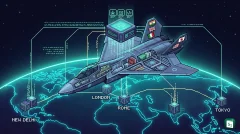
Reliance Industries Ltd and UK-based Rolls-Royce announced on 14 August 2026 in Mumbai and London their strategic intent to jointly design, develop, manufacture and deliver a sovereign indigenous combat engine for India’s Advanced Medium Combat Aircraft (AMCA) programme. The two companies will also explore setting up a dedicated Aerospace Gas Turbine Complex in India as a Centre of Excellence for power and propulsion technology. The move aims to give India end-to-end capability in aero engines, one of the most complex and closely guarded defence technologies, and support the Atmanirbhar Bharat vision for self reliance.
What Is the Advanced Medium Combat Aircraft Programme?
The Advanced Medium Combat Aircraft (AMCA) is India’s fifth generation stealth fighter programme, designed as a twin engine, single seat, multirole aircraft with low observability, internal weapons carriage and network centric warfare capabilities. It is led by the Aeronautical Development Agency (ADA) under the Defence Research and Development Organisation (DRDO), with Hindustan Aeronautics Limited (HAL) as the principal manufacturing partner, and is intended for the Indian Air Force and, in a future variant, the Indian Navy.
The programme traces back to feasibility studies in the early 2000s, with formal design work accelerating after 2010. The Cabinet Committee on Security (CCS), chaired by the Prime Minister, cleared the prototype development phase in March 2024 with an allocation of about ₹15,000 crore for five prototypes. Under the current roadmap, prototype rollout is expected around 2028 to 2029, first flight around 2029 to 2030, certification by the early 2030s and production and induction around 2034 to 2035. A full scale engineering model was displayed at Aero India 2025 in Bengaluru.
In May 2025, the Ministry of Defence approved a new execution model that opened the programme to competitive bidding from private industry alongside HAL. Three industry consortia led by Tata Advanced Systems, Larsen and Toubro with Bharat Electronics Limited, and Bharat Forge were shortlisted in early 2026, and a request for proposal for five prototypes was issued on 27 May 2026. The aircraft is planned in two blocks. AMCA Mk1 will fly with the American General Electric F414 engine, which produces about 98 kilonewton (kN) of thrust with afterburner, while AMCA Mk2 will require a more powerful 110 to 130 kN class indigenous engine with supercruise capability, meaning sustained supersonic flight without using afterburner.
What Does the Reliance Rolls-Royce Partnership Propose?
The announcement on 14 August 2026 is a strategic intent to partner, not a final contract or government selection. Reliance Industries Ltd and Rolls-Royce said they intend to offer joint capabilities for the complete cycle of a sovereign engine, including design, development, manufacturing, testing, production and through-life support in India. The proposal brings together Rolls-Royce’s global leadership in advanced propulsion with Reliance’s strengths in large scale manufacturing, technology integration and project execution.
Anant Ambani, Executive Director of Reliance Industries Ltd, said India’s strategic autonomy requires sovereign capability in critical technologies and that combining propulsion expertise with Reliance’s scale can build an enduring national aero engine ecosystem. Tufan Erginbilgic, Chief Executive Officer of Rolls-Royce plc, said the tie up joins Rolls-Royce’s century long engineering heritage with Reliance’s industrial leadership and marks a milestone toward a self reliant aerospace ecosystem in India.
Rolls-Royce had already submitted its final proposal for the AMCA engine in June 2026, offering a clean sheet 110 kN plus engine tailored for the fighter, with full transfer of technology and full Indian Intellectual Property Rights (IPR). If contracted by late 2026, its roadmap envisaged core testing by 2030, first engine flight by 2034 and production by 2036, according to company briefings.
The Aerospace Gas Turbine Complex as a Centre of Excellence
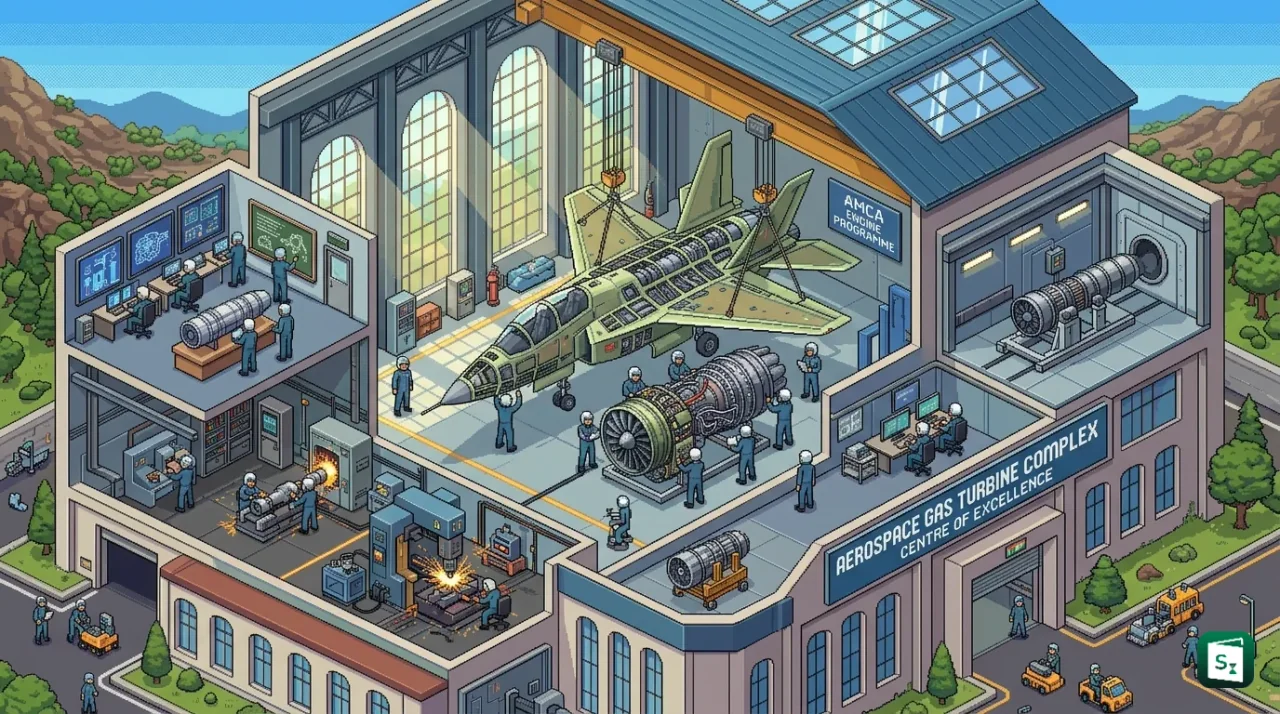
At the centre of the partnership is the plan to explore a dedicated Aerospace Gas Turbine Complex in India, to be developed as a Centre of Excellence (CoE) for power and propulsion. The complex is intended to create sovereign, end-to-end Indian capability across design, development, manufacturing, testing, production and long term maintenance and upgrades.
Beyond the AMCA engine, the companies said the complex would unlock wider collaboration in defence, civil aerospace and next generation power and propulsion systems. This includes potential work on hybrid electric propulsion, advanced thermal management, sustainable aviation technologies and high thrust turbofan families derived from the core engine for transport aircraft and future platforms. The intent is to build not just one engine but the industrial base, supply chains, skilled workforce and testing infrastructure that India currently lacks for combat class aero engines.
Why Does India Need an Indigenous Combat Engine?
Aero engines are among the hardest technologies to master. They operate at extreme temperatures, pressures and rotational speeds, and depend on advanced metallurgy such as single crystal turbine blades, nickel based superalloys and sophisticated cooling designs. Only a handful of countries can design and produce high thrust fighter engines independently, which makes import dependence a strategic vulnerability.
For India, this vulnerability is visible in current programmes. The Light Combat Aircraft (LCA) Tejas flies with imported General Electric F404 engines, and the Tejas Mk2 and AMCA Mk1 are planned around the GE F414 engine. Local production of the F414 in India is under negotiation with the United States, but dependence on a foreign supplier for the heart of the fighter remains.
The AMCA Mk2 requirement makes self reliance urgent. The IAF currently operates about 29 fighter squadrons against a sanctioned strength of 42.5, while regional competitors are fielding fifth generation aircraft such as China’s J-20 and the emerging J-35 that Pakistan is reported to be evaluating. The Mk2 needs a 110 to 130 kN engine to enable supercruise, low infrared signature, higher payload and compatibility with advanced systems such as Active Electronically Scanned Array (AESA) radar, AI assisted sensor fusion and future directed energy systems. Without an Indian designed engine, the programme would repeat the cycle of foreign dependence at the most critical stage.
Lessons from the Kaveri Engine Programme
India’s earlier attempt to build a fighter engine, the GTRE GTX-35VS Kaveri, offers context. Started in the late 1980s by the Gas Turbine Research Establishment (GTRE) in Bengaluru under DRDO, the Kaveri was meant to power the Tejas. It achieved about 46 kN dry thrust and 70.5 kN with afterburner, against a requirement of about 81 kN, and later high altitude tests in Russia confirmed shortfalls in thrust and weight goals. The programme was delinked from the Tejas and is now being repurposed for unmanned platforms such as the Ghatak Unmanned Combat Aerial Vehicle (UCAV) and for technology demonstration.
The Kaveri experience showed that developing hot section technology, materials and testing facilities without a long term foreign partner with deep production know how is extremely difficult. Both the Safran and Rolls-Royce proposals now promise full transfer of technology and full Indian ownership of intellectual property, a direct response to the limitations that constrained the Kaveri effort, where core technology was not fully transferred.
The 110 to 130 kN Requirement Explained
Thrust is measured in kilonewtons, and the number decides how much weight an aircraft can lift, how fast it can accelerate and whether it can sustain supersonic speed efficiently. The table below compares engine options linked to the AMCA:
| Engine Option | Thrust Class | Status and Role |
|---|---|---|
| GE F414-GE-INS6 | About 98 kN with afterburner | Proven American engine for AMCA Mk1 and Tejas Mk2, with licensed production planned in India |
| Kaveri derivative | About 46 to 75 kN | Indigenous demonstrator, now aimed at UAVs, not suitable for fifth generation fighter thrust needs |
| Safran GTRE co-developed engine | 110 to 130 kN | Clean sheet design under discussion within the Horizon 2047 India France roadmap, awaiting CCS approval, offering full transfer of technology |
| Rolls-Royce Reliance proposed engine | 110 to 130 kN, scalable to 120 to 145 kN for future variants | Clean sheet design with variable cycle technology concepts, full Indian IPR, with proposed growth to power future platforms |
Variable cycle engine technology, mentioned in advanced proposals, allows the engine to adjust its bypass ratio in flight. This helps it act like a fuel efficient engine during cruise and a high thrust engine during combat, improving range and acceleration, both vital for a stealth fighter that must fly long distances and then fight at high speed.
Who Are the Two Partners?
Reliance Industries Ltd (RIL) is India’s largest private sector company by revenue, headquartered in Mumbai. It was founded in 1966 by Dhirubhai Ambani as Reliance Commercial Corporation and is now led by Chairman and Managing Director Mukesh Ambani. For the year ended 31 March 2026, it reported consolidated revenue of ₹11,75,919 crore, about $124 billion. Its businesses span hydrocarbon exploration and production, petroleum refining and marketing, petrochemicals, advanced materials and composites, renewables including solar and hydrogen, retail, and digital services through Jio Platforms. It is ranked 85th in the Fortune Global 500 for 2026 and 55th in the Forbes Global 2000, the highest among Indian companies. The execution role in the aero engine proposal is associated with Executive Director Anant Ambani.
Reliance has been expanding its presence in defence and aerospace through partnerships and supply chain investments, reflecting a broader shift where large private groups are joining public sector firms such as HAL in defence production under the Make in India and Atmanirbhar Bharat initiatives.
Rolls-Royce Holdings plc is a British engineering group headquartered in London, listed on the London Stock Exchange (LSE: RR). With more than 100 years of history, it is one of the world’s leading makers of aero engines for civil and military aircraft, as well as marine and power systems. It powers aircraft such as the Eurofighter Typhoon with the EJ200 engine and is a core partner in the Global Combat Air Programme (GCAP), a sixth generation fighter effort with the United Kingdom, Italy and Japan. The company has long standing operations in India, including supply of engines for the Indian Air Force’s Hawk advanced jet trainers and industrial partnerships with HAL for components.
The company is led by Chief Executive Officer Tufan Erginbilgic. The company already operates engineering, services and supply chain facilities in India and has stated that the Reliance partnership builds on those existing capabilities.
Where Does This Leave the Safran Proposal?
The Reliance Rolls-Royce announcement does not replace the parallel track with France. On 15 July 2023, India and France agreed under the Horizon 2047 roadmap for the India France strategic partnership to jointly develop a combat aircraft engine for the AMCA Mk2. Since then, Safran Aircraft Engines of France and GTRE have been negotiating a co-development plan for a 110 to 130 kN class engine.
In August 2025, Defence Minister Rajnath Singh confirmed that the Safran co-development was planned over about 10 years, with costs estimated at around ₹61,000 crore, about $7 billion, and with full transfer of technology and full Indian intellectual property after Safran revised its earlier position on retaining partial rights. That proposal is being processed for final approval by the Cabinet Committee on Security. Reports in August 2026 indicated a decision was expected around mid August, close to the date of the Reliance Rolls-Royce announcement.
Both contenders promise similar headline terms, full transfer of technology, full Indian ownership of intellectual property, modular design and scalability to higher thrust for future Indian platforms that could replace the Su-30MKI fleet after 2045. The difference lies in the technical path. Safran’s base is the M88 engine that powers the Rafale, a proven but fourth generation design with about 75 kN thrust that would be scaled up with a new core. Rolls-Royce offers a clean sheet design drawing on its work on advanced variable cycle concepts for next generation fighters. Analysts have noted Safran’s advantage in existing Rafale commonality with the Indian Air Force and Navy, while Rolls-Royce points to broader family growth potential to 140 to 280 kN class turbofans for transport and civil use.
The Ministry of Defence has asked GTRE to evaluate both proposals on transfer depth, intellectual property, technical feasibility and long term autonomy, and to recommend a partner for the Mk2 engine. Until the CCS takes a final decision, the two proposals remain competing offers, and the government has described the Reliance Rolls-Royce move as a statement of intent among private industry rather than a government contract.
Significance for India’s Defence Self Reliance
The partnership matters for three reasons that go beyond one aircraft.
First, it signals the entry of a major Indian private conglomerate into military aero engine development, a field long dominated by DRDO, ADA, GTRE and HAL. Under the Atmanirbhar Bharat framework, the government has pushed for greater private sector participation to speed up development and build industrial depth.
Second, it addresses the most guarded chokepoint in fighter production. Airframes, radars such as the indigenous Uttam AESA radar using Gallium Nitride (GaN) technology, and weapons can be developed more readily, but engines need special alloys, precision casting, high temperature coatings and decades of test data. A gas turbine complex that covers design to through life support would give India the ecosystem that the Kaveri programme lacked.
Third, success would reduce strategic dependence. India currently negotiates production of American engines while planning a French co-development, which leaves exposure to export controls and foreign policy shifts. A sovereign engine with Indian intellectual property would allow independent upgrades, exports without external veto and lifecycle control for a fleet that is expected to number about 126 aircraft or seven squadrons of AMCA, with estimates of around 250 engines needed in the coming decade including spares.
The Way Forward
For now, the partnership will be judged on how quickly a statement of intent becomes a structured joint venture with funding, work share, and access to core hot section technology. Key watchpoints include whether the government selects one partner or encourages competitive prototyping, how the intellectual property terms are enforced in contracts, and whether the Aerospace Gas Turbine Complex secures land, testing infrastructure such as high altitude test facilities, and a supplier base for critical raw materials.
If a contract is signed by late 2026, as envisaged in the roadmaps discussed by both bidders, the core could be ready by 2030, full engine development by 2034, and integration into AMCA Mk2 prototypes by 2035, aligning with the planned induction in the mid 2030s. The immediate step is the expected CCS decision on the Safran GTRE proposal, which will clarify whether the Reliance Rolls-Royce offer becomes an alternative, a complementary track, or a competitive bid that prompts revised terms. Either way, India’s pursuit of a 110 to 130 kN class indigenous engine has moved from a single negotiation to a contested industrial process, increasing leverage for technology transfer and long term manufacturing in India.
Key Takeaways
- Reliance Industries Ltd and Rolls-Royce announced strategic intent on 14 August 2026 in Mumbai and London to co-develop a sovereign indigenous combat engine for the AMCA programme.
- The partnership will explore an Aerospace Gas Turbine Complex as a Centre of Excellence for power and propulsion, covering design, development, manufacturing, testing, production and through-life support.
- AMCA is a twin engine fifth generation stealth fighter led by ADA under DRDO, with HAL as manufacturing partner, cleared by the CCS in March 2024 at about ₹15,000 crore for five prototypes.
- AMCA Mk1 will use the GE F414 engine of about 98 kN thrust, while AMCA Mk2 requires a 110 to 130 kN class indigenous engine with supercruise capability.
- RIL, founded in 1966 by Dhirubhai Ambani and headquartered in Mumbai, reported ₹11,75,919 crore revenue for FY26, and Rolls-Royce plc, headquartered in London, has over 100 years of aero engine heritage.
- The parallel Safran and GTRE proposal for a 110 to 130 kN engine under the Horizon 2047 roadmap is awaiting final CCS approval, with Rolls-Royce having submitted its final offer in June 2026.