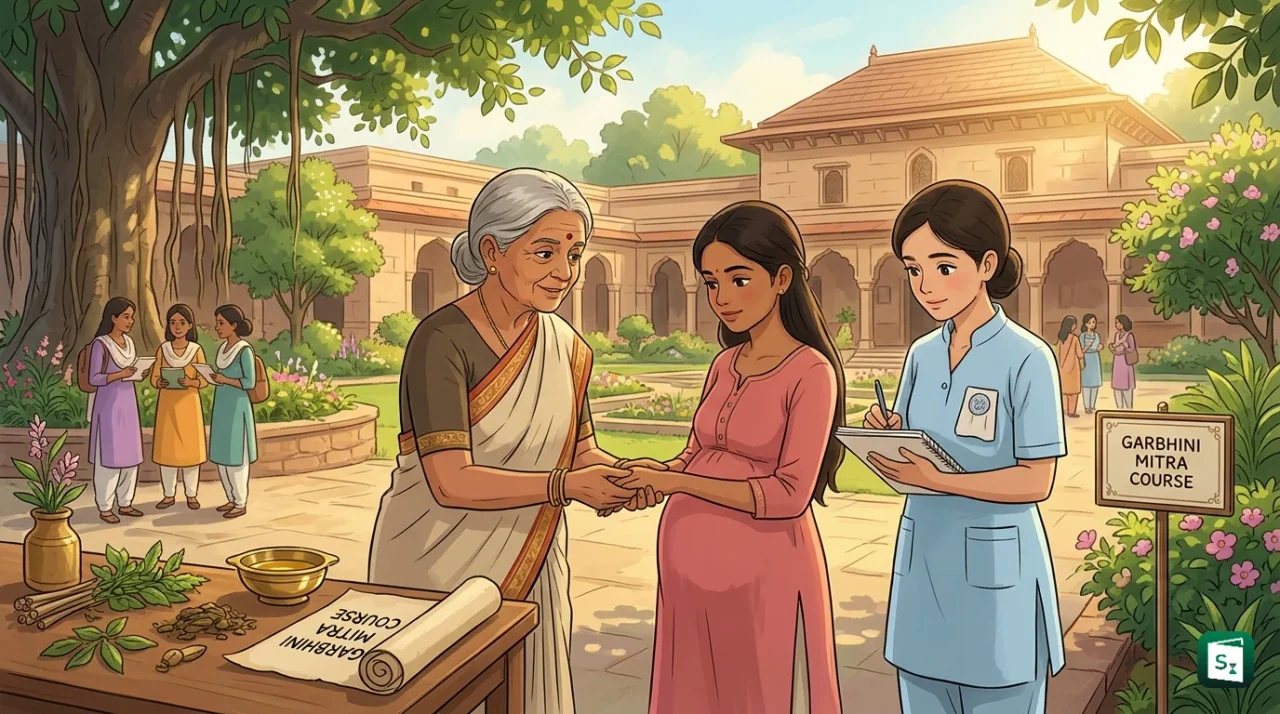
The All India Institute of Ayurveda (AIIA) in New Delhi has launched the Garbhini Mitra Course for the 2026-2027 academic session, a six-month offline programme announced on 24 August 2026. The course will train personnel to provide health education, lifestyle guidance and community-level support to women during pregnancy and the postnatal period. Rooted in Ayurveda, it aims to create non-clinical wellness guides who complement regular medical care rather than replace it.
What Is the Garbhini Mitra Course?
The Garbhini Mitra Course is a structured healthcare skill-development programme that trains support personnel to assist women through pregnancy and the early postnatal phase with health education and wellness guidance. The name Garbhini Mitra literally means a friend to the pregnant woman, reflecting its focus on continuous, compassionate support rather than clinical treatment.
The programme is offered by the All India Institute of Ayurveda (AIIA), New Delhi, an autonomous premier institute under the Ministry of Ayush. It is a six-month offline course conducted at the AIIA campus in Sarita Vihar, New Delhi. Classes are held from Monday to Friday between 3:00 PM and 5:00 PM, and each batch admits a maximum of 20 students to allow focused, hands-on training.
The objective is to build a cadre of trained assistants who can give lifestyle and dietary advice, provide emotional support, teach safe practices, and help identify warning signs that need timely referral to doctors. The course is skill-based and does not authorise graduates to perform diagnostic tests or clinical procedures.
Ayurvedic Roots of the Programme
The course is built on classical Ayurvedic knowledge of maternal care, which describes pregnancy, childbirth and recovery as distinct phases requiring specific regimens for diet, lifestyle and mental well-being. These traditional frameworks are now combined with modern concepts of hygiene, safety and basic life support.
Three Core Concepts Behind the Curriculum
| Ayurvedic Concept | Meaning | Focus Area |
|---|---|---|
| Garbhadhana Vidhi | Pre-conceptional care | Preparation of parents for healthy conception through diet, lifestyle and wellness practices |
| Garbhini Paricharya | Antenatal care | Month-wise and trimester-wise regimen for the pregnant woman, including nutrition, daily routine and yoga |
| Sutika Paricharya | Postnatal care | Care and recovery of the mother after delivery and support for newborn care, including massage and nutrition |
Garbhini Paricharya is the detailed Ayurvedic guideline for antenatal care. It prescribes stage-specific food, activities and rest to support fetal growth and maternal health. Sutika Paricharya deals with the Sutika Kala, the postnatal period traditionally considered as about 45 days after birth, and focuses on restoring strength, improving lactation and preventing postnatal complications. Garbhadhana Vidhi refers to pre-conceptional measures that aim to ensure the physical and mental readiness of parents.
By integrating these three pillars, the programme trains participants to offer holistic, culturally familiar guidance that aligns with modern antenatal advice on nutrition, exercise and hygiene.
What the Course Teaches
The curriculum blends Ayurveda-based wellness with essential non-clinical healthcare skills. It is practical and community-oriented, designed for support workers rather than doctors.
Key practical modules include trimester-specific dietetics and lifestyle modifications that explain what to eat and how to adjust daily routines in each stage of pregnancy. Participants also learn pregnancy-safe yoga, breathing exercises and meditation techniques, along with methods for providing emotional support during labour.
Newborn and postnatal care forms another important part. This covers newborn massage or Abhyanga, basic postnatal nutrition and counselling for the mother on rest and recovery. In addition, the course provides training in Basic Life Support (BLS) protocols to respond to emergencies until medical help arrives.
To ensure safe community practice, the syllabus also includes infection control, sanitisation, biomedical waste management and workplace safety. Graduates are taught to maintain hygiene in home and clinic settings, handle waste correctly and follow safety norms, skills that are essential for work in Ayush centres, maternity clinics and community health projects.
The programme clearly states its limits. It complements clinical antenatal care, it does not replace it. Routine check-ups, measurement of blood pressure and haemoglobin, ultrasound scans and other diagnostic tests must still be done by qualified medical professionals. Garbhini Mitras are trained to recognise danger signs and facilitate timely referral.
Who Can Apply and How the Course Is Run
The course is kept accessible to widen the pool of community health supporters. Any candidate who has passed the Senior Secondary (10+2) examination from a recognised board in India is eligible. Applicants must be at least 18 years old at the time of application. Candidates who are currently awaiting their Class 12 results may also submit provisional applications.
Training is entirely offline at the AIIA campus, Gautampuri, Sarita Vihar, Mathura Road, New Delhi 110076. The batch size is limited to 20 students, which helps maintain personal mentoring and practical demonstrations. The full duration is six months, with weekday classes.
The last date for submitting applications for the first batch of the 2026-2027 session is 31 August 2026. Detailed admission information, fees and application forms are provided in the official Academic Brochure released by AIIA and linked in the Press Information Bureau release dated 24 August 2026.
After completion, participants receive skill training certification. The course is affiliated with the broader skill development ecosystem for Ayush, and AIIA is known to link similar short-term programmes with the Healthcare Sector Skill Council (HSSC) and National Skill Development Corporation (NSDC) for certification standards.
What Will Garbhini Mitras Do After Training
Graduates can work as Garbhini Mitra Assistants, Prenatal and Postnatal Care Assistants, Antenatal Wellness Guides and Maternal Health Support Workers. These are non-clinical support roles, not doctor or nurse positions.
Opportunities exist in Ayush centres, maternity clinics, wellness institutions, non-governmental organisations (NGOs) and community health projects. In these settings, a Garbhini Mitra can conduct health education sessions, counsel families on diet and lifestyle, demonstrate safe yoga and newborn massage techniques, and support mothers emotionally through pregnancy and after birth.
Their critical function is early identification and referral. They are trained to notice warning signs such as high blood pressure, anaemia symptoms, reduced fetal movement or postpartum complications and to guide the family to seek qualified medical care quickly. This bridge role is valuable in areas where awareness of antenatal care is low and skilled support at the community level can improve outcomes.
About the All India Institute of Ayurveda
The All India Institute of Ayurveda (AIIA) is an apex autonomous institute under the Ministry of Ayush, Government of India. It is located in Gautampuri, Sarita Vihar, New Delhi and is conceived on the lines of the All India Institute of Medical Sciences (AIIMS) to bring synergy between traditional Ayurvedic wisdom and modern tools and technology.
The idea of establishing AIIA was announced in 2000 by then Prime Minister Atal Bihari Vajpayee at the Vaidya Ram Narayan Sharma Memorial Award ceremony. The foundation stone was laid in 2007 after approval by the Ministry of Finance in 2003, outpatient services began in 2009, and the institute was formally established as an autonomous body after the creation of the Ministry of Ayush on 9 November 2014. The institute was inaugurated in 2010 and again dedicated to the nation by Prime Minister Narendra Modi in 2017.
AIIA functions as a 200 to 300-bedded referral hospital with about 25 specialty departments, 12 clinics and 8 interdisciplinary research laboratories, offering postgraduate and doctoral programmes affiliated to the University of Delhi and approved by the National Commission for Indian System of Medicine (NCISM). It also serves as a nodal centre for international collaboration in Ayurveda and publishes the quarterly peer-reviewed Journal of Ayurveda Case Reports (AyuCaRe). A satellite centre of AIIA has also been established in Goa with a 250-bedded facility on a 50-acre campus to promote Ayurveda, education and medical tourism.
The institute is headed by a Director and operates from its address at Mathura Road, Gautampuri, Sarita Vihar, New Delhi 110076.
Why This Initiative Matters for Maternal Health
India has made progress in reducing maternal and neonatal risks, but gaps remain in health literacy, lifestyle counselling and postnatal support, especially at the community level. Clinical services focus on check-ups and delivery, while everyday guidance on nutrition, safe activity, mental well-being and newborn care often depends on family knowledge. A trained wellness guide can fill this gap with reliable, standardized advice.
The Ministry of Ayush, formed in 2014 after upgrading the earlier Department of Indian System of Medicine and Homoeopathy created in 1995 and renamed as Department of Ayush in 2003, is responsible for the development of Ayurveda, Yoga and Naturopathy, Unani, Siddha and Homoeopathy (Ayush). Its mandate includes education, research, quality control and integration of traditional systems with public health. Initiatives like Garbhini Mitra support this mandate by expanding skilled human resources for wellness and prevention.
Evidence building is also underway. The Central Council for Research in Ayurvedic Sciences (CCRAS) has studied the feasibility of introducing Ayurveda interventions such as Garbhini Paricharya at primary health centres in Himachal Pradesh and in Gadchiroli, Maharashtra, and the Ministry collaborates with the Indian Council of Medical Research (ICMR) through Ayush-ICMR Advanced Centres for Integrative Health Research (AI-ACIHR) at selected AIIMS institutions. These efforts aim to create scientific validation for traditional care practices and to design models for integrative healthcare.
By training grassroots wellness supporters who do not replace doctors but strengthen referral and health education, the Garbhini Mitra Course represents a step towards more comprehensive, prevention-focused maternal care rooted in Indian knowledge systems and aligned with modern safety standards.
Key Takeaways
- The Garbhini Mitra Course for 2026-2027 was launched on 24 August 2026 by the All India Institute of Ayurveda (AIIA), New Delhi, under the Ministry of Ayush.
- It is a six-month offline skill programme held Monday to Friday, 3:00 PM to 5:00 PM at Sarita Vihar, New Delhi, with 20 students per batch.
- Eligibility is 10+2 pass from a recognised board and minimum age 18 years, with provisional application allowed for those awaiting results, and the last date is 31 August 2026.
- The curriculum is rooted in Garbhadhana Vidhi for pre-conceptional care, Garbhini Paricharya for antenatal care, and Sutika Paricharya for postnatal care.
- Training includes trimester-specific diet, pregnancy-safe yoga, newborn Abhyanga massage, emotional support, Basic Life Support, infection control and biomedical waste management and is strictly non-clinical and complementary to medical care.
- The All India Institute of Ayurveda is an autonomous apex institute under the Ministry of Ayush, located in Gautampuri, Sarita Vihar, New Delhi, established in 2015, with outpatient services since 2009, affiliated to the University of Delhi, and a satellite centre in Goa.