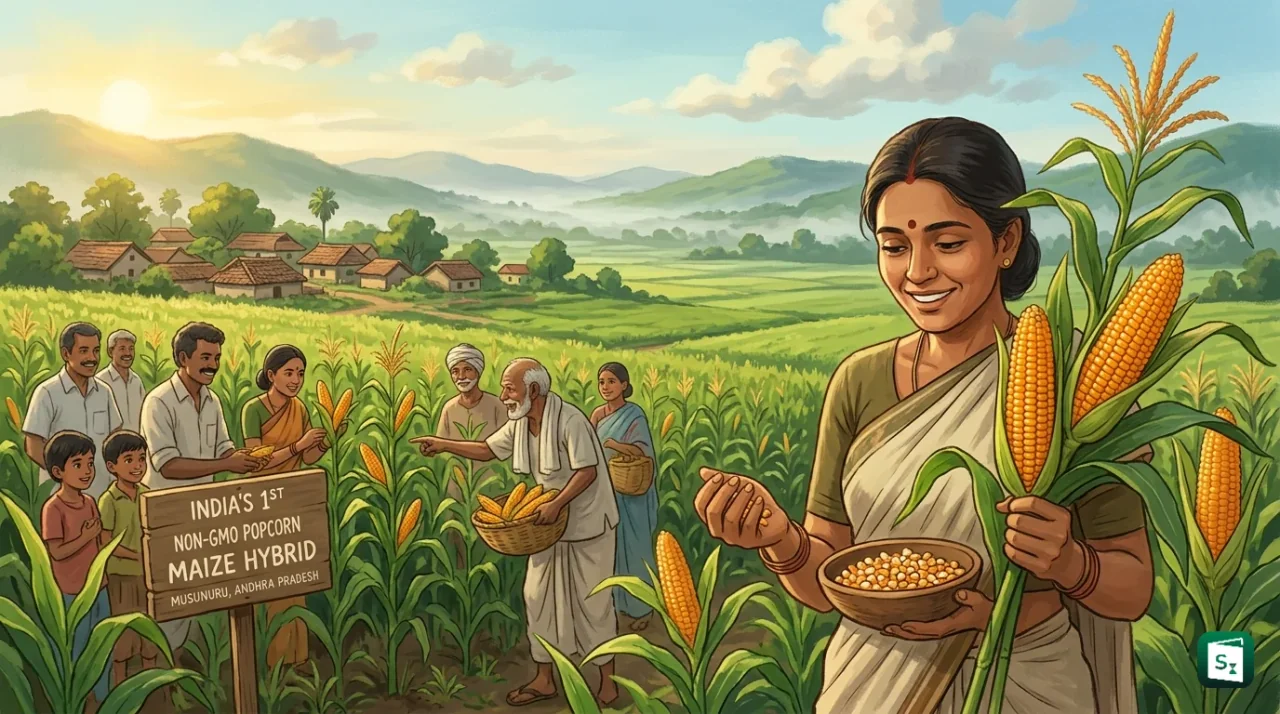
Vice President C. P. Radhakrishnan launched India’s first non-GMO, high-expansion popcorn maize hybrid seeds on 24 August 2026 at Musunuru in Eluru district, Andhra Pradesh. The launch took place at the Gourmet Popcornica facility at Katrenipadu, in the presence of Governor S. Abdul Nazeer and Chief Minister N. Chandrababu Naidu. The two hybrids, Krisna459 and Godari234, are the country’s first indigenously developed popcorn hybrids designed to match international popping quality without genetic modification.
What Are the New Popcorn Maize Hybrids?
The two hybrids launched at Musunuru are Krisna459 and Godari234, India’s first non-Genetically Modified Organism (non-GMO) high-expansion popcorn maize hybrids. A Genetically Modified Organism (GMO) is a plant whose genetic material has been altered using genetic engineering to introduce a new trait, while a non-GMO plant is developed without such laboratory based genetic alteration. Both hybrids were unveiled at the Gourmet Popcornica facility at Katrenipadu in Musunuru mandal, Eluru district.
The Vice President described the launch as an important step towards Aatmanirbhar Bharat in agriculture, noting that India had for years depended on imported hybrid technology for high-quality popcorn maize. He said the indigenous hybrids would help reduce that dependence, conserve foreign exchange, and strengthen India’s ability to compete in global popcorn markets. He also visited the factory and cold storage unit to review processing, quality control, packaging and storage operations, and felicitated farmers associated with the programme.
Governor S. Abdul Nazeer, Chief Minister N. Chandrababu Naidu, and state ministers Nara Lokesh, Kinjarapu Atchannaidu and Kolusu Parthasarathy were present at the ceremony along with scientists from the ICAR-Indian Institute of Maize Research (ICAR-IIMR) and representatives of the company’s international collaborator Preferred Popcorn, USA.
Understanding Popcorn Maize and High-Expansion Quality
Popcorn maize is a special type of maize (Zea mays), a cereal belonging to the Poaceae family, whose kernels pop when heated. Each kernel contains a small amount of moisture trapped inside a hard outer covering. When heated, the moisture turns into steam, pressure builds up, and the outer covering bursts to form fluffy popcorn. Not every maize variety can do this, only popcorn types have the kernel structure and moisture balance needed for good popping.
High-expansion refers to how much volume a kernel produces after popping. It is measured as the expansion ratio, or the volume of popped corn obtained from a given weight of kernels. A higher expansion ratio means more popped volume per kilogram, which is a key commercial quality measure. It determines profitability for cinemas, snack makers and food service providers, because better expansion gives more servings from less raw material.
What Non-GMO and Hybrid Mean
A hybrid seed is produced by crossing two carefully selected parent lines with complementary traits. The cross combines desirable characters such as yield, disease resistance, uniformity and popping quality in the offspring. Hybrid vigour often gives better performance than open-pollinated varieties, but farmers need to buy fresh hybrid seed each season to retain that advantage.
Non-GMO means the hybrid has been created through conventional breeding and selection, without inserting genes from another organism using genetic engineering. A common misunderstanding is that every hybrid is a GMO, which is not correct. A seed can be both hybrid and non-GMO, and that is the case with Krisna459 and Godari234. They carry improved popping and agronomic traits developed through crossing and selection, but their DNA has not been modified in a laboratory. This distinction matters in India, where GMO food crops face strict regulatory scrutiny.
How the Indigenous Hybrids Were Developed
The hybrids are the result of a science and industry partnership between the ICAR-Indian Institute of Maize Research (ICAR-IIMR), headquartered in Ludhiana, Punjab, and Gourmet Popcornica Private Limited, a Chennai-headquartered agri-to-consumer company. ICAR, the Indian Council of Agricultural Research, was established in 1929 and is the apex body for agricultural research and education in India, functioning under the Ministry of Agriculture and Farmers Welfare. It has 113 institutes and 74 agricultural universities in its network.
ICAR-IIMR was originally established as the Directorate of Maize Research in January 1994 in New Delhi, and became the Indian Institute of Maize Research on 9 February 2015. It shifted to Ludhiana in 2016 and coordinates national maize research through the All India Coordinated Research Project (AICRP) on Maize. Its mandate is to develop high-yielding, stress-tolerant hybrids and to improve maize-based farming systems with economic and environmental sustainability.
The collaboration with Gourmet Popcornica formally began in February 2021 with agreements for the IIMR-bred hybrid LPCH 3 and later expanded to new popcorn hybrids. Over the past four years, scientists from IIMR and the company’s breeding team worked on yield, popping expansion, and resistance to diseases and pests, while adapting tropical popcorn types to Indian soil and climatic conditions. The company also converts open fields into hybrid test beds for yield trials and seed production. Gourmet Popcornica was recognised by ICAR-IIMR on its Founder’s Day on 9 February 2026 for its contribution to expanding maize cultivation.
According to the company, the research focus was to combine Indian adaptation with premium popping traits known from US popcorn, so that kernels perform well in the field and also meet quality expectations of processors and consumers. The result is two hybrids with improved field performance and higher popping volume suitable for commercial processing.
Why Import Substitution Matters for India
India’s popcorn market illustrates how a niche crop can affect foreign exchange and farmer incomes. A decade ago, almost 100 percent of the popcorn consumed in India was imported. The total popcorn maize market was about 50,000 tonnes in 2014-15. By 2025-26, the market had grown to about 1.30 lakh tonnes, and domestic production now meets close to 70 percent of demand.
This shift has reduced import dependence from nearly 100 percent to about 30 percent and, according to company and research estimates, has saved foreign exchange. Earlier estimates noted savings of about $125 million, while recent assessments linked to the transition point to potential savings of about ₹810 crore if domestic growth continues. Imports that earlier came mainly from countries such as the United States, Argentina and Brazil have been partly replaced by Indian grown kernels.
The growth is also tied to institutional support. Under the Aatmanirbhar Bharat initiative, the focus has been on building a domestic value chain that links public research, private processing and contract farming. If current expansion continues, officials project the market will reach about 1.80 lakh tonnes by 2030, when India could meet its full domestic requirement and emerge as an exporter of premium popcorn maize to Asian markets.
| Period | Popcorn Maize Market Size | Share Met by Domestic Production |
|---|---|---|
| 2014-15 | About 50,000 tonnes | Negligible, almost fully imported |
| 2025-26 | About 1.30 lakh tonnes | Close to 70 percent |
| 2030 (projected) | About 1.80 lakh tonnes | Target is full self-sufficiency |
Significance for Farmers and the Food Processing Sector
For farmers, the new hybrids offer a move from commodity grain to a value-added crop with assured markets. Gourmet Popcornica now works with more than 17,500 farmers cultivating popcorn maize on about 40,000 acres across eight to nine states, including Andhra Pradesh, Telangana, Maharashtra and others. The company operates on a contract farming model, which means farmers agree before sowing to sell their produce at pre-agreed terms, giving them price certainty and an assured buyer.
The company started its popcorn journey in 2014, opened a bulk processing facility at Nuzvid in Andhra Pradesh in 2018, and built a storage and production hub at Musunuru in 2023 with a capacity to handle about 29 tonnes per hour and cold storage of 45,000 tonnes. This hub is described as one of Asia’s largest popcorn processing centres, supplying more than 2,200 cinema screens and over 3,400 screens across different reports, along with snack makers and retailers. Chief Minister Naidu noted that the facility commands about 70 percent share of the national popcorn market and said farmers who sign agreements with the company gain a stable link to processing and value addition.
The Vice President highlighted that many of these farming families were cultivating without taking loans for the activity, reflecting growing confidence in the value chain. The model includes scientific cultivation practices, mechanisation such as mechanical planters and drone spraying, and end-to-end support for quality control. At the same event, the Vice President recalled the role of government schemes that support farm incomes and risk coverage, including PM-KISAN, PM Fasal Bima Yojana, Kisan Credit Card and Namo Drone Didi.
For the food processing sector, domestic hybrids with high expansion reduce dependence on imported raw material, lower logistics costs, and improve supply reliability. Processing a crop domestically also keeps more value within the country. Andhra Pradesh currently processes only about 10 percent of its total agricultural output, so initiatives that connect farm production to processing are seen as a way to raise rural incomes and create rural employment. The Chief Minister also noted that cropping patterns around Nuzvid are shifting towards commercial crops such as palm oil and cocoa alongside aquaculture.
Maize in India: Background and National Context
Maize is India’s third most important food crop after rice and wheat. Annual production exceeds 43 million tonnes, as noted by the Governor at the launch. It is a versatile crop used for food, animal and poultry feed, starch, and industrial products. Of the total maize output, about 49 percent is used as poultry feed, 12 percent as animal feed, 25 percent as food, 13 percent for starch processing and about 1 percent as seed.
India is among the world’s leading maize producers but average yields remain below global levels, leaving scope for hybrid adoption. Popular maize growing states include Andhra Pradesh, Karnataka and Maharashtra. Maize is largely a kharif crop, with about 80 percent of production coming in the kharif season and arrivals from October onwards.
The institutional context is relevant for regulation. GMO crops in India are governed by the Genetic Engineering Appraisal Committee (GEAC) under the Ministry of Environment, Forest and Climate Change. Apart from Bt cotton, which is the only GM crop approved for commercial cultivation, other GM food crops such as Bt brinjal have faced a moratorium. Non-GMO hybrids such as the new popcorn seeds therefore avoid the regulatory path required for GMOs, while still delivering better quality through conventional breeding. Seed regulation more broadly is guided by the Seeds Act, 1966 and related controls on variety notification and certification.
The new Vice President who launched the seeds, C. P. Radhakrishnan, was born on 4 May 1957 in Tiruppur, Tamil Nadu, and assumed office as the 15th Vice President of India on 12 September 2025 after serving as Governor of Jharkhand, Telangana (additional charge), Puducherry (additional charge) and Maharashtra. He was elected to the Lok Sabha from Coimbatore in 1998 and 1999 and later served as Tamil Nadu BJP president. As Vice President, he is also the ex officio Chairman of the Rajya Sabha under Article 64 of the Constitution.
The Way Forward
The immediate significance of Krisna459 and Godari234 is ownership of genetics. Farmers who were earlier moved from commodity maize to contract-based popcorn farming now gain access to Indian-bred seed itself, rather than relying on imported germplasm. With 40 Memorandums of Understanding signed between ICAR-IIMR and 28 private seed companies for maize hybrids nationally, and strong breeder seed demand for IIMR hybrids, the popcorn launch fits into a wider effort to expand affordable, high-quality seed access.
The next steps involve scaling seed production, demonstration across diverse agro-climatic zones, and ensuring timely availability at less than market rates, as IIMR has done for other hybrids such as DMRH 1301, DMRH 1308 and LQMH 1. Wider adoption will depend on agronomic guidance, post-harvest handling and storage infrastructure, and continued linkages between processors and growers.
If the production trajectory from 50,000 tonnes to 1.30 lakh tonnes continues towards 1.80 lakh tonnes by 2030, India can close the import gap fully and position itself as a reliable exporter of premium popcorn maize to Asian and global markets. The Musunuru model, which brings together public research, private enterprise, processing infrastructure and farmer partnerships, is now being viewed as a test case for how specialised value chains can help crop diversification, raise value addition, and support rural livelihoods while advancing self-reliance.
Key Takeaways
- Vice President C. P. Radhakrishnan launched India’s first non-GMO high-expansion popcorn maize hybrids, Krisna459 and Godari234, on 24 August 2026 at Musunuru in Eluru district, Andhra Pradesh.
- The hybrids were developed jointly by ICAR-Indian Institute of Maize Research (ICAR-IIMR), Ludhiana and Gourmet Popcornica, with the partnership dating to February 2021.
- High-expansion means higher popped volume per kilogram of kernels, a key commercial parameter for popcorn, while non-GMO indicates development through conventional crossing without genetic engineering.
- India’s popcorn maize market grew from about 50,000 tonnes in 2014-15 to about 1.30 lakh tonnes in 2025-26, with domestic production now meeting close to 70 percent of demand and a target of 1.80 lakh tonnes and full self-sufficiency by 2030.
- Gourmet Popcornica works with more than 17,500 farmers on about 40,000 acres across eight to nine states and operates one of Asia’s largest popcorn processing centres at Musunuru, with 45,000 tonnes cold storage capacity.
- Maize is India’s third most important food crop after rice and wheat with production above 43 million tonnes, and ICAR, established in 1929, is the apex agricultural research body headquartered in New Delhi.