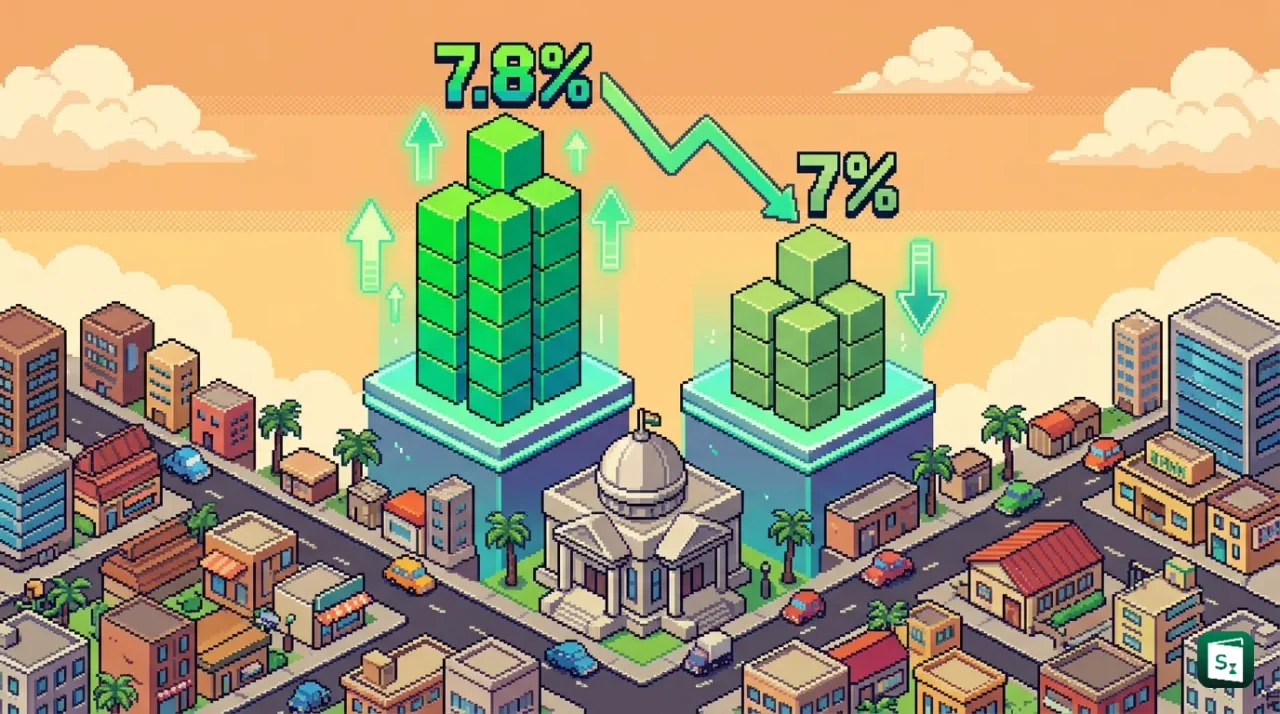
Domestic rating agency ICRA Ltd has estimated India’s real Gross Domestic Product (GDP) growth at 7% in the first quarter of FY27 (April to June 2026), marking a four-quarter low from 7.8% in Q4 FY26. The projection, released on 17 August 2026, is in line with the Reserve Bank of India’s Monetary Policy Committee (MPC) forecast for the same quarter. While quarterly growth is seen cooling, ICRA has retained its full-year FY27 real GDP forecast at 6.7% and expects nominal GDP growth to accelerate sharply to 13%, a four-year high.
What Has ICRA Forecast for Q1 FY27?
Rating agency ICRA Ltd projected on 17 August 2026 that India’s real GDP expanded by 7% year on year in Q1 FY27, easing from 7.8% in Q4 FY26. The agency, led by Chief Economist Aditi Nayar, said this would be the slowest pace in four quarters. The estimate matches the forecast made by the Reserve Bank of India’s Monetary Policy Committee (MPC) for the same quarter, which also pegged growth at 7%.
ICRA also estimates real Gross Value Added (GVA) growth at 7.2% in Q1 FY27, down from 7.9% in Q4 FY26. GVA measures the value of goods and services produced before adding indirect taxes and subtracting subsidies, while GDP adds that net tax component. ICRA noted that GDP growth is likely to be about 0.2 percentage points lower than GVA in the June quarter due to a likely compression in net indirect taxes, driven by muted growth in indirect tax collections and a sharp rise in combined spending on fertiliser and fuel subsidies.
For the full year, ICRA kept its outlook unchanged. Real GDP growth for FY27 is forecast at 6.7%, moderating from 7.7% in FY26. This is based on an assumed average crude oil price of $80 to $85 per barrel for the fiscal year. At the same time, nominal GDP growth, which includes price changes, is expected to jump to 13% in FY27 from 8.9% in FY26, marking a four-year high. The sharp rise in nominal growth reflects expectations of higher inflation prints through the year.
| Indicator | Q4 FY26 (Actual) | Q1 FY27 (ICRA Estimate) | Full Year FY27 (ICRA Forecast) |
|---|---|---|---|
| Real GDP Growth | 7.8% | 7.0% | 6.7% |
| Real GVA Growth | 7.9% | 7.2% | Not separately forecast |
| Nominal GDP Growth | 9.1% (Q4) / 8.9% (FY26) | Hardening trend | 13.0% (four-year high) |
Why Growth Is Expected to Moderate in Q1 FY27?
ICRA’s moderation call does not point to a broad loss of volume growth, but to a mix of sector specific drags and temporary cost pressures. High frequency indicators for industry and services showed steady domestic volume expansion during the June quarter, which eased concerns that the spike in commodity prices linked to the West Asia conflict would sharply dent activity.
Divergent Sectoral Trends
The agency expects a mixed pattern across the three broad sectors. Industrial Gross Value Added (GVA) is projected to grow by 7.7% in Q1 FY27, slightly faster than 7.3% in Q4 FY26. Industrial production is estimated to have accelerated to 5.8%, a six-quarter high, with manufacturing output rising 6.3%. Agriculture GVA is pegged at 4%, supported by farm activity.
In contrast, services GVA is estimated to slow to 7.9%. ICRA noted that business sentiment among services companies weakened materially in the June quarter. The pace of optimism fell to its lowest level in five years, reflecting headwinds from the West Asia crisis and persistent wage cost pressures. Since services account for more than half of India’s GVA, even a modest slowing in this segment pulls down overall GDP growth.
Pressure From the West Asia Conflict
The West Asia conflict has been a key drag. ICRA highlighted sizeable losses at oil refining companies in the June quarter, as higher global crude and input prices squeezed margins while product prices adjusted with a lag. With India being the world’s third largest crude importer, volatility in oil directly affects trade, inflation and refinery earnings. The agency’s full year forecast assumes crude stays at $80 to $85 per barrel. Risks, it said, remain tilted to the downside if tensions continue and supply chains stay disrupted.
The conflict also weighed on merchandise trade and raised freight and input costs. Even though services exports remained healthy and merchandise exports showed a rebound, broader uncertainty kept business confidence in check.
Squeeze in Net Indirect Taxes
Another reason GDP is seen growing slower than GVA is the expected compression in net indirect taxes. Net indirect taxes equal indirect taxes less subsidies. When tax collections grow slowly and subsidy spending rises, the gap between GVA and GDP narrows. ICRA noted that muted indirect tax growth combined with higher fertiliser and fuel subsidy outgo could shave about 0.2 percentage points off GDP relative to GVA in Q1 FY27.
For the rest of the year, ICRA flagged two additional downside risks, monsoon related uncertainty including El Nino conditions and the possibility that elevated inflation could further weigh on demand, especially in rural areas.
Real GDP vs Nominal GDP: Why Both Numbers Matter
Real GDP and nominal GDP are two ways of measuring the size of the economy, and the difference is important for both policy and exam concepts.
Nominal GDP measures the value of all final goods and services at current market prices in that year. It includes both higher output and higher prices. Real GDP measures output at constant prices, using a fixed base year, so it removes the effect of inflation and shows how much quantity actually increased.
In India, GDP is released by the National Statistical Office (NSO) under the Ministry of Statistics and Programme Implementation (MoSPI) in both forms. Since 27 February 2026, the new national accounts series uses 2022-23 as the base year, replacing the earlier base year of 2011-12. This revision, recommended by the Advisory Committee on National Accounts Statistics, adds new data sources such as the Annual Survey of Unincorporated Sector Enterprises (ASUSE), Periodic Labour Force Survey (PLFS), Goods and Services Tax (GST) and Public Financial Management System (PFMS) data, and integrates a Supply and Use Table (SUT) framework to improve consistency.
The link between the two measures is the GDP deflator. It is defined as Nominal GDP divided by Real GDP multiplied by 100. In growth terms, the difference between nominal and real growth roughly equals the deflator based inflation. A low deflator means nominal and real growth are close, a high deflator means they diverge.
That explains ICRA’s seemingly opposite forecasts. Real growth is slowing to 6.7% because volume expansion is moderating, but nominal growth is rising to 13% because the price level is hardening. The agency expects Consumer Price Index (CPI) inflation and Wholesale Price Index (WPI) pressures to push up the deflator after an unusually low level in recent quarters. When the deflator was just 0.9% in Q1 FY26, nominal growth was only one percentage point above real growth at 8.8% versus 7.8%. A higher deflator in FY27 would widen that gap.
Why does this matter? The government budgets in nominal terms. Tax collections, fiscal deficit as a share of GDP, debt ratios and the size of the economy in rupees all depend on nominal GDP. Real GDP, by contrast, is the better guide to actual economic health, jobs and demand. If nominal GDP rises mainly due to prices while real growth stays weak, it is inflation, not more production, driving the headline.
ICRA in Context: How Its Forecast Compares
ICRA’s numbers sit close to official and central bank expectations, with a slightly cautious tone for the full year.
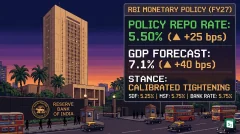
The Reserve Bank of India’s Monetary Policy Committee (MPC) in its meeting held from 3 to 5 August 2026, chaired by Governor Sanjay Malhotra, projected real GDP growth for FY27 at 6.7%, with Q1 at 7%, Q2 at 6.4%, Q3 at 6.5% and Q4 at 6.8%. Growth for Q1 FY28 was seen at 7.3%. The MPC kept the policy repo rate unchanged at 5.25% and continued with a neutral stance. In its earlier June 2026 review, the RBI had placed FY27 growth at 6.6%, Q1 at 6.6%, and cited West Asia tensions, supply disruptions and El Nino risks as key headwinds. Chief Economic Adviser V Anantha Nageswaran had earlier suggested that under the new GDP series, FY27 growth could be in the 7 to 7.4% range, a bit higher than the 6.8 to 7.2% projected in the Economic Survey.
Official data provides the baseline. As per Provisional Estimates released on 5 June 2026 by MoSPI, real GDP grew 7.7% in FY26 against 7.1% in FY25, while Q4 FY26 growth was 7.8%. In nominal terms, GDP expanded 8.9% in FY26 to ₹346.36 lakh crore and 9.1% in Q4 to ₹94.65 lakh crore. These figures are part of the new series with base year 2022-23, which will be fully backcast to 1950-51 by December 2026 using the splicing method.
Who Is ICRA?
ICRA Limited, originally Investment Information and Credit Rating Agency of India Limited, was set up on 16 January 1991 by leading financial institutions, commercial banks and financial services companies. It is headquartered in Gurugram, Haryana, with its registered office in New Delhi, and is listed on both the Bombay Stock Exchange (BSE: 532835) and the National Stock Exchange (NSE: ICRA). Moody’s Corporation holds a majority stake of about 51.86% as of December 2024, and ICRA operates as an affiliate of Moody’s Investors Service under a technical services agreement. Apart from credit ratings, ICRA provides research, risk assessment and consulting services and has expanded into Nepal, Sri Lanka and Indonesia through subsidiaries.
What This Outlook Means for the Economy
A 7% growth in Q1 still keeps India as the world’s fastest growing major economy, even if it marks a sequential step down. The composition matters more than the headline. Strong industrial and farm activity suggests domestic demand is holding up, supported by private consumption, fixed investment and government capital expenditure, while services exports remain resilient.
The expected jump in nominal GDP to 13% has practical implications. A higher nominal base can improve fiscal ratios, such as bringing the fiscal deficit as a share of GDP closer to target even if spending stays steady, and it supports the trajectory toward becoming a $4 trillion economy. At the same time, the underlying inflation that drives nominal growth can squeeze household budgets. ICRA and the RBI both flagged that CPI inflation, which rose to 4.4% in June 2026 after 16 months below target, could stay elevated, with full year inflation projected around 5% and peaking in Q3 FY27 due to food and fuel.
For policy, the moderation supports a cautious stance. The MPC highlighted that headline inflation is largely supply side driven, with core inflation excluding food and fuel at 3.9% and excluding precious metals even lower at 2.3 to 2.5%, indicating demand pressures remain contained. Yet uncertainty around crude prices, trade policy, including US tariff actions, and monsoon distribution means both growth and inflation risks are finely balanced.
For the rest of FY27, much will depend on three factors identified by ICRA and the RBI, whether West Asia tensions ease and oil settles near $80 to $85 per barrel, whether the southwest monsoon is evenly distributed despite El Nino risks, and whether services confidence recovers from its five year low. If those risks persist, ICRA warns that real growth could face further downside pressure, even as nominal growth stays high because of inflation.
Key Takeaways
- ICRA Ltd estimated real GDP growth at 7% in Q1 FY27, a four-quarter low from 7.8% in Q4 FY26, with real GVA at 7.2% in the same quarter.
- The agency retained its full year FY27 real GDP forecast at 6.7%, moderating from 7.7% in FY26, assuming average crude oil prices of $80 to $85 per barrel.
- Nominal GDP growth for FY27 is projected at 13%, a four-year high, up from 8.9% in FY26, indicating a hardening price level and higher GDP deflator.
- Sectorally, ICRA expects industry GVA at 7.7% and agriculture at 4% in Q1 FY27, while services GVA slows to 7.9% amid the weakest services sentiment in five years.
- The RBI’s MPC (3 to 5 August 2026) projected FY27 real GDP at 6.7% with Q1 at 7%, keeping the repo rate at 5.25% with a neutral stance.
- ICRA Limited, established on 16 January 1991 and headquartered in Gurugram, is an affiliate of Moody’s Corporation which holds about 51.86% stake.
- India’s new national accounts series uses 2022-23 as the base year, replacing 2011-12, with Provisional Estimates showing FY26 real GDP growth at 7.7% and Q4 FY26 at 7.8%.