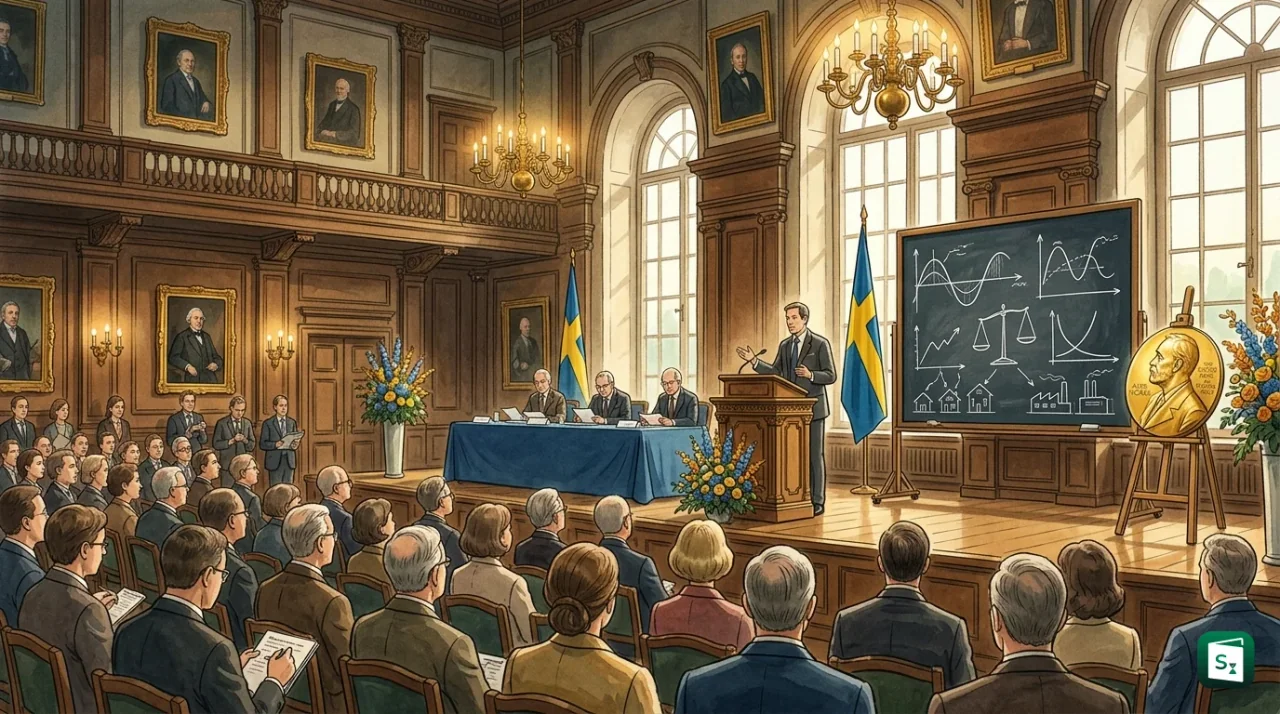
The Royal Swedish Academy of Sciences announced the 2026 Nobel Prize in Economic Sciences on 12 October 2026, jointly awarding it to Americans Robert E Hall of Stanford University and Michael Woodford of Columbia University. The pair was honoured for laying the microeconomic foundations of macroeconomic stabilisation. Their models now guide how central banks and governments around the world set interest rates and time fiscal action.
What Is the Nobel Prize in Economic Sciences?
The Nobel Prize in Economic Sciences is the Sveriges Riksbank Prize in Economic Sciences in Memory of Alfred Nobel. Sveriges Riksbank, Sweden’s central bank, created it in 1968 for its 300th anniversary. The Royal Swedish Academy of Sciences awards it every year for outstanding work in economics.
The economics prize is not one of the five prizes set up in the will of Alfred Nobel in 1895. The original Nobel Prizes cover Physics, Chemistry, Physiology or Medicine, Literature and Peace, first given in 1901. The economics prize was added much later on the basis of a donation from Sveriges Riksbank to the Nobel Foundation. It is awarded under the same principles and presented at the same ceremony, so it is widely called the Economics Nobel.
The first economics prize went in 1969 to Ragnar Frisch and Jan Tinbergen for developing dynamic models to study economic processes. Between 1969 and 2026, 58 prizes have gone to 101 individuals. The prize can be shared by a maximum of three persons in any year.
Who Are the 2026 Economic Nobel Laureates?
Robert E Hall, born in 1943 in Palo Alto in the United States, is Professor of Economics at Stanford University in California. He earned his PhD in 1967 from the Massachusetts Institute of Technology (MIT). Hall is also a Senior Fellow at the Hoover Institution and earlier served as President of the American Economic Association in 2010.
Michael Woodford, born in 1955 in Chicopee in the United States, is the John Bates Clark Professor of Political Economy at Columbia University in New York. He earned his PhD in 1983 from MIT after studying at the University of Chicago and Yale Law School. Both laureates therefore share MIT as their doctoral institution.
The two will share the prize equally, with a prize share of one half each. Their citation is for microeconomic foundations of macroeconomic stabilisation. That phrase means they showed how everyday decisions by households and firms form the base on which economy wide policy should rest.
What Is Microeconomic Foundations of Macroeconomic Stabilisation?
Macroeconomic stabilisation means using government spending and central bank interest rates at the right time to smooth out booms and recessions. Recessions are eased by cutting interest rates and raising budget deficits. Overheating is cooled by the reverse.
Microeconomic foundations means building that big picture policy on small picture behaviour. Instead of linking total inflation, production and consumption through past statistics alone, Hall and Woodford modelled the choices of millions of individual households and firms and added them up.
A core idea is that people look ahead. Households decide how much to save based on what income they expect in future. Firms set prices based on what they expect costs, rival prices and interest rates to be. Central banks can shift those expectations by clearly communicating future plans, and steer the economy in the right direction.
The Academy noted that this work gave central banks and finance ministries a stable base for models used across the world. These models are better equipped to handle shocks such as energy crises or sudden shifts in household spending.
Analogy · Bottom Up Economic Model Expand analogy
Think of the economy like a large cricket stadium crowd doing a Mexican wave. Old models watched only the wave from a distance. Hall and Woodford studied why each person stands up, when they look at their neighbours, and what announcement over the loudspeaker makes them move together.
Why the Old Stabilisation Models Failed
For decades, policy relied on traditional Keynesian models based on ideas of economist John Maynard Keynes. These models linked inflation, output and unemployment through observed correlations. They worked in many cases but broke down in the 1970s.
During the oil crises of the 1970s, stimulus raised inflation without cutting unemployment in Western economies. Low growth, high unemployment and high inflation persisted together. Many concluded that stabilisation policy did more harm than good.
Economists such as Robert Lucas argued that the links between large variables were not fixed. If policy tried to use them, households and firms would change their behaviour and the link would shift. This argument is known as the Lucas critique. Models needed to be built on deeper household and firm behaviour that would hold even when policy changed.
How Robert Hall and Michael Woodford Rebuilt the Model
Hall on Consumption and Expectations
In a landmark paper in 1978, Hall showed that household consumption depends on expectations of future income, not just current income. If households think rationally about the future, changes in total consumption should be hard to predict. Later work with Frederic Mishkin in 1982 found that about 80 percent of households behaved in this forward looking way while the rest spent whatever came in hand.
That insight became the consumption block of the new model. It also implied that temporary tax cuts or handouts would not lift spending as much as earlier thought, because forward looking households would save for the future. Policymakers had to account for how people anticipate policy.
Woodford and the New Keynesian Framework
Woodford built the full working model, called the New Keynesian model, on Hall’s consumption block and related advances of the 1970s and 1980s. His book Interest and Prices, published in 2003, presents the complete framework. The simplest version has only three equations.
The first equation describes consumption and links it to interest rates. The second describes inflation and links it to production costs and sticky prices, which means firms do not change prices instantly and often keep markups over cost. The third describes the central bank’s interest rate rule.
Woodford drew on the idea of the natural rate of interest, introduced by Swedish economist Knut Wicksell. If the policy rate sits below this neutral level, it stokes spending. If it sits above, it cools spending. Central banks therefore steer activity by adjusting rates rather than by directly fixing the money supply. His work also showed why clear and credible communication about future rates matters so much for holding inflation steady.
The model quickly became a laboratory for policy. Central banks could ask what happens to output and inflation if the rate is cut today or raised by a fixed amount. Since the estimates rest on household and firm behaviour, the answers stay more reliable when policy shifts. The framework also spread from monetary policy to fiscal policy analysis.
Prize Money, Medal and Ceremony Details
Where Is the Nobel Prize Awarded and When Is It Given
The economics laureates are announced in mid October each year by the Royal Swedish Academy of Sciences in Stockholm, Sweden. For 2026, the economics announcement came on 12 October, the last of six daily announcements held from 5 to 12 October. The award ceremony takes place on 10 December, the anniversary of Alfred Nobel’s death, at the Stockholm Concert Hall.
Each prize consists of a gold medal, a personal diploma and a cash award. No economics prize has ever been given posthumously. Under rules in force since 1974, a prize cannot be awarded after death unless the person dies after the announcement.
How Much Is the Nobel Prize Money in 2026
The 2026 Nobel Prize amount is 12 million Swedish kronor (SEK) per full prize, shared equally between Hall and Woodford. The Nobel Foundation raised the amount by SEK 1 million in September 2026. In 2025 the full amount was SEK 11 million. At recent exchange rates, SEK 12 million equals about $1.2 million, or roughly ₹10.5 crore.
The cash comes from the funds placed by Sveriges Riksbank with the Nobel Foundation. When the economics prize started, the full amount in 1969 was SEK 375,000. It crossed SEK 10 million in 2001, was trimmed to SEK 8 million in 2012, and has since been raised in steps to the current SEK 12 million.
| Nobel Prize Category | Awarding Body | Award Location |
|---|---|---|
| Physics | Royal Swedish Academy of Sciences | Stockholm |
| Chemistry | Royal Swedish Academy of Sciences | Stockholm |
| Physiology or Medicine | Karolinska Institutet | Stockholm |
| Literature | Swedish Academy | Stockholm |
| Peace | Norwegian Nobel Committee | Oslo |
| Economic Sciences | Royal Swedish Academy of Sciences | Stockholm |
Indian Connection and Past Economic Nobel Laureates
India has two economics laureates with direct Indian links.
Amartya Sen won the prize in 1998 for contributions to welfare economics. Born on 3 November 1933 in Santiniketan, he was cited for work on social choice, welfare and poverty measurement and for his book Poverty and Famines (1981). That book argued that famines reflect failed entitlements to food, not only falls in total food supply.
Abhijit Banerjee, born in 1961 in Mumbai, shared the 2019 prize with Esther Duflo and Michael Kremer for their experimental approach to easing global poverty. The trio split poverty into smaller testable questions and used field trials to find what improves schooling and child health. One of their school studies helped extend remedial tutoring to more than five million Indian children.
The 2025 economics prize went to Joel Mokyr, Philippe Aghion and Peter Howitt for work on innovation driven growth and creative destruction. That context shows a clear shift. The 2025 award explained long run growth, while the 2026 award explains short run stabilisation. Together they cover the two central tasks of economic policy, growing the pie and steadying its path.
Key Takeaways
- The 2026 Nobel Prize in Economic Sciences was awarded jointly to Robert E Hall and Michael Woodford on 12 October 2026.
- The citation was for microeconomic foundations of macroeconomic stabilisation, the basis of the New Keynesian model.
- Hall’s landmark 1978 paper showed household consumption depends on expectations of future income.
- Woodford’s 2003 book Interest and Prices built the full three equation model now used by central banks.
- The 2026 prize money is SEK 12 million shared equally, worth about $1.2 million.
- India’s economics laureates are Amartya Sen (1998) for welfare economics and Abhijit Banerjee (2019) for experiments on global poverty.