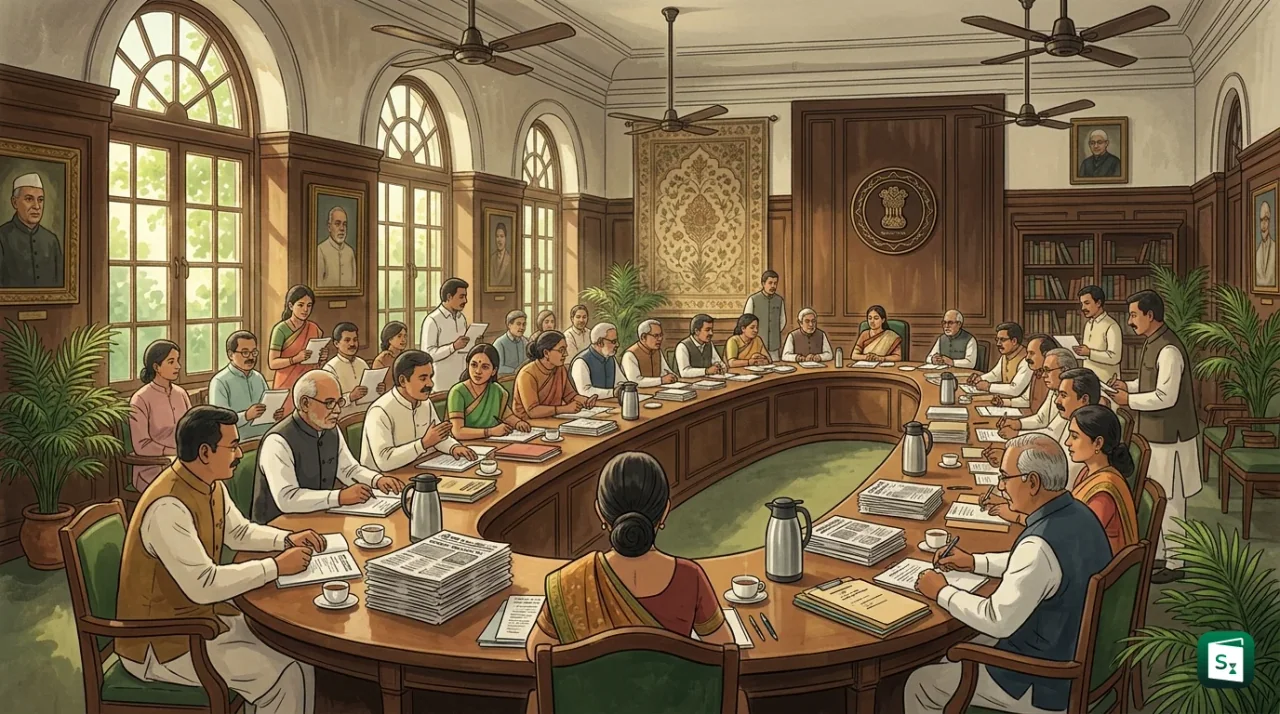
The Ministry of Information and Broadcasting notified the reconstitution of the Press Council of India on 7 October 2026 by nominating 13 working journalists as members. The notification names six editors and seven journalists other than editors under the Press Council Act, 1978. With this step, the 15th term of the Council moves closer to its full sanctioned strength of one Chairperson and 28 members.
What Is the Press Council of India?
The Press Council of India is a statutory, autonomous and quasi-judicial body that preserves press freedom and maintains standards of newspapers and news agencies in India. It functions under the Ministry of Information and Broadcasting and is governed by the Press Council Act, 1978.
The Press Council of India acts as a watchdog for print media. It handles complaints against newspapers, news agencies, editors and journalists for violation of journalistic ethics, and it also hears complaints by the press about threats to its freedom. The Council is headquartered in New Delhi. Its mandate covers newspapers and news agencies only. It does not regulate television, radio or digital and online news platforms.
How Was the Council Reconstituted in October 2026?
The Ministry of Information and Broadcasting issued Gazette Notification S.O. 5494(E) on 7 October 2026 to nominate 13 members to the Press Council of India. The nominations were made under clause (a) of sub-section (3) and sub-section (5) of Section 5, read with Section 6, of the Press Council Act, 1978. The notification amends the earlier reconstitution notification S.O. 5509(E) dated 19 December 2024.
The 13 nominees fill the working journalists quota. Six come from the editors category and seven from the category of working journalists other than editors. The editors nominated are Pradeep Kumar Jain, Sayed Raza Husain Rizvi, Ankur Dua, Aparna Shukla, Raj Parwana (Narender Singh) and Vinod Bajpai. The seven other working journalists are Vinod Kohli, Geetartha Pathak, Prajnananda Chaudhuri, Kingshuk Pramanik, C. K. Nayak, Prasanna Kumar Mohanty and Bijoy Kakchingtabam.
Before this notification, the Council had 14 members in place. These included five Members of Parliament, six representatives of newspaper owners and three experts nominated by the Bar Council of India (BCI), the University Grants Commission (UGC) and the Sahitya Akademi. The latest nominations complete the journalists bloc and take the Council close to its full strength for its 15th term. Under the Act, every nomination takes effect from the date it is notified in the Official Gazette.
How Many Members Are There in the Press Council of India?
The Press Council of India consists of one Chairperson and 28 other members. Section 5 of the Press Council Act, 1978 fixes this composition. Each type of member is drawn from a defined category to balance the interests of journalists, newspaper owners, Parliament and expert institutions.
| Category | Number | Nominated By or From |
|---|---|---|
| Working journalists, including six editors and seven others | 13 | Panels from journalists associations, notified by the Central Government |
| Persons owning or managing newspapers, with two each from big, medium and small papers | 6 | Panels from owners associations, notified by the Central Government |
| Persons managing news agencies | 1 | Panels from news agency associations |
| Experts in education and science, law, and literature and culture | 3 | One each by the UGC, the Bar Council of India and the Sahitya Akademi |
| Members of Parliament | 5 | Three from the Lok Sabha nominated by the Speaker, two from the Rajya Sabha nominated by the Chairman |
The Act also protects language diversity. Among the 13 journalist members, at least three editors and four other working journalists must be connected with newspapers published in Indian languages. A working journalist who owns or manages a newspaper cannot be nominated in the journalists quota. Members serve a term of three years, and one-third of the members retire every year by rotation, though retiring members can be renominated.
Who Is the Chairperson of the Press Council of India?
The Chairperson of the Press Council of India is Justice Ranjana Prakash Desai, a retired judge of the Supreme Court of India. The Central Government renominated her through Gazette Notification S.O. 2088(E) dated 24 April 2026 for a period of three years from the date of publication.
The Chairperson is nominated by a committee consisting of the Chairman of the Rajya Sabha, the Speaker of the Lok Sabha and a person elected by the members of the Council. By convention, a retired Supreme Court judge holds this post. Justice Desai first assumed charge on 17 June 2022 and became the first woman to head the Council.
Justice Desai served as a judge of the Bombay High Court from 1996 and as a judge of the Supreme Court from September 2011 to October 2014. After retirement, she headed the Appellate Tribunal for Electricity, the Authority for Advance Rulings (Income Tax) and the Delimitation Commission of India, which completed the delimitation exercise for the Union Territory of Jammu and Kashmir in May 2022. She also chaired the search committee for the Lokpal.
Why Was the Press Council of India Set Up?
The First Press Commission (1952 to 1954) recommended a press council to protect press freedom and uphold standards. Parliament created the first Council under the Press Council Act, 1965, which started work in 1966. The Council was dissolved during the Emergency in 1976.
Parliament then passed the Press Council Act, 1978, which came into force on 7 September 1978. The Second Press Commission of 1978 had also supported a strong press body. The Council re-established under this law is the body that functions today. Its stated objects are to preserve the freedom of the press and to maintain and improve the standards of newspapers and news agencies in India.
Is the Press Council of India a Statutory Body?
The Press Council of India is a statutory body because Parliament created it through the Press Council Act, 1978. It is not a constitutional body, since no provision of the Constitution establishes it. Freedom of the press itself flows from Article 19(1)(a) of the Constitution, which guarantees freedom of speech and expression, subject to reasonable restrictions under Article 19(2).
The Council is also autonomous and quasi-judicial, which means it is not a court but holds court-like inquiries after hearing both sides. Section 15 gives it civil court powers to summon witnesses and demand documents. Every inquiry counts as a judicial proceeding, but it cannot force disclosure of news sources.
What Are the Powers and Functions of the Council?
Section 13 of the Act lists the functions of the Council. It helps newspapers and news agencies protect their independence and frames the Norms of Journalistic Conduct, the code of ethics for print journalism. It keeps a watch on developments that may restrict the flow of news of public interest, including foreign assistance to newspapers and concentration of newspaper ownership.
Section 14 gives the Council its power to censure. If a newspaper, news agency, editor or journalist offends standards of ethics or public taste or commits professional misconduct, the Council can hold an inquiry after giving a hearing. It can then warn, admonish or censure the newspaper or journalist, or record disapproval of the conduct. It can also direct publication of inquiry details when public interest demands it.
The reach of this power has clear limits. The Council cannot impose fines, suspend publication or cancel licences. It cannot hear matters that are already pending before a court. Its strength works mainly through public admonition and moral authority. Complaints can be filed with the Council online, by post or by email under the Press Council (Procedure for Inquiry) Regulations, 1979.
The Way Forward
With the journalists bloc now notified, the 15th term of the Council can function closer to full strength. A complete Council clears pending complaints faster and gives weight to its adjudications on issues such as paid news, pre-poll and exit-poll guidelines and press freedom violations.
The larger debate remains open. Demands have been raised from time to time for a wider media council covering television and digital news, and for stronger penalty powers. Any such change needs fresh legislation and must pass the test of Article 19(2) by balancing accountability with the freedom of the press. Until then, the Council continues as the dedicated regulator for print, funded partly through government grants and partly through a levy collected from newspapers under Section 17 of the Act.
Key Takeaways
- The Ministry of Information and Broadcasting nominated 13 working journalists to the Press Council of India through notification S.O. 5494(E) dated 7 October 2026.
- The Council comprises one Chairperson and 28 members, including 13 journalists, six newspaper owners, five MPs and three experts.
- Justice Ranjana Prakash Desai is the Chairperson, renominated in April 2026 for a three-year term.
- The Council works under the Press Council Act, 1978, which came into force on 7 September 1978.
- It is a statutory, autonomous and quasi-judicial body that can warn, admonish or censure but cannot impose fines.