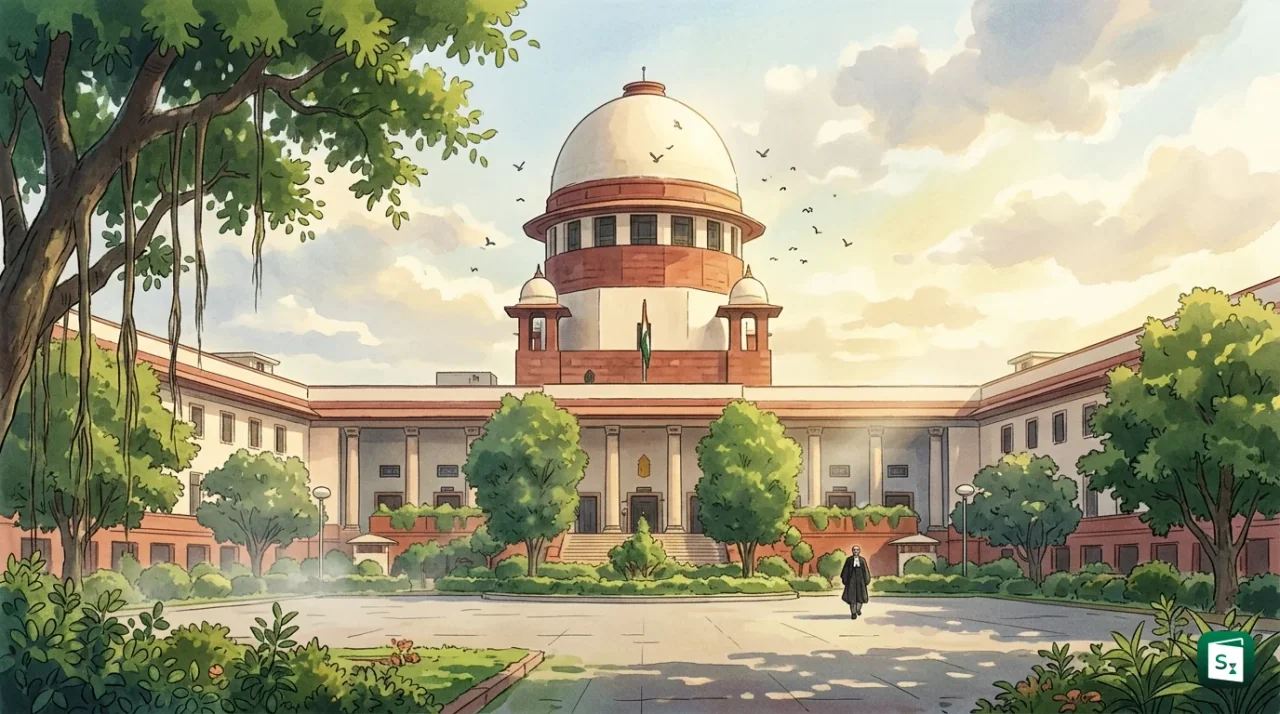
President Droupadi Murmu cleared the elevation of Justices Sunita Agarwal, Devendra Kumar Upadhyaya and Aparesh Kumar Singh as judges of the Supreme Court of India on 5 October 2026. The three appointees were serving as Chief Justices of the Gujarat, Delhi and Telangana High Courts. With their joining, the working strength of the Supreme Court will rise to 37 judges against a sanctioned strength of 38, and the number of women judges will rise to three.
What Is the Supreme Court of India?
The Supreme Court of India is the highest court in the country and the final interpreter of the Constitution. It was inaugurated on 28 January 1950 in New Delhi, two days after the Constitution came into force. The Court deals with constitutional cases, appeals from High Courts, disputes between the Centre and states, and protection of fundamental rights.
The Constitution describes the Supreme Court in Articles 124 to 147. Article 124 provides for its establishment and composition. Article 129 declares the Supreme Court a Court of Record, which means its judgments are recorded permanently and it can punish for contempt of itself. Article 142 gives the Court wide power to pass any order needed to do complete justice in a case.
The Supreme Court is often called the guardian of the Constitution because it can review laws and government actions through judicial review and strike them down if they violate the Constitution. Its motto, inscribed on its seal, is Yato Dharmastato Jayah (Where there is Dharma, there is victory). The Chief Justice of India heads the Court. Surya Kant is the Chief Justice of India (as of October 2026).
How Many Judges Are There in the Supreme Court?
The Supreme Court now has a sanctioned strength of 38 judges, which includes the Chief Justice of India and 37 other judges. Its working strength will be 37 judges once the three new appointees take oath, leaving one vacancy. The vacancy exists because the current working strength before these appointments was 34 judges.
Sanctioned strength means the maximum number of posts allowed by law. Working strength means the number of judges actually in office. Parliament fixes the number of Supreme Court judges under Article 124(1) through the Supreme Court (Number of Judges) Act, 1956.
The strength was raised from 34 to 38 in 2026 to handle rising pendency. The Union Cabinet approved the proposal on 5 May 2026. President Droupadi Murmu then issued the Supreme Court (Number of Judges) Amendment Ordinance, 2026 on 16 May 2026, which was later replaced by the Supreme Court (Number of Judges) Amendment Act, 2026. The government stated that more than 92,000 cases were pending on 1 January 2026, and fresh filings in 2025 had crossed 75,000, well above disposals.
| Stage | Sanctioned Strength (Including Chief Justice) |
|---|---|
| At inception in 1950 | 8 |
| 1956 Act | 11 |
| 1960 Amendment | 14 |
| 1977 Amendment | 18 |
| 1986 Amendment | 26 |
| 2009 Amendment | 31 |
| 2019 Amendment | 34 |
| 2026 Ordinance and Act | 38 |
Who Are the Three New Judges?
The three new judges are senior Chief Justices of High Courts with long experience in constitutional, civil and service matters. The Supreme Court Collegium recommended their names on 28 September 2026, and the Union Law Ministry notified their appointment on 5 October 2026. They will take charge from the date they assume office and are expected to take oath on 6 October 2026.
| Judge | Present Post Before Elevation | Parent High Court | Date of Birth and Retirement |
|---|---|---|---|
| Justice Sunita Agarwal | Chief Justice, Gujarat High Court | Allahabad | Born 30 April 1966, retires 29 April 2028 |
| Justice Devendra Kumar Upadhyaya | Chief Justice, Delhi High Court | Allahabad | Born 16 June 1965, retires 15 June 2027 |
| Justice Aparesh Kumar Singh | Chief Justice, Telangana High Court | Jharkhand | Born 7 July 1965, retires 6 July 2027 |
Justice Sunita Agarwal graduated in science from Lucknow University and earned her law degree from Awadh University. She enrolled as an advocate in December 1990 and practised for 21 years at the Allahabad High Court in civil, writ and commercial matters. She was appointed Additional Judge of the Allahabad High Court on 21 November 2011 and became a permanent judge on 6 August 2013. She became Chief Justice of the Gujarat High Court on 23 July 2023. She has handled service law, education, land acquisition and constitutional cases, and is a trained mediator. Her elevation takes the number of women judges in the Supreme Court to three.
Justice Devendra Kumar Upadhyaya also began at the Allahabad High Court. He served as Chief Standing Counsel for the State of Uttar Pradesh before his elevation as Additional Judge on 21 November 2011. He became a permanent judge in August 2013. He served as Chief Justice of the Bombay High Court from July 2023 and was then transferred as Chief Justice of the Delhi High Court in January 2025. He is known for work in constitutional and administrative law and Centre state disputes.
Justice Aparesh Kumar Singh studied law at the University of Delhi and enrolled in 1990. He practised at the Patna High Court from 1990 to 2000 and at the Jharkhand High Court until 2012. He was appointed Additional Judge of the Jharkhand High Court on 24 January 2012 and became a permanent judge on 16 January 2014. He served as Acting Chief Justice of Jharkhand from 20 December 2022 to 19 February 2023. He then served as Chief Justice of the Tripura High Court from 17 April 2023 and as Chief Justice of the Telangana High Court from 19 July 2025. His maternal great grandfather, B. P. Sinha, was the sixth Chief Justice of India.
How Are Supreme Court Judges Appointed?
Judges of the Supreme Court are appointed by the President of India on the recommendation of the Supreme Court Collegium. A person must be a citizen of India and must have been a High Court judge for five years, an advocate for ten years, or a distinguished jurist. They hold office until the age of 65 years.
Article 124(2) lays down this appointment method. In practice, the Collegium sends its recommendation to the Union government. The Department of Justice processes the file, and the President issues the warrant of appointment. The appointment takes effect from the date the judge assumes charge.
A Supreme Court judge must take an oath before taking office. The oath is given in the form prescribed in the Third Schedule of the Constitution. A judge can resign by writing to the President. A judge can be removed only by impeachment under Article 124(4), which needs a motion passed by both Houses of Parliament on grounds of proved misbehaviour or incapacity.
What Is the Supreme Court Collegium?
The Supreme Court Collegium is the group of senior judges that recommends appointments and transfers of judges to the Supreme Court and High Courts. It consists of the Chief Justice of India and the four senior most judges of the Supreme Court. The system is based on three Supreme Court judgments known as the Judges Cases.
The Collegium that recommended the three new judges met on 28 September 2026. It was headed by Chief Justice Surya Kant and included Justices Vikram Nath, B. V. Nagarathna, M. M. Sundresh and P. S. Narasimha. The Collegium resolution placed Justice Agarwal first in the batch, followed by Justices Upadhyaya and Singh. All three ranked among the senior most Chief Justices of High Courts in the country at that time.
The Collegium system aims to keep judicial appointments free from executive control. The government can seek reconsideration once, but it generally notifies the names after the Collegium reiterates them. Parliament had passed the National Judicial Appointments Commission (NJAC) Act in 2014 as an alternative, but the Supreme Court struck it down in 2015 to protect judicial independence.
Significance and the Way Forward
The three elevations bring the Supreme Court close to full strength at a time of heavy backlog. A fuller court allows the Chief Justice to form more division benches for regular civil and criminal appeals and to set up Constitution Benches of five or more judges for important questions of law. This can speed up disposal and reduce waiting time for litigants.
The elevation of Justice Agarwal raises women representation to three judges. Justice B. V. Nagarathna, who is also a member of the Collegium, is in line to become the first woman Chief Justice of India in 2027. Earlier in 2026, the Collegium had recommended senior advocate V. Mohana for direct elevation from the Bar, which added another woman judge to the Court.
None of the three new judges is in the direct line of succession for the post of Chief Justice of India based on seniority and retirement dates. Their value lies in long High Court leadership experience. With one vacancy still left, another Collegium recommendation is expected in the coming months. The Court will also need to manage upcoming retirements, including that of Justice Satish Chandra Sharma in November 2026 and Chief Justice Surya Kant in February 2027.
Key Takeaways
- Justices Sunita Agarwal, Devendra Kumar Upadhyaya and Aparesh Kumar Singh were elevated to the Supreme Court on 5 October 2026 after a Collegium recommendation on 28 September 2026.
- The working strength of the Supreme Court of India will rise to 37 judges against a sanctioned strength of 38 judges including the Chief Justice.
- The sanctioned strength was raised from 34 to 38 through the Supreme Court (Number of Judges) Amendment Ordinance and Act, 2026.
- Judges of the Supreme Court are appointed by the President under Article 124 and hold office until the age of 65 years.
- The five member Collegium was headed by Chief Justice Surya Kant and included Justices Vikram Nath, B. V. Nagarathna, M. M. Sundresh and P. S. Narasimha.
- With Justice Agarwal’s elevation, the Supreme Court has three women judges.