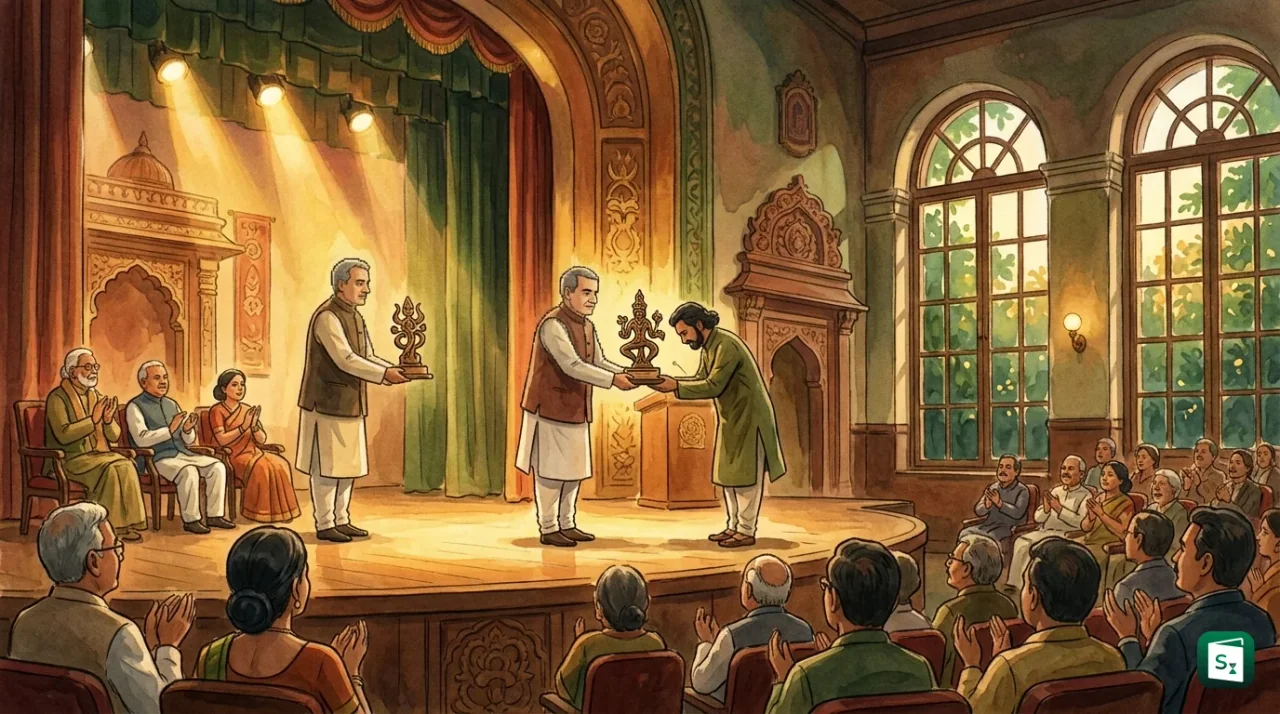
The Lalit Kala Akademi announced 20 Lalit Kala Akademi Awards at the 65th National Exhibition of Art in New Delhi on 29 September 2026. Union Minister for Culture and Tourism Gajendra Singh Shekhawat felicitated the winners at Rabindra Bhavan in a ceremony attended by senior officials of the Ministry of Culture. The exhibition, which drew 6,175 artworks from 2,495 artists across 27 States and Union Territories, stands as India’s premier annual platform for contemporary visual art.
What Is Lalit Kala and What Is the Lalit Kala Akademi?
The term Lalit Kala means fine art in Hindi and Sanskrit. It covers visual art forms such as painting, sculpture, drawing, printmaking, photography and ceramics. The Lalit Kala Akademi, which is also written as Lalit Kala Academy, is India’s National Academy of Art for these visual arts.
The Lalit Kala Akademi was inaugurated on 5 August 1954 by Maulana Abul Kalam Azad, who was then the Minister for Education. The Akademi was registered as an autonomous body on 11 March 1957 under the Societies Registration Act, 1860. It functions under the Ministry of Culture and is headquartered at Rabindra Bhavan, 35 Ferozeshah Road, New Delhi.
The Akademi is the youngest of the three national Akademies set up by the Government of India. The other two are the Sangeet Natak Akademi for music, dance and drama and the Sahitya Akademi for literature. While those bodies look after performing arts and letters, the Lalit Kala Akademi focuses only on visual arts. It preserves traditional, folk and tribal art and also promotes modern and contemporary practice through exhibitions, workshops, camps, lectures, scholarships and publications.
The Lalit Kala Akademi works through its General Council, Executive Board and expert committees. Its network includes regional centres at Chennai, Lucknow, Kolkata, Bhubaneswar and Garhi in New Delhi, along with sub centres at Shimla, Ahmedabad, Agartala and Patna. The Akademi maintains a permanent collection of contemporary, modern, folk and tribal works and also organises art events outside India to present Indian art to the world.
The National Exhibition of Art: India’s Premier Annual Art Platform
The National Exhibition of Art (NEA) is the most prestigious annual event of the Lalit Kala Akademi. It began in 1955 to showcase the best visual art produced in the country during the year. In that first edition, 280 works were chosen from about 1,200 entries for display, and ten awards of ₹1,000 each were given.
The exhibition has changed shape many times over seven decades. From 1956 onward, the best exhibit also received the Akademi’s Gold Plaque. From 1958, the Akademi allowed sale of exhibits under its supervision, and both the Akademi and the National Gallery of Modern Art (NGMA) began buying works for their permanent collections. The prize money rose in stages to ₹5,000, then ₹10,000, then ₹25,000 in 2001 and ₹40,000 in 2002. In recent years the National Art Award has carried a plaque, a shawl and a cash prize of ₹2 lakh.
The National Exhibition has also travelled beyond the capital to widen public access. Over the decades it has been held in Kolkata, Mumbai, Chennai, Jaipur, Amritsar, Lucknow, Guwahati, Patna, Hyderabad, Bhopal, Ahmedabad, Bengaluru and Kochi, often with state academies and cultural bodies as partners. This rotation has helped the Akademi bring contemporary trends to regional audiences and discover talent from smaller centres.
The previous edition offers a useful benchmark. The 64th National Exhibition of Art was inaugurated on 5 August 2025 in New Delhi, a date that also marked the Akademi’s foundation day. President Droupadi Murmu conferred the awards on 20 artists on 24 September 2025. For the first time in the history of the exhibition, the award winning artworks were made available for sale to support artist livelihoods.
65th National Exhibition of Art: Selection Process and Scale
The 65th National Exhibition of Art received an overwhelming response from artists across India. The Lalit Kala Akademi received 6,175 artworks from 2,495 artists representing 27 States and Union Territories. This wide participation underlines the national character of the exhibition and its pull among both established and emerging artists.
Selection followed a strict two tier jury process. A First Tier Jury screened all entries and chose 270 artworks for public display at the Lalit Kala Akademi Art Gallery at Rabindra Bhavan. A Second Tier Jury then judged these displayed works and picked 20 artworks by 20 artists for the Lalit Kala Akademi Awards. The selected works cover painting, sculpture, printmaking, drawing and mixed media and show strong experimentation with materials, ideas and forms.
| Stage of the 65th Exhibition | Figure |
|---|---|
| Total artworks received | 6,175 |
| Total artists who applied | 2,495 |
| States and Union Territories represented | 27 |
| Works chosen for display by First Tier Jury | 270 |
| Works chosen for awards by Second Tier Jury | 20 |
The exhibition is on view at the Lalit Kala Akademi Art Gallery, Rabindra Bhavan, New Delhi. The Ministry of Culture has extended the show until 31 October 2026 and has invited the public, art lovers and visitors to see the diverse trends in contemporary Indian art.
Who Won the 20 Awards at the 65th National Exhibition?
The Lalit Kala Akademi announced the list of 20 awardees on 27 September 2026. The winners were chosen for works across sculpture, painting, drawing, printmaking and other media. Four names highlighted in the initial announcement were Chandra Shekhar Sain for sculpture, Gopal Chandra Naskar for painting, Pankaj Kumar Sharma for drawing and Pritam Madhukar Deuskar for printmaking.
The full list of award winning artists, works and media shows the range of contemporary practice, from terracotta and white marble to etching, water colour wash and mixed media.
| Artist | Award Winning Work | Medium and Category |
|---|---|---|
| Chandra Shekhar Sain | My Entire World - I | Terracotta, Sculpture |
| Gopal Chandra Naskar | The Tune of The Srimad Bhagavad Gita | Acrylic on Canvas, Painting |
| Kishor Kumar Narkhadiwala | Paryavaran | Oil on Canvas, Painting |
| Mrinal Dey | Hopeless Settlement | Acrylic on Canvas, Painting |
| Nidhi Chopra | Tangible Dreams | Ceramic, Sculpture |
| Nimai Singh Sarungbam | Mudra - I | Teak Wood, Sculpture |
| Pankaj Kumar Sharma | Haloed Traveler - II | Panel Works, Drawing |
| Pooja Rajpoot | Prakriti Shoshan | White Marble, Sculpture |
| Praveen Kumar | Where The Walls Remember | Mix Medium, Painting |
| Pritam Madhukar Deuskar | Of Time and The City | Etching, Printmaking |
| Rajendra Prasad | Sujata With Buddha | Water Colour Wash, Painting |
| Ramesh Vithal Thorat | Untitled - II | Oil on Canvas, Painting |
| Raviram Ramakrishnan | Fisherwoman | Copper, Oxidised, Welded, Sculpture |
| Sanjay Kumar | When Memories Come Back - 7 | Mix Media, Painting |
| Sanjay Kumar Sahani | Youth | Oil on Canvas, Painting |
| Sanjib Kumar Gogoi | Aakar Nirankar - II | Acrylic and Oil on Canvas, Painting |
| Santa Deb | Attraction of Simplicity | Ceramic, Sculpture |
| Siddharth Shahjirao Shingade | Trees | Mix Media, Painting |
| Usharanjan Mandal | Wheel of A Crowded City | Mix Media, Other Medium |
| Vijendra Sharma | Life 2025 | Oil on Canvas, Painting |
Painting forms the largest group among the winners, followed by sculpture. The drawing and printmaking awards draw special attention because these disciplines often get less public visibility than painting and large sculpture. The Akademi has congratulated all 20 winners and thanked the two juries for completing the rigorous selection.
Award Ceremony at Rabindra Bhavan: Key Highlights
The felicitation ceremony for the 65th National Exhibition of Art was held on 29 September 2026 in New Delhi. Gajendra Singh Shekhawat, Union Minister for Culture and Tourism (as of October 2026), attended as chief guest and felicitated the 20 award winning artists. The event took place at Rabindra Bhavan, the cultural complex on Ferozeshah Road that houses the Lalit Kala Akademi, the Sangeet Natak Akademi and the Sahitya Akademi.
Senior officials present included Vivek Aggarwal, Secretary in the Ministry of Culture, K. K. Mishra, Joint Secretary for Akademies, and Rajeev Kumar, Secretary of the Lalit Kala Akademi. Padma Shri artists Sudharak Olwe, Sudarshan Pattnaik and Ashok Kumar Vishwas also attended. Their presence linked emerging award winners with widely recognised masters of photography, sand art and painting.
The ceremony also carried a message on sustainability. The Minister and other dignitaries viewed artworks made from waste materials during the Seva Hi Sanskriti workshops held at various centres of the Akademi. He praised the Waste to Wonder effort, which turns discarded material into art and shows how creativity can support cleaner surroundings. The Seva Hi Sanskriti workshops were organised around the birthday of Prime Minister Narendra Modi to combine service with culture.
A monograph on Abdul Aziz Raiba, edited by Ram Gopal Khadilkar, was released during the programme. Raiba was an eminent modern Indian painter known for bold lines, vibrant colours and a distinctive blend of Indian tradition with modern art. After the ceremony, the Minister and other dignitaries visited the exhibition at the Lalit Kala Gallery.
Why the National Exhibition Matters for Art and Creative Economy
The National Exhibition of Art does more than confer awards. It gives artists from across the country a national stage, direct contact with audiences, collectors and institutions, and a record of current trends in Indian visual art. For many young artists, selection among 270 displayed works from more than 6,000 entries itself brings professional recognition.
The exhibition also supports livelihoods. Display and sale of works can bring direct income to participating artists and help them continue their practice. The decision at the 64th edition to allow sale of award winning works, and the continued focus on visibility and market links, reflect a clear policy shift toward artist empowerment. The Ministry of Culture has stressed wider opportunities and greater visibility for contemporary Indian art as a core goal.
This push fits into a larger cultural network. The National Gallery of Modern Art (NGMA), headquartered in New Delhi with branches in Mumbai and Bengaluru, preserves modern Indian art and often acquires important works. The Lalit Kala Akademi feeds this ecosystem by identifying new talent through the National Exhibition, the Print Biennale of India and scholarships, while NGMA preserves and displays the longer history. The Akademi’s 72nd Foundation Day, observed on 5 August 2026 at Rabindra Bhavan, recalled this continuing role of over seven decades.
Key Takeaways
- The Lalit Kala Akademi announced 20 awards at the 65th National Exhibition of Art, felicitated on 29 September 2026 at Rabindra Bhavan, New Delhi.
- The 65th edition received 6,175 artworks from 2,495 artists across 27 States and Union Territories, of which 270 works were displayed after First Tier Jury screening.
- Chandra Shekhar Sain won for sculpture, Gopal Chandra Naskar for painting, Pankaj Kumar Sharma for drawing and Pritam Madhukar Deuskar for printmaking through etching.
- The Lalit Kala Akademi was inaugurated on 5 August 1954 by Maulana Abul Kalam Azad and registered on 11 March 1957 under the Societies Registration Act, 1860.
- The National Exhibition of Art began in 1955 and is organised by the Akademi under the Ministry of Culture from its headquarters at Rabindra Bhavan, New Delhi.
- The 65th exhibition has been extended until 31 October 2026, while the 64th edition awards were conferred by President Droupadi Murmu on 24 September 2025.