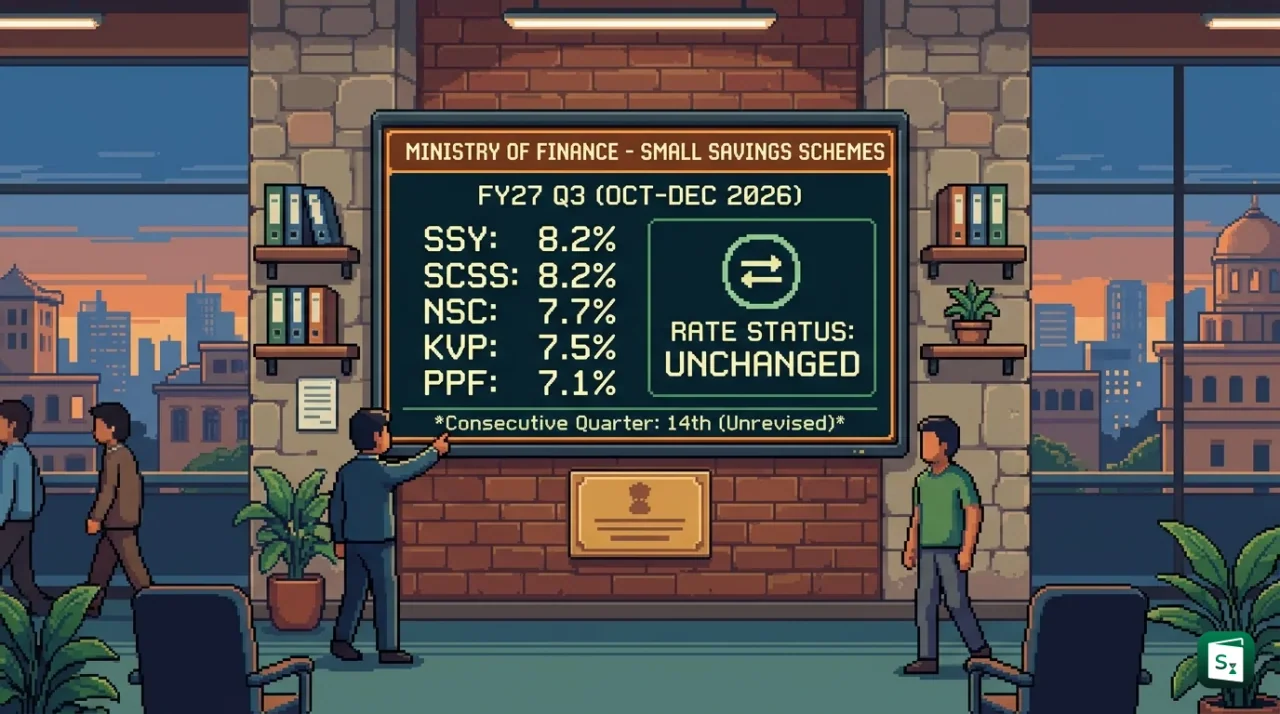
The Department of Economic Affairs has kept the small savings scheme interest rate unchanged for all schemes for the July to September 2026 quarter, the second quarter of FY27. The notification issued on 30 June 2026 extends the status quo on Public Provident Fund at 7.1 percent, National Savings Certificate at 7.7 percent, and Sukanya Samriddhi Yojana and Senior Citizen Savings Scheme at 8.2 percent each. The freeze protects predictable returns for crores of post office savers while keeping small savings aligned with government bond yields and bank deposit rates.
Small Savings Scheme Interest Rates Unchanged for Q2 FY27
The Department of Economic Affairs, which functions under the Ministry of Finance, announced that rates for the second quarter of FY27, from 1 July 2026 to 30 September 2026, will remain the same as the first quarter from 1 April 2026 to 30 June 2026. The decision continues a long period without revision. The last broad adjustment took place for the January to March 2024 quarter, when the government raised the Sukanya Samriddhi Yojana rate and the three year time deposit rate.
The Public Provident Fund rate has stayed at 7.1 percent since April 2020. That is more than six years without change. Other schemes were last revised in late 2023 and early 2024. The present freeze therefore matters most for safety seeking households, including retirees and parents saving for a girl child, who depend on fixed, government backed income.
The complete post office savings scheme list with rates for July to September 2026 is given below.
| Scheme | Interest Rate for Q2 FY27 | How Interest Is Paid |
|---|---|---|
| Post Office Savings Account | 4.0 percent | Annually |
| 1 Year Time Deposit | 6.9 percent | Compounded quarterly |
| 2 Year Time Deposit | 7.0 percent | Compounded quarterly |
| 3 Year Time Deposit | 7.1 percent | Compounded quarterly |
| 5 Year Time Deposit | 7.5 percent | Compounded quarterly |
| 5 Year Recurring Deposit | 6.7 percent | Compounded quarterly |
| Senior Citizen Savings Scheme | 8.2 percent | Paid every quarter |
| Monthly Income Scheme | 7.4 percent | Paid every month |
| National Savings Certificate | 7.7 percent | Compounded annually, paid on maturity |
| Public Provident Fund | 7.1 percent | Compounded annually |
| Kisan Vikas Patra | 7.5 percent | Compounded annually, amount doubles in 115 months |
| Sukanya Samriddhi Yojana | 8.2 percent | Compounded annually |
The Sukanya Samriddhi Yojana and the Senior Citizen Savings Scheme jointly offer the highest rate at 8.2 percent. The National Savings Certificate follows at 7.7 percent, while Kisan Vikas Patra and the five year time deposit pay 7.5 percent each.
What Is the National Small Savings Fund?
The National Small Savings Fund, often shortened to NSSF, is a separate pool inside the Public Account of India. The Union Budget for 1999-2000 created the fund with effect from 1 April 1999. All money collected through small savings certificates, post office deposits and Public Provident Fund flows into this fund. All withdrawals by depositors are also paid out of it.
The NSSF is administered by the Department of Economic Affairs under the National Small Savings Fund (Custody and Investment) Rules, 2001. These rules were framed by the President under Article 283(1) of the Constitution, which deals with custody of public money. The purpose was simple. Small savings transactions were delinked from the Consolidated Fund of India so they could run in a transparent and self sustaining manner. Since the NSSF sits in the public account, its transactions do not directly increase the fiscal deficit of the central government.
Money in the fund is invested in central and state government securities as per norms fixed by the central government. Interest paid on those securities becomes income of the fund. Interest paid to savers and the cost of running small savings schemes are the expenditure of the fund. The outstanding small savings balances as on 31 March 1999, amounting to more than ₹1.76 lakh crore, were converted into special central government securities. Those securities form part of the internal debt of India.
How Are Small Savings Interest Rates Decided?
The Ministry of Finance reviews small savings interest rates every quarter. The present system of quarterly review started on 1 April 2016. Before that, rates were reset once a year.
The method follows the recommendations of the Shyamala Gopinath Committee. The committee was set up on 8 July 2010 under Shyamala Gopinath, then Deputy Governor of the Reserve Bank of India, to review the National Small Savings Fund. It submitted its report in 2011. The government accepted the core idea. Each small savings scheme is linked to the yield on government securities, called G-Secs, of similar maturity. A small extra margin, called a spread, is added on top.
A basis point is one hundredth of a percent. So 100 basis points equal 1 percent. Under the framework, most schemes carry a spread of 25 basis points above comparable G-Sec yields. The Senior Citizen Savings Scheme carries a higher spread of 100 basis points because of its social goal of supporting retired persons. The Sukanya Samriddhi Yojana carries a spread of 75 basis points in practice to support savings for the girl child.
In the first half of 2026, the 10 year G-Sec yield stayed near 6.7 to 6.9 percent. Adding 25 basis points gives a formula value near 7.1 percent. The notified Public Provident Fund rate of 7.1 percent therefore sits close to the formula level. The Senior Citizen Savings Scheme rate of 8.2 percent sits well above its formula value, which shows that the government uses its discretion to keep returns attractive for senior citizens and to avoid sharp cuts that could hurt household savings.
What Is PPF Account and How Does It Work?
The Public Provident Fund is a 15 year government backed savings scheme open to resident individuals, including accounts opened for minors. It offers an interest rate of 7.1 percent per year, compounded annually, with deposits from ₹500 to ₹1.5 lakh per financial year and full tax exemption on deposit, interest and maturity.
The Public Provident Fund, usually called PPF, was launched in 1968 by the central government. It is operated through post offices and authorised banks. Any resident Indian can open one account in their own name. A parent can open an account for a minor child. Non Resident Indians cannot open a new PPF account. An existing account held before a person becomes a non resident can continue till maturity on a non repatriable basis.
Deposits can range from ₹500 to ₹1.5 lakh in a financial year. The limit of ₹1.5 lakh has stayed unchanged since 2014. Interest is calculated every month on the lowest balance between the 5th and the last day of the month. It is credited once a year on 31 March. A person who deposits ₹1.5 lakh every year for 15 years at 7.1 percent builds a maturity amount near ₹40.68 lakh, of which about ₹18.18 lakh is interest. That shows the power of annual compounding over a long period.
Withdrawals follow strict rules. Partial withdrawal is allowed from the seventh financial year, up to 50 percent of the eligible balance, with only one withdrawal per year. A loan can be taken between the third and sixth years. Premature closure is allowed after five years only on specific grounds such as serious illness or higher education, with a penalty of 1 percent interest. After 15 years, the account can be closed, or extended in blocks of five years with or without fresh deposits.
Is PPF taxable. No. PPF enjoys EEE status, which means Exempt Exempt Exempt. Deposits up to ₹1.5 lakh qualify for deduction under Section 80C of the Income Tax Act under the old tax regime. Interest earned each year is tax free. The full maturity amount is tax free under Section 10(11). No tax is deducted at source.
Sukanya Samriddhi Yojana Rate and Features
The Sukanya Samriddhi Yojana is a deposit scheme for a girl child that pays 8.2 percent per year, the joint highest rate among small savings. A parent can open the account before the girl turns 10, deposit up to ₹1.5 lakh per year for 15 years, and receive tax free maturity after 21 years from opening.
The Sukanya Samriddhi Yojana, usually called SSY, was launched in January 2015 as part of the Beti Bachao Beti Padhao campaign. The Department of Economic Affairs administers the rate, while post offices and authorised banks operate accounts. The scheme is open only to resident parents or guardians for a maximum of two girl children in a family. A third account is allowed only in case of twin or triplet girls.
The minimum deposit is ₹250 per year and the maximum is ₹1.5 lakh per year. Deposits are required for 15 years. The account matures after 21 years from opening, or at the marriage of the girl after age 18. Interest is compounded annually at the rate notified each quarter. That means the rate floats. If the government changes the rate next quarter, the whole balance starts earning the new rate.
Partial withdrawal up to 50 percent is allowed after the girl turns 18 or passes Class 10, whichever is earlier, for higher education. Premature closure is allowed only on compassionate grounds such as death of the account holder or serious medical treatment. Like PPF, SSY enjoys EEE tax status. Deposits qualify under Section 80C, and interest and maturity are tax free under Section 10(11A). No loan facility exists under SSY.
Senior Citizen Savings Scheme Rate and Eligibility
The Senior Citizen Savings Scheme is a five year deposit for persons aged 60 years and above that pays 8.2 percent per year, with interest paid every quarter. The rate is fixed on the day of deposit for the full term, deposits up to ₹30 lakh are allowed, and interest is taxable though deposits qualify for Section 80C benefits.
The Senior Citizen Savings Scheme, usually called SCSS, was launched in 2004 to give assured income after retirement. It is available at post offices and authorised banks. Eligibility starts at 60 years of age. Retired persons between 55 and 60 years can also open an account within one month of receiving retirement benefits, with proof from the employer. Retired defence personnel can open from 50 years of age under specified conditions.
Deposits can range from ₹1,000 to ₹30 lakh. The limit was raised to ₹30 lakh in Budget 2023 from ₹15 lakh earlier. The term is five years, extendable once for three more years at the rate prevailing at extension. Unlike PPF and SSY, the SCSS rate is locked. The 8.2 percent rate fixed on the day of opening continues for the full term even if later quarterly reviews cut rates.
Interest is paid every quarter, in April, July, October and January. That makes SCSS popular for monthly household budgets. Premature closure is allowed after one year with penalty. Closure between one and two years deducts 1.5 percent of the deposit, while closure after two years deducts 1 percent. Interest is fully taxable as income from other sources. Tax is deducted at source at 10 percent if annual interest exceeds ₹50,000. Deposits qualify for Section 80C deduction under the old tax regime.
What Is NSC Scheme and Is NSC Interest Taxable?
The National Savings Certificate is a five year one time deposit that pays 7.7 percent per year, compounded annually. A deposit of ₹10,000 grows to about ₹14,490 in five years. Interest is taxable, but annual interest is treated as reinvested and qualifies for Section 80C except in the final year.
The National Savings Certificate, usually called NSC, is issued as the VIII Issue at post offices. The minimum investment is ₹1,000 with no maximum limit. Only resident individuals can invest. Trusts and Hindu Undivided Families cannot buy new certificates. The rate is locked on the day of purchase. The 7.7 percent rate therefore stays fixed for the full five years.
Is NSC interest taxable or not. Annual interest is taxable, but the treatment is special. Each year the interest is deemed to be reinvested, so the investor can claim it as a fresh deduction under Section 80C for the first four years. Only the interest of the fifth and final year is fully taxable, since no reinvestment happens after maturity. This makes NSC useful for persons who have not exhausted their ₹1.5 lakh Section 80C limit.
Kisan Vikas Patra, Monthly Income Scheme and Deposits
Kisan Vikas Patra, often called KVP, pays 7.5 percent per year and doubles the invested amount in 115 months, or nine years and seven months. The minimum deposit is ₹1,000 with no maximum limit. The certificate can be bought singly or jointly and can be transferred between persons. Interest is locked on the day of purchase and is fully taxable. KVP offers no deduction under Section 80C. Premature closure is allowed after 30 months under specified conditions.
The Post Office Monthly Income Scheme pays 7.4 percent per year, with interest paid every month. That means a deposit of ₹10,000 earns about ₹62 every month. The maximum deposit is ₹9 lakh for a single account and ₹15 lakh for a joint account. The term is five years. The rate is locked on the day of opening. Interest is fully taxable. The scheme suits persons who need steady monthly cash flow without market risk.
Post office time deposits work like bank fixed deposits. The one year, two year, three year and five year deposits pay 6.9 percent, 7.0 percent, 7.1 percent and 7.5 percent respectively. The five year recurring deposit, where a fixed sum is deposited every month, pays 6.7 percent. The basic post office savings account pays 4.0 percent. Time deposit interest is taxable, though the five year time deposit qualifies for Section 80C benefits.
Why Rates Were Kept Unchanged
The Department of Economic Affairs balances three goals when it reviews rates. First, savers must get a positive return after inflation. Second, the government must control its own borrowing cost, since NSSF money funds central and state needs. Third, small savings rates must not rise so high that banks cannot attract deposits or pass on policy rate cuts.
In early 2026, bond yields stayed in a narrow band and retail inflation pressures were mixed. A sharp rise in small savings rates would have forced banks to keep fixed deposit rates high. That would have weakened the transmission of monetary policy. A sharp cut would have hurt retirees who rely on SCSS quarterly payouts and Monthly Income Scheme payouts for daily expenses. A status quo protected both sides.
The distinction between floating and locked rates also matters. PPF and SSY rates float, so any future change applies to the full balance from the next quarter. SCSS, NSC, KVP, Monthly Income Scheme and time deposits lock the rate at opening. Savers who plan to open a locked product gain certainty from the present 8.2 percent or 7.7 percent levels for the full term, even if later quarters bring cuts.
Key Takeaways
- The Department of Economic Affairs kept all small savings scheme rates unchanged for Q2 FY27 from 1 July to 30 September 2026 as per its 30 June 2026 notification.
- SSY and SCSS jointly pay the highest rate at 8.2 percent, while NSC pays 7.7 percent, KVP pays 7.5 percent and PPF pays 7.1 percent.
- The National Small Savings Fund created on 1 April 1999 in the Public Account of India collects all small savings and is run under Article 283(1) rules.
- Quarterly reviews since 1 April 2016 follow the Shyamala Gopinath Committee formula of G-Sec yield plus a spread of 25 to 100 basis points.
- PPF and SSY enjoy full EEE tax exemption, while SCSS, NSC, KVP and MIS interest is taxable with limited Section 80C benefits.