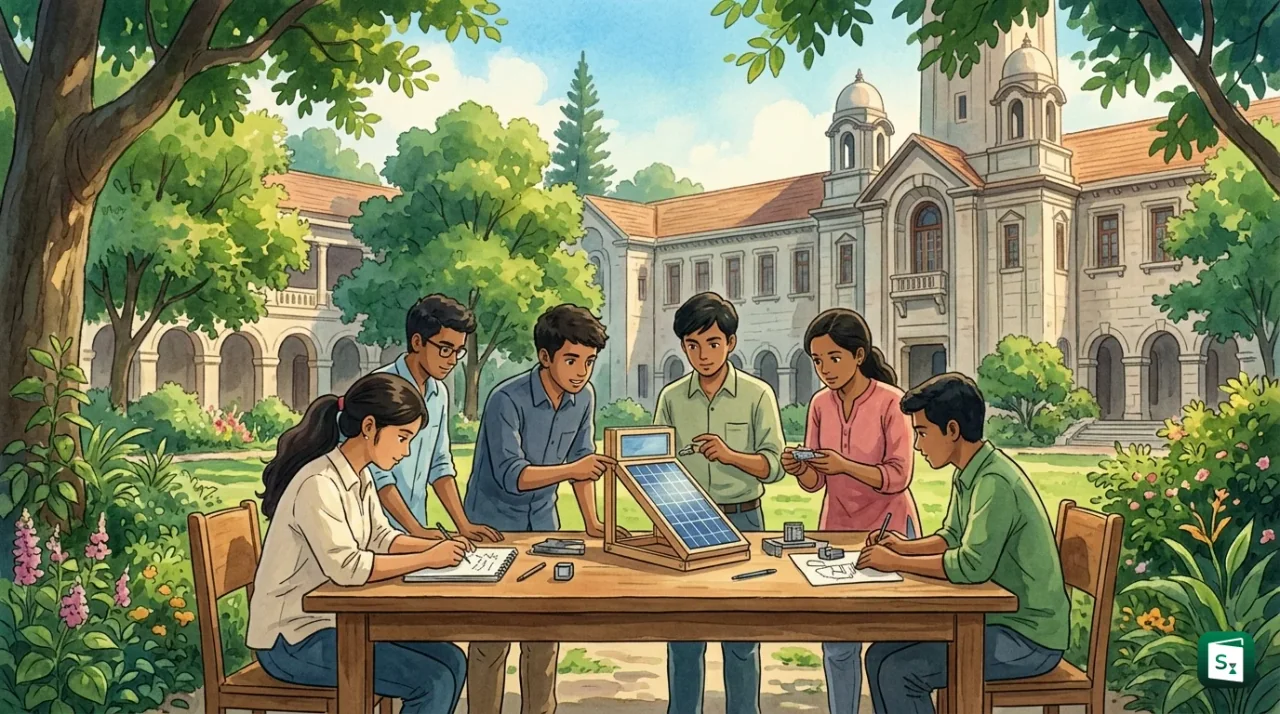
Union Education Minister Pralhad Joshi inaugurated the Seva First Innovation Challenge (SFIC) for the South Zone at the Indian Institute of Science (IISc), Bengaluru on 25 September 2026. He also launched the official website and registration portal at sevafirst.mic.gov.in. The challenge invites students and young innovators to spot everyday community problems and build practical solutions that can be tested and scaled.
What Is SFIC and What Does Seva Mean?
The Seva First Innovation Challenge (SFIC) is a national youth innovation programme of the Ministry of Education that asks students to identify local community problems and develop affordable and workable solutions. Seva means selfless service, so the challenge treats useful innovation for neighbours and society as a form of service.
The SFIC is organised jointly by the Ministry of Education with the All India Council for Technical Education (AICTE) and the University Grants Commission (UGC). AICTE oversees technical education in India, while UGC oversees universities and colleges. The official portal for this challenge is sevafirst.mic.gov.in, which is managed through the Ministry Innovation Cell ecosystem.
This portal is different from two similarly named service portals that often appear in search results. Seva Sindhu is the Karnataka state government service delivery portal for certificates and welfare services. Digital Seva Portal relates to Common Service Centres that deliver online government services in villages and towns. Neither of them is linked to the innovation challenge.
South Zone Launch at IISc Bengaluru
The Ministry of Education launched the South Zone edition of the Seva First Innovation Challenge 2026 at the J N Tata Auditorium in IISc Bengaluru on 25 September 2026. Union Education Minister Pralhad Joshi addressed students, faculty members, start ups and industry representatives at the event. He said innovation that starts from a real human need and ends in a practical solution becomes an act of seva.
The launch was attended by IISc Director Prof. Govindan Rangarajan, Additional Secretary in the Department of Higher Education Anandrao V. Patil and UGC Secretary Prof. Shyama Rath, along with directors and representatives of NITs and other institutions. The Minister also launched the SFIC website and registration portal to receive entries and build a national repository of ideas. He asked start ups and industry partners to mentor young innovators and help strong ideas move toward adoption and scale. He added that the strongest solutions from across India would be showcased at the National Finale in New Delhi in December 2026.
IISc Bengaluru will serve as the South Zone Nodal Institute. The institute, established in 1909 in Bengaluru through a partnership involving Jamsetji Tata, the Mysore State and the Government of India, is now an Institution of Eminence. For SFIC, it will handle technical evaluation and mentorship for the southern region.
| South Zone Coverage Under IISc Bengaluru | Details |
|---|---|
| States (5) | Karnataka, Tamil Nadu, Kerala, Andhra Pradesh, Telangana |
| Union Territories (3) | Puducherry, Andaman and Nicobar Islands, Lakshadweep |
| Nodal role | Technical evaluation, mentorship and regional coordination |
Five National Themes and Two Solution Tracks
The SFIC will bring together young innovators from schools, Industrial Training Institutes (ITIs), polytechnics, colleges and universities. Every entry must fit into one of five national themes and one of two solution tracks. The design pushes students to link a local problem they have seen, such as water waste in their street or crop loss in a nearby village, to a larger national priority.
| Five Themes of SFIC 2026 | Focus areas |
|---|---|
| Clean and Sustainable Bharat | Water, waste management, energy efficiency and environment |
| Prosperous Farmers, Prosperous Bharat | Agriculture, rural livelihoods and artisan incomes |
| Healthy and Inclusive Bharat | Health, nutrition, assistive technology and inclusion |
| Educated and Skilled Bharat | Education, skilling and sports |
| Secure Bharat | Manufacturing, mobility, safety and digital public infrastructure |
The two tracks separate the type of solution a team offers. Track A (Product or Technology Solution) covers a device, software system or engineering process. Track B (Business Model or Governance Solution) covers a new way to deliver a public service or organise finance and management for a community need. The aim is to take promising ideas beyond paper through mentoring, lab access, incubation and field testing.
Who Can Participate and How Registration Works
The challenge is open from Class 6 to research scholars. Participation is divided into three levels so that school children, vocational trainees and college researchers compete with peers of a similar stage.
| Participation Level | Who Is Eligible | Expectation |
|---|---|---|
| Junior | School students of Classes 6 to 12 | Simple working idea or model linked to a community need |
| Technical | Students of ITIs and polytechnics | Skill based fix or working prototype |
| Open | Undergraduate, postgraduate students and research scholars | Prototype or pilot with a clear path to use on the ground |
Registration and submission for SFIC 2026 remain open from 25 September to 24 October 2026. Entry is free. The process is institution led. Each school, ITI, polytechnic, college or university nominates a coordinator. The coordinator registers the institution on sevafirst.mic.gov.in, verifies the account through the email link, enters team details and selects the level, theme and track before submitting the entry with a short problem and solution note.
The challenge carries a total prize pool of ₹5.4 crore. Reports on the official portal mention top awards of ₹10 lakh, ₹5 lakh and ₹3 lakh in each category, along with mentorship, laboratory and fabrication access, and incubation and pilot support. The National Finale is scheduled in New Delhi from 10 to 17 December 2026, where the strongest zonal solutions will compete.
Link to NEP 2020 and Viksit Bharat 2047
The SFIC connects directly to the National Education Policy (NEP) 2020. NEP 2020 places critical thinking, creativity, experiential learning and problem solving at the centre of education. The challenge gives students a chance to experiment, build and learn by doing from an early age.
The Minister linked the effort to the goal of Viksit Bharat by 2047, the national mission for a developed India by the 100th year of Independence. He noted that nearly 65 percent of Indians are below the age of 35. This young and technology friendly population is seen as the main force for grassroots innovation.
The government pointed to the existing support system for such ideas. This includes more than 10,000 Atal Tinkering Labs in schools and about 17,300 Institutions Innovation Councils in colleges, along with programmes such as the Smart India Hackathon. SFIC is meant to use this network and guide student ideas toward mentoring, incubation and real use in communities.
Key Takeaways
- Union Education Minister Pralhad Joshi inaugurated the South Zone Seva First Innovation Challenge at IISc Bengaluru on 25 September 2026.
- The official registration portal for SFIC 2026 is sevafirst.mic.gov.in, with entries open from 25 September to 24 October 2026.
- IISc Bengaluru, established in 1909, is the South Zone Nodal Institute for five states and three Union Territories.
- SFIC 2026 has five national themes and two tracks, Track A for product or technology and Track B for business model or governance solutions.
- The National Finale will be held in New Delhi from 10 to 17 December 2026 with a total prize pool of ₹5.4 crore.