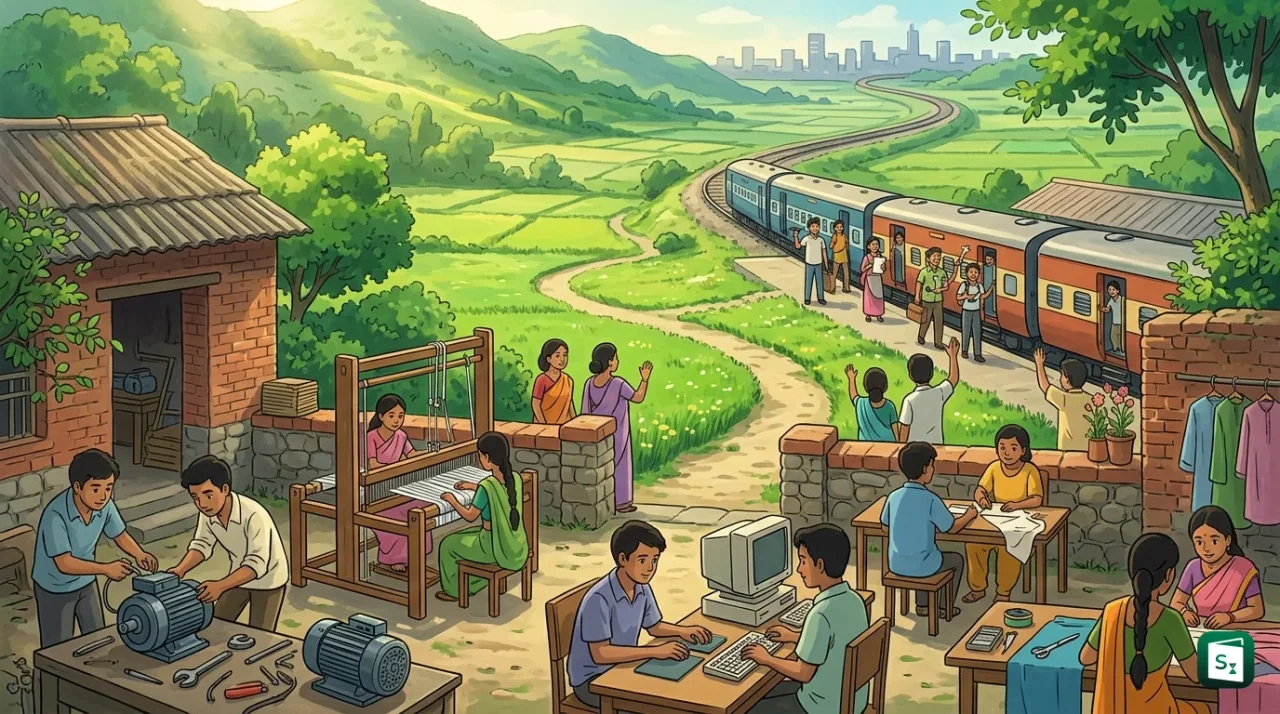
The Deen Dayal Upadhyaya Grameen Kaushalya Yojana (DDU-GKY) has completed 12 years of implementation in September 2026, with more than 18.47 lakh rural youth trained since its launch on 25 September 2014. The Ministry of Rural Development runs the scheme as the placement linked skilling arm of the Deendayal Antyodaya Yojana National Rural Livelihoods Mission (DAY-NRLM). The milestone matters because it marks a shift from one time training to six month assured placement, retention support and career growth under the new DDU-GKY 2.0 framework.
What Is DDU-GKY?
The Deen Dayal Upadhyaya Grameen Kaushalya Yojana (DDU-GKY) is a government placement linked skill training programme for poor rural youth. The Ministry of Rural Development launched DDU-GKY on 25 September 2014, observed as Antyodaya Diwas, as part of the National Rural Livelihoods Mission.
DDU-GKY is fully government funded and implemented as a Centrally Sponsored Scheme. It is not a private course. The Centre and states share costs, while training is delivered free to the candidate. Food, accommodation, uniform, course material and assessment costs are covered. The core promise is simple. Learn a skill and get a job that pays regular monthly wages at or above the minimum wage.
The scheme has its roots in the earlier Aajeevika Skills programme and the Special Projects component of the Swarnjayanti Gram Swarozgar Yojana (SGSY). DDU-GKY rebuilt that experience with a strict outcome rule. Training agencies get paid when candidates actually get placed and stay in work. That placement first design separates DDU-GKY from general skill courses.
DDU-GKY Under DAY-NRLM: Background and Parent Mission
The Deendayal Antyodaya Yojana National Rural Livelihoods Mission (DAY-NRLM) is the parent mission of DDU-GKY. The Ministry of Rural Development launched the National Rural Livelihoods Mission (NRLM) in June 2011 by restructuring SGSY. The programme was renamed as DAY-NRLM in 2016. It organises poor rural households into Self Help Groups (SHGs) and their federations and connects them to credit, livelihoods and entitlements.
DAY-NRLM works in mission mode across the country except Delhi and Chandigarh. It has mobilised more than 10.05 crore rural households into over 90.90 lakh SHGs and reached 7,145 blocks across 745 districts. Bank credit worth over ₹13.41 lakh crore has flowed to these SHGs through formal banks. This vast SHG network helps find poor youth, counsel families and support candidates after placement.
Inside this architecture, DDU-GKY handles skilled wage employment. A sister programme, Rural Self Employment Training Institutes (RSETIs), handles self employment. RSETIs are bank led district institutes that give free residential training to rural youth aged 18 to 50 years and help them start small enterprises. As of 2026, 647 RSETIs in 634 districts have trained 63.47 lakh candidates and settled 45.60 lakh, with about 94 percent in self employment. Together, DDU-GKY and RSETIs give rural youth two clear paths. A salaried job or an own enterprise.
Twelve Year Milestone: Training and Placement in Numbers
Twelve years after its launch, DDU-GKY operates in 31 States and Union Territories through 749 approved projects, more than 760 active training centres and over 455 Project Implementing Agencies (PIAs). PIAs are the training and placement partners. They can be companies, societies, trusts and, under DDU-GKY 2.0, self help group federations and captive employers who hire directly for their own units.
Since 2014-15, DDU-GKY has trained more than 18.47 lakh candidates across 36 sectors and over 800 job roles and placed over 12.43 lakh candidates. Women form a large share of this success. More than 9.71 lakh women were trained and over 6.34 lakh secured placements. The table below captures the scale as reported in September 2026.
| Indicator under DDU-GKY | Achievement since 2014-15 |
|---|---|
| Candidates trained | More than 18.47 lakh |
| Candidates placed | More than 12.43 lakh |
| Women trained | More than 9.71 lakh |
| Women placed | More than 6.34 lakh |
| Sectors covered | 36 sectors |
| Job roles offered | More than 800 roles |
| Active training centres | More than 760 centres |
| Project Implementing Agencies | More than 455 PIAs |
Top trades include apparel and textiles, retail, hospitality, construction, telecom, banking and financial services, automotive, healthcare, beauty and wellness, and logistics. Placement in the exact training domain is not compulsory. A candidate trained in one trade can take a verified job in another trade. What counts is regular wage, self or gig work that lasts the minimum placement period with proof such as salary slips and employer verification.
Who Can Apply? Eligibility, Age Limit and Social Inclusion
DDU-GKY is meant for rural youth aged 15 to 35 years from poor households. Identification is done through documents such as BPL or Antyodaya Anna Yojana cards, MGNREGA worker households with at least 15 days of work, Rashtriya Swasthya Bima Yojana cards and families of SHG members. The Kaushal Panjee Skill Register at kaushalpanjee.nic.in is the entry point. Candidates register, get a Kaushal Panjee ID (KPID) and are then mobilised by PIAs and State Rural Livelihoods Missions (SRLMs).
Social inclusion is mandatory, not advisory. Every project must ensure 50 percent coverage for Scheduled Castes and Scheduled Tribes, 33 percent for women, 15 percent for minorities and 5 percent for persons with disabilities. Special groups such as manual scavengers, victims of trafficking and transgender persons get priority. In Particularly Vulnerable Tribal Group areas the upper age limit extends to 45 years. This design ensures that benefits reach those with the weakest access to formal education and city based training.
Training is fully free. Apart from tuition and assessment, candidates receive uniform, boarding and lodging for residential courses, and post placement support. Placed candidates who move within the district, within the state or outside the state receive graded support for two, three and six months respectively. The idea is to reduce dropouts in the first months when rent, food and travel costs are highest.
Courses, Training Model and Training Centre Network
The DDU-GKY courses list spans employable trades that need short, practical learning rather than a college degree. Current offerings include aerospace and aviation, agriculture and food processing, apparel, beauty and wellness, construction, electronics, green jobs, healthcare, hospitality, logistics, plumbing, retail, telecom, textiles and IT enabled services. Courses follow Qualification Packs National Occupational Standards (QP-NOS) set with Sector Skill Councils, and certification is done through authorised assessors.
Course duration ranges from 3 months to 12 months. The minimum training load is 576 hours. A typical three month course has 396 hours of domain or technical training and 180 hours of compulsory non domain training. That non domain block has four fixed parts. English communication for 60 hours, employability and life skills for 60 hours, computer and digital literacy for 30 hours, and entrepreneurship for 30 hours. Longer courses scale up proportionally to 1,152 hours for six months and 2,304 hours for twelve months.
Training centres must meet SMART norms for classrooms, labs, residential space and faculty. Attendance is tracked through geo tagged and time stamped biometric systems, now upgraded to face authentication on the Kaushal Bharat portal. Candidates can search for a DDU-GKY training centre near their home on Kaushal Panjee, check the training centre list by state and district, and view PIA performance ratings. Certificates can be verified online, which helps employers trust the DDU-GKY certificate during hiring.
DDU-GKY 2.0 Guidelines: What Has Changed?
The DDU-GKY 2.0 guidelines were notified in May 2025 and apply from 1 April 2025 for financial year 2025-26. The revised framework keeps placement as the core outcome but moves from training numbers to durable employment. Funding is released in batch mode when milestones are met. PIAs must place at least 70 percent of trained candidates. Five percent of funds are kept for innovative projects, and a skill loan window supports high end training through empanelled agencies.
Longer Placement, Retention Support and Career Growth
Under the earlier rule, placement meant continuous work for at least 3 months. DDU-GKY 2.0 extends the minimum placement period to 6 months. It covers continuous and non continuous work and recognises wage employment, self employment and gig employment. Tracking continues for 12 months to check continuity.
Financial support has been strengthened to match this longer horizon. Placed candidates receive ₹7,620 in post placement support at ₹1,270 per month for six months. Those who remain employed for 365 days with a break of not more than 60 days receive additional retention support of ₹5,000. After 12 months of placement, candidates can access upskilling and reskilling to earn more and move up. Migration Support Centres, Job Melas and alumni networks back this journey.
Migration Support, Job Melas and Digital Monitoring
Many trained youth migrate to cities for work. State Rural Livelihoods Missions (SRLMs) therefore set up Migration Support Centres (MSCs) in home states and in destination clusters with many placed candidates. MSCs help with accommodation, counselling, employer links and settling into city life. Annual funding per centre has risen from ₹10 lakh to up to ₹30 lakh.
Job Melas at gram panchayat and block levels connect skilled youth with verified employers. Funding of up to ₹50,000 per panchayat fair and ₹1 lakh per block fair is available when 100 and 200 candidates are placed respectively. Outcomes are tracked for one year on Kaushal Panjee.
Technology now covers the full programme cycle. PIA onboarding, Project Registration Number generation, training centre management, candidate enrolment, assessment, payments and placement verification run on Kaushal Bharat with real time dashboards, a public candidate portal, automated grievance redressal and integration with the Skill India Digital Hub. Early rollout in 2025-26 shows momentum. Goa pioneered the first DDU-GKY 2.0 batches, Andhra Pradesh started training of more than 12,000 candidates in three months, and Jammu and Kashmir commenced training for 91 percent of its allocated target.
Special Focus: Roshni, Himayat and Regional Support
DDU-GKY 2.0 retains targeted interventions for difficult regions. Roshni serves Left Wing Extremism affected districts notified by the Ministry of Home Affairs. It mandates residential training and 40 percent coverage for women. The model has been extended to Aspirational Districts with focus on local infrastructure, health, education and traditional skills.
Himayat is the dedicated DDU-GKY scheme for Jammu and Kashmir and Ladakh. It covers rural and urban youth from both poor and non poor households and supports wage, self and gig work. Himayat is 100 percent centrally funded and run with state support through dedicated mission units.
Regional equity is built into finance. 10 percent of total DDU-GKY allocation is earmarked for North Eastern states. PIAs working in special areas such as the North East, Jammu and Kashmir, Himachal Pradesh, Uttarakhand, island territories and Left Wing Extremism districts receive an additional 10 percent special area allowance over base training cost. This offsets higher logistics and mobilisation costs.
The Way Forward
The Union Budget 2026-27 has allocated ₹750 crore to DDU-GKY, signalling continued priority for rural skilling. All 31 participating States and Union Territories have been given a combined target of more than 9 lakh candidates under DDU-GKY 2.0 for the two year period 2026-28. Duration flexibility, industry led courses in green jobs, care economy, logistics, retail and healthcare, and stronger post placement tracking are expected to improve retention.
The test for the next phase is clear. Training numbers are already large. Success will now be judged by how many rural youth stay employed after six months, how many women and disadvantaged groups move into regular wages, and how fast digital monitoring, employer partnerships and migration support turn a first job into a stable livelihood.
Key Takeaways
- DDU-GKY stands for Deen Dayal Upadhyaya Grameen Kaushalya Yojana and was launched on 25 September 2014 by the Ministry of Rural Development.
- DDU-GKY is the placement linked skilling arm of DAY-NRLM, which was launched in June 2011 and renamed in 2016.
- In 12 years DDU-GKY has trained more than 18.47 lakh candidates across 36 sectors and 800 job roles and placed over 12.43 lakh.
- The scheme covers rural youth aged 15 to 35 years with mandatory 50 percent SC/ST, 33 percent women and 5 percent persons with disabilities coverage.
- DDU-GKY 2.0 guidelines notified in May 2025 extend minimum placement from 3 months to 6 months and provide ₹7,620 post placement support plus ₹5,000 retention support.
- The Union Budget 2026-27 allocated ₹750 crore to DDU-GKY, with a target of more than 9 lakh candidates for 2026-28.