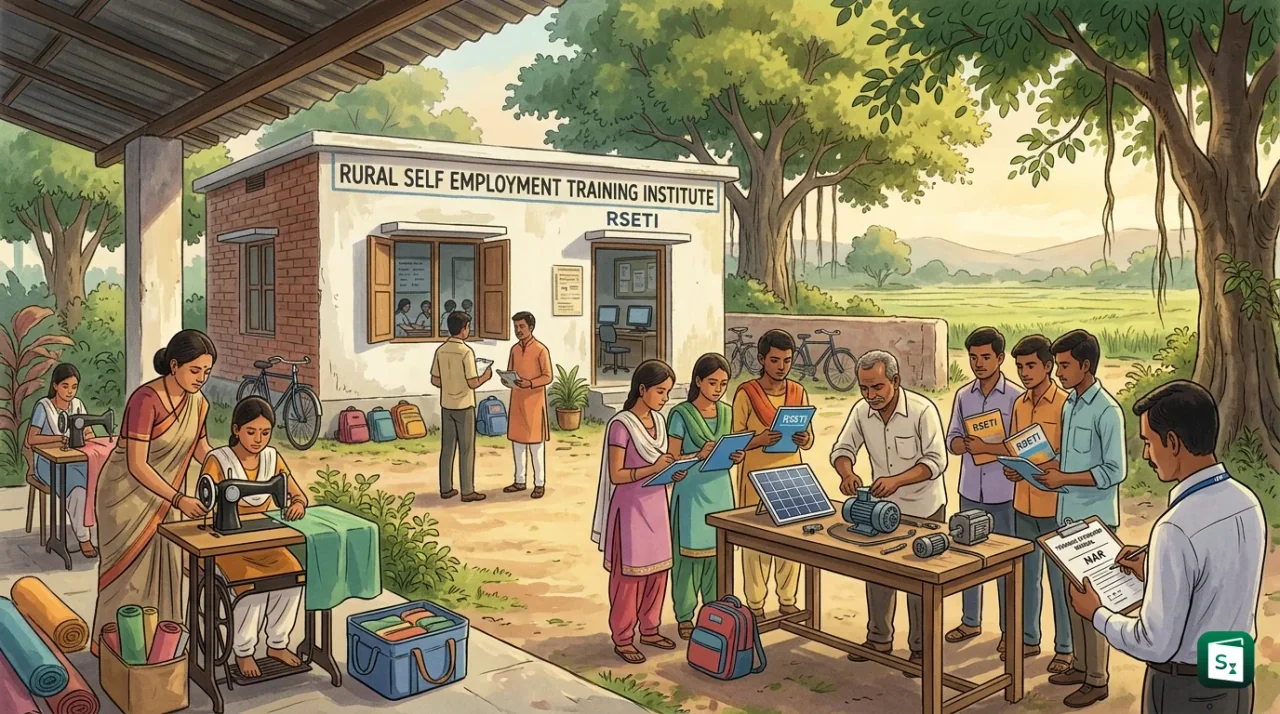
The Ministry of Rural Development and the National Academy of RUDSETI exchanged a Memorandum of Understanding on 12 October 2026 in New Delhi to bring every Rural Self Employment Training Institute in the country onto a single training standard. The agreement covers candidate registration, trainer certification and assessment, and comes with a training target of 6.35 lakh rural youth for the current year. For a network of 647 institutes run by different banks, the pact shifts the focus from counting buildings and budgets to measuring the quality of what is taught inside them.
What Did the Ministry of Rural Development and NAR Sign?
The Ministry of Rural Development signed an MoU with the National Academy of RUDSETI on 12 October 2026 to standardise training, quality administration and capacity building across Rural Self Employment Training Institutes. NAR is the apex resource organisation for the RSETI network and has mentored these institutes since a first agreement in 2011.
A Memorandum of Understanding is a written statement of intent between two parties. It is not a contract enforceable in a court of law in the way a commercial agreement is, and it usually does not create financial liability by itself. Its value lies in fixing responsibilities, timelines and reporting standards so that both sides know exactly who does what.
The document was exchanged between S. Sasikumar, Joint Secretary (Rural Skills) in the Department of Rural Development, and Raju N. Kori, Director General of NAR, in the presence of Rohit Kansal, Secretary, Department of Rural Development.
| Field | Detail |
|---|---|
| Agreement | Memorandum of Understanding on RSETI training standards |
| Date of exchange | 12 October 2026 |
| Place | New Delhi |
| Ministry signatory | S. Sasikumar, Joint Secretary (Rural Skills) |
| NAR signatory | Raju N. Kori, Director General |
| Witnessed by | Rohit Kansal, Secretary, Department of Rural Development |
| Coverage | All RSETIs sponsored by banks across States and Union Territories |
| Training target for the year | 6.35 lakh rural youth |
A Repeat Partnership, Not a First Agreement
This is not the first time the ministry has leaned on NAR to fix quality. On 29 July 2011, the ministry signed an MoU with NAR when only about 354 RSETIs were functional. Back then, each institute was expected to train at least 750 Below Poverty Line youth a year and reach a settlement rate of 50% in the first year, 60% in the second and 70% by the third.
That agreement also created the National Centre for Excellence of RSETIs (NACER) in 2011, headed by a National Director for RSETIs, to carry out intensive mentoring and monitoring. NAR was asked to develop common curriculum, quality audit tools, training aids and an online management information system. The 2026 agreement in effect renews that mandate for a much larger network, now with digital tools that did not exist fifteen years ago.
What Is an RSETI and How Does It Work?
A Rural Self Employment Training Institute is a bank-sponsored residential centre, one in each district, that gives free short-term skill and entrepreneurship training to unemployed rural youth. After the course, the institute helps the trainee prepare a project report and apply for a bank loan to start a micro-enterprise.
The full form of RSETI is Rural Self Employment Training Institute. The model was launched as a national scheme by the Ministry of Rural Development in January 2009. It was directly inspired by RUDSETI, a voluntary experiment started in Karnataka in 1982 that had produced settlement rates above 70%, far higher than most government training programmes of the time.
Each RSETI is sponsored by the lead bank of the district. The Lead Bank Scheme, introduced by the Reserve Bank of India in 1969, assigns one bank to coordinate banking and credit in every district. That bank sets up the RSETI, deputes an officer as its Director, and bears the running cost. The ministry pays a one-time grant of ₹1 crore for constructing the institute building, the State government provides land free of cost, and the training cost of eligible poor candidates is reimbursed.
| Feature | Position |
|---|---|
| Institutes operational | 647 |
| Districts covered | 634 |
| States and Union Territories | 33 |
| Sponsor banks | 25 |
| Eligibility age | 18 to 50 years |
| Cost to trainee | Free, including food and lodging |
| Course duration | One to six weeks |
| NSQF-aligned courses offered | 73 |
| Candidates trained since 2009 | 63.47 lakh |
| Candidates settled | 45.60 lakh |
How the RSETI Model Works
Training is residential, practical and short. A batch usually has 25 to 35 trainees, and every course carries entrepreneurship development inputs, roughly a quarter to a third of total content. Trainees learn a trade such as tailoring, food processing, dairy and poultry management, beauty care, mobile repair or computer basics, and alongside it they learn costing, marketing, bookkeeping and how to speak to a bank.
The distinctive part is what happens after the course. Each trainee prepares a business plan during training, and branch managers are invited to the institute so that loan applications can be filled on the spot. The RSETI then tracks the candidate for at least two years. A candidate counts as settled only if he or she is running a venture earning at least ₹5,000 a month for three continuous months, or has held a wage job for at least three months.
From Ujire in 1982 to a National Movement
The story begins in a small village in Dakshina Kannada district of Karnataka. In 1982, the Sri Dharmasthala Manjunatheshwara Educational Trust, Syndicate Bank and Canara Bank joined hands to start the first RUDSETI at Ujire, under the leadership of Dr. D. Veerendra Heggade, the Dharmadhikari of Sri Kshetra Dharmasthala.
The idea was simple. Rural youth who could not enter higher education were chasing scarce white-collar jobs. Instead of writing someone else’s account as a salaried employee, they could write their own by starting a small enterprise. Short residential training, discipline, handholding and a bank loan at the end would turn them into employers rather than job seekers.
The results drew attention. The Ministry of Rural Development studied the model and, in 2009, asked banks to replicate it in every lead district. RUDSETI itself now runs around 27 units and has trained several lakh youth, while the RSETI network it inspired has grown to 647 institutes.
As the network expanded, a new problem appeared. NAR was established in 2008 at Bengaluru as an apex training and research body for RUDSETI-type institutes. It was registered as a trust and jointly sponsored by the SDME Trust, Syndicate Bank and Canara Bank. In 2020, Syndicate Bank merged into Canara Bank, so the founding banking partnership now sits inside a single lender.
Inside the Agreement: What Changes on the Ground
The 2026 MoU works at four levels: who is enrolled, what is taught, who teaches it, and how learning is certified. Each of these has a direct effect on whether an RSETI certificate carries weight with a bank or an employer.
| Reform area | What the MoU requires | Why it matters |
|---|---|---|
| Enrolment | Registration through Kaushal Panjee with Aadhaar-based face authentication | Stops duplicate and ghost candidates |
| Course design | NSQF-aligned new-age courses and MoRD-notified core Entrepreneurship Development Programmes | Makes skills comparable across trades and districts |
| Training quality | Industry-benchmarked training aids and equipment; compliance with Common Norms | Raises the floor for poorly equipped institutes |
| Trainer quality | Structured Training of Trainers programmes | A good course fails without a capable trainer |
| Assessment | Standardised assessment and certification through the Unified Portal | Makes the pass standard uniform nationwide |
Kaushal Panjee and Aadhaar Face Authentication
Kaushal Panjee is the Rural Skills Division’s digital skill register, used to identify, mobilise and track rural youth for both RSETIs and the Deen Dayal Upadhyaya Grameen Kaushalya Yojana. Registration happens at the Gram Panchayat level, and the data is linked to the Socio-Economic and Caste Census of 2011 so that candidates from deprived households are prioritised.
Attendance will now be authenticated through the Aadhaar Enabled Biometric Attendance System, or AEBAS, using face authentication. This is the same principle already used in several skilling schemes: a candidate must be physically present to be marked present. For a programme that pays out on the basis of trainees trained, this removes an old leak.
NSQF-Aligned Courses and Common Norms
The National Skills Qualifications Framework was notified on 27 December 2013 and organises every qualification into ten levels, defined by learning outcomes rather than by how long a course runs. A trainee certified at a particular level can, in principle, move upward or sideways into another course or into formal education. Courses are approved by the National Skills Qualifications Committee.
The Common Norms, issued by the Ministry of Skill Development and Entrepreneurship, standardise training hours, funding per candidate, trainer eligibility and third-party assessment across all central skilling schemes. By binding RSETIs to both frameworks, the MoU makes an RSETI qualification legible outside the district where it was earned.
Training of Trainers and the Unified Portal
The agreement also strengthens Training of Trainers, the process by which RSETI directors and faculty are themselves trained and refreshed. NAR already runs trainer programmes on entrepreneurship development, counselling and business development services for micro-enterprises.
Assessment and certification will run through the Unified Portal at kaushal.rural.gov.in. Under the wider RSETI 2.0 reform, final assessment has moved to computer-based testing with question banks in regional languages, and certificates carry a unique identifier and QR code backed by blockchain, so a bank can verify a credential instantly before sanctioning a loan.
Why Uniform Standards Matter in a Bank-Run Model
The RSETI design has an unusual feature. The ministry sets policy and pays for training, the State government gives land, and the bank runs the institute. Because the same scheme is executed by 25 different banks, each with its own trust, its own staff rules and its own internal priorities, the quality of training drifted.
This was recognised early. When the first MoU was drafted in 2011, the ministry noted that institutes promoted by different banks were following different training norms, and that while banks monitored the finances closely, the quality of teaching was not being watched with the same attention. Settlement rates varied accordingly.
Uniform standards fix this in practical ways. A candidate in a remote district should not receive a weaker course than one in a better-funded district. An employer or a lending bank should be able to trust a certificate without knowing which bank sponsored the institute. And the ministry, which reimburses training costs, should be able to compare performance across institutes on a common yardstick rather than on 25 separate ones.
There is a governance gain as well. Face-authenticated attendance and a single portal mean that data on enrolment, attendance, assessment and settlement sits in one place. That allows the ministry to spot a persistently underperforming institute and act, instead of discovering the problem years later through an audit.
RSETI Within DAY-NRLM and India’s Wider Skilling Push
RSETIs are funded under the Deendayal Antyodaya Yojana National Rural Livelihoods Mission (DAY-NRLM), the ministry’s flagship poverty alleviation programme. DAY-NRLM was launched in June 2011 by restructuring the Swarnajayanti Gram Swarozgar Yojana, and was renamed to its present form in 2016. It works through four components: social mobilisation and community institutions, financial inclusion, livelihood promotion, and convergence.
The mission’s core method is to organise rural poor households, especially women, into Self Help Groups and then federate them. RSETIs sit on the livelihood promotion side of that architecture. They convert an SHG member or a BPL household youth into an entrepreneur who can borrow, produce and sell.
This is where RSETI differs from the ministry’s other major skilling scheme. DDU-GKY, launched on 25 September 2014, is placement-linked and aims at wage employment. RSETI aims at self-employment. The two are complementary, and a rural youth can enter either pathway through the same Kaushal Panjee register.
| Dimension | RSETI | DDU-GKY |
|---|---|---|
| Primary goal | Self-employment and micro-enterprise | Wage employment |
| Age group | 18 to 50 years | 15 to 35 years |
| Training type | Short residential, one to six weeks | Longer, placement-linked courses |
| Outcome measured | Settlement, tracked for two years | Placement and retention |
| Implementing partner | Sponsor bank | Project Implementing Agency |
| Current network | 647 institutes in 634 districts | 749 projects, over 760 training centres |
Both schemes also draw on the wider national framework created by the Skill India Mission, launched in 2015, and the National Policy on Skill Development and Entrepreneurship, 2015. The policy explicitly called for common norms so that courses funded by different ministries could be compared and quality could be assured.
From Certificate to Credit: The Enterprise Link
A training certificate is useful only if it unlocks money. RSETI’s design builds that link into the course itself, which is why the standardisation of certification has direct financial consequences.
A graduate with a verified, blockchain-backed certificate can approach a bank under Pradhan Mantri Mudra Yojana, which gives collateral-free loans to small non-farm enterprises, or under the Prime Minister’s Employment Generation Programme, which supports new micro-enterprises with subsidy-linked bank credit. Other routes include Stand Up India for Scheduled Caste, Scheduled Tribe and women entrepreneurs, PM Vishwakarma for traditional artisans, and PM SVANidhi for street vendors.
The outcomes suggest the approach works. Of the 45.60 lakh candidates settled so far, around 94% have set up self-employment ventures and about 6% have taken wage employment. Bank finance has been facilitated for more than 22 lakh beneficiaries. In effect, a modest training grant has been multiplied into a much larger flow of credit into rural enterprises.
What Challenges Remain, and the Way Forward
Standardising a network is easier on paper than in a district. Many RSETIs operate with a single Director and a small support staff, and the same officer is expected to mobilise candidates, run batches, maintain records and follow up with former trainees for two years. Adding digital attendance, computer-based testing and portal compliance to that workload can strain a thin team unless support staff are increased in proportion.
Connectivity is the second constraint. Most district headquarters and a large majority of villages now have 4G coverage, but a residential institute in a remote block can still lose connectivity during an assessment window. A fallback mechanism for offline capture, followed by later synchronisation, will decide whether the digital reform reaches the institutes that need it most.
The more fundamental question is about enterprise survival, not enrolment. Settlement is counted at the two-year mark, but many micro-enterprises in tailoring, food processing or dairy face weak demand, poor market linkage and informal competition. Training quality alone cannot fix that. Access to working capital, branding support and a reliable buyer are what keep a venture alive after the certificate is issued.
The direction of policy is clear. The ministry has raised the annual training target per institute from the older norm of 750 to about 1,000 candidates, expanded the course basket to 73 NSQF-aligned programmes, and set an overall target of 6.35 lakh rural youth for the year, higher than the target for 2025-26. The stated aim is to shift the RSETI ecosystem towards outcome-oriented monitoring, where quality of training and durability of settlement matter more than the number of batches conducted.
The clearest test is whether a certificate from a remote district is accepted without question by a bank, and whether the trainee is still earning from the enterprise two years later.
Key Takeaways
- The Ministry of Rural Development and the National Academy of RUDSETI exchanged an MoU on 12 October 2026 to standardise training across all RSETIs.
- The agreement was signed by S. Sasikumar, Joint Secretary (Rural Skills), and Raju N. Kori, Director General of NAR, in the presence of Secretary Rohit Kansal.
- RSETIs have been set a training target of 6.35 lakh rural youth for the current year, higher than the 2025-26 target.
- India has 647 RSETIs across 634 districts in 33 States and Union Territories, sponsored by 25 banks, which have trained 63.47 lakh candidates and settled 45.60 lakh.
- The MoU introduces Kaushal Panjee registration with Aadhaar face authentication through AEBAS, NSQF-aligned courses and certification on the Unified Portal.
- RUDSETI was founded in 1982 at Ujire, Karnataka, by the SDME Trust with Syndicate Bank and Canara Bank under Dr. D. Veerendra Heggade; its apex body NAR was set up in 2008.
- The National Skills Qualifications Framework was notified on 27 December 2013 and has ten levels; the first MoRD-NAR MoU was signed on 29 July 2011.
- RSETIs receive funding under DAY-NRLM, launched in June 2011 by restructuring the Swarnajayanti Gram Swarozgar Yojana.