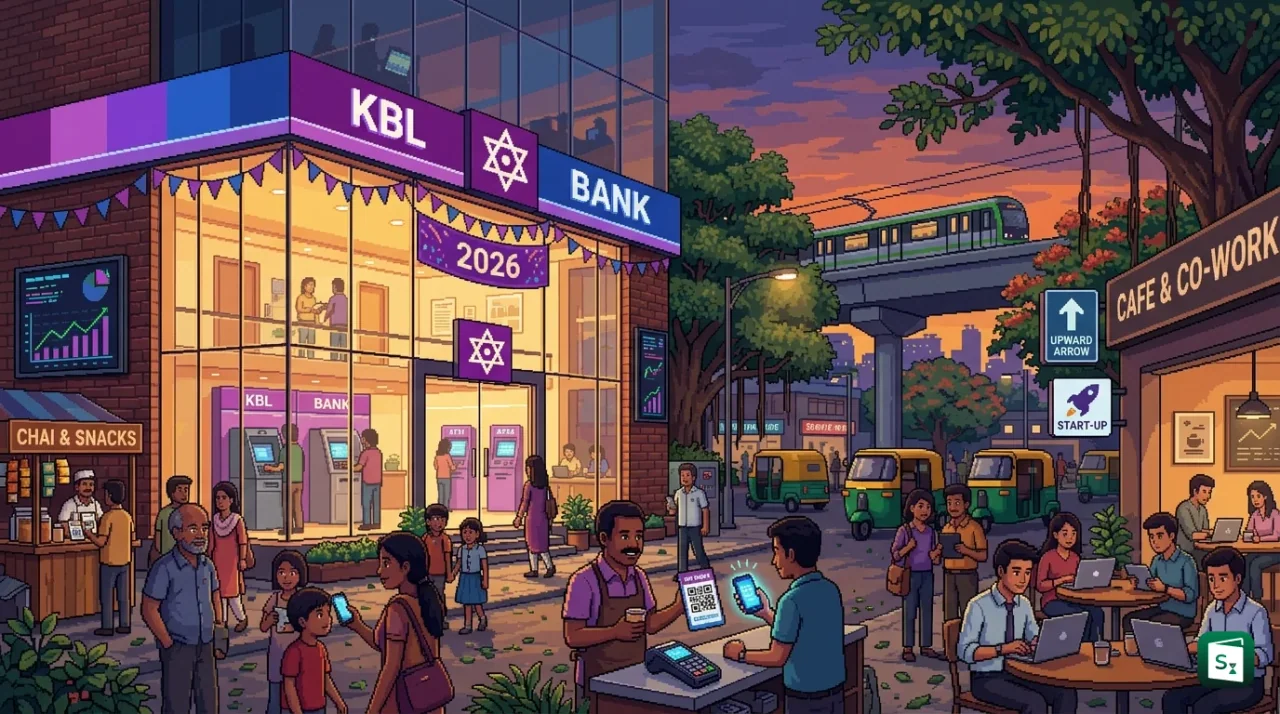
Karnataka Bank Ltd unveiled Nava Dhamaka 2026: Enhancing Banking Experience at its Bull Temple Road Office in Bengaluru on 15 October 2026. Managing Director and CEO Raghavendra S Bhat launched nine solutions spanning digital banking, investments, payments, customer engagement and lending. The package links the bank’s century old trust with faster digital payments, simpler service and fresh credit for startups and small firms.
What Is Nava Dhamaka 2026?
The Nava Dhamaka 2026 is Karnataka Bank’s 2026 product bundle to make banking faster, simpler and more digital. Karnataka Bank launched the bundle in Bengaluru on 15 October 2026 with nine solutions for trading, internet and mobile banking, UPI, digital rupee, institutional collections, lead handling and small business credit.
Karnataka Bank hosted the launch at its Bull Temple Road Office (BTRO) in Bengaluru. Managing Director and CEO Raghavendra S Bhat inaugurated the programme in the presence of senior executives, technology partners and regional officials. Former cricketer Brijesh Patel attended as a distinguished guest along with several long standing customers who shared their service experience.
The theme for Karnataka Bank is clear. The bank wants technology to cut paperwork, reduce branch visits and give customers safe digital options for saving, paying, investing and borrowing. The bank said the new tools will improve convenience, strengthen digital payment capacity, improve service delivery and support entrepreneurship.
Nine Solutions Across Digital Banking, Investments and Payments
Karnataka Bank grouped the nine launches into five work areas. These are investments, digital banking, payments, customer engagement and lending. The table below gives a quick view of each solution.
| Solution | What It Offers |
|---|---|
| Composite trading and wealth platform | Combines demat account access, brokerage and wealth management in one online window |
| Revamped Retail Internet Banking | New look and simpler navigation for Karnataka Bank internet banking users |
| Enhanced KBL Mobile Banking | Adds Soulabhya Plus Deposits and smoother FASTag services on KBL Mobile Plus |
| UPI for NRI customers | Unified Payments Interface (UPI) access for eligible NRE and NRO account holders |
| PIN-less CBDC payments | Small value payments on the Central Bank Digital Currency (CBDC) platform without entering a PIN |
| POS for religious institutions | Point of Sale (POS) machines and digital collection system for temples, mutts and trusts |
| AI Voice Bot for lead validation | Artificial Intelligence (AI) based voice calls to check and route new customer leads |
| Drop Line Facility under KBL Micromitra | Working capital support where the usable limit falls in steps as the business repays |
| KBL Startup Finance | Dedicated loan scheme for startups and new entrepreneurs |
Stronger Digital Banking and Service Delivery
Karnataka Bank internet banking, also known as KBL MoneyClick, now runs on a revamped retail platform. Internet banking lets customers use a browser to check balances, transfer funds, open deposits and pay bills without visiting a branch. The new design focuses on clean screens and fewer clicks. It also supports government collections such as direct tax and customs duty through internet banking.
KBL Mobile Plus is the bank’s mobile banking app for phones and tablets. The Nava Dhamaka upgrade adds Soulabhya Plus Deposits to the app journey. Soulabhya Plus is a term deposit where a customer can withdraw part of the money in multiples of ₹5,000 while the rest keeps earning the original interest rate. The minimum opening amount is ₹25,000 with a tenure of six months to 60 months. The app upgrade also improves FASTag services. FASTag is the sticker on vehicles that pays toll charges automatically from a linked account.
Smarter Payments for Everyday Use
Karnataka Bank extended UPI services to eligible Non Resident Indian customers holding Non Resident External (NRE) and Non Resident Ordinary (NRO) accounts. UPI is India’s instant phone based system that moves money between bank accounts using a virtual ID or QR code. The facility follows the national framework that lets NRIs with international mobile numbers link NRE and NRO accounts to UPI apps. It helps families receive support, pay bills in India and settle merchant payments without an Indian SIM.
The bank also introduced PIN-less transactions on the CBDC platform. CBDC, or the digital rupee (e rupee), is legal tender issued by the Reserve Bank of India (RBI) in digital form. Customers hold it in a CBDC wallet and pay by scanning QR codes. For small amounts, usually up to ₹500 per transaction within a daily cap, the wallet processes payment without a PIN. This saves time at shops and in crowded billing lines.
Karnataka Bank added a full POS solution for temples, mutts, trusts and other religious bodies. Devotees can donate by card, QR or UPI at counters. The back end records each collection. This brings clear audit trails and reduces cash handling for institutions that receive large festive footfalls.
How Will Lending and Customer Engagement Improve?
Karnataka Bank opened a composite online trading and wealth management platform under Nava Dhamaka 2026. A demat account, short for dematerialised account, holds shares and securities in electronic form instead of paper certificates. The new platform joins demat access and brokerage with wealth advice on mutual funds, bonds and deposits. A customer can view holdings, place orders and track goals from one login. This reduces the need to juggle separate apps for banking and investing.
Customer engagement gets support from an AI enabled Voice Bot for lead validation. When a person shows interest in a loan or deposit online, the bot calls back, confirms the need and passes a clean lead to the branch or sales team. This cuts missed calls and fake enquiries. Branch staff can then focus on serious requests. The system also helps the bank measure which campaigns bring real demand.
On the credit side, Karnataka Bank added two focused options. The Drop Line Facility under KBL Micromitra supports micro and small businesses that need working capital or funds for machines and vehicles. Micromitra is the bank’s loan window for micro enterprises with assistance that often ranges from ₹10,000 to ₹10 lakh. In a drop line structure, the sanctioned limit falls at fixed intervals, monthly, quarterly or yearly, in line with cash flow. The design builds repayment discipline while keeping withdrawals flexible in the early months.
KBL Startup Finance is a dedicated credit scheme for startups and emerging entrepreneurs. Startups are young firms built around new products, technology or scalable services. They often lack long profit records and collateral, which makes standard loans hard to access. A dedicated scheme gives them clearer eligibility, assessment based on business plans and cash projections, and closer mentoring from the bank. Karnataka Bank expects the scheme to support technology driven entrepreneurship and job creation in its branch catchment areas.
Is Karnataka Bank a Private Bank?
No, Karnataka Bank is not a nationalised bank. Karnataka Bank Ltd is a private sector scheduled commercial bank headquartered in Mangaluru, Karnataka. Karnataka Bank was incorporated on 18 February 1924 and began business on 23 May 1924, and its shares trade on the NSE and BSE.
Karnataka Bank is an A Class Scheduled Commercial Bank. Scheduled means the bank figures in the Second Schedule of the Reserve Bank of India Act, 1934. Karnataka Bank entered that list on 6 January 1958. The bank grew from South Canara roots during the freedom movement and later absorbed Sringeri Sharada Bank, Chitradurga Bank and Bank of Karnataka in the 1960s. Its tagline is Your Family Bank Across India.
Karnataka Bank runs more than 950 branches, over 1,100 ATMs and cash recyclers and hundreds of e lobbies across 22 states and two Union Territories (as of October 2026). The registered head office stands at Mahaveera Circle, Kankanady, Mangaluru. The Managing Director and CEO is Raghavendra S Bhat, a career officer who joined the bank as a clerk in 1981 and took charge as chief in July 2025. The bank has no single promoter holding above five percent, which keeps its board professionally run.
Why the Initiative Matters
Karnataka Bank completed a century in February 2024 and now chases a business turnover of ₹2 lakh crore. Old private banks face stiff competition from large private lenders and fast fintech apps. A joint launch of deposits, payments and credit shows that Karnataka Bank wants to grow low cost deposits, fee income from trading and POS, and quality retail and MSME loans at the same time. MSME stands for micro, small and medium enterprises, the small factories, traders and service firms that create most non farm jobs.
The payment choices fit national policy. The RBI pilots the digital rupee for retail use, while the National Payments Corporation of India (NPCI) extends UPI to NRI accounts with international mobile numbers. PIN-less small tickets and NRI access cut queues and bring more formal flows into bank accounts. The temple POS adds the same logic to donations, where transparency builds public trust.
The credit choices fill a clear gap. Micro units need small working limits without heavy paperwork. Startups need lenders who read business models instead of past balance sheets. Drop line limits and startup finance, paired with an AI voice system that filters leads, can speed up sanctions and improve follow up. For customers, the test will be simple. Fewer app failures, quick balance checks on KBL internet banking and KBL Mobile Plus, clear toll free support on 1800 425 1444 and 1800 572 8031, and fair loan pricing will decide if Nava Dhamaka becomes daily habit.
Key Takeaways
- The Nava Dhamaka 2026: Enhancing Banking Experience bundle was unveiled by Karnataka Bank Ltd in Bengaluru on 15 October 2026 with nine solutions.
- The launch at the Bull Temple Road Office was inaugurated by Managing Director and CEO Raghavendra S Bhat.
- Digital upgrades include revamped Karnataka Bank internet banking, enhanced KBL Mobile Plus with Soulabhya Plus Deposits, UPI for NRE and NRO holders and PIN-less CBDC payments.
- Institutional tools include a POS solution for temples, mutts and trusts and an AI enabled Voice Bot for lead validation.
- The credit push adds the Drop Line Facility under KBL Micromitra for micro enterprises and KBL Startup Finance for startups.
- Karnataka Bank, incorporated on 18 February 1924 and headquartered in Mangaluru, is a private sector A Class Scheduled Commercial Bank.