Bank of India went live with user level programmable Digital Rupee and auto issuance on its Central Bank Digital Currency platform on 29 September 2026 in Mumbai. The feature lets an account holder schedule automatic e₹ payments to a beneficiary CBDC wallet at a fixed amount and frequency while fixing the purpose for which the money can be spent. The technology was built by Montran India in line with Reserve Bank of India and National Payments Corporation of India guidelines.
What Is CBDC and Digital Rupee?
The Central Bank Digital Currency (CBDC) is the digital form of Rupee issued by the Reserve Bank of India. Called Digital Rupee or e₹, it carries the same value as physical cash and is held in a CBDC wallet. It supports person to person and merchant payments like notes.
CBDC is the short form for Central Bank Digital Currency. In India, the official names used for it are Digital Rupee, electronic rupee, e rupee and e₹. All these terms mean the same thing. The Reserve Bank of India, which was set up in 1935 and is headquartered in Mumbai, creates the e₹ and issues it to banks electronically.
The design follows a two level system. The Reserve Bank creates the digital tokens. Banks and approved non bank operators then load them into customer wallets and handle onboarding. This is similar to how physical notes move from the central bank to banks and then to the public. The wallet shows e₹ in familiar denominations like ₹10 and ₹100, and it automatically returns change during a payment.
How Does Bank of India Programmable CBDC Work?
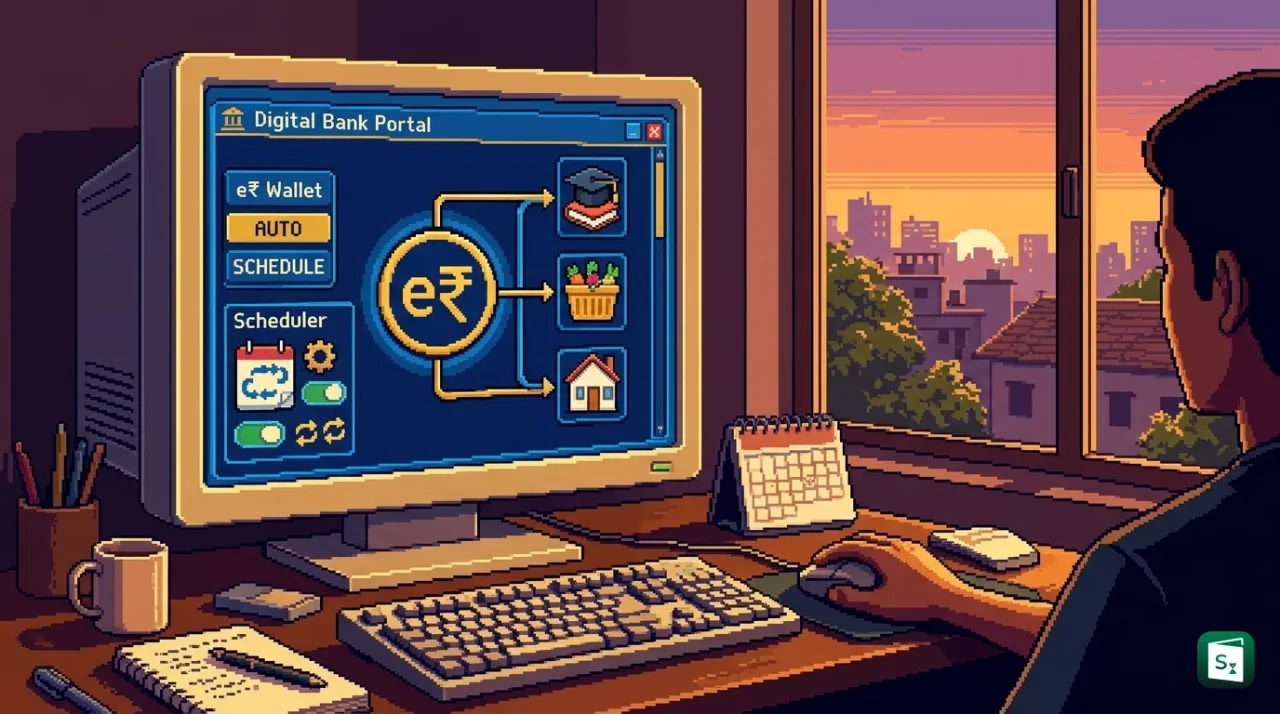
Bank of India allows an account holder to create a rule once for a recurring payment. The account holder selects a beneficiary CBDC wallet, fixes an amount and frequency such as every month, and sets the allowed purpose. The Bank of India system then issues the e₹ automatically on due dates without fresh approval each time.
Programmable money means conditions travel with the money itself. The Bank of India platform can lock the funds to approved merchant categories, a specific merchant payment address, a geographic area, or a validity period with an expiry date. Real time checks at the time of payment confirm whether the shop or service matches the rule. If the condition is not met, the transfer does not go through.
A working example is a parent in Mumbai supporting a student in another city. The parent can set a monthly education allowance of a fixed sum that can be spent only on tuition and meals. The student receives the e₹ in the Bank of India Digital Rupee wallet and the app clearly shows the attached conditions. The parent does not need to repeat the same transfer every month and retains control over end use.
The technical functionality for the Bank of India solution was developed by Montran India. Montran India built the user level programmability layer and the auto issuance engine inside the bank CBDC channel. Bank of India General Manager and Chief Technology Officer Ashutosh Mishra said the design removes repeated manual steps and gives customers greater flexibility. Montran India Chief Executive Officer Julie Esca said programmability changes the digital rupee from a simple payment tool into an instrument that can carry usage rules.
What Is a CBDC Wallet and How to Use Digital Rupee?
The CBDC wallet is an app wallet that stores Digital Rupee like a purse stores notes. Bank of India Digital Rupee and other e rupee apps work on Android and iOS. Users link a savings account, load e₹, and pay merchants by scanning CBDC or UPI QR codes.
The Bank of India customer downloads the Bank of India Digital Rupee app from the Play Store or App Store and registers with a linked savings account. This link helps with quick onboarding because separate fresh KYC is not needed. For special programmable cases such as Direct Benefit Transfer beneficiaries and corporate use, onboarding through mobile or Aadhaar authentication is also allowed without making a savings account compulsory.
The Reserve Bank permits e₹ transactions round the clock, 24 hours a day and 7 days a week. There is no minimum balance to keep the wallet open. There are no charges for using e₹, and no interest is paid on wallet balances because e₹ is designed to work like cash. If the phone is lost, the wallet can be recovered on a new device using the same phone number and SIM.
Bank of India wallet users can send money person to person and pay person to merchant. Payments at a CBDC QR move directly between two e₹ wallets and settle instantly without passing through bank accounts. The e₹ app can also scan a UPI QR at shops, and in that case settlement follows UPI timelines. Interoperability of this kind means a merchant does not need two separate acceptance systems.
Is CBDC Legal Tender and How Is It Different From UPI?
Is CBDC Legal Tender in India?
The Digital Rupee is legal tender in India under Section 26 of the Reserve Bank of India Act, 1934. The Reserve Bank guarantees every e₹ note like a paper note. The e₹ is a direct liability of the Reserve Bank and is exchangeable at par with physical cash.
This legal position separates e₹ from all private options. Cryptocurrencies such as Bitcoin are decentralised and are not issued by any central bank. They are not legal tender and their value changes with market trading. Stablecoins and tokenised deposits are claims on private issuers. The e₹ carries sovereign backing.
How Is CBDC Different From UPI?
The Digital Rupee is money itself while Unified Payments Interface (UPI) is a system to move money. The e₹ can be withdrawn from a bank account and held separately in a wallet as a store of value. UPI only sends instructions to shift bank deposits between accounts.
The table below captures the practical difference for daily use.
| Feature | Digital Rupee (e₹) | UPI | e-RUPI voucher |
|---|---|---|---|
| What moves | Central bank token, the token is the money | Instruction to move bank deposits | Prepaid voucher redeemed over UPI rails |
| Issued by | Reserve Bank of India | Payer bank through NPCI switch | Sponsor bank with prefunded value |
| Settlement between CBDC wallets | Instant and final on transfer | Through bank clearing as per UPI timelines | On voucher redemption |
| Needs bank account | Not always, Aadhaar or mobile onboarding possible for benefit cases | Yes, bank account must be linked | No, QR or SMS string is enough |
| Programmable at money level | Yes, purpose, geography and expiry can be coded | No, limits sit at account or app level | Purpose bound but only at voucher level |
The Reserve Bank has clarified a second confusion around the name e-RUPI. The e-RUPI system, introduced on 2 August 2021, is a person specific and purpose specific prepaid voucher sent by QR code or SMS. It works on UPI rails and does not need a bank account, but it is not central bank money. Programmable e₹ is different because the conditions sit inside legal tender itself.
India’s CBDC Pilot and Institutional Framework
The Reserve Bank started the wholesale pilot for e₹-W on 1 November 2022 for settlement of secondary market deals in government securities. The retail pilot for e₹-R followed on 1 December 2022 in closed user groups of customers and merchants. Both pilots remain limited and controlled rollouts to test technology, safety, scale and public acceptance before any full launch.
The Reserve Bank operates a two tier model. The Reserve Bank creates e₹ and passes it electronically to pilot banks and approved non banks. The banks open wallets, manage tokens through issuance, loading and redemption, and run customer support and dispute handling. The National Payments Corporation of India, set up in 2008 and headquartered in Mumbai, provides the settlement rails and QR interoperability framework for retail payments.
The retail and wholesale segments serve different needs.
| Aspect | Retail CBDC (e₹-R) | Wholesale CBDC (e₹-W) |
|---|---|---|
| Users | Public, merchants, benefit recipients | Banks, primary dealers and financial institutions |
| Purpose | Daily payments, welfare transfers, purpose bound allowances | Interbank settlement, reduced settlement risk |
| Current use cases | Wallet transfers, programmable Direct Benefit Transfer, offline NFC payments | Government securities settlement, call money market, tokenised certificates of deposit and corporate bonds |
| Access | Mobile wallet apps on Android and iOS | Restricted institutional platform |
Bank of India is one of 19 pilot banks offering CBDC wallets (as of October 2026). The Bank of India was founded on 7 September 1906 in Mumbai and was nationalised on 19 July 1969 along with 13 other banks. The Bank of India is headquartered at Bandra Kurla Complex in Mumbai, and Rajneesh Karnatak is its Managing Director and Chief Executive Officer (as of September 2026). The bank operates more than 5,200 branches and is a founding member of SWIFT.
| Pilot Bank | Digital Rupee App Name |
|---|---|
| Bank of India | Bank of India Digital Rupee |
| State Bank of India | eRupee by SBI |
| HDFC Bank | HDFC Bank Digital Rupee |
| ICICI Bank | Digital Rupee by ICICI Bank |
| Axis Bank | Axis Mobile Digital Rupee |
| Yes Bank | YES PAY Next and Digital Rupee section |
| Punjab National Bank | PNB Digital Rupee |
| Bank of Baroda | Bank of Baroda Digital Rupee |
| Union Bank of India | Digital Rupee by UBI |
| Canara Bank | Canara Digital Rupee |
The pilot has grown in stages. The Reserve Bank widened programmable use on 30 August 2024 to cover fuel, groceries, education, dining, healthcare and travel. HDFC Bank introduced user level programmability on 29 August 2024. In April 2024 the Reserve Bank allowed non bank payment firms to offer wallets, and Cred became the first financial technology platform to offer e₹ access with Yes Bank as the issuing partner. Retail users crossed 6 million by end March and reached about 7 million by October 2025, while circulation stood at ₹1,016 crore in March 2025. Food subsidy transfers using programmable tokens were tested in Gujarat, Puducherry and Chandigarh, and tokenised certificates of deposit were settled through the Unified Markets Interface using wholesale e₹.
Significance and Way Forward
Bank of India puts control of purpose bound money in the hands of ordinary users for the first time at scale. Earlier programmability in India was driven mainly by the government or a company for subsidies and employee benefits. The Bank of India model allows a family, a small firm or a local body to set its own rules for allowances, fees and vendor payments. This can reduce misuse, cut follow up work, and create a clear audit trail because every spend can be checked against the original purpose.
The gain for public delivery is direct. Subsidies for food, fertiliser, fuel and scholarships can be locked to approved shops and given an expiry date so funds cannot be diverted to cash or unrelated use. The Reserve Bank annual report for 2025 to 2026 places such Direct Benefit Transfer work at the centre of next expansion along with business applications. The offline feature using Near Field Communication helps in areas with weak internet because two devices can complete a tap and pay without live connectivity. Cross border pilots under Project Rialto and Project Mandala of the Bank for International Settlements Innovation Hub test whether the same finality can lower cost and delay in foreign transfers.
Limits remain. UPI is free, instant and widely accepted, so many users see little reason to load a separate wallet for simple shop payments. Merchant acceptance for programmed tokens is still patchy. Privacy questions need careful handling because traceable and conditional money can raise fears of tracking. Cyber safety, dispute resolution when a beneficiary cannot spend as intended, and awareness in rural areas will decide actual use.
The path ahead is phased testing rather than a nationwide launch. The Reserve Bank has said it is in no hurry for a full rollout and will focus in 2026 to 2027 on cross border pilots, more welfare schemes, tokenised assets through the CBDC and Asset Tokenisation Sandbox, and interoperability with BHIM and UPI QR codes. For Bank of India, success will be measured by repeat use of auto issuance for school fees and allowances, clear category lists in its app, and smooth handling of expiry and refunds.
Key Takeaways
- Bank of India went live with user level programmable CBDC and auto issuance on 29 September 2026, with technology built by Montran India.
- Digital Rupee (e₹) is India’s Central Bank Digital Currency issued by the Reserve Bank of India and is legal tender under Section 26 of the RBI Act, 1934.
- Programmable e₹ can be locked by expiry date, geography, merchant category code and merchant payment address, with rules travelling with the money.
- Retail pilot e₹-R started on 1 December 2022 and wholesale pilot e₹-W started on 1 November 2022, with 19 pilot banks offering wallets.
- Bank of India was founded on 7 September 1906, nationalised on 19 July 1969, and is headquartered at Bandra Kurla Complex, Mumbai.
- e-RUPI, launched on 2 August 2021, is a prepaid voucher on UPI rails and is different from e₹, which is sovereign central bank money.