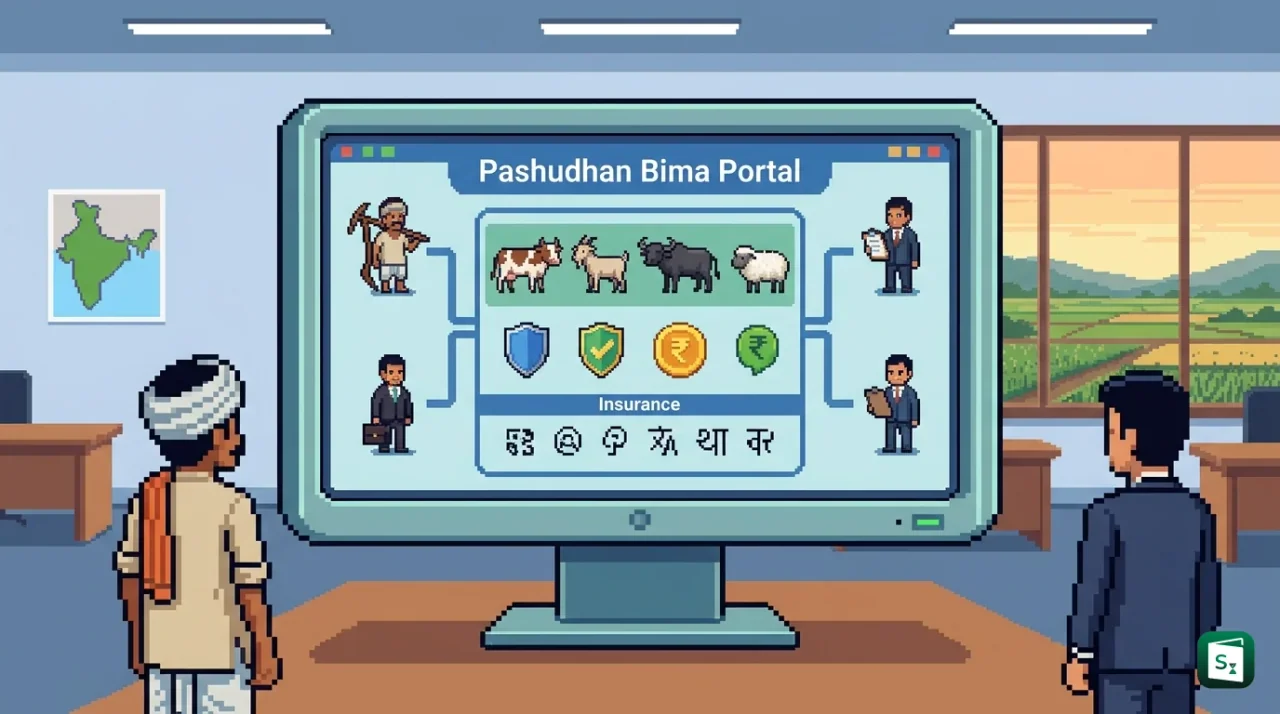
Union Minister Rajiv Ranjan Singh launched the Livestock Insurance Portal, also called the Pashudhan Bima Portal, on 28 September 2026 in New Delhi. The Department of Animal Husbandry and Dairying developed the portal under the Livestock Insurance activity of the National Livestock Mission to bring farmers, state governments, insurers and implementing agencies on one digital platform. With access in Hindi, English and 11 regional languages, the portal aims to make cattle insurance and cow insurance simpler, faster and more transparent for rural households.
What Is Livestock Insurance?
Livestock insurance is a financial protection policy for farm animals against death due to disease, accidents and natural calamities. The National Livestock Mission reimburses most of the premium so the farmer pays only 15 percent. The insured animal must be tagged, examined by a veterinarian and valued at market price.
Livestock refers to farm animals kept for milk, meat, wool, draught work or breeding. These include cows, buffaloes, goats, sheep, pigs, rabbits, horses, donkeys, mules, camels, yaks and mithun. For millions of small and landless farmers, these animals are savings on legs. When an animal dies, the family loses both daily income and a valuable asset.
The Pashudhan Bima Yojana, which is the Livestock Insurance activity under the National Livestock Mission, protects owners from that shock. The policy pays the agreed sum insured if the tagged animal dies during the cover period. The sum insured is the current market price fixed jointly by the owner and the insurer in the presence of a veterinary doctor. The minimum value follows local market rates, often linked to milk yield for cows and buffaloes.
What Does the New Pashudhan Bima Portal Do?
The Department of Animal Husbandry and Dairying launched the Livestock Insurance Portal at https://rashtriyapashubima.dahd.gov.in on 28 September 2026 in New Delhi. The portal was launched by Rajiv Ranjan Singh, Union Minister for Fisheries, Animal Husbandry and Dairying and Panchayati Raj, in the presence of Minister of State S. P. Singh Baghel and Secretary Naresh Pal Gangwar. More than 4,000 participants from state governments, insurance companies and field agencies joined the launch online.
The portal creates an end to end digital ecosystem for livestock insurance. Earlier, farmers, state agencies and insurers handled enrolment, premium payment and claims through separate offline steps. The new system places registration, policy issue, premium management, claim processing, beneficiary verification and monitoring on one transparent interface. Farmers can now submit applications online and track each stage digitally, while officials can see real time data for better decisions.
| Portal Function | What It Means for Users |
|---|---|
| Online registration and policy issuance | Farmers apply with tag number and get cover after veterinary examination and premium payment |
| Premium management | Farmer share and Centre and state shares are recorded and routed to the insurer in one workflow |
| Claim processing and verification | Death intimation, post mortem report and policy papers are uploaded and checked digitally |
| Real time tracking and monitoring | Farmers, insurers and state agencies can follow policy and claim status without repeated visits |
| Multilingual access | Services and information are available in Hindi, English and 11 regional languages |
The Department expects the portal to cut delays in enrolment, improve accountability in claim settlement and make business easier for insurers. The platform also strengthens data records on insured animals, which helps in planning health camps, vaccination and breed improvement.
How Does Livestock Insurance Work?
Livestock insurance work starts with identification and ends with claim payment. The farmer registers a healthy animal with a valid ear tag. A registered veterinary practitioner examines the animal, confirms its health and helps fix its market value. The farmer then pays only the beneficiary share of the premium to the insurer or its agent. The policy cover starts once these formalities are complete and the premium is received.
The policy covers death due to disease including contagious outbreaks, accidents and natural calamities such as floods, lightning, cyclones, drought and earthquakes. Cover can also extend to permanent total disability if that option is chosen with extra premium, though state level rules under the National Livestock Mission focus mainly on death claims. Deaths in the first 15 days from non accidental causes, theft, wilful injury, slaughter without veterinary or legal approval, and transport beyond permitted distance are not covered. Animals must have completed the required vaccination for diseases like foot and mouth disease, anthrax and sheep pox, with certificates produced at claim time.
| Animals Covered | Examples |
|---|---|
| Milch animals | Indigenous and crossbred cows and buffaloes |
| Pack and draught animals | Horse, donkey, mule, camel, pony and male cattle and buffalo |
| Small animals | Goat, sheep, pig, rabbit, yak and mithun |
The question of cattle insurance cost and cow insurance price matters most to small farmers. The gross premium for a one year policy is generally around 4.3 percent of the sum insured in normal areas. The farmer pays only 15 percent of that premium. The rest is paid by governments. There is no goods and services tax on the premium under the scheme, which lowers the cost further. Policies can be taken for one, two or three years, with premium rates rising for longer terms.
Claim settlement is designed to be simple. Only a few papers are needed, mainly the insurance policy, the claim form, the ear tag and the post mortem report from a veterinarian. State guidelines require payment through direct benefit transfer to the Aadhaar linked bank account, often within 15 days of complete documents. If the insurer delays beyond the limit, penal interest applies.
National Livestock Mission: Scheme Framework and Subsidy Support
The National Livestock Mission is a centrally sponsored scheme with an outlay of ₹2,300 crore. The Department of Animal Husbandry and Dairying has run the scheme since 2014-15. The scheme was recast in 2021-22 to push jobs and entrepreneurship in small livestock and fodder. The scheme was further changed on 21 February 2024 to add breed improvement of camels, horses and donkeys and fodder growth on wastelands and degraded forest land.
The Mission has three sub missions. The Sub Mission on Breed Development of Livestock and Poultry supports rural poultry farms and sheep, goat, piggery and equine breeding units. The Sub Mission on Feed and Fodder Development strengthens fodder seed chains and fodder block, hay baling and silage units. The Sub Mission on Research and Development, Livestock Insurance, Extension and Innovation funds research, awareness, training and the insurance activity. The Small Industries Development Bank of India (SIDBI) channels capital subsidy for entrepreneurship projects through scheduled banks.
The Livestock Insurance activity runs in all districts. In March 2024 the Department made two farmer friendly changes. The beneficiary share was cut from a slab of 20 to 50 percent based on poverty and social category to a flat 15 percent for all. The subsidised limit was raised from 5 cattle units to 10 cattle units per household. Pigs and rabbits remain capped at 5 cattle units. One cattle unit means one large animal or ten small animals such as goats or sheep, so a family can protect up to 10 cows or buffaloes or up to 100 goats within the limit.
| Region | Farmer Pays | Centre Pays | State Pays |
|---|---|---|---|
| General states | 15 percent | 51 percent (60 percent of balance 85 percent) | 34 percent (40 percent of balance 85 percent) |
| Himalayan and North Eastern states | 15 percent | 76.5 percent (90 percent of balance 85 percent) | 8.5 percent (10 percent of balance 85 percent) |
| Union Territories | 15 percent | 85 percent | Nil |
In the past five years the Centre released about ₹161.07 crore under the activity and insured about 60.80 lakh animals. The portal now aims to raise that coverage by removing paperwork hurdles and giving insurers and states a common dashboard.
Digital Ecosystem: From Pashu Aadhaar to Insurance Portal
The Pashudhan Bima Portal does not stand alone. It sits within a wider digital push for animal husbandry led by the Department of Animal Husbandry and Dairying and the National Dairy Development Board, which is headquartered in Anand, Gujarat and was established in 1965.
The National Digital Livestock Mission creates a farmer centred database called Bharat Pashudhan. Field veterinarians use a mobile app to record breeding, artificial insemination, vaccination, treatment and milk recording. Each animal gets a 12 digit bar coded ear tag called Pashu Aadhaar. The tag acts as a single key for all records. By late 2025 more than 35.68 crore Pashu Aadhaar tags had been generated and over 84 crore transactions had been logged.
This base makes insurance safer. When insurance records link to Pashu Aadhaar, the same animal cannot be insured twice and its health and vaccination history can be checked during a claim. Farmers can also see their animal details on the 1962 Livestock Owner App and call the toll free number 1962 for mobile veterinary units at the doorstep. The National Livestock Mission portal for entrepreneurship at nlm.udyamimitra.in already runs end to end online subsidy through the Small Industries Development Bank of India. The new insurance portal completes that chain for risk protection.
Why the Portal Matters for Rural Livelihoods
Livestock gives daily cash from milk, eggs and wool and helps families survive crop failure. Most animals are held by small, marginal and landless keepers spread across villages. A single death from lumpy skin disease, floods or heat stress can push such a family into debt. Affordable insurance keeps that risk from becoming a lasting loss.
The portal helps on four fronts. Farmers gain easy online entry and status tracking in a familiar language. Insurers gain verified tag data and faster premium flow. State implementing agencies gain clean records for audits and planning. The Centre gains national data to target funds and check delays. At the launch, the Minister stressed wide publicity through social media and information campaigns so that more keepers learn about the 15 percent premium and the higher 10 unit limit.
The task ahead is awareness and last mile linkage. Field staff will need to connect Bharat Pashudhan records with insurance policies, ensure timely ear tagging and veterinary certificates, and train farmers to report death and file claims quickly. If states, insurers and village functionaries use the common dashboard well, the portal can lift insurance coverage, speed up payments and make livestock a more secure source of rural income.
Key Takeaways
- The Pashudhan Bima Portal was launched on 28 September 2026 in New Delhi by Union Minister Rajiv Ranjan Singh under the National Livestock Mission.
- The portal at rashtriyapashubima.dahd.gov.in handles policy issue, premium, claims and monitoring in Hindi, English and 11 regional languages.
- Farmers pay only 15 percent of the premium while the Centre and states share the remaining 85 percent in 60:40 and 90:10 ratios.
- Subsidy is available for up to 10 cattle units per household, where 1 cattle unit equals 10 small animals, with pigs and rabbits capped at 5 units.
- The National Livestock Mission, running since 2014-15 with a ₹2,300 crore outlay, has insured about 60.80 lakh animals in five years.
- Each animal is identified by a 12 digit Pashu Aadhaar ear tag under Bharat Pashudhan, with over 35.68 crore tags generated for linked health and insurance records.