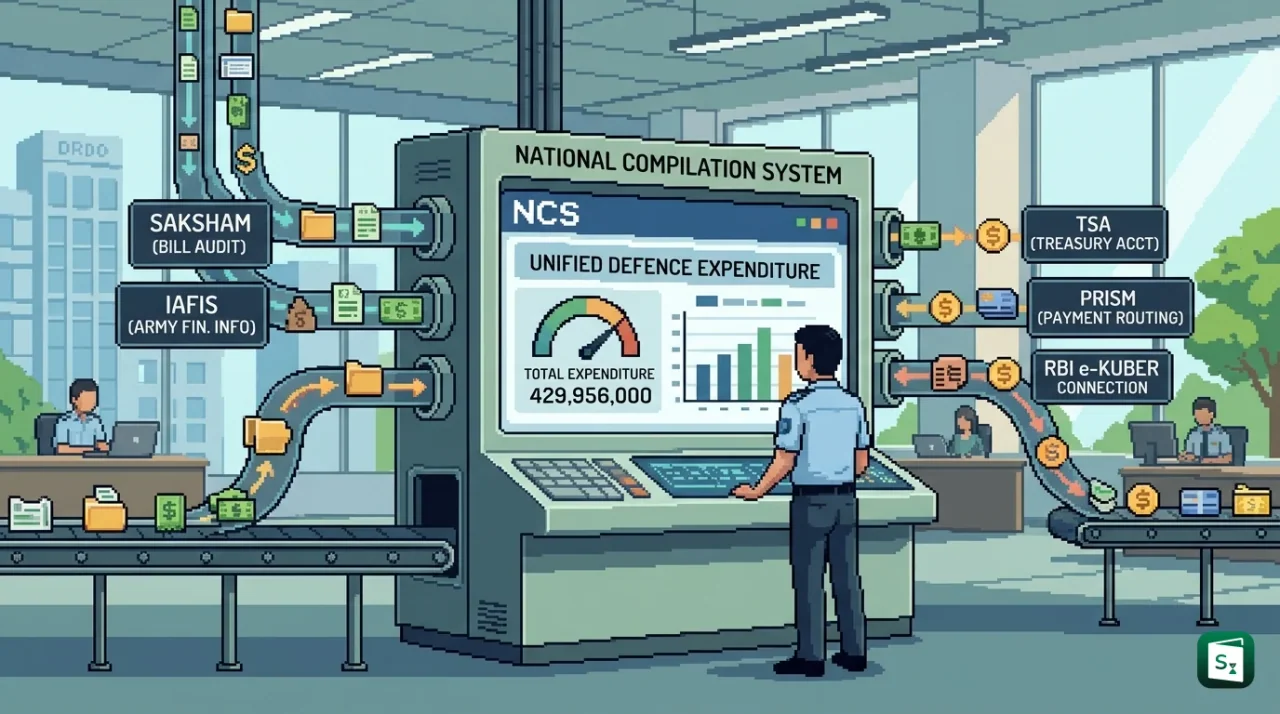
Defence Minister Rajnath Singh launched three digital finance initiatives at the 279th Annual Day of the Defence Accounts Department (DAD) held on 1 October 2026 at DRDO Bhawan in New Delhi. The announcements link the Department’s SAKSHAM payment system with the Army’s financial system, route funds for defence autonomous bodies through a Treasury Single Account on PRISM and RBI e-KUBER, and rebuild the National Compilation System as a single record of defence spending. Together they push paperless bills, just in time fund release and real time tracking of India’s nearly ₹7.85 lakh crore defence budget.
Three Initiatives Launched on the 279th Annual Day
The Defence Accounts Department (DAD) celebrated its 279th Annual Day on 1 October 2026 at the Dr D.S. Kothari Auditorium, DRDO Bhawan in New Delhi. Defence Minister Rajnath Singh presided over the event. Controller General of Defence Accounts (CGDA) Alka Nangia Arora (as of October 2026) presented the Department’s yearly progress on centralised audit, payment, accounting, financial advice and pension management.
The Minister called for maximum digitisation, maximum automation and maximum transparency across defence finance. He asked the Department to integrate the financial systems of the Army, Navy and Air Force and to move from an annual review of balances to an anytime review of balances. In practice this means budget balances and expenditure data should update in real time through the Management Information System, so decision makers can act quickly.
The Department and the three Services recorded nearly 100 percent expenditure in 2025-26. The Minister praised this outcome. He also urged stronger quality audit, clean digital data and faster settlement of grievances and court cases linked to serving personnel and veterans.
| Initiative | What It Connects | Core Outcome |
|---|---|---|
| SAKSHAM integrated with IAFIS | DAD bill audit system with Indian Army Financial Information System (IAFIS) | Paperless bills with real time bill and budget status |
| Treasury Single Account through PRISM | Defence autonomous bodies with RBI e-KUBER through Payment Routing and Integrated System Management (PRISM) | Just in time fund release with full visibility |
| Revamped National Compilation System (NCS) | All defence expenditure records on one platform | Accurate and granular budget reporting |
The event also featured the Raksha Mantri Awards for Excellence 2026 for teams that advanced digitisation of the Annual Review of Balances and projects such as SAKSHAM and SAMAR-SETU. Three publications were released, the Comprehensive Statistical Handbook on Defence Expenditure (COSHE) 2026, Raksha Lekha Bharati and the Market Intelligence Report 2025-26. A short film on SPARSH, which stands for System for Pension Administration (Raksha), was screened to show progress on centralised defence pensions.
What Is SAKSHAM?
The System for Accounting and Knowledge Sharing Management (SAKSHAM) is the Defence Accounts Department’s bill audit and payment system. It digitises defence bills, validates them against budget and rules, processes payments and shares bill status. It runs on a secure data centre over the DAD network with role based access.
SAKSHAM replaces scattered manual checks with one digital pipeline. It carries stronger validation checks, controlled access for each role and a design that can handle rising volumes of bills from units, depots, workshops and headquarters. The Department presents SAKSHAM as a step toward one nation, one function and one application for defence accounting and payments. This phrase means one common software should perform the same finance function across the country instead of many local systems.
Readers should not confuse the defence SAKSHAM with other portals that use the same word. The name Saksham also appears for a scholarship scheme, a power sector capacity portal and a tax related CBIC module. Those systems have different owners and purposes. In defence finance news, SAKSHAM always refers to the Defence Accounts Department system described here.
SAKSHAM Integrated With Army Financial Information System
The Indian Army Financial Information System (IAFIS) is the Army’s internal system for budget, sanction and expenditure information. The new integration creates a digital bridge between IAFIS and SAKSHAM. Budget allotments, sanctions and bills now travel electronically between the Army and the Defence Accounts Department without paper files.
The change matters for daily working. Units can see the live status of a bill and the exact budget balance that remains. Clerical re-entry falls. Errors from mismatched figures reduce. Processing becomes fully paperless from bill submission to payment.
The integration currently covers the Army. The Defence Minister has asked for a wider integration that also brings the financial systems of the Navy and the Air Force into the same real time picture. That goal connects closely with joint planning, shared logistics and common reporting needs across the three Services.
What Is the Treasury Single Account?
The Treasury Single Account (TSA) is a system in which government funds stay in the central exchequer until actual payment to a vendor or beneficiary. Autonomous bodies receive an assignment limit, not advance cash. The Reserve Bank of India honours payments only within that limit and within the financial year.
The idea came from the Expenditure Management Commission, which recommended in 2015 that autonomous bodies be brought under TSA coverage. The Department of Expenditure in the Ministry of Finance issues the operating guidelines. Pilot runs began with bodies such as the Indian Council of Medical Research and IIT Delhi before wider rollout to more than a hundred autonomous bodies.
TSA follows the just in time principle. Money leaves the Consolidated Fund of India at the moment of payment, not weeks earlier. This stops parking of large idle balances in commercial bank accounts, improves cash management and reduces the need for extra government borrowing. Autonomous bodies open assignment accounts with the Reserve Bank, issue payment advice through the Public Financial Management System (PFMS) and reconcile payment scrolls from the Bank. Only electronic payments are allowed against the assignment account, with narrow exceptions for tax deductions, foreign supplier credits and similar regulated transfers.
PRISM Platform Integrated With RBI e-KUBER
The Payment Routing and Integrated System Management (PRISM) platform is the Defence Ministry’s channel for routing Treasury Single Account payments. The Minister operationalised TSA in the Ministry of Defence through PRISM. The platform is fully integrated with RBI e-KUBER for settlement and accounting.
This link gives better grant management for autonomous bodies under the Ministry of Defence. Each body can track its assignment limit, payment advice and actual expenditure in one flow. The government gains clear visibility of how much has been spent and how much limit remains. Since funds move only when payments are made, idle balances fall and interest costs reduce.
The move aligns with a wider central push to route large government payments through e-KUBER. From July 2025, central ministries were asked to process payments above ₹75 crore through e-KUBER to speed reconciliation and improve vendor payment tracking. Defence adoption through PRISM extends the same discipline to defence grants and autonomous institutions.
What Is e-KUBER?
The e-KUBER is the Core Banking Solution platform of the Reserve Bank of India, headquartered in Mumbai and established in 1935 under the RBI Act, 1934. It settles government receipts and payments, conducts auctions of government securities and provides portal access for balance viewing, fund transfers and electronic scrolls.
Government departments send digitally signed payment files to e-KUBER. The Reserve Bank processes them through NEFT or RTGS for credit to the payee’s account, usually on the same day if files arrive before the cut off time. The system then returns debit notifications and scrolls to the concerned Pay and Accounts Office for accounting and reconciliation. Access is available through the secure INFINET network or the internet with digital certificates. For defence, e-KUBER acts as the banker that actually moves money once PRISM and PFMS have authorised the payment within the assignment limit.
Revamped National Compilation System for Defence Expenditure
The National Compilation System (NCS) is the single source for accounting and compilation of all defence expenditure in India. The revamped NCS was built on a new technical design to improve accuracy and speed. It collects payment and accounting data from across the Defence Accounts Department and presents one consistent national picture.
Granular reporting is the main gain. The Ministry of Finance, the Ministry of Defence, Service Headquarters and field Controllers can each view expenditure at the level of detail they need. This supports budget planning, mid year reviews and control of balances. Reliable compilation also feeds publications such as COSHE, which policy makers and researchers use to study trends in pay, pension, stores, works and capital acquisition.
The NCS complements SAKSHAM and PRISM. SAKSHAM handles individual bills and payments. PRISM plus TSA handles fund release to autonomous bodies. NCS brings all spending together for accounting, audit and reporting. When these three layers work on updated data, the shift from annual review to anytime review becomes practical.
Defence Accounts Department, IDAS and Defence Budget Framework
The Defence Accounts Department is one of the oldest departments under the Government of India. Its roots go back to the Military Pay Master appointed in 1750 for the garrison at Fort William in Calcutta and to the Articles of War of 1747 that allowed such appointments. The office grew through stages as Commissary General, Military Auditor General and Military Accountant General. On 1 October 1951, the organisation was renamed the Defence Accounts Department and its head was designated the Controller General of Defence Accounts (CGDA). The Department functions under the Ministry of Defence and works closely with the Financial Adviser (Defence Services). After 1983, with the Integrated Financial Adviser scheme, administrative control rests firmly with the Defence Ministry.
Officers of the Indian Defence Accounts Service (IDAS) form the management cadre of the Department. IDAS is an organised Group A civil service. Officers enter mainly through the Civil Services Examination conducted by the Union Public Service Commission, which was established under Article 320 of the Constitution. The CGDA acts as the cadre controlling authority. Training spans foundation training at Lal Bahadur Shastri National Academy of Administration in Mussoorie, professional training in financial management and departmental training at the National Academy of Defence Financial Management in Pune. The network includes Principal Controllers and Controllers of Defence Accounts for the Army, Navy, Air Force, pensions at Prayagraj, research and development, border roads and factories.
The scale of work is large. The Union Budget for 2026-27 allocated ₹7.85 lakh crore to the Ministry of Defence, the highest among ministries and about 14.67 percent of total central expenditure. This includes around ₹2.19 lakh crore for capital outlay, over ₹1.71 lakh crore for defence pensions covering more than 34 lakh pensioners, and ₹1.39 lakh crore earmarked for procurement from domestic industry. Pensions flow largely through SPARSH and other authorised disbursing agencies. With salary and pension together forming close to 44 percent of defence spending, accurate audit, fast payments and clean compilation directly affect readiness, vendor confidence and welfare of veterans. The Minister also pressed for early progress on SAMPURNA, a planned fully automated revenue procurement system using data analytics, artificial intelligence and machine learning for decision support.
Key Takeaways
- The 279th Annual Day of the Defence Accounts Department was held on 1 October 2026 at DRDO Bhawan in New Delhi.
- SAKSHAM, the System for Accounting and Knowledge Sharing Management, was integrated with the Indian Army Financial Information System (IAFIS) for paperless bills.
- The Treasury Single Account was operationalised in the Defence Ministry through PRISM integrated with RBI e-KUBER for just in time fund release.
- The revamped National Compilation System (NCS) serves as the single source for accounting of all defence expenditure.
- The Defence Accounts Department traces its origin to 1747 to 1750 and was renamed in its present form on 1 October 1951 under the CGDA.
- India’s defence allocation in 2026-27 stands at ₹7.85 lakh crore, with over ₹1.71 lakh crore for pensions covering more than 34 lakh pensioners.