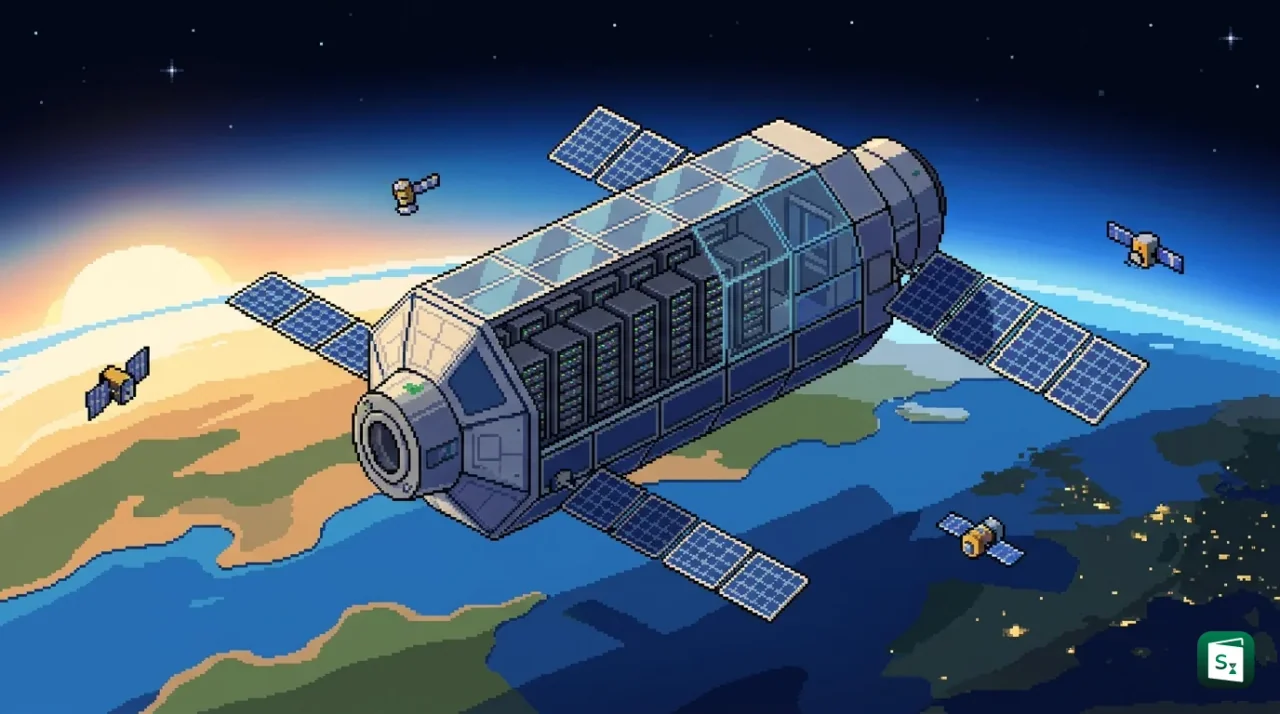
SpaceX launched 130 small satellites into low Earth orbit on 1 October 2026 on its Transporter-18 rideshare mission from Vandenberg Space Force Base in California. The Falcon 9 rocket lifted off from Space Launch Complex 4E and placed the payloads into sun synchronous orbit. The most watched payload was MVP, Google’s first in orbit test for Project Suncatcher, a plan to run artificial intelligence computing on solar powered satellites.
What Is SpaceX?
SpaceX is an American space company founded in 2002 by Elon Musk to lower the cost of space travel with reusable rockets. It designs, builds and launches the Falcon 9 and Falcon Heavy rockets, Dragon capsules and Starlink internet satellites from the United States.
The full name of the company is Space Exploration Technologies Corporation. Elon Musk is its Chief Executive Officer and Chief Technology Officer (as of October 2026), while Gwynne Shotwell serves as President and Chief Operating Officer. The company was incorporated on 14 March 2002 in California and was later reincorporated in Texas.
SpaceX is headquartered at Starbase in Texas. Its large engineering and manufacturing campus remains at Hawthorne in California, where Falcon rockets and Dragon spacecraft are built and mission control is operated. The company follows a vertically integrated model, which means it builds most parts of its rockets in house. This approach, combined with reuse, has helped SpaceX increase its launch rate and bring down costs.
Falcon 9: The Reusable Rocket Behind the Mission
Falcon 9 is a two stage rocket built by SpaceX to carry people and satellites into Earth orbit and beyond. The name comes from its nine first stage engines and the Millennium Falcon spacecraft in popular science fiction. The present operational version is called Falcon 9 Block 5, which is designed for repeated reuse with quick refurbishment.
Falcon 9 stands 70 metres tall with a diameter of 3.7 metres and a liftoff mass of 549,054 kg. It can carry 22,800 kg to low Earth orbit, 8,300 kg to geosynchronous transfer orbit and 4,020 kg toward Mars in fully expendable mode. Reusable flights carry less payload because extra fuel and landing hardware must be carried for recovery.
| Feature | Detail |
|---|---|
| Height | 70 m |
| Diameter | 3.7 m |
| Stages | Two |
| First stage engines | 9 Merlin engines using liquid oxygen and rocket grade kerosene |
| Sea level thrust | More than 1.7 million pounds |
| Second stage engine | 1 Merlin Vacuum engine, 981 kN thrust, 397 seconds burn time |
| Payload fairing | 13.1 m height, 5.2 m diameter, carbon composite |
| Recovery hardware | 4 hypersonic grid fins and landing legs on first stage |
Is Falcon 9 Reusable?
Falcon 9 is partly reusable. Its first stage booster returns to Earth and flies again after landing on ground pads or drone ships. Its second stage and payload fairing upper parts are expendable except fairing recovery efforts, so the full rocket is not reused in one piece.
How Falcon 9 Works
Falcon 9 lifts off on the power of its nine Merlin engines. About two and a half minutes into flight, the first stage shuts down and separates. The second stage, powered by a single Merlin Vacuum engine, then ignites and can restart several times to place different payloads into different orbits. The payload fairing, which protects satellites during ascent, is jettisoned about three minutes after liftoff.
After separation, the booster flips, uses its grid fins to steer during reentry and reignites some engines to slow down. It then lands vertically on a ground pad such as Landing Zone 4 at Vandenberg or on a sea based drone ship. For Transporter-18, booster B1082 completed its 25th flight and landed back at Vandenberg about seven and a half minutes after liftoff.
Low Earth Orbit: Where the 130 Payloads Were Placed
Low Earth orbit, usually shortened to LEO, is the region of space relatively close to Earth where most satellites, crewed stations and Earth imaging missions operate. It is generally taken to mean orbits at an altitude of under 2,000 km above Earth, with most missions flying between 160 km and 2,000 km. Objects below about 160 km lose height quickly because of drag from the upper atmosphere.
Satellites in LEO move very fast to stay in orbit. A typical LEO satellite travels at about 7.8 km per second and circles Earth in about 90 minutes. This means a station like the International Space Station, which flies at about 400 to 420 km, goes around Earth about 16 times a day. Proximity gives sharper images and lower signal delay, but a single satellite passes quickly over any ground point. Continuous services like internet or imaging therefore need constellations of many satellites working together.
| Orbit | Altitude | Speed and Period | Common Use |
|---|---|---|---|
| Low Earth Orbit (LEO) | Under 2,000 km, often 400 to 1,000 km | About 7.8 km per second, about 90 minutes per orbit | Space station, Earth imaging, Starlink internet, small satellites |
| Medium Earth Orbit (MEO) | 2,000 to 20,000 km, navigation fleets near 20,200 km | Slower, about 12 hours for semi synchronous orbit | GPS, Galileo and GLONASS navigation |
| Geosynchronous Orbit (GEO) | About 35,786 km above the equator | Matches Earth rotation, 24 hours per orbit | Fixed TV, weather and communication satellites |
Transporter-18 targeted a sun synchronous orbit, a special type of polar LEO. A sun synchronous satellite passes over the same part of Earth at the same local solar time each day, so lighting stays nearly constant for imaging. The launch placed payloads into this orbit, which is preferred for Earth observation and rideshare missions. Google’s planned Suncatcher shell uses a dawn dusk sun synchronous orbit at about 650 km, where satellites see near constant sunlight for solar power.
What Is Project Suncatcher?
Project Suncatcher is Google’s research moonshot announced in November 2025 to test whether artificial intelligence computing can run in space. It plans solar powered satellite constellations carrying Google Tensor Processing Units linked by lasers to form future orbital data centres.
The project is led by Google Research under Senior Director Travis Beals. A Tensor Processing Unit (TPU) is Google’s custom chip built to speed up machine learning work. Project Suncatcher wants to place these chips on satellites so that heavy AI tasks can be computed in orbit using sunlight, instead of using land, water and power grids on Earth.
The design has three technical pillars. First, satellites would fly in tight clusters, only hundreds of metres to a few kilometres apart, so that laser links can carry very high data rates between chips. Google has tested a bench scale link that reached 800 Gbps each way, or 1.6 Tbps in total, using a single transceiver pair with dense wavelength division multiplexing. Second, flight software must hold dozens of satellites in precise formation despite uneven gravity and thin atmospheric drag. Models based on orbital dynamics equations suggest clusters of up to 81 satellites in arrays about one kilometre wide could stay stable with limited corrections. Third, the chips must survive radiation, shaking and heat. Tests on Trillium TPU v6e chips in a proton beam at the Crocker Nuclear Laboratory of the University of California, Davis showed they could tolerate more radiation than a five year LEO mission would deliver. The team also shook the hardware on all three axes to mimic launch vibration and tested cooling in thermal vacuum chambers.
Google is developing the flight hardware with Planet Labs, an American Earth imaging company founded in 2010 by former NASA scientists and headquartered in San Francisco. Planet operates more than 200 satellites in orbit and collects over 350 million square kilometres of imagery daily. The original plan spoke of two prototype satellites by early 2027. The MVP flight on Transporter-18 is the first in orbit step before that two satellite link test.
Transporter-18 Mission: Profile and Rideshare Model
The Transporter-18 mission lifted off on 1 October 2026 at 11:32 am Pacific Time from Space Launch Complex 4E (SLC-4E) at Vandenberg Space Force Base in Santa Barbara County, California. The launch window of 58 minutes had opened at 11:18 am. After stage separation, the upper stage powered to orbit and began releasing payloads about 54 minutes after liftoff, with deployments spread over roughly 11 minutes.
| Item | Detail |
|---|---|
| Mission | Transporter-18, dedicated smallsat rideshare |
| Rocket | Falcon 9, booster B1082, 25th flight |
| Launch site | SLC-4E, Vandenberg Space Force Base, California |
| Landing site | Landing Zone 4 at Vandenberg |
| Orbit | Sun synchronous low Earth orbit |
| Payload count | 130 payloads |
Transporter missions are part of SpaceX’s Smallsat Rideshare Program, which sells shared launches to many small satellite owners. A basic booking costs about $350,000 for 50 kg to sun synchronous orbit, with extra mass charged at about $7,000 per kg. Missions to this orbit fly about every four months, with frequent flights to mid inclination orbits. If a customer is delayed, payments can be applied to a later flight with a small rebooking fee. With Transporter-18, SpaceX has now launched more than 1,800 rideshare payloads in total. The previous mission, Transporter-17 in early July 2026, had carried 81 payloads.
The manifest mixed CubeSats, MicroSats, hosted payloads and larger carrier craft. It included two spacecraft carrying reentry vehicles and four orbital transfer vehicles, which are space tugs that later release 41 smaller payloads into their final slots. Among named payloads were Google’s MVP, Star Catcher’s Protostar prototype for power beaming research, NASA’s SPRITE CubeSat to study galactic dust and high energy radiation, and GHGSat’s C-18 Eleanor and C-19 Aidan methane tracking satellites arranged through deployer company Exolaunch. NASA also flew small craft to test new propulsion and satellite inspection skills. Multiple payloads built by Indian private companies were also deployed, underlining the growing role of small firms in low cost access to orbit. The day itself was rare for launch tempo, with Crew-13 lifting off from Florida in the morning, Transporter-18 from California at midday Pacific time and a Falcon Heavy mission for the National Reconnaissance Office late at night.
Orbital Data Centres: Why Put AI in Space
An orbital data centre is a group of satellites that does computing in orbit instead of on the ground. The idea is not to send solar power down to Earth. The satellites use sunlight to run chips in space and send only the processed data down by radio or laser. Google’s version would link clusters of TPU carrying satellites with free space optical links, which are high speed laser beams between satellites, to act as one large machine.
Energy is the main driver. In a dawn dusk sun synchronous orbit, panels face near constant sunlight and can collect up to eight times more solar energy than the same panels on the ground, where night, clouds and seasons cut output. This matters because AI training needs huge and steady power, while new ground data centres face limits on land, grid connections, water for cooling and local approvals. Space also offers natural cold, but cooling is still hard because there is no air to carry heat away. Google is testing a mix of heat pipes and radiators to move heat from chips to space, first in thermal vacuum chambers and now in orbit.
The MVP satellite is the first real check of these ideas. MVP is about the size of a refrigerator and carries four TPUs powered by solar panels supplying about 1 kW. It was built with Planet, which will help bring it into operation. The flight will record how the chips handle launch shaking, high gravity loads, proton radiation that can flip digital bits, and repeated hot cold cycles in vacuum. The next step, planned for 2027 with two satellites, will test high bandwidth laser pointing between two moving craft, a task that needs the precision of hitting a coin sized target from miles away.
Vandenberg Space Force Base suits such missions because of geography. The base sits on the California coast in Santa Barbara County and was established in 1941. It is operated by the United States Space Force through Space Launch Delta 30 and launches from the Western Range. Rockets heading south from SLC-4E fly over open ocean all the way toward Antarctica, which makes it safe to reach polar and sun synchronous orbits used by imaging, weather, communication and defence satellites.
Significance and the Way Forward
Transporter-18 shows how rideshare has changed access to space for small players. Universities, startups and public labs that could never book a full rocket can now buy a standard slot and reach a precise orbit on schedule. For India, where private firms are building small satellites and payloads for foreign rockets, regular low cost rideshares provide flight heritage, which means proven performance in space that later helps win commercial and government orders.
The Suncatcher test adds a new layer to this story. If AI computing can shift partly to orbit, future data capacity would depend less on ground power and more on launch cost, solar cell efficiency and laser networking. Google has estimated that if launch costs fall below $200 per kg by the mid 2030s, orbital computing could compare with ground centres on energy cost. Other firms are moving in the same direction, with filings and concepts for orbital compute clusters from major space and cloud players. At the same time, regulators and scientists flag space debris, collision risk in crowded LEO shells and the need for environmental review of large constellations.
The way forward will be set by data from MVP. Google will study chip error rates, power stability and thermal control over months in orbit and refine vibration, shielding and radiator designs. A two satellite mission in 2027 will then test whether high speed links can be held steady between fast moving craft. Only if both computing and networking prove stable will larger clusters of tens of satellites, and later the proposed 81 satellite blocks, move from paper studies to deployment.
Key Takeaways
- SpaceX’s Transporter-18 launched 130 payloads to sun synchronous orbit on 1 October 2026 on a Falcon 9 from SLC-4E at Vandenberg Space Force Base.
- The reused booster B1082 completed its 25th flight and landed at Landing Zone 4, showing Falcon 9 first stage reusability.
- MVP is Google’s first Project Suncatcher in orbit test, a fridge sized satellite with four TPUs and about 1 kW of solar power.
- Project Suncatcher was announced in November 2025 by Google Research to build solar powered orbital data centres using TPUs and laser links.
- Falcon 9 is 70 m tall and can lift 22,800 kg to low Earth orbit, using nine Merlin engines in its first stage.
- Low Earth orbit lies at under 2,000 km altitude, with satellites moving at about 7.8 km per second and circling Earth in about 90 minutes.