The Digital India BHASHINI Division exchanged a Memorandum of Understanding with the National Institute of Electronics and Information Technology on 19 November 2026 in New Delhi. The pact will bring BHASHINI multilingual AI tools into NIELIT classrooms, training content and digital platforms under the BHASHINI for Seva Sanchalan Sahayogi Programme. It aims to let students learn emerging technologies in their own Indian language instead of English alone.
What Is BHASHINI?
BHASHINI stands for Bhasha Interface for India. It is India’s National Language Translation Mission to provide language technology as a digital public good in Indian languages.
The mission was launched by the Prime Minister on 4 July 2022 during Digital India Week in Gandhinagar, Gujarat. It is run by the Ministry of Electronics and Information Technology (MeitY). The work is executed by the Digital India BHASHINI Division (DIBD), which is an Independent Business Division under the Digital India Corporation (DIC).
DIC is a not for profit company set up by MeitY under Section 8 of the Companies Act. It was first set up in 2001 as Media Lab Asia and renamed as Digital India Corporation in 2017. DIBD was created in 2022 to anchor BHASHINI and build an ecosystem of startups, academia, industry and government.
BHASHINI offers open artificial intelligence tools for translation, speech recognition, speech synthesis, transliteration and optical character recognition. Its models are shared through open APIs, so developers, startups and departments can add multilingual features to their own apps and portals. More than 350 to 1,000 pre trained models are listed on the platform, built with about 70 research institutes including IITs and IIITs. The Chief Executive Officer of DIBD is Amitabh Nag.
What Does the DIBD NIELIT MoU Cover?
The Digital India BHASHINI Division and the National Institute of Electronics and Information Technology exchanged the Memorandum of Understanding on 19 November 2026. The MoU was exchanged by Swati Bisht Chowdhary, Head of Ecosystem Engagement at BHASHINI, and S. K. Dhurandher, Registrar of NIELIT, in the presence of officials from both sides.
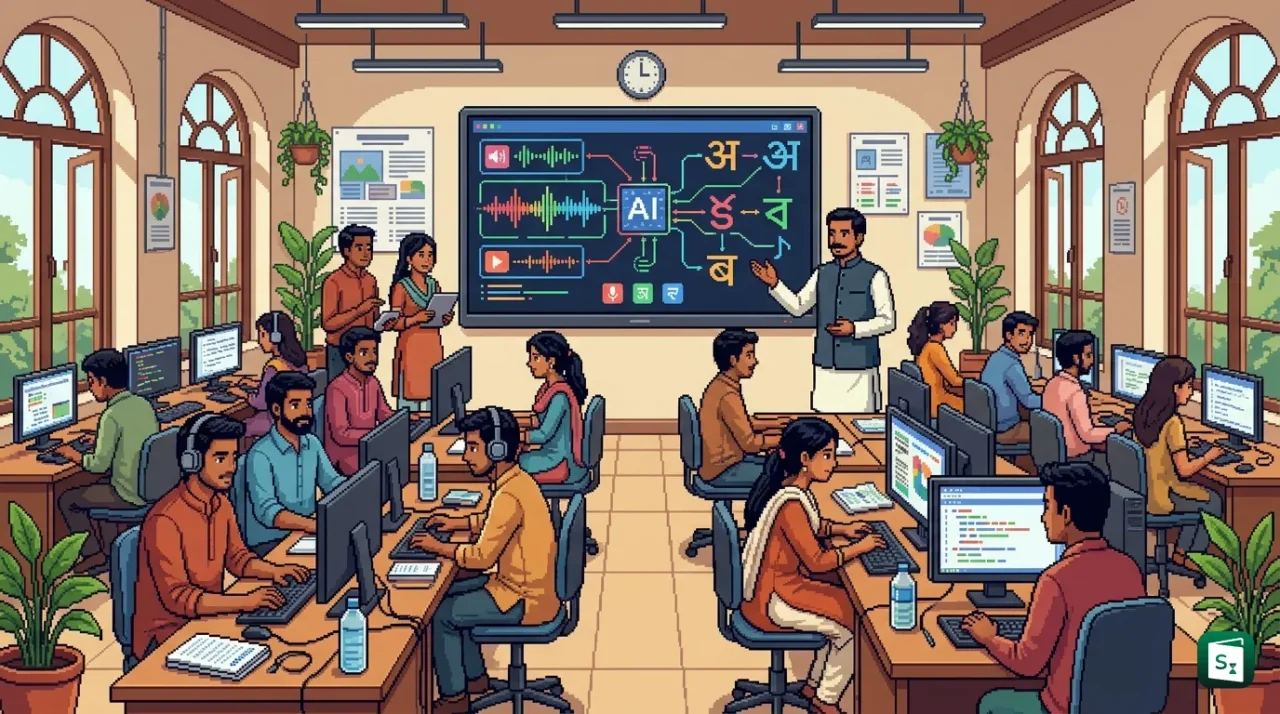
The aim is to use BHASHINI indigenous language AI with NIELIT strength in electronics, information technology, education, research and skill training. The focus is to reduce language barriers in technical education. Students from different language backgrounds should be able to access digital knowledge, emerging technology lessons and skill courses in their preferred language.
| Area of Cooperation | What It Will Do |
|---|---|
| Multilingual learning content | Convert NIELIT course material, training resources and digital platforms into Indian languages |
| Language technology use | Apply AI translation, speech to text and text to speech in classrooms and institutional services |
| Domain resources | Build subject glossaries and language data for technical and emerging technology subjects |
| Research and innovation | Joint work on language models, data contribution through tools like Bhashadaan, and pilot apps |
| Capacity building | Train students, teachers, trainers and researchers to use and build multilingual AI |
The partners will also test how multilingual AI can improve delivery of institutional services. This includes AI help for learning support, documentation and public facing digital services in the language chosen by the citizen. The effort supports the goal of Viksit Bharat 2047 for an inclusive and digitally empowered nation.
What Is the BHASHINI for Seva Sanchalan Sahayogi Programme?
The BHASHINI for Seva Sanchalan Sahayogi Programme is the partnership framework through which BHASHINI joins hands with banks, departments and institutions to add multilingual AI to public services. The word Sahayogi means partner or collaborator. Under it, BHASHINI provides translation APIs, voice tools and reference apps such as Udyat, Mitra, AppMitra and Pravakta.
The programme promotes multilingual governance across the 22 languages listed in the Eighth Schedule of the Constitution. It supports voice first access, so a person can speak, listen and transact in the mother tongue instead of typing in English. It also invites partners to share language data, build domain models and run awareness drives.
Earlier pacts under the same programme show the pattern. DIBD signed with the Reserve Bank of India in February 2026 for multilingual banking models, with the Department for Promotion of Industry and Internal Trade (DPIIT) in June 2026 for startup and investment platforms, and with Punjab National Bank in July 2026 for multilingual digital banking. The NIELIT pact extends the same model to technology education and skill development.
What Is NIELIT?
NIELIT stands for the National Institute of Electronics and Information Technology. It is an autonomous scientific society under MeitY and acts as a national body for human resource development in electronics and information technology.
NIELIT was formed on 9 November 1994 as the DOEACC Society under the Societies Registration Act, 1860. Several electronics design centres and regional computer centres were merged into it in 2002. It was renamed as NIELIT on 10 October 2011 to reflect its wider role beyond accreditation. Its headquarters is at NIELIT Bhawan in Dwarka, New Delhi, and it now runs more than 50 centres across India.
The institute offers formal and non formal courses, digital literacy courses and accreditation of private training institutes. Its popular programmes include the Course on Computer Concepts (CCC), Basic Computer Course and Expert Computer Course, along with O, A, B and C level courses linked to foundation, advanced diploma, MCA equivalent and MTech equivalent standards. It is also a key agency for digital literacy, e governance and skill projects.
How Many Languages Does BHASHINI Support?
BHASHINI now supports 36 Indian languages for text, 23 Indian languages for voice and 35 international languages. The starting mandate was the 22 Scheduled languages, but coverage has expanded to include more dialects and tribal languages.
Its National Hub for Language Technology powers more than 800 government websites and processes over 24 million AI inferences daily, with total inferences crossing 11 billion. Core services include automatic speech recognition, text to text translation, text to speech, speech to speech translation, optical character recognition and transliteration. The platform allows direct Indian language to Indian language translation without using Hindi or English as a middle step.
For NIELIT, this scale matters. A lesson recorded in English can be rendered in Tamil, Bengali, Marathi or Manipuri. A student can ask a question by voice in Dogri or Bodo and receive study material in the same language. This voice first design helps first time digital users and learners outside metro cities.
Key Takeaways
- The DIBD NIELIT MoU was exchanged on 19 November 2026 under the BHASHINI for Seva Sanchalan Sahayogi Programme.
- BHASHINI was launched on 4 July 2022 as the National Language Translation Mission under MeitY and is run by DIBD under DIC.
- The MoU was exchanged by Swati Bisht Chowdhary of DIBD and S. K. Dhurandher of NIELIT to link multilingual AI with technical education.
- NIELIT, formed in 1994 as DOEACC Society and renamed in 2011, is headquartered in New Delhi with more than 50 centres.
- BHASHINI supports 36 Indian text languages, 23 Indian voice languages and 35 international languages and powers over 800 government websites.