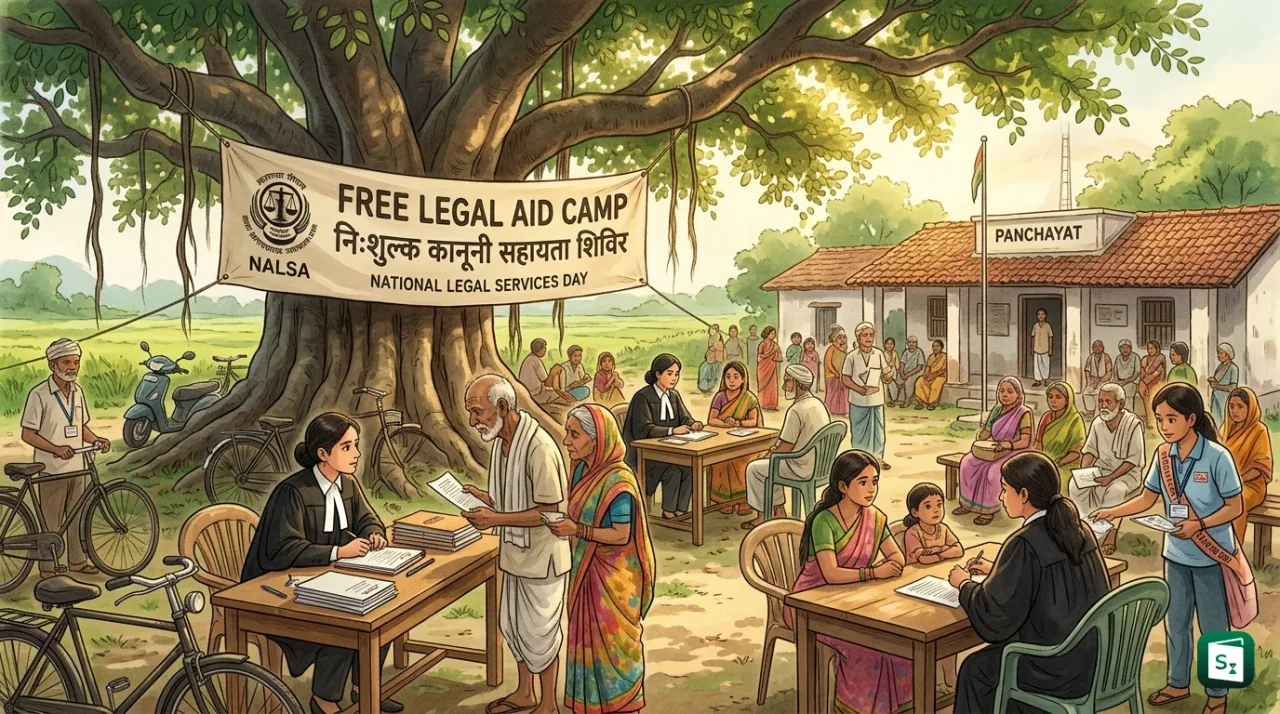
National Legal Services Day is observed in India on 9 November to mark the enforcement of the Legal Services Authorities Act, 1987. The National Legal Services Authority leads the day to promote free legal aid, legal literacy camps and settlement of disputes through Lok Adalats for weaker sections.
When Is National Legal Services Day Observed and Why
National Legal Services Day is observed on 9 November every year in India. The day marks the enforcement of the Legal Services Authorities Act, 1987, which came into force on 9 November 1995.
The Act was passed by Parliament on 11 October 1987 to create a uniform national network for free legal aid. It remained inactive for eight years. The Central Government brought it into force in November 1995 through notification S.O. 893(E). The National Legal Services Authority (NALSA) was constituted soon after, and its office became fully functional in February 1998.
In the first annual meet of State Legal Services Authorities on 12 September 1998 in New Delhi, the then Executive Chairman of NALSA, Justice A. S. Anand, gave a call to observe 9 November every year as Legal Services Day. Since then, NALSA at the national level and State, District and Taluk bodies at lower levels organise legal literacy camps, Lok Adalats and awareness drives on this date to inform people about their rights and the availability of free legal help.
What Is NALSA and How Does It Work
NALSA is the short form for the National Legal Services Authority. It is the central authority set up under the Legal Services Authorities Act, 1987 to provide free and competent legal services to weaker sections and to organise Lok Adalats for amicable settlement of disputes.
NALSA functions under the Ministry of Law and Justice through the Department of Justice. It is not a departmental office. It is a statutory body created by Parliament, and it lays down policies, frames economical schemes for legal services and gives funds to State authorities for implementation.
The leadership structure is judicial. The Chief Justice of India is the Patron-in-Chief of NALSA. The second senior most judge of the Supreme Court serves as the Executive Chairman. In November 2025, Justice Vikram Nath was nominated as Executive Chairman with effect from 24 November 2025. The first Executive Chairman was Justice K. Ramaswamy after the Act came into force.
NALSA sits at the top of a three tier network:
| Level | Body | Headed By |
|---|---|---|
| National | National Legal Services Authority | Chief Justice of India as Patron-in-Chief |
| State | State Legal Services Authority in each State | Chief Justice of the High Court as Patron-in-Chief |
| District | District Legal Services Authority in each district | District Judge as Chairman |
Below the district level, Taluk Legal Services Committees coordinate work in taluks and mandals. The Supreme Court Legal Services Committee and High Court Legal Services Committees handle cases before those courts. Funds flow through the National Legal Aid Fund, State Legal Aid Funds and District Legal Aid Funds, with support from Central and State governments and donations.
Article 39A and the Legal Services Authorities Act of 1987
The Constitution promises justice to all citizens in its Preamble. Article 39A gives this promise a clear legal base. It says the State shall secure that the legal system promotes justice on the basis of equal opportunity and shall provide free legal aid to ensure that no citizen is denied justice due to economic or other disabilities.
Article 39A was not part of the original Constitution of 1950. Parliament inserted it through the 42nd Amendment Act, 1976. It is a part of the Directive Principles of State Policy. Articles 14 on equality before law and 21 on protection of life and personal liberty also support the right to free legal help. In the Hussainara Khatoon case of 1979, the Supreme Court held that free legal aid is implicit in the fair procedure under Article 21.
To carry out this mandate, Parliament passed the Legal Services Authorities Act, 1987. The Act defines legal services to include representation in any case before a court, tribunal or authority and advice on any legal matter. A case includes suits and proceedings before civil, criminal and revenue courts.
Who Is Entitled to Free Legal Services
Section 12 of the Act lists the categories entitled to free legal services if they have a genuine case. The list covers:
- a member of a Scheduled Caste or Scheduled Tribe
- a victim of trafficking in human beings or begar under Article 23
- a woman or a child
- a person with disability
- a victim of mass disaster, ethnic violence, caste atrocity, flood, drought, earthquake or industrial disaster
- an industrial workman
- a person in custody, including in protective, juvenile or psychiatric homes
- a person with annual income below the limit fixed by the government
The income limit forms the economic test. For cases before the Supreme Court, the current limit is annual income of less than ₹5 lakh. For other courts, State governments fix the limit. An affidavit about income is generally treated as sufficient unless the authority has reason to doubt it.
Free aid is not limited to lower courts. It is available from the Taluk court to the Supreme Court. It can include a panel lawyer, payment of court fees, witness expenses, drafting, printing and supply of certified copies. NALSA also helps beneficiaries claim benefits under welfare schemes.
How Lok Adalats Deliver Speedy Justice
A Lok Adalat is a forum where pending cases or pre litigation disputes are settled by compromise. It is one of the main alternative dispute resolution methods in India along with mediation. NALSA and other legal services bodies organise Lok Adalats at regular intervals.
Lok Adalats have statutory status under the Legal Services Authorities Act. The award of a Lok Adalat is deemed to be a decree of a civil court. It is final and binding on the parties, and no appeal lies against it. There is no court fee when a matter is filed in a Lok Adalat. If a pending court case is settled there, the court fee already paid is refunded.
Members of a Lok Adalat act only as conciliators. They cannot force a settlement. They help the parties reach an agreement in an independent and fair manner. Any matter relating to an offence which cannot be compounded under law cannot be settled, and divorce matters are not taken up.
Three forms are important for readers to distinguish:
- Lok Adalat: held for pending and pre litigation cases at all levels from Taluk to High Court
- National Lok Adalat: held on a single day across the country in all courts on a fixed subject. Four National Lok Adalats were scheduled in 2025 on 8 March, 10 May, 13 September and 13 December
- Permanent Lok Adalat: set up under Section 22B for public utility services such as transport, post and telecom. If parties fail to agree, it can decide the dispute up to ₹10 lakh, except in offence cases
From 2016 to December 2025, Lok Adalats settled crores of cases. This includes pending cases settled through National Lok Adalats, State Lok Adalats and Permanent Lok Adalats, along with pre litigation matters resolved before they reached regular courts.
NALSA Schemes and Recent Legal Aid Numbers
NALSA frames preventive and strategic schemes and the State and District authorities carry them out. Recent schemes include support for victims of acid attacks, compensation for women survivors of sexual assault, child friendly legal services for children in 2024, legal services for persons with mental illness and intellectual disabilities in 2024, legal services for senior citizens, and the SHIKSHA scheme for holistic inclusion through schooling and the SPRUHA scheme for unseen and vulnerable groups.
Field work runs through panel lawyers, Legal Aid Defence Counsels for criminal cases, and Para Legal Volunteers who act as the link between institutions and villages. Free helplines support access. NALSA uses toll free number 15100, while the Tele-Law service uses 14454.
Two large programmes expand reach beyond court buildings:
- Tele-Law: free pre litigation advice through video conferencing at Common Service Centres, the mobile app and helpline. By early 2026, more than 1.12 crore advices had been enabled through about 2.5 lakh centres across 777 districts
- Nyaya Bandhu: pro bono help where volunteer advocates take cases of eligible persons. By early 2026, more than 10,000 advocates had registered, with pro bono panels in 23 High Courts and clubs in 109 law colleges
The Department of Justice runs these under the DISHA scheme for holistic access to justice. The Legal Aid Defence Counsel System now functions in 680 districts. In 2024 to 2025, defence counsels handled 5,32,413 criminal cases and disposed of 3,72,750 of them, a disposal rate of about 70 percent. NALSA reported that legal aid had reached 44.22 lakh people between 2022 and 2025 and that 23.58 crore cases were resolved through various Lok Adalats in that period.
The NALSA case of 2014 also forms part of its identity. In NALSA vs Union of India, the Supreme Court recognised transgender persons as a third gender and directed the Centre and States to treat them as socially and educationally backward for reservations, health care, education and separate public toilets. This judgment is often asked as the NALSA judgment.
Why National Legal Services Day Differs From Constitution Day
Readers often confuse National Legal Services Day with National Law Day. National Legal Services Day falls on 9 November and marks the 1995 enforcement of the legal aid law. Constitution Day, also called National Law Day, falls on 26 November and marks the adoption of the Constitution on 26 November 1949. It came into force on 26 January 1950. The government notified 26 November as Constitution Day in 2015 during the 125th birth anniversary of B. R. Ambedkar.
On 9 November, State authorities organise Lok Adalats, legal aid camps, school programmes, rallies, poster displays and door to door drives with ASHA workers and self help groups. In 2024, the theme highlighted empowering justice through accessible legal aid for all. In 2024, NALSA marked the day in New Delhi with the launch of the child friendly services scheme and the scheme for persons with mental illness and intellectual disabilities. In 2025, NALSA marked three decades of service with a national conference on strengthening legal aid delivery in the Supreme Court on 8 and 9 November.
Key Takeaways
- National Legal Services Day is observed every year on 9 November to mark the enforcement of the Legal Services Authorities Act, 1987 in 1995.
- NALSA stands for the National Legal Services Authority, a statutory body under the Ministry of Law and Justice headed by the Chief Justice of India as Patron-in-Chief.
- Article 39A, inserted by the 42nd Amendment in 1976, directs the State to provide free legal aid to ensure equal justice.
- Section 12 of the 1987 Act entitles women, children, Scheduled Castes, Scheduled Tribes and persons with annual income below ₹5 lakh before the Supreme Court to free legal services.
- The award of a Lok Adalat is deemed to be a decree of a civil court, is final and binding, and no appeal lies against it.