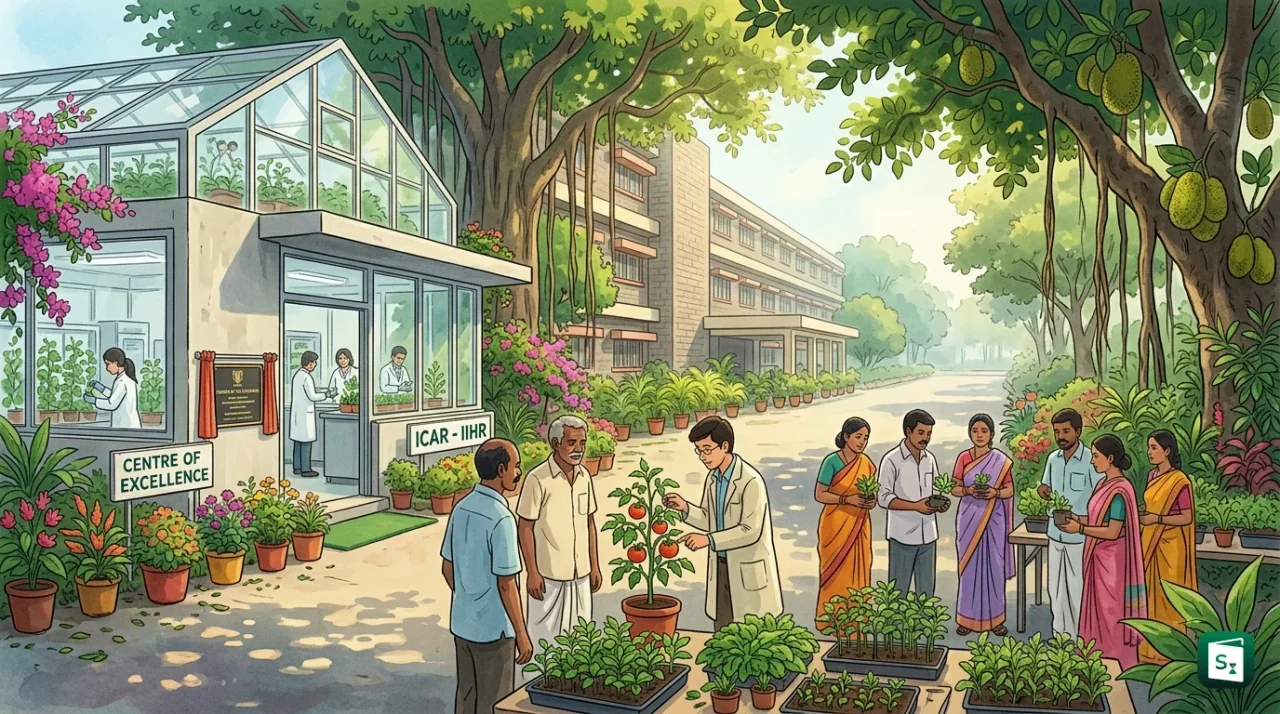
Dr M L Jat, Secretary of the Department of Agricultural Research and Education and Director General of the Indian Council of Agricultural Research, inaugurated the Centre of Excellence for Genome Editing in Horticultural Crops at ICAR-IIHR Bengaluru on 15 November 2026. The centre houses a Biosafety Level-II laboratory and a Farmers Advanced Training Centre. It will use genome editing tools to develop climate resilient and nutritious varieties of tomato, chilli, grapes, papaya and pomegranate.
What Is Genome Editing and How Does Genome Editing Work?
A genome is the complete set of DNA present in an organism. Genome sequencing means reading and mapping this full DNA sequence, while genome editing means making precise changes in that sequence to get a useful trait. The Genome India Project, a separate national programme to sequence the genomes of Indians for health research, shows how widely sequencing is now used, but editing goes one step further by rewriting specific DNA letters.
Genome editing technology uses molecular scissors that cut DNA at a chosen spot. The cell then repairs the cut, and scientists use that repair to create a desired change. The most widely used tool is CRISPR-Cas9, in which a guide RNA leads the Cas9 protein to the target DNA and the protein makes a double strand cut. Two older tools work on a similar principle: zinc finger nuclease (ZFN), which uses engineered zinc finger proteins to find DNA, and TALEN, which uses proteins from plant bacteria to bind the target. CRISPR-Cas9 has become dominant because it is simpler, cheaper and faster to design.
In plants, the process starts inside a contained laboratory. Scientists insert the editing components into plant cells, grow those cells into full plants through tissue culture, and then separate out plants that carry only the desired mutation. In the next generation, the editing machinery is removed by breeding, so the final plant carries the new trait but no foreign DNA.
What Was Inaugurated at ICAR-IIHR Bengaluru?
The Indian Council of Agricultural Research (ICAR) is the apex body for agricultural research and education in India. ICAR was established on 16 July 1929 as the Imperial Council of Agricultural Research and now functions under the Department of Agricultural Research and Education (DARE) in the Ministry of Agriculture and Farmers Welfare. It is headquartered in New Delhi. Its chief executive is the Director General, who also serves as Secretary of DARE. The post is currently held by Dr M L Jat.
The ICAR-Indian Institute of Horticultural Research (ICAR-IIHR) is the first horticultural research institute set up by ICAR. It was established on 5 September 1967 in New Delhi and shifted to Hessarghatta, Bengaluru on 1 February 1968. The main campus covers about 263 hectares. The institute works on fruits, vegetables, ornamentals, medicinal and aromatic plants and mushrooms, and its varieties carry the ARKA brand. It has developed more than 330 varieties and hybrids.
On 15 November 2026, Dr Jat visited the Hessarghatta campus and inaugurated two facilities. Director of IIHR Dr Tusar Kanti Behera and Assistant Director General for Fruits and Spices Dr V B Patel were present along with scientists, students and farmers.
| Facility | What It Contains | Purpose |
|---|---|---|
| Centre of Excellence for Genome Editing in Horticultural Crops | BSL-II Laboratory with negative pressure control, plant tissue culture and transformation facility with advanced growth chambers, high end molecular biology laboratory, bioinformatics laboratory | To carry out contained editing, grow edited plants, confirm DNA changes and build genome resources |
| Farmers Advanced Training Centre (ATC) | Training and interaction space for farmers, entrepreneurs and nursery owners | To spread IIHR varieties, natural farming practices and climate resilient methods such as mulching, sprinkler irrigation and intercropping |
During the visit, Dr Jat stressed self reliance in genome resources, prioritisation of research, better targeting and a strong data ecosystem. He asked scientists to identify areas where Indian research can set global standards. He also interacted with farmers on natural farming and steps to reduce the effect of El Nino on horticultural crops.
Which Horticultural Crops and Traits Will the Centre Target?
Horticultural crops are high value crops grown for food, nutrition and income, and not mainly for cereals and pulses. They include fruits, vegetables, flowers, plantation crops, spices, medicinal and aromatic plants and mushrooms. Climate resilient crops are varieties that give stable yields even under heat, drought, salinity, floods or new pests linked to climate change.
The CoE will focus at first on five crops: tomato, chilli, grapes, papaya and pomegranate. Work is being taken up under the ICAR project titled Enabling Climate Resilience and Ensuring Food and Nutritional Security through Genome Editing in Horticultural Crops. The aim is to develop trait specific varieties and hybrids rather than general yield improvement alone.
| Crop | Targeted Trait Under the Programme |
|---|---|
| Tomato | Multiple disease resistance and Vitamin D biofortification |
| Chilli | Anthracnose resistance linked to the CaERF28 gene |
| Grapes | Mildew resistance |
| Papaya | Papaya potyvirus resistance linked to the eIF4 gene |
| Pomegranate | Resistance to bacterial nodal blight |
The centre will also work on genome editing for precision guided sterile insect technique, a pest control method that reduces pest populations without heavy pesticide use. For India, where horticulture now contributes a large share of farm output and nutrition, such traits can cut crop losses, reduce chemical sprays and improve quality for both fresh sale and processing.
How Is Genome Editing Different From Genetic Modification?
Genetic modification inserts a foreign gene, often from an unrelated species, into a plant. Such plants are called genetically modified organisms (GMOs) and face strict biosafety clearance. Genome editing, by contrast, edits the plant’s own genes. When no foreign DNA remains in the final plant, the product looks like a plant produced by natural mutation or conventional breeding.
Indian rules divide editing into three types based on the repair method. SDN stands for site directed nuclease, the enzyme that cuts DNA at a fixed spot.
| Type | What Happens at the DNA Level | Foreign DNA in Final Plant | Regulation in India |
|---|---|---|---|
| SDN-1 | Cut is repaired by the cell itself, creating small deletions or changes that switch off or alter a gene | No | Exempt from Rules 7 to 11 of Rules 1989 if confirmed free of foreign DNA |
| SDN-2 | Cut is repaired using a small template to create a precise change of a few letters | No | Exempt from Rules 7 to 11 of Rules 1989 if confirmed free of foreign DNA |
| SDN-3 | A long foreign gene is inserted at the cut site | Yes | Treated like a GMO, with full biosafety assessment |
This distinction explains why India released DRR Dhan 100 (Kamala) and Pusa DST Rice 1 in 2025 as the country’s first genome edited rice varieties. Both were made with CRISPR-Cas from popular parents Samba Mahsuri and MTU1010, carry no foreign DNA, and were cleared as SDN-1 and SDN-2 products. Kamala gives about 19 percent higher yield with earlier maturity, while Pusa DST Rice 1 gives 10 to 30 percent higher yield under drought and salt stress.
Questions of safety, legality and ethics depend on this difference. SDN-1 and SDN-2 plants are considered as safe as conventional mutants because their DNA changes could also occur in nature. SDN-3 plants raise the same safety and ethical concerns as GMOs because they carry new genes. In India, SDN-1 and SDN-2 research is legal within containment under Institutional Biosafety Committees, while any release must still pass variety testing.
Why Genome Editing Matters for Food Security and Climate Resilience in India
Food security means that all people have enough safe and nutritious food at all times. Nutritional security adds quality to this idea, with enough vitamins, minerals and protein in the diet. Fruits and vegetables are central to both because they supply vitamins, fibre and income between cereal harvests.
India is among the world’s largest producers of horticultural crops, ranking second in fruits and vegetables after China. Yet yields are still hit by heat waves, uneven rain, salinity and fast spreading viruses and fungi. Papaya ringspot, chilli anthracnose, grape mildew and pomegranate bacterial blight can wipe out large parts of a harvest in a single season. El Nino years make the losses worse.
Genome editing is important for three practical reasons. First, it is fast. Conventional breeding takes 8 to 12 years to combine disease resistance with good taste and shelf life, while editing can change a single known gene within a popular variety. Second, it is precise. Only the target gene changes, so the fruit keeps the qualities farmers and buyers already like. Third, it is cost effective for public research because edited lines without foreign DNA do not need the long GMO approval path and can move faster to field trials.
Vitamin D biofortified tomato shows the nutritional side. Vitamin D deficiency is common in India despite sunshine, and a tomato that produces more of the vitamin precursor can add nutrition without changing diets. Disease resistant grapes and pomegranate reduce fungicide and antibiotic sprays, which lowers costs and residue risks.
How India Regulates Genome Edited Plants and Biosafety Labs
All work on genome edited plants in India starts inside containment. Biosafety levels are grades of laboratory safety from BSL-1 to BSL-4, based on risk to people and the environment. Each level adds stricter control over entry, equipment and airflow.
| Level | Risk Level | Key Controls | Typical Use |
|---|---|---|---|
| BSL-1 | Minimal, microbes not known to cause disease in healthy adults | Open bench work, sink, lab coat and gloves as needed | Non pathogenic E. coli |
| BSL-2 | Moderate, local microbes linked to diseases of varying severity | Restricted entry, work in biological safety cabinet, autoclave for waste, self closing doors, eyewash | Plant pathogens, Staphylococcus aureus |
| BSL-3 | Serious, microbes that can spread through air | All BSL-2 controls plus controlled airflow, double doors, health monitoring | Tuberculosis bacteria |
| BSL-4 | Dangerous and exotic, often fatal without cure | Separate building, full body suits, complete decontamination | Ebola virus |
The new CoE has a BSL-II laboratory, which keeps edited plant material and associated microbes inside through negative air pressure and filtered cabinets. This stops accidental release into the open while scientists handle tissue culture, transformation and molecular checks. The bioinformatics unit then confirms the exact DNA change by sequencing.
The legal path has three layers. The base law is the Environment (Protection) Act, 1986 and the Rules of 1989 for genetically engineered organisms. On 30 March 2022, the Ministry of Environment, Forest and Climate Change exempted SDN-1 and SDN-2 plants free of foreign DNA from Rules 7 to 11 of these Rules. The Department of Biotechnology then issued the Guidelines for Safety Assessment of Genome Edited Plants, 2022 on 17 May 2022 and standard operating procedures on 4 October 2022.
Research must be approved by an Institutional Biosafety Committee (IBSC) and reported to the Review Committee on Genetic Manipulation (RCGM). Scientists must prove through overlapping PCR tests that no vector DNA remains. Once the IBSC and RCGM accept the proof, the line can leave containment. It must still pass field evaluation in the All India Coordinated Research Project network and variety release norms before farmers can grow it.
Key Takeaways
- The Centre of Excellence for Genome Editing in Horticultural Crops was inaugurated at ICAR-IIHR Bengaluru on 15 November 2026 by Dr M L Jat.
- The centre works under the ICAR project on Enabling Climate Resilience and Ensuring Food and Nutritional Security and includes a BSL-II laboratory and a Farmers Advanced Training Centre.
- The first focus crops are tomato, chilli, grapes, papaya and pomegranate for traits such as virus, fungus and bacterial resistance and Vitamin D biofortification.
- SDN-1 and SDN-2 edited plants without foreign DNA are exempt from Rules 7 to 11 of Rules 1989 under the order of 30 March 2022, while SDN-3 plants are treated like GMOs.
- ICAR, set up on 16 July 1929 and headquartered in New Delhi, runs ICAR-IIHR, set up on 5 September 1967 and shifted to Hessarghatta, Bengaluru in 1968.