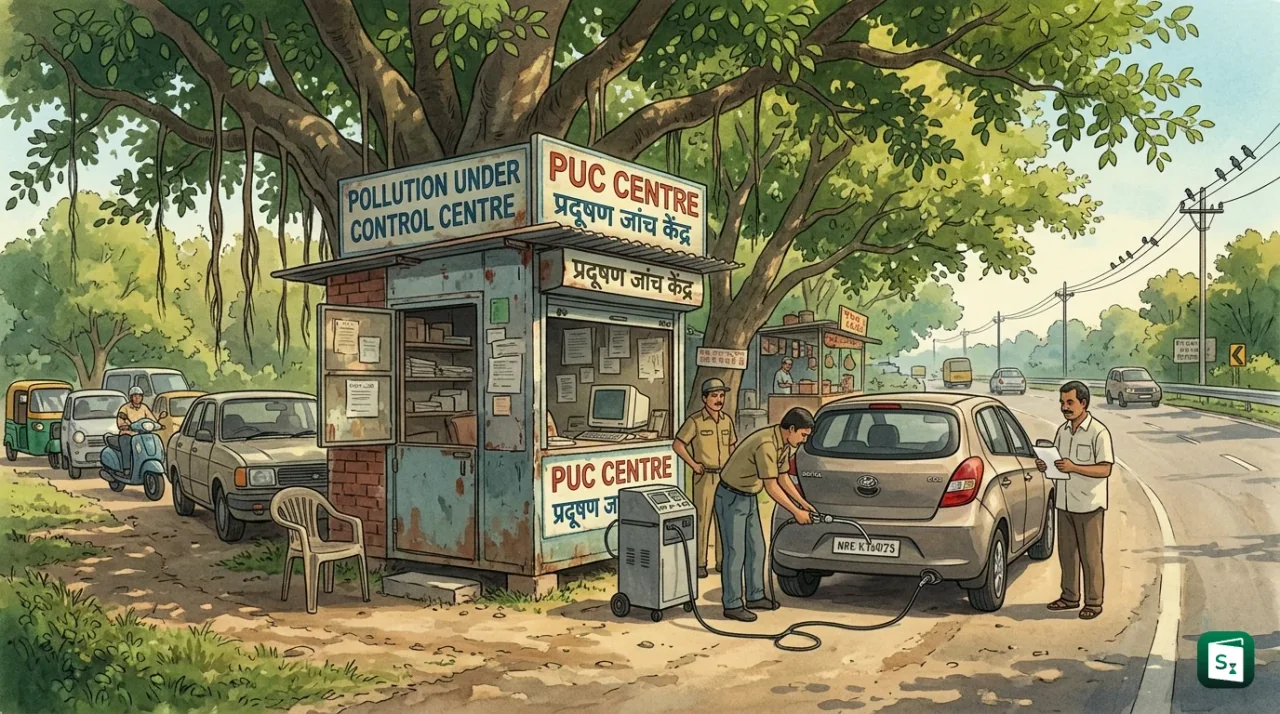
The Ministry of Road Transport and Highways has revised Pollution Under Control certificate validity through the Central Motor Vehicles (Sixteenth Amendment) Rules, 2026. Non-transport BS-VI vehicles up to six years old will now need renewal once in three years, while older and lower norm vehicles face shorter periods. The change links testing frequency to vehicle age and emission standard to reduce load on cleaner vehicles.
What Is a PUC Certificate and Why Is It Mandatory?
A Pollution Under Control (PUC) certificate, also called a Pollution Under Control Certificate (PUCC), is an official document which certifies that exhaust emissions from a motor vehicle are within prescribed limits. The test measures pollutants such as carbon monoxide, hydrocarbons and smoke density using gas analysers at authorised centres. The certificate records the vehicle number, emission readings and period of validity.
The requirement flows from Rule 115 of the Central Motor Vehicles Rules, 1989, which sets emission standards and in-use testing for vehicles. The Ministry of Road Transport and Highways (MoRTH), the apex body for road transport law and national highway development, frames these standards under the Motor Vehicles Act, 1988. After the first year from the date of first registration, every motor vehicle running in a public place must carry a valid PUC certificate.
The certificate is issued or renewed only by an agency authorised by the concerned state government or Union Territory administration. It is linked to the VAHAN database, the national vehicle registry, and can be produced physically or in digital form through the Parivahan portal and mParivahan app. An officer authorised under Rule 116 can demand its production during checking.
Driving without a valid certificate is punishable under Section 190(2) of the Motor Vehicles Act, 1988. The law provides for a penalty which may extend to ₹10,000 and disqualification from holding a driving licence for three months for the first contravention, and imprisonment up to six months or fine up to ₹10,000 or both for a second or later contravention. States fix the actual compounding amount within this ceiling, so the challan amount can differ across states.
What Are the New PUC Validity Rules for BS-I to BS-VI Vehicles?
The Ministry notified the changes through the Central Motor Vehicles (Sixteenth Amendment) Rules, 2026, issued as G.S.R. 991(E) dated 13 November 2026. The amendment substitutes sub-rule (7) of Rule 115 of the Central Motor Vehicles Rules, 1989. It came into force on publication in the Official Gazette and creates one national schedule for all states and Union Territories.
Bharat Stage (BS) norms are tailpipe emission standards fixed by the central government on the lines of European norms. Higher stages set stricter limits for pollutants such as nitrogen oxides, particulate matter, carbon monoxide and hydrocarbons. India moved to BS-IV nationwide in April 2017 and leapfrogged directly to BS-VI from 1 April 2020, skipping BS-V. All new vehicles sold after that date must meet BS-VI standards.
Under the new schedule, validity for BS-VI vehicles depends on two factors. The first is vehicle age counted from the date of first registration. The second is whether the vehicle is a non-transport vehicle, such as a private car or two wheeler, or a transport vehicle, such as a taxi, bus or goods carrier.
| Emission standard and vehicle type | Age from first registration | New PUC validity |
|---|---|---|
| BS-I, BS-II and BS-III, all vehicles | Any age | 3 months |
| BS-IV, all vehicles | Any age | 6 months |
| BS-VI non-transport vehicles | Up to 6 years | 3 years |
| BS-VI non-transport vehicles | More than 6 years and up to 10 years | 1 year |
| BS-VI non-transport vehicles | More than 10 years | 6 months |
| BS-VI transport vehicles | Up to 6 years | 2 years |
| BS-VI transport vehicles | More than 6 years and up to 10 years | 1 year |
| BS-VI transport vehicles | More than 10 years | 6 months |
The revision extends validity for cleaner young vehicles but shortens it for older technology vehicles. The comparison with the earlier central practice is given below.
| Vehicle group | Earlier central validity | New validity |
|---|---|---|
| BS-I, BS-II and BS-III vehicles | 6 months | 3 months |
| BS-IV vehicles | 12 months | 6 months |
| BS-VI non-transport vehicles up to 6 years | 12 months | 3 years |
| BS-VI non-transport vehicles aged 6 to 10 years | 12 months | 1 year |
| BS-VI non-transport vehicles above 10 years | 12 months | 6 months |
| BS-VI transport vehicles up to 6 years | 12 months | 2 years |
| BS-VI transport vehicles aged 6 to 10 years | 12 months | 1 year |
| BS-VI transport vehicles above 10 years | 12 months | 6 months |
Why Has PUC Validity Been Linked to Vehicle Age and Emission Norms?
The Ministry has stated three aims for the change. The first is to match testing frequency with the pollution risk of a vehicle. The second is to reduce the compliance burden on owners of newer and cleaner vehicles. The third is to keep close watch on emissions from older in-use vehicles while making the certification system more efficient.
New BS-VI vehicles carry advanced emission control systems such as diesel particulate filters, selective catalytic reduction units and upgraded on-board diagnostics. BS-VI Phase 2 standards, effective from 1 April 2023, added real driving emission checks in addition to laboratory tests. Such vehicles generally stay within limits for longer when maintained well, so a three year or two year certificate reflects their lower risk.
Older vehicles show the opposite pattern. Engines wear with age, maintenance levels vary and early BS norms allowed far higher levels of pollutants. A BS-IV vehicle can emit more than twice the nitrogen oxides and particulates of a comparable BS-VI vehicle. Frequent testing of BS-I to BS-IV vehicles therefore helps detect high emitters early and pushes owners toward repair or replacement.
The new table also ends variation across states. Earlier central rules broadly gave six months for older vehicles and 12 months for BS-IV and BS-VI vehicles, but actual practice differed by state and city. Delhi, for example, followed a three month cycle for older vehicles in its local orders. A single national schedule now applies uniformly to all states and Union Territories.
How Will Renewal and Transition to the New Validity Work?
Certificates issued before the amendment remain valid until the expiry date printed on them. Owners do not need fresh certificates immediately. The revised validity will apply only at the first renewal after the new rules came into force. A four year old private BS-VI car holding a one year certificate, for example, will become eligible for a three year certificate at its next renewal, but its current certificate will not get an automatic extension.
The amendment also fixes the start date of a renewed certificate. If renewal is done within the ten days preceding the expiry of the existing certificate, the new certificate takes effect from the date of expiry of the old certificate. This protects the remaining days and avoids loss of validity due to early testing.
If renewal is done after the old certificate has expired, the new certificate takes effect from the date of renewal. In such cases the gap period remains uncovered and can attract penalty if the vehicle is used on a public road. Every vehicle must therefore hold a continuous valid certificate, and age for BS-VI slabs is counted from the date of first registration recorded in the registration certificate and VAHAN records.
Key Takeaways
- The Central Motor Vehicles (Sixteenth Amendment) Rules, 2026, notified as G.S.R. 991(E) on 13 November 2026, revised PUC validity based on age and emission norms.
- BS-VI non-transport vehicles up to 6 years old get a 3 year PUC validity, while BS-VI transport vehicles up to 6 years old get a 2 year validity.
- BS-I, BS-II and BS-III vehicles now have 3 months validity and BS-IV vehicles have 6 months validity under the single national schedule.
- Renewal within the ten days before expiry takes effect from the old expiry date, while renewal after expiry takes effect from the renewal date.
- Driving without a valid PUC certificate is punishable under Section 190(2) of the Motor Vehicles Act, 1988 with a penalty up to ₹10,000 and licence disqualification.