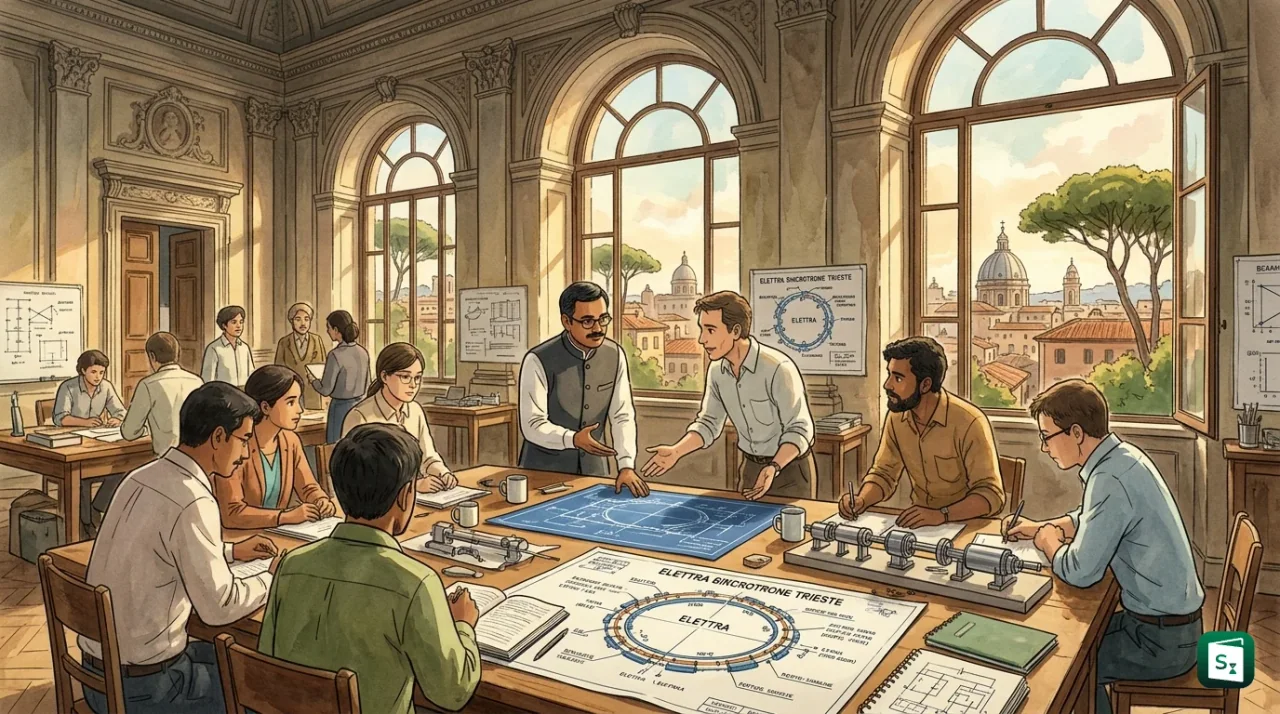
Union Minister Jitendra Singh led India at the second India Italy Science and Innovation Dialogue 2026 in Rome on 12 November 2026 with Italian Minister Anna Maria Bernini. The two sides agreed to deepen joint research in clean technology, quantum, artificial intelligence, big data, biotech and health, with a focus on turning lab results into startups and products. India also announced it will invest more than €7 million over five years from 2026-27 as co-partner in the Elettra 2.0 upgrade at Trieste.
What Did the Second India Italy Science and Innovation Dialogue Decide?
The second India Italy Science and Innovation Dialogue took place in Rome on 12 November 2026 at Palazzo Lante, the home of the National Institute for Nuclear Physics (INFN). Union Minister Jitendra Singh, Minister of State (Independent Charge) for Science and Technology and Earth Sciences, co-chaired the meet with Italian Minister for University and Research Anna Maria Bernini. The first dialogue was held in New Delhi on 11 April 2025, so the Rome edition continued a yearly cycle.
The Rome dialogue was organised around two sessions. The first session, Research Excellence and Strategic Technologies, covered clean technology, quantum technologies, artificial intelligence, high performance computing and big data, plus biotech and health. The second session, From Research to Innovation, focused on incubators, technology transfer, pilot scale demonstration, validation and commercialisation.
Both sides agreed on a joint action agenda with four practical steps. India and Italy will prepare a new joint research call in 2027 for projects in artificial intelligence, clean energy and hydrogen, and advanced biotechnology including gene therapy and mRNA technologies. Researcher mobility and shared access to large facilities will expand. Incubators supported by the Indian Department of Science and Technology (DST) and Italian innovation hubs will work together on startup support. The India Italy Joint Scientific Council, set up under the April 2025 science cooperation pact, will track progress.
Singh linked the agenda to Indian mission mode programmes such as the Anusandhan National Research Foundation (ANRF) and the Research Development and Innovation scheme. The message was clear. Joint work must move from papers to products, jobs and skills.
What Is a Synchrotron and How Does It Work?
A synchrotron is a large circular particle accelerator that produces extremely bright X-rays, called synchrotron radiation, for studying materials at atomic and molecular scale. Electrons are first generated and boosted close to the speed of light, then stored for hours in a ring under vacuum. Powerful magnets bend their path, and each bend releases intense light that is channelled into laboratories called beamlines.
Each beamline selects a specific wavelength and focuses it on a sample. Scientists then study how the light is scattered, absorbed or diffracted. Three broad methods are common. Imaging shows inner structure in high detail. Spectroscopy reveals which elements are present and how they bond. Diffraction reveals how atoms are arranged in crystals.
The uses are wide. In health, synchrotron light maps protein structures and helps design drugs and vaccines. In energy and materials, it studies batteries, solar cells, semiconductors and steel under real conditions. In heritage science, it reads faded inks and analyses pigments without damaging objects.
India operates its own national facility, the Indus Synchrotron Radiation Facility at the Raja Ramanna Centre for Advanced Technology (RRCAT) in Indore. Indus-1, commissioned in 1999, is a 450 MeV ring for ultraviolet and soft X-ray work. Indus-2, a 2.5 GeV ring, is the largest and highest energy accelerator in India and provides hard X-rays up to about 40 keV. Access to Elettra in Italy therefore adds higher brightness and specialised beamlines that complement domestic capacity.
What Are the New Micro XRD and Xpress Superbend Beamlines?
The Elettra Sincrotrone Trieste centre in Trieste, Italy operates a synchrotron light source used by researchers from many countries. On 13 November 2026, Jitendra Singh visited the centre and announced that India will contribute more than €7 million, about ₹73 crore, over five years from 2026-27 as co-partner in Elettra 2.0. The money will support new research infrastructure and training for Indian users.
Elettra 2.0 is an upgrade from a third generation to a fourth generation light source. The old ring shut down in July 2025 after 32 years of operation. The new ring keeps the same 259.2 metre tunnel but uses a modern six bend lattice. The design cuts electron beam emittance by about 50 times and raises brightness and coherence by more than 100 times. The ring will run mainly at 2.4 GeV with up to 400 mA current, giving sharper images down to nanometre scale. User operation is planned from January 2027, with the full set of 32 beamlines ready by 2029.
| Feature | Current Elettra | Elettra 2.0 |
|---|---|---|
| Generation | Third generation | Fourth generation low emittance ring |
| Horizontal emittance | About 7,000 to 10,000 pm rad | About 212 pm rad at 2.4 GeV |
| Brightness gain | Base level | More than 100 times higher at 10 keV |
| Commissioning | Operated from 1994 to 2025 | User runs from January 2027, full completion by 2029 |
Under Elettra 2.0, the two India linked beamlines XRD2 and Xpress will be retired and replaced. XRD2 and Xpress were built jointly with DST support of about ₹22 crore and were jointly inaugurated on 20 October 2016. The replacements are a microfocus beamline for macromolecular crystallography called micro-XRD, for detailed study of proteins and biological molecules, and a high pressure diffraction beamline called Xpress Superbend, for studying materials under extreme pressure. The new facilities will expand work in chemistry, physics, advanced materials and structural biology for Indian and international teams.
How the Elettra Partnership Grew Since 1998
The Elettra partnership between India and Italy is more than 25 years old. Indian scientists began experiments at Elettra in 1998. India is now the second largest user of the facility after Italy. Elettra has received more than 1,100 proposals from Indian groups, ahead of France with 1,098 proposals. About 50 to 60 Indian scientists visit Trieste every year for beam time.
The Department of Science and Technology supported access through the Indo Italian Executive Programme of Cooperation (EPOC). Under EPOC 2022 to 2024, DST gave ₹2 crore over three years to support 50 visits a year. EPOC 2025 to 2027 proposes ₹1.5 crore over three years for continued access.
DST had already agreed to join the redevelopment of the India linked beamlines. A Letter of Intent between DST and Elettra Sincrotrone Trieste was signed in March 2026. The May 2026 India Italy Joint Declaration welcomed that Letter of Intent and noted the long value of Elettra cooperation. Singh reaffirmed the pledge during the Trieste visit on 13 November 2026, turning the intent into a firm five year funding commitment.
India Italy Special Strategic Partnership and the May 2026 Joint Declaration
The science dialogue sits inside a wider rise in India Italy relations. The science link is old. The first intergovernmental science and technology agreement was signed in 1978 and renewed on 28 November 2003. It covers joint projects, researcher exchange, industrial research and workshops. Yet political ties gained speed only recently.
India and Italy raised ties to a Strategic Partnership in March 2023. Prime Minister Narendra Modi and Italian Prime Minister Giorgia Meloni then adopted the Joint Strategic Action Plan (JSAP) 2025 to 2029 at the G20 summit in Rio de Janeiro in November 2024. The plan lists ten areas, including political dialogue, trade, connectivity, science and innovation, space, energy, defence, security, migration and culture.
On 19 to 20 May 2026, Modi visited Rome and the two leaders raised ties again to a Special Strategic Partnership. The May 2026 Joint Declaration set a trade goal of €20 billion by 2029, up from €14.25 billion in 2025. It backed the India Middle East Europe Economic Corridor (IMEC), new work on critical minerals and agriculture, a defence industrial roadmap, and creation of INNOVIT India to link startup ecosystems in fintech, health, semiconductors, agritech, energy, quantum and artificial intelligence. The science section welcomed the first dialogue in Delhi in April 2025 and looked to the Rome edition later in the year, along with a joint research call and researcher mobility.
Why Trieste Matters for Research and Trade
Trieste hosts three global research centres that India uses closely. Singh visited all three on 13 November 2026. The Elettra Sincrotrone Trieste facility provides synchrotron beam time. The Abdus Salam International Centre for Theoretical Physics (ICTP), founded in 1964 in Trieste by Nobel laureate Abdus Salam and supported by the Italian government with the International Atomic Energy Agency (IAEA) and UNESCO, has trained more than 15,000 Indian scientists. DST funded its Ramanujan Prize for young mathematicians from developing countries for many years. During the visit, DST and ICTP signed a Letter of Intent for joint mentoring, training and researcher mobility. The International Centre for Genetic Engineering and Biotechnology (ICGEB), an intergovernmental body with headquarters in Trieste and laboratories in New Delhi and Cape Town, works on health, crops and industry for 69 member states. Both India and Italy are host countries.
Trieste is also an economic gateway. Italy is the fourth largest trading partner of India in the European Union. Bilateral goods trade was €14.25 billion in 2025, and services trade was €1.33 billion. Both governments want goods trade to reach €20 billion by 2029. Italian Deputy Prime Minister Antonio Tajani met Commerce Minister Piyush Goyal in Rome on 18 November 2026 and agreed to set up task forces to cut delays for firms. Tajani named the port of Trieste as a possible European terminal for IMEC, linking India to Central and Eastern Europe by sea and rail. The Sparkle and Airtel Blue Raman cable between Genoa and India already supports the digital link.
Key Takeaways
- The second India Italy Science and Innovation Dialogue was held in Rome on 12 November 2026, co-chaired by Jitendra Singh and Anna Maria Bernini.
- India committed more than €7 million over five years from 2026-27 as co-partner in Elettra 2.0 at Trieste.
- The XRD2 and Xpress beamlines from 2016 will be replaced by micro-XRD for protein crystallography and Xpress Superbend for high pressure diffraction.
- India Italy ties rose from a Strategic Partnership in 2023 to a Special Strategic Partnership in May 2026, guided by the Joint Strategic Action Plan 2025 to 2029.
- India and Italy target bilateral goods trade of €20 billion by 2029, up from €14.25 billion in 2025, with Trieste proposed as an IMEC gateway.