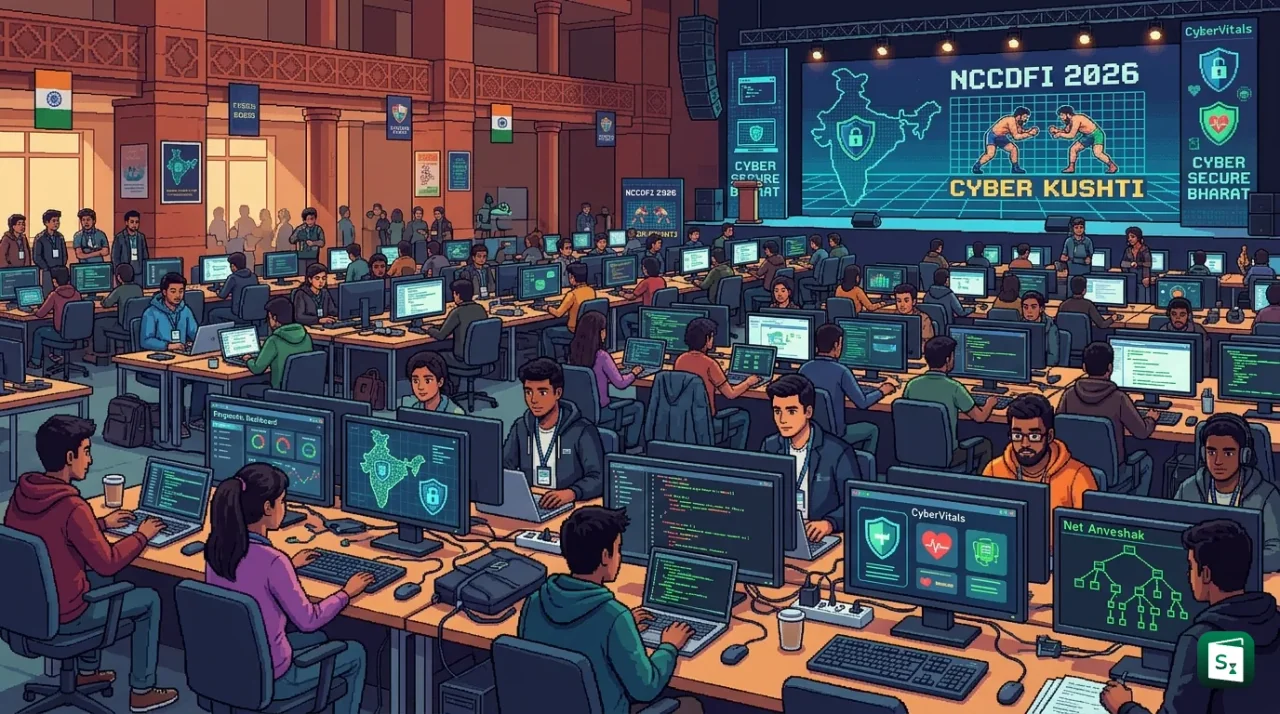
The 3rd National Conference on Cyber Security, Digital Forensics and Intelligence (NCCDFI 2026) was held on 16 and 17 November 2026 at the Dr Ambedkar International Centre in New Delhi. The National Institute of Electronics and Information Technology (NIELIT) organised the conference under the theme Cyber Secure Bharat: Fortifying India’s Digital Future. The event launched two home grown tools, CyberVitals and Net Anveshak, and started the Cyber Kushti 2026 hackathon on cybersecurity and AI.
What Is the National Conference on Cyber Security, Digital Forensics and Intelligence?
The National Conference on Cyber Security, Digital Forensics and Intelligence (NCCDFI) is NIELIT’s national platform to discuss cybercrime, digital investigation and cyber defence. NCCDFI 2026 was the third edition. It took place on 16 and 17 November 2026 at the Dr Ambedkar International Centre at 15 Janpath in New Delhi.
The journey of the conference began in Kohima in 2024. The first edition was held on 25 and 26 July 2024 at the Capital Convention Centre in Kohima. NIELIT Kohima organised it with the Nagaland Police and the state information technology department. The second edition was held in 2025 at Gauhati University in Guwahati, Assam. That edition expanded the event from a regional meet to a national platform.
The 2026 theme was Cyber Secure Bharat: Fortifying India’s Digital Future. The inaugural session was led by Prof M. M. Tripathi, Director General of NIELIT and Vice Chancellor of NIELIT Deemed to be University. Senior officers joined him, including the Directors General of Police of Nagaland and Tamil Nadu, the Economic Adviser of the Ministry of Electronics and Information Technology (MeitY) and the Mission Director of the Andhra Pradesh State Quantum Mission.
NCCDFI 2026 brought together police officers, defence personnel, judges, industry leaders, researchers, teachers and students. It had seven technical sessions with more than 30 speakers and an industry exhibition. The programme listed 10 tracks: cybersecurity, digital forensics, AI security, critical infrastructure, threat intelligence, blockchain and crypto, drone and IoT forensics, digital evidence, cyber law, and cloud security. Knowledge partners included the Indian Cybercrime Coordination Centre (I4C), the Indian Computer Emergency Response Team (CERT-In), Delhi Police, CyberPeace, the Military College of Telecommunication Engineering in Mhow, Maharashtra Cyber, Telangana Cyber Security Bureau and the Software Technology Parks of India.
What Is Cyber Security and Why Is It Important for India?
Cyber security is the practice of protecting computers, phones, networks and data from theft, damage and illegal access. It uses technology, clear rules and trained people to prevent attacks and to respond fast when an attack happens. For India, it protects banking, power grids, government records and the daily online life of crores of citizens.
Cyber crime refers to crimes that use computers or the internet as a tool or target. Common types include phishing, ransomware, fake customer care calls, investment fraud, identity theft and attacks on company servers. Police handle cybercrime under state powers, while the central government supports them with systems and funds.
Three pressures make this work urgent now. First, India has one of the largest online populations in the world, with widespread use of UPI, mobile banking and government portals. Second, attackers now use artificial intelligence to create fake images, voices and messages at large scale. Third, critical services such as electricity, telecom, banking and transport depend on connected computer systems. A single breach can stop payments, leak personal data or weaken public trust.
India responds through a layered system. CERT-In, set up in 2004 under MeitY, acts as the national agency for incident response and issues alerts and guidelines. The National Critical Information Infrastructure Protection Centre (NCIIPC) protects critical systems such as power and banking networks. The National Cyber Coordination Centre (NCCC) helps generate situational awareness about threats. The Indian Cybercrime Coordination Centre (I4C), which became an attached office of the Ministry of Home Affairs on 1 July 2024, coordinates the fight against cybercrime, runs the National Cybercrime Reporting Portal and supports forensic labs for police. The National Cyber Security Policy 2013 provides the umbrella framework for this work, with a vision of a secure and resilient cyberspace for citizens, businesses and government.
What Is Digital Forensics and Cyber Intelligence?
Digital forensics is the scientific method to find, preserve and study digital evidence from phones, computers and networks so that it can be used in investigation and in court. Cyber intelligence is the collection and analysis of information about attackers, their tools and their plans to predict and stop future attacks.
Digital forensics follows a strict chain. Experts first seize the device without changing the data. Then they make an exact copy for study. They recover deleted files, check call records, analyse images and videos, study malware and trace money trails. The findings are written as digital evidence, which must meet legal standards to be accepted by courts.
Common branches include computer forensics, mobile phone forensics, network forensics and cloud forensics. Device forensics deals with phones and hard disks. Network forensics tracks data moving across routers and servers. Multimedia forensics checks if a photo or video is real or altered. At NCCDFI 2026, sessions covered automated investigations, advanced device and multimedia forensics, drone and IoT forensics, and tools to preserve website evidence for court use.
Cyber intelligence adds the preventive side. Analysts track open sources, dark web forums, fake apps and phishing networks. This is called threat intelligence and open source intelligence (OSINT). Banks use it to block fraud accounts. Police use it to find gangs that run fake call centres in different states. Companies use it to patch weak software before attackers exploit it.
What Happened at NCCDFI 2026 in New Delhi?
Day one of NCCDFI 2026 ended on 16 November 2026 with three concrete outcomes: launch of two indigenous tools, start of a national hackathon and signing of seven partnership agreements. NIELIT Director General M. M. Tripathi set three priorities for the road ahead: build India’s own technology, build people and national skills, and build a strong national ecosystem with government, police, colleges and industry working together.
He also listed NIELIT tools already in use or under development. These include the Integrated Cyber Security and Analysis System (ICSAS), a live website acquisition tool that preserves online evidence for investigation, a cybercrime management system and CyberDaksh, an AI assistant being built to help investigators analyse cases faster.
CyberVitals and Net Anveshak: Two New Indigenous Tools
NIELIT launched CyberVitals and Net Anveshak on the first day of the conference. Both tools are developed in India to reduce dependence on foreign software for basic security tasks.
| Feature | CyberVitals | Net Anveshak |
|---|---|---|
| Built by | NIELIT | NIELIT Gorakhpur |
| Main users | Mobile phone users and citizens | Colleges, offices and government departments |
| Main job | Phone safety and privacy check | Network discovery, monitoring and diagnosis |
| Key functions | Detects risky permissions, malware, unsafe app sources and outdated apps | Finds connected devices, scans ports, checks PC security and tracks uptime |
| Special function | Checks images for AI generated content and gives a trust score | Combines many network tools in one application |
| Live monitoring | Tracks network activity, app behaviour and notifications in real time | Monitors network health and troubleshoots faults |
CyberVitals works like a health check for a phone. It flags apps that ask for more access than they need, such as a torch app asking for contacts and location. It warns about apps installed from unsafe sources and software that has not been updated. Its image check helps users spot synthetic photos used in fraud and impersonation. Such automated detection is only an indicator, not final proof, and needs regular updates to keep pace with new AI image tools.
Net Anveshak works like a control room for a small network. Many district offices, police units and colleges run computer networks without a full security team. The tool shows which devices are connected, finds open ports that attackers could misuse and helps staff fix connection problems. By bringing these checks into one home grown suite, it can lower cost and improve control for public institutions.
Cyber Kushti 2026: Cybersecurity and AI Hackathon
Cyber Kushti 2026 is a three level hackathon on the application of AI in cybersecurity. NIELIT organised it with industry and training partners alongside the technical sessions. The name uses the image of a wrestling arena to describe the contest between defenders and attackers.
The contest has three stages: Review, Attack and Defend. Teams can use any AI tool, but they are judged on their own reasoning and skill. Level 1 was an online round called The Akhada. Level 2 was an online round called The Dangal. Level 3, called The Kesari, was held in person in New Delhi on 16 November 2026, with results at the valedictory session on 17 November.
Participation was large. A total of 1,031 teams with 3,093 participants registered. Of these, 923 teams with 2,769 members were cleared for Level 1, 50 teams reached Level 2 and 10 teams reached the final. Many participants came from IITs, technical universities and colleges. The winning team was to receive a cash prize of ₹2.25 lakh.
Seven Partnership Agreements Signed at the Conference
NIELIT exchanged memoranda of understanding with seven partners to support joint research, technology development, training and knowledge sharing. The partners cover language technology, quantum safety, industry training and higher education.
| Partner | Area of Work |
|---|---|
| BHASHINI | AI platform for Indian languages |
| Anuvadini | AI based translation platform |
| JNTU Hyderabad | University collaboration for courses and research |
| IBM India | Technology and industry training |
| QuNu Labs | Quantum security |
| InGage Technologies | Technology solutions |
| Pan IIT Alumni Foundation | Link with IIT alumni network |
The organisers said these agreements will support long term cooperation, joint labs, specialised courses and industry linked projects in cybersecurity, digital forensics and intelligence.
What Is NIELIT and What Does It Do?
NIELIT stands for the National Institute of Electronics and Information Technology. It is an autonomous scientific society under MeitY. Its history goes back to 1994, when it was formed as the DOEACC Society to accredit private computer courses. Centres for electronics design set up from 1974 onward were merged into it in 2002. The society was renamed NIELIT on 10 October 2011.
NIELIT is now a Deemed to be University under the distinct category as per University Grants Commission rules of 2023. It is the only university under MeitY. Its main campus is at Ropar in Punjab, about 40 km from Chandigarh. It has 11 constituent centres at Agartala, Aizawl, Ajmer, Chhatrapati Sambhajinagar, Calicut, Imphal, Itanagar, Kohima, Gorakhpur, Patna and Srinagar, along with a wider network of 56 centres and more than 700 accredited institutes across India.
The institute trains people in electronics, information technology, cyber law, cybersecurity, cloud computing, data analytics and related fields. It runs formal degrees such as B.Tech, M.Tech and PhD, as well as O, A, B and C level courses for skill development. It also runs the NIELIT Digital University, which has reported more than 3.70 lakh enrolments, and semiconductor training facilities in Ahmedabad and Guwahati. Its mandate includes training police, judges, armed forces and government staff to handle digital evidence and cyber threats.
Proposed Quantum and AI University Campus in Amaravati
At NCCDFI 2026, NIELIT announced a plan to set up a dedicated Quantum and AI university campus at Amaravati in Andhra Pradesh. The campus is described as India’s first dedicated campus of this kind for quantum technologies and artificial intelligence.
The background to the plan lies in two earlier steps. NIELIT and the Andhra Pradesh government signed an agreement on 20 February 2026 at the India AI Impact Summit in New Delhi to set up the campus. In August 2026, the Andhra Pradesh Capital Region Development Authority, chaired by Chief Minister N. Chandrababu Naidu, approved 8.5 acres in Amaravati for the project.
Key facts shared about the project are given below. The NIELIT announcement at NCCDFI 2026 did not add new figures on cost or dates, so the approved plan remains the reference point.
| Item | Approved Plan |
|---|---|
| Location | Amaravati, Andhra Pradesh, with temporary classes at Acharya Nagarjuna University in Guntur |
| Area and cost | 8.5 acres with proposed investment of ₹730.70 crore over five years, proposed to be funded by MeitY grant in aid |
| Start of courses | Academic and skill programmes from September 2026 at the temporary facility |
| Courses | UG, PG, doctoral, diploma and executive programmes in quantum computing, quantum communication and security, AI and machine learning, data science, chip design, VLSI, embedded systems and high performance computing |
| Research block | Quantum Research, Innovation and Incubation Block of about 1.25 lakh sq ft with labs for quantum photonics, cryogenics, cleanroom and nano fabrication, chip design and data centres |
| Training target | About 8,250 learners in five years, including 1,650 in degree programmes and 6,600 in skilling courses |
| Partners | Proposed tie ups with IIT Tirupati, IIIT Sri City, Andhra University and JNTU institutions |
The campus plan aligns with three national missions: the National Quantum Mission, the IndiaAI Mission and the India Semiconductor Mission. It also supports Digital India and the goal of self reliance in critical technology. The permanent campus is planned with solar power, energy efficient utilities, hostels for 500 residents, smart classrooms and incubation space for start ups.
How NCCDFI 2026 Fits Into India’s Cyber Security Framework
NCCDFI 2026 links three strands of national policy: indigenous tools, skilled people and coordinated institutions. The launch of CyberVitals and Net Anveshak supports the push to build India’s own technology rather than only use imported products. The hackathon and training partnerships address the shortage of skilled investigators, analysts and engineers.
The conference also strengthens coordination. Police forces from Nagaland, Tamil Nadu, Maharashtra, Telangana and Manipur joined central agencies, the judiciary and industry on one stage. Panel discussions covered national cybersecurity, protection of critical infrastructure, incident response, financial cybercrime, international cooperation and capacity building. An exhibition showed forensic tools, drone systems, surveillance solutions and AI based security products.
For readers, the larger picture is clear. India needs secure phones in every hand, secure networks in every office and secure skills in every investigation unit. Events like NCCDFI aim to connect these three levels, so that a citizen who reports fraud on the national portal, a police officer who collects phone evidence and an engineer who patches a power grid system all work within one trusted digital system.
Key Takeaways
- The 3rd NCCDFI 2026 was held on 16 and 17 November 2026 at the Dr Ambedkar International Centre in New Delhi under the theme Cyber Secure Bharat.
- NIELIT, an autonomous society under MeitY and a Deemed to be University, organised the conference with partners like I4C and CERT-In.
- NIELIT launched CyberVitals for mobile safety and AI image checks and Net Anveshak built by NIELIT Gorakhpur for network monitoring.
- Cyber Kushti 2026 drew 1,031 teams with 3,093 participants, with 10 teams reaching the final for a ₹2.25 lakh top prize.
- The proposed Quantum and AI campus in Amaravati will cover 8.5 acres with ₹730.70 crore investment and train 8,250 learners in five years.