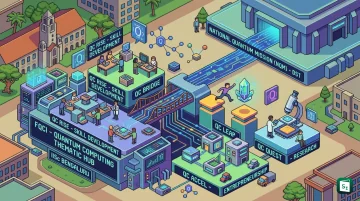
The IISc Bengaluru, has established the Foundation for Quantum Computing Innovation (FQCI) to function as the Quantum Computing Thematic Hub (QC T-Hub) under the National Quantum Mission (NQM). It is to be noted that the NQM is implemented by the Department of Science and Technology (DST).
FQCI is tasked with developing skilled manpower and promoting entrepreneurship in quantum technologies through 5 specialized programmes: Quantum Computing (QC) Rise, QC Bridge, QC Leap, QC Accel, and QC Quest.
The Centre for Development of Telematics (C-DOT) has unveiled 14 indigenous quantum products during its 43rd Foundation Day celebrations in New Delhi. The products are developed in the areas of Quantum Key Distribution (QKD) and Post-Quantum Cryptography (PQC).
The newly launched QKD systems include “Q-AKSHAY CD” (a fibre-based system using Coherent One Way and Differential Phase Shift protocols in a compact 1U size) and “Q-AKSHAY MD” (based on the Measurement Device Independent protocol). The hardware components introduced include “C-SPD” (a Single-Photon Detector) and “C-RD” (a wideband Radio Frequency (RF) driver).
The encryptor lineup features “Q-SETU” (securing Layer 3 communications up to 80 Mbps), “Q-MAHASETU” (a commercial-grade Layer 2/3 encryptor up to 40 Gbps), “Q-VIKRAM” and “Q-PARAKRAM” (defence-grade Layer 2/3 encryptors up to 1 Gbps), and “Q-AMOGH” (a high-speed Layer 1 optical encryptor up to 200 Gbps).
For secure communications, C-DOT introduced “Q-DARSHAN” (a quantum-safe video Internet Protocol (IP) phone) and “Q-VACHAN” (an in-line node using National Institute of Standards and Technology (NIST) PQC algorithms). The network solutions include “Q-RAQSHAK” (for enterprise network protection), “Q-VAAYU” (a wireless point-to-point solution), and “Q-VAJRA1000” (a quantum-safe access node).
The Centre for Development of Telematics (C-DOT) has signed a tripartite agreement with the IISc Bengaluru and the Foundation for Science Innovation and Development (FSID) to establish a C-DOT Centre of Excellence (CoE) at the FSID, IISc Bengaluru.
Punjab National Bank (PNB) has signed an MoU with the Andhra Pradesh government to establish the 'PNB Quantum Finance Hub' at the Amaravati Quantum Valley (AQV) in Amaravati.
This initiative marks the first bank-led Quantum Finance Hub in India, making PNB the first bank to partner with a state government to set up a dedicated Quantum Finance Facility.
The Centre for Development of Telematics (C-DOT) has signed an MoU with the IIT Hyderabad to advance research and innovation in next-generation communication technologies.
Under this collaboration, C-DOT is establishing a Centre of Excellence (CoE) at the campus. This marks the 4th CoE established by C-DOT, following those at IIT Kanpur, IIT Gandhinagar, and IIT Roorkee.
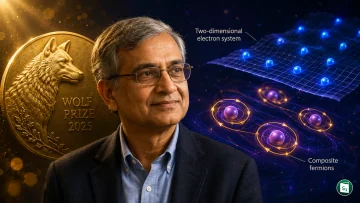
Jainendra K Jain, an Indian-born theoretical physicist, has been honoured with the prestigious Wolf Prize 2025 in the Physics category. He is the first Indian-born theoretical physicist to receive this honour, recognised for his 1989 discovery of composite fermions.
In the Physics category, the prize was jointly awarded to James P Eisenstein (USA), Jainendra K Jain (India/USA), and Mordehai Heiblum (Israel) for their contributions to the study of two-dimensional electron systems and composite fermions. Each category carries a diploma and a cash prize of $100,000.
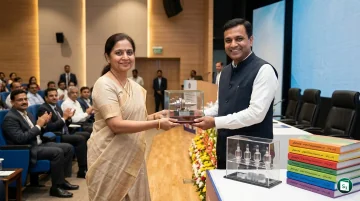
The Council of Scientific and Industrial Research (CSIR) organized a 'Technology Transfer and Bharatiya Nirdeshak Dravya (BND) Release Function' at its headquarters in New Delhi.
During the event, 7 indigenous technologies developed by the CSIR-National Physical Laboratory (CSIR-NPL) and the CSIR-Central Road Research Institute (CSIR-CRRI) were transferred to the industry to promote commercialisation. Additionally, 10 BND reference materials were released, and 5 vapor cells for quantum sensing applications, developed by CSIR-NPL, were handed over.
Union Minister Ashwini Vaishnaw has inaugurated a 20 kW Akashvani FM transmitter in Jaisalmer, Rajasthan, to upgrade communication capabilities along the India-Pakistan border.
He also announced the establishment of an Advanced Quantum Computing and Quantum Communications Lab and a dedicated AI Lab at the Malaviya National Institute of Technology (MNIT) in Jaipur.
Microsoft has unveiled “Majorana 2”, its second-generation topological quantum computing chip developed using its agentic AI platform, “Microsoft Discovery”.
The prototype features 12 topological qubits as a model for scalable systems, with the company aiming to develop commercially viable quantum systems by 2029. Additionally, Microsoft has introduced “Scout”, an AI-powered Microsoft 365 assistant designed to autonomously manage schedules, emails, and meetings.
RBI has issued final amendment directions for Urban Co-operative Banks (UCBs) and Rural Co-operative Banks (RCBs), mandating a 3-year cooling-off period for directors who have completed a continuous tenure of 10 years on the board.
RBI has also established an 8-member expert panel under the Quantum Secure and Adaptive Financial Ecosystem (Q-SAFE) initiative to evaluate the risks posed to the financial system by the adoption of quantum technology. The panel is led by Anil Prabhakar, a professor at the IIT Madras, who serves as the convener.
The Andhra Pradesh government, in collaboration with the Small Industries Development Bank of India (SIDBI), has announced the launch of an angel fund through the Ratan Tata Innovation Hub (RTIH) in New Delhi.
The initiative aims to make the state a hub for deep-tech innovation by providing startups with early-stage funding, industry access, ecosystem support, and global scaling opportunities.