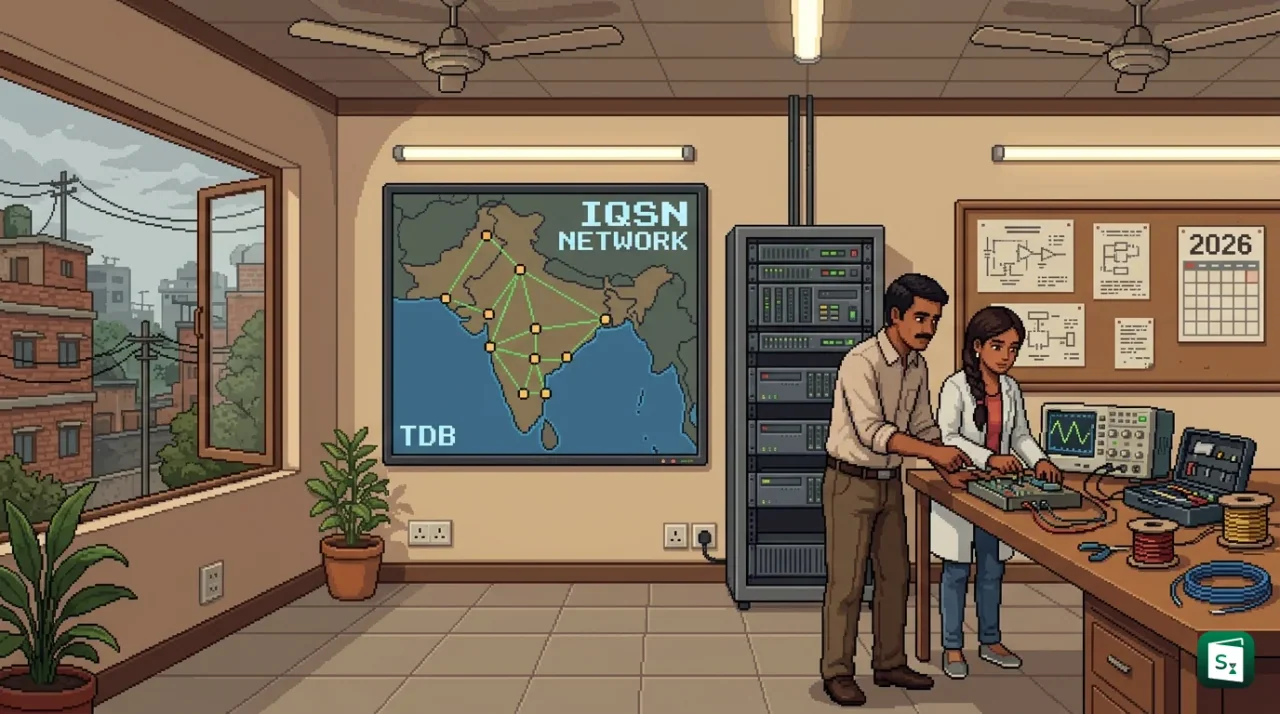
The Technology Development Board (TDB) signed an agreement with QNu Labs Private Limited, a Bengaluru-based deep-tech company, on 16 October 2026, to extend financial support of ₹150 crore under the Research Development and Innovation (RDI) Fund. The money will help build an indigenous technology backbone for India’s Quantum Secure and Sensing Networks (IQSN) as part of a ₹300 crore project. The deal matters because it pushes homegrown quantum security from the laboratory towards real, deployable systems for defence, telecom, banking and critical infrastructure.
What Did the TDB-QNu Labs Agreement Announce?
The agreement commits ₹150 crore of government financial support to QNu Labs for a project whose total cost is ₹300 crore. The remaining cost is met by the company as its own contribution. The stated goal is to build an indigenous technology backbone for India’s Quantum Secure and Sensing Networks (IQSN), a sovereign stack that India can rely on instead of depending on imported security hardware.
A key technical target of the programme is to move a portfolio of quantum technologies from Technology Readiness Levels (TRL) 4 to 5 up to TRL-9. TRL is a scale from 1 to 9 that measures how mature a technology is. At TRL 4 or 5, a technology has been proven only in a laboratory environment. At TRL-9, it is a fully validated system ready for actual deployment. In simple terms, this project aims to convert promising laboratory research into finished products that can be installed and used in the field.
Funding Through Optionally Convertible Debt
The ₹150 crore support is not a free grant. It is routed through Optionally Convertible Debt (OCD). In this instrument, the government extends money to the company as a loan, but the loan can later be converted into equity shares at a decided stage. This lets public money earn a return if the venture succeeds, while also sharing risk with the company. The RDI Fund is designed to support research at higher readiness levels, and QNu Labs will use this capital for engineering refinement, system integration and validation of the IQSN technology stack.
What Is the Technology Development Board?
The Technology Development Board (TDB) is a statutory body set up to help Indian firms turn research into commercial products. It was constituted under the Technology Development Board Act, 1995, which received presidential assent on 16 December 1995, and the Board became functional on 1 September 1996. It works under the Department of Science and Technology (DST), Ministry of Science and Technology.
The TDB is the first body of its kind within the government whose sole aim is to commercialise the results of indigenous research. It provides financial assistance through equity, soft loans and grants. Its soft loans carry a simple interest rate of 5 per cent per annum. The Board’s funds come largely from the Research and Development Cess collected from industry under the Research and Development Cess Act, 1986, which was amended in 1995.
The Board is chaired by the Secretary of the DST, Prof. Umesh V. Waghmare, and its Secretary is Rajesh Kumar Pathak (as of October 2026). The Board has about 11 members, drawn from senior government departments and nominated experts. Under the RDI framework, the TDB became the first Second Level Fund Manager to launch project calls, sign agreements and release funds.
What Is the RDI Fund?
The Research, Development and Innovation (RDI) Fund is a ₹1 lakh crore government fund created to boost private sector research in sunrise and strategic sectors, giving long-term, low-cost capital to companies developing high-risk technologies. It was approved by the Union Cabinet on 1 July 2025 and formally launched by Prime Minister Narendra Modi in November 2025. The Department of Science and Technology (DST) is its nodal ministry.
The Fund aims to transform India from a technology consumer into a developer of globally competitive products. Its objectives include financing projects at TRL 4 and above, supporting the acquisition of strategically critical technologies, and building a dedicated Deep-Tech Fund of Funds. The total outlay is ₹1 lakh crore over six years, including ₹20,000 crore in the financial year 2025-26.
How the Two-Tier Funding Structure Works
The RDI Fund does not invest directly in companies. It works through a two-tier design. At the first level, a Special Purpose Fund (SPF) set up within the Anusandhan National Research Foundation (ANRF) acts as the custodian of the money. At the second level, the capital is channelled through Second Level Fund Managers (SLFMs), which can be Alternative Investment Funds, Development Finance Institutions, Non-Banking Finance Companies or Focused Research Organisations.
Funding is offered as unsecured long-term loans at low interest rates, roughly 2 to 4 per cent, with repayment tenures of up to 15 years and moratorium provisions. Support can cover up to 50 per cent of the total project cost, and it is collateral-free, meaning companies do not have to pledge personal or corporate guarantees. On 12 October 2026, the Fund announced its first cohort of 19 Second Level Fund Managers with a total commitment of ₹7,131 crore.
What Is the National Quantum Mission?
The National Quantum Mission (NQM) is India’s flagship programme to build capability in quantum technologies. Approved by the Union Cabinet on 19 April 2023, it runs from 2023-24 to 2030-31 with an outlay of ₹6,003.65 crore and is implemented by the Department of Science and Technology (DST). It is one of nine initiatives under the Prime Minister’s Science Technology Innovation Advisory Council (PM-STIAC).
The Mission works across four technology verticals: Quantum Computing, Quantum Communication, Quantum Sensing and Metrology, and Quantum Materials and Devices. Its targets include building intermediate-scale quantum computers with 50 to 1,000 physical qubits in eight years, satellite-based secure quantum communication over 2,000 km, and inter-city quantum key distribution over the same distance. It also aims to develop highly sensitive magnetometers and atomic clocks for precision timing, navigation and secure communication.
The Four Thematic Hubs
The Mission is implemented through sector-specific Thematic Hubs (T-Hubs), each set up as a Section-8 non-profit company. These hubs connect researchers, startups and public laboratories under a hub-and-spoke model.
| Vertical | Host Institution | Thematic Hub Company |
|---|---|---|
| Quantum Computing | IISc Bengaluru | Foundation for QC Innovation |
| Quantum Communication | IIT Madras with C-DOT, New Delhi | IITM CDOT Samgnya Technologies Foundation |
| Quantum Sensing and Metrology | IIT Bombay | Qmet Tech Foundation |
| Quantum Materials and Devices | IIT Delhi | QMD Foundation |
India’s Quantum Communication Milestones
India has moved faster than its original timeline. The Mission had set a target of achieving 2,000 km of quantum-secure communication in eight years, but it has already completed about half that distance in less than four years. A 1,000 km quantum communication network, built with indigenous technology, was demonstrated in April 2026, making it one of the longest quantum key distribution deployments in the world. Earlier, a 500 km network had been demonstrated, and in October 2026, a free-space quantum-secure link over 5.56 km was also tested. The number of startups supported under the NQM has risen from eight to seventeen.
The Four Pillars of the IQSN Programme
The IQSN programme is built around four connected pillars that together aim to create a single quantum trust framework. The framework secures the message being sent, along with the device sending it, the location it reports and the time it records.
| Pillar | Core Technologies | What It Protects |
|---|---|---|
| Identity Security | Quantum-secure physical unclonable functions (PUFs) and quantum-safe trusted platform modules (TPMs) | Device identity, authentication and cryptographic security |
| Location Integrity | Compact quantum magnetometers for electromagnetic tampering detection and GPS-denied navigation | Trusted navigation and protection against spoofed positioning |
| Network Security | Chip-based and satellite-based quantum key distribution (QKD), secure communication modules and encryption systems | Confidentiality of communication across terrestrial and long-distance networks |
| Time Integrity | Indigenous atomic clock technology and secure time synchronisation using QKD-authenticated distribution | Tamper-resistant timing for telecom, finance and defence |
Under identity security, QNu Labs will develop quantum-secure physical unclonable functions. A PUF works like a unique electronic fingerprint that a chip produces from tiny, unavoidable variations created during manufacturing. Since it cannot be copied or cloned, it can prove that a device is genuine. The company will also build quantum-safe trusted platform modules, which are secure hardware chips that store keys and confirm a device’s identity.
Under location integrity, the work involves compact quantum magnetometers. These are highly sensitive sensors that can detect tiny changes in magnetic fields, useful for spotting electromagnetic tampering and for navigating when GPS signals are jammed or unavailable. Such capabilities have clear applications in defence and other mission-critical platforms.
Under network security, the programme advances a quantum-safe communications ecosystem using chip-based quantum key distribution (QKD) and satellite-based QKD, along with secure communication modules and encryption systems. This is aimed at protecting both short terrestrial links and long-distance networks. Under time integrity, the focus is on indigenous high-precision timing, including atomic clocks and secure time synchronisation. Reliable, tamper-resistant time is vital for telecommunications, financial systems and defence operations.
What Is Quantum Key Distribution?
Quantum Key Distribution (QKD) is a method of sharing a secret encryption key between two parties using individual particles of light, called photons. Because measuring a photon changes its state, any attempt by an eavesdropper to intercept the key is instantly detectable. This makes QKD a physics-based form of security, not a purely mathematical one.
How Does QKD Work?
The most famous QKD method is the BB84 protocol, proposed by Charles Bennett and Gilles Brassard in 1984. In a QKD link, the sender encodes the key into the quantum states of photons and transmits them over optical fibre or free space. The receiver measures them. The two sides then compare a random sample of their results over a normal channel. If an attacker had tapped the line, the comparison will not match, and the key is discarded and replaced. Once a clean key is agreed upon, it encrypts the actual message.
Analogy · The Uncopyable Sealed Envelope Expand analogy
Imagine sending a password in a sealed envelope that turns red the moment anyone other than the intended receiver opens it. Even if an intruder reads the password, the receiver will immediately know the secret was exposed and can throw it away. QKD works the same way, because the laws of physics guarantee that any eavesdropping leaves a visible trace.
QKD Compared With Post-Quantum Cryptography
Quantum-safe security usually relies on two complementary approaches. QKD is a hardware, physics-based method, while Post-Quantum Cryptography (PQC) is a software-based method that uses new mathematical algorithms running on ordinary classical computers. The table below compares the two.
| Feature | Quantum Key Distribution (QKD) | Post-Quantum Cryptography (PQC) |
|---|---|---|
| Basis of security | Laws of quantum physics | Complex mathematical problems |
| Hardware needed | Specialised optical and quantum equipment | Ordinary computers and updated software |
| Eavesdropping detection | Detectable in real time | Not detectable |
| Distance limits | Limited by fibre and repeaters | No distance limit |
| Deployment | Selected high-security links | Broad, large-scale use |
In practice, many countries, including India, are pairing the two: PQC for wide deployment across systems, and QKD for the most sensitive, high-assurance links.
Why India Needs Quantum-Secure Infrastructure
Most of today’s digital security rests on encryption methods that a future quantum computer could break. The danger is not only in the future. Intelligence agencies and criminal groups are already using a strategy called harvest now, decrypt later, in which they collect and store encrypted data today, hoping to decode it once powerful quantum computers arrive. Sensitive records such as government communication, financial data and medical histories could be exposed years after they were intercepted.
To prepare for this, the DST constituted a Task Force that published a report titled Quantum Safe Ecosystem in India in May 2026. Chaired by Dr. Rajkumar Upadhyay, the CEO of C-DOT, the report sets a phased national roadmap for moving to post-quantum cryptography.
| Milestone | Critical Information Infrastructure | Other Enterprises |
|---|---|---|
| Build foundations | By 2027 | By 2028 |
| Migrate high-priority systems | By 2028 | By 2030 |
| Full PQC adoption | By 2029 | By 2033 |
The accelerated timelines cover the government, defence, power, telecom, transport, and banking and financial services sectors. These deadlines make the TDB-QNu Labs agreement timely. By backing indigenous technology now, India aims to secure its critical systems with homegrown hardware rather than waiting for foreign suppliers.
About QNu Labs
QNu Labs Private Limited is a Bengaluru-based deep-tech cybersecurity company founded in 2016 and incubated at the IIT Madras Research Park. It builds quantum-safe products across the security spectrum. Its main offerings include ARMOS, a quantum key distribution platform, Tropos, a quantum random number generator, and QShield, a unified quantum security platform.
The company was selected as one of the first eight startups supported under the National Quantum Mission in November 2024. It has since scaled quickly in the quantum communication space. In 2024, QNu Labs delivered 25 QKD systems to the Indian Navy, and it went on to demonstrate a 500 km QKD network and later a 1,000 km network, using existing optical fibre.
In September 2026, the company raised over ₹350 crore, made up of a ₹200 crore Series A1 equity round co-led by the National Quantum Mission and the venture fund Speciale Invest, and the ₹150 crore convertible debt under the RDI Fund. Its total capital raised stands at about ₹375 crore. A portion of this funding will build a 2,000 km QKD trunk network connecting Bengaluru and Delhi, aimed at protecting banking systems, data centres and power corridors.
The Way Forward
The TDB-QNu Labs agreement is the starting point of a longer engineering journey. The IQSN programme will now involve further research, engineering refinement, system integration and validation to lift the technologies towards deployment. QNu Labs will work with academic institutions, startups and industry to strengthen the wider quantum ecosystem. The company has also said the programme will extend its base into chip-based and satellite-based QKD, quantum sensing and artificial intelligence.
For India, the significance lies in timing. The country must move its critical infrastructure to quantum-safe encryption by 2029, and doing so with indigenous hardware reduces dependence on foreign technology. If the IQSN programme succeeds, it could give India a sovereign quantum trust framework covering device identity, secure communication, trusted navigation and tamper-resistant timing, all built from the hardware level upward.
Key Takeaways
- The Technology Development Board (TDB) signed an agreement with QNu Labs on 16 October 2026, providing ₹150 crore under the RDI Fund for a project with a total cost of ₹300 crore.
- The support is extended as Optionally Convertible Debt (OCD), and the project targets moving technologies from TRL 4-5 to TRL-9.
- The project will build an indigenous technology backbone for India’s Quantum Secure and Sensing Networks (IQSN) across four pillars: identity security, location integrity, network security and time integrity.
- The Technology Development Board is a statutory body under the Technology Development Board Act, 1995, functioning under the Department of Science and Technology.
- The RDI Fund has a corpus of ₹1 lakh crore over six years and is administered through a Special Purpose Fund within the Anusandhan National Research Foundation (ANRF).
- The National Quantum Mission, approved on 19 April 2023 with an outlay of ₹6,003.65 crore, has four thematic hubs at IISc Bengaluru, IIT Madras with C-DOT, IIT Bombay and IIT Delhi.
- India demonstrated a 1,000 km quantum communication network in April 2026, achieving half of the Mission’s 2,000 km target ahead of schedule.
- Quantum Key Distribution (QKD) uses the quantum states of photons to share encryption keys, making eavesdropping detectable, and relies on the BB84 protocol proposed in 1984.