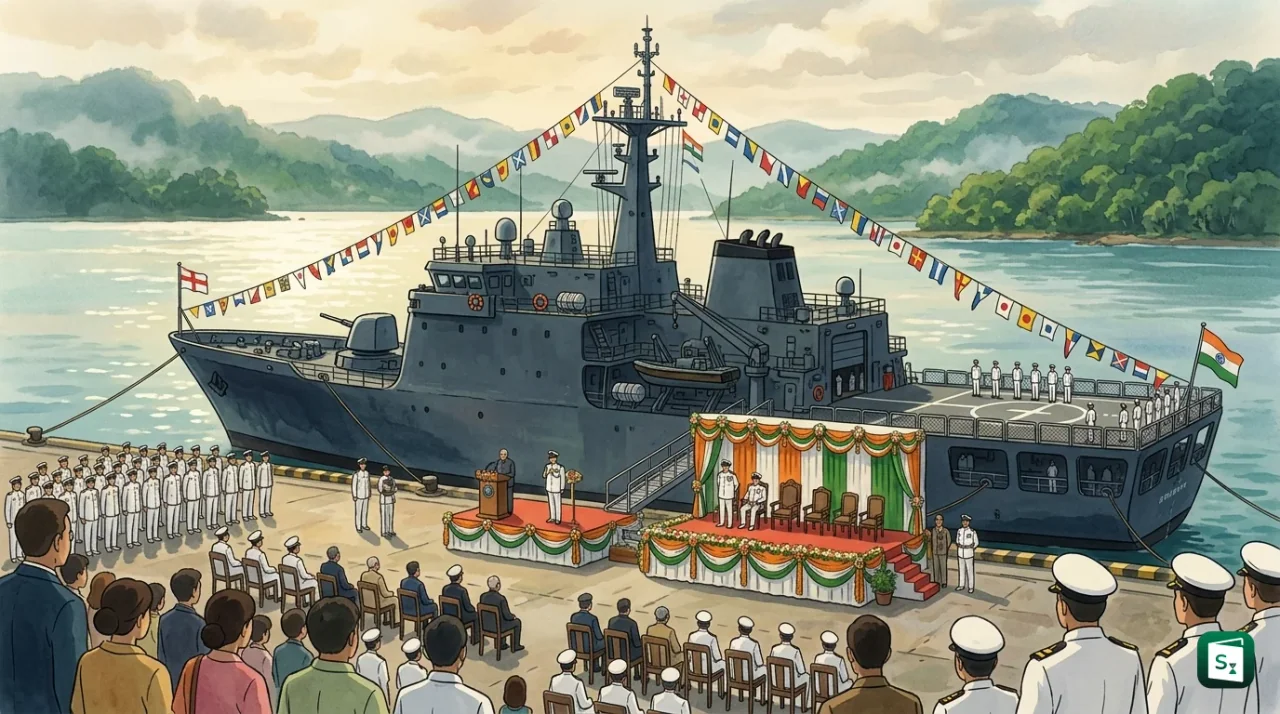
India commissioned INS Samarthak, its first indigenous Multi-Purpose Vessel, at the naval base in Karwar, Karnataka, on 16 October 2026. Vice President C.P. Radhakrishnan presided over the ceremony, which inducted the first major warship built by an Indian private shipyard. Built by Larsen & Toubro (L&T) with over 75 per cent indigenous content, the vessel is designed to test and evaluate next-generation indigenous weapons, sensors and unmanned systems.
What Is INS Samarthak and Why Does It Matter?
INS Samarthak is the Indian Navy’s first indigenously built Multi-Purpose Vessel (MPV), a versatile utility ship meant to test new weapons and sensors, support unmanned systems and assist in disaster relief. It bears the pennant number A 10 and was commissioned at Naval Base Karwar on 16 October 2026.
A Multi-Purpose Vessel is not a frontline combatant. It is a flexible, low-cost platform that can perform many supporting roles so that expensive destroyers and frigates are freed up for genuine combat duties. The Navy describes the MPV as an “ideal utility ship” for strategically important operations.
The ship carries deep symbolic meaning. The word Samarthak means “The Proponent” or supporter, and it signals a vessel built to enable other platforms rather than to fight on its own. Two features make its commissioning notable for India’s defence sector.
First, INS Samarthak is the first major warship built by an Indian private shipyard and commissioned into the Navy. Until now, almost all Indian warships were constructed at state-owned yards such as Mazagon Dock, Garden Reach Shipbuilders and Cochin Shipyard. Second, the ship will act as a floating testbed, allowing the Navy to trial indigenous weapons and electronic systems at sea before they are fitted on frontline warships.
For India’s defence economy, the event underlines a shift from a “Buyer’s Navy” that imports ships to a “Builder’s Navy” that designs and constructs them at home.
Key Features and Specifications of INS Samarthak
The vessel is diesel powered and built for endurance rather than speed. Its Dynamic Positioning System lets the ship hold a precise position at sea, which is essential when launching and recovering targets or operating drones in rough conditions.
| Feature | Detail |
|---|---|
| Builder | L&T Shipyard, Kattupalli, near Chennai |
| Pennant number | A 10 |
| Length | About 107 metres |
| Displacement | About 3,700 tonnes |
| Maximum speed | 15 knots |
| Endurance | Over 4,500 nautical miles at 10 knots |
| Indigenous content | More than 75 per cent |
| Contract value | ₹887 crore for the first two vessels |
Weapons and Combat Provisions
INS Samarthak is not expected to fight as a combatant, so it does not carry a full weapons fit in normal service. Instead, the bow area has provisions to mount different systems when trials demand it. These include a 76 mm naval gun, 40 mm close-in weapon systems, 30 mm guns and 12.7 mm machine guns. There are also provisions for heavyweight and lightweight torpedo launchers, Kavach chaff launchers and an RBU-6000 based indigenous rocket launcher.
Its integrated combat suite combines indigenous sensors, weapons and electronic systems tuned for the demanding maritime environment. Various radars and sonars can be fitted temporarily so that the Navy can test them at sea.
Roles and Missions
The ship’s value lies in its adaptability. It can carry out maritime surveillance and reconnaissance, offshore patrolling and Low Intensity Maritime Operations (LIMO), which cover routine security tasks short of full combat. It will serve as a platform for target deployment and trials, letting the Navy test weapons and sensors at sea.
A major role is acting as a mothership for unmanned systems, supporting uncrewed aerial, surface and subsurface vehicles. The vessel can also be deployed for Humanitarian Assistance and Disaster Relief (HADR) and can be converted into a limited hospital ship during emergencies, besides assisting in salvage and firefighting.
Because the MPV can carry out these auxiliary roles, the Navy’s frontline warships can focus on combat. This separation of duties is central to fleet efficiency.
Built by L&T: A Private Shipyard’s First Major Warship
The Ministry of Defence signed the contract for the first two Multi-Purpose Vessels with L&T Shipyard on 25 March 2022 for ₹887 crore. The keels of both ships were laid in March 2023, and INS Samarthak was launched at L&T’s Kattupalli yard on 14 October 2024. Its sister ship, Utkarsh, meaning “Superior in Conduct”, was launched on 13 January 2025.
L&T Shipbuilding operates two yards: Kattupalli on the east coast near Chennai and Hazira on the west coast near Surat. The Kattupalli yard, spread over roughly 900 acres, is one of India’s largest shipyards and uses a ship-lift with dry and wet berths to move vessels after near-complete construction on land. A dedicated Warship Design Centre in Chennai supports this work with modern 3D design and product lifecycle tools.
The company has designed, built and delivered more than 65 defence vessels over the past decade, including interceptor boats and offshore patrol vessels for the Coast Guard. INS Samarthak is its first major warship to enter the Indian Navy’s fleet.
The ship uses modular construction and pre-outfitting, where large sections are assembled and fitted out inside covered workshops before being joined. This approach compresses build timelines and improves quality, and it has generated employment and capability development across the domestic supply chain.
The Crest and Motto
Every Indian Naval ship carries a crest and a motto that reflect its character. The crest of INS Samarthak shows an Indian elephant emerging from the waves, symbolising strength, intelligence and agility. The ship’s official motto is “Victory is Our Sole Aim”. Its first Commanding Officer is Commander Sushil Kumar Singh.
INS Samarthak and the Multi-Purpose Vessel Programme
INS Samarthak is the first of a planned class of four Multi-Purpose Vessels. Two vessels, Samarthak and Utkarsh, were ordered together in 2022, and the Navy has cleared the path to order two more. The programme is designed to give the fleet a dependable utility platform that can be produced quickly and at relatively low cost.
A key mission for the class is mine countermeasures (MCM). The Indian Navy currently operates no dedicated Mine Countermeasure Vessels, and a long-running effort to acquire a dozen such ships has faced delay for years. The MPV will help fill this gap by acting as a mothership for MCM uncrewed surface and underwater vehicles, launching and recovering them while staying clear of the danger zone.
Along with mine warfare, the class will support the launch and recovery of aerial and subsurface targets and serve as a base for uncrewed platforms. Its large flight deck and stern-mounted crane suit these operations.
| Vessel | Meaning | Status |
|---|---|---|
| Samarthak | The Proponent | Commissioned on 16 October 2026 |
| Utkarsh | Superior in Conduct | Launched; under construction |
| Two additional vessels | Not yet named | Cleared for order |
The MPVs are expected to remain support platforms rather than combatants. Their main contribution is freeing up costly frontline warships from tests, patrols and trials, while giving the Navy a low-risk way to evaluate new technology at sea.
Karwar and INS Kadamba: The Commissioning Venue
Karwar in Karnataka is home to INS Kadamba, one of the Indian Navy’s largest naval bases. The base is being built under Project Seabird, the largest naval infrastructure project in India. INS Kadamba was commissioned on 31 May 2005, and both of the Navy’s aircraft carriers, INS Vikramaditya and INS Vikrant, are based there.
Karwar was chosen because it lies farther from potential missile threats than Mumbai and offers hilly terrain that helps conceal installations. The base also holds India’s first shiplift and transfer system for docking ships and submarines, and it eases congestion at the Mumbai dockyard.
Project Seabird was first sanctioned in 1985, and the foundation stone was laid by Prime Minister Rajiv Gandhi in October 1986. Its timeline has unfolded in phases.
| Phase | Focus | Status |
|---|---|---|
| Phase I | Berthing, docking and basic logistics | Completed in 2011 at a cost of ₹2,629 crore |
| Phase IIA | Naval Air Station, full naval dockyard, logistics support | Ongoing; a roughly $3 billion expansion to host 32 warships and 23 yardcraft |
| Phase IIB | Final expansion to host 50 warships and 40 auxiliary ships | In the planning stage |
Under Phase IIA, Chief of the Defence Staff General N.S. Raja Subramani inaugurated new residential and utility facilities at Karwar on 8 October 2026. More than 90 per cent of the project’s materials and equipment are sourced domestically, again reflecting the Aatmanirbhar Bharat approach. Once fully complete, Karwar is expected to become the largest naval base east of the Suez Canal.
Commissioning INS Samarthak at Karwar ties the new vessel to a base that itself embodies India’s long-term maritime ambition.
Aatmanirbhar Bharat in Naval Shipbuilding
The induction of INS Samarthak sits within a much larger push for self-reliance in defence. Under the Aatmanirbhar Bharat and Make in India initiatives, India’s defence production reached a record ₹1.78 lakh crore in 2025-26, with 76 per cent coming from public-sector entities and 24 per cent from the private sector. Defence exports, meanwhile, rose to ₹38,424 crore in 2025-26.
The Indian Navy has been at the centre of this shift. Of the 66 ships and submarines currently on order, 64 are being built in Indian shipyards, and most carry indigenous content of 75 per cent or more. Every new warship or submarine now adds to a fleet that the Navy aims to grow from roughly 140 vessels to over 200 warships and submarines by 2035.
The approach works through serial production, where repeat orders to the same yard sustain a wide base of suppliers and skilled workers. The year 2026 saw a steady stream of indigenous inductions, building momentum ahead of INS Samarthak’s commissioning.
| Vessel | Class or Type | Builder | Commissioned or Launched |
|---|---|---|---|
| INS Dunagiri | Nilgiri-class stealth frigate | GRSE, Kolkata | 21 June 2026 |
| INS Sanshodhak | Survey Vessel (Large) | GRSE, Kolkata | 21 June 2026 |
| INS Agray | ASW Shallow Water Craft | GRSE, Kolkata | 21 June 2026 |
| INS Mahendragiri | Project 17A stealth frigate | MDL, Mumbai | 11 July 2026 |
| INS Malvan | Mahe-class ASW Shallow Water Craft | CSL, Kochi | 22 July 2026 |
| INS Mangrol | Mahe-class ASW Shallow Water Craft | CSL, Kochi | 12 October 2026 |
| INS Samarthak | Multi-Purpose Vessel | L&T, Kattupalli | 16 October 2026 |
Bringing a private yard into warship building widens this industrial base. State-owned yards will continue to build the largest combatants, while private shipyards take on utility and support vessels. This division allows the Navy to grow its fleet faster without overloading any single yard.
The Way Forward
The immediate task is to bring the second vessel of the order, Utkarsh, to commissioning and to move ahead with the two additional MPVs cleared for construction. As more platforms of this class enter service, the Navy will gain a dedicated fleet for trials and support missions.
INS Samarthak’s success will be judged by how well it converts into operational capability. Its value depends on indigenous sensors, weapons and unmanned systems being tested on it and then fitted on frontline warships. A single hull alone will not complete the journey to self-reliance. Sustained repeat orders, a stable vendor base and steady investment in naval design will matter more.
The wider goal is a balanced fleet that can safeguard India’s sea lanes, protect trade and act as the region’s first responder. The Navy’s role as a preferred security partner in the Indian Ocean Region rests on this strength, and much of it will be built at home. INS Samarthak is a small but meaningful step in that direction.
Key Takeaways
- INS Samarthak was commissioned into the Indian Navy at Karwar, Karnataka, on 16 October 2026 as the service’s first indigenous Multi-Purpose Vessel (MPV).
- INS Samarthak is the first major warship built by an Indian private shipyard, L&T Shipyard at Kattupalli near Chennai.
- The vessel carries over 75 per cent indigenous content and bears the pennant number A 10.
- The ship is about 107 metres long with a displacement of about 3,700 tonnes, a maximum speed of 15 knots and an endurance of over 4,500 nautical miles.
- The name Samarthak means “The Proponent”, the ship’s motto is “Victory is Our Sole Aim”, and its crest shows an Indian elephant emerging from the waves.
- The first two MPVs were ordered from L&T in March 2022 for ₹887 crore; the second vessel is named Utkarsh.
- Karwar is home to INS Kadamba, developed under Project Seabird, which is planned to become the largest naval base east of the Suez Canal.