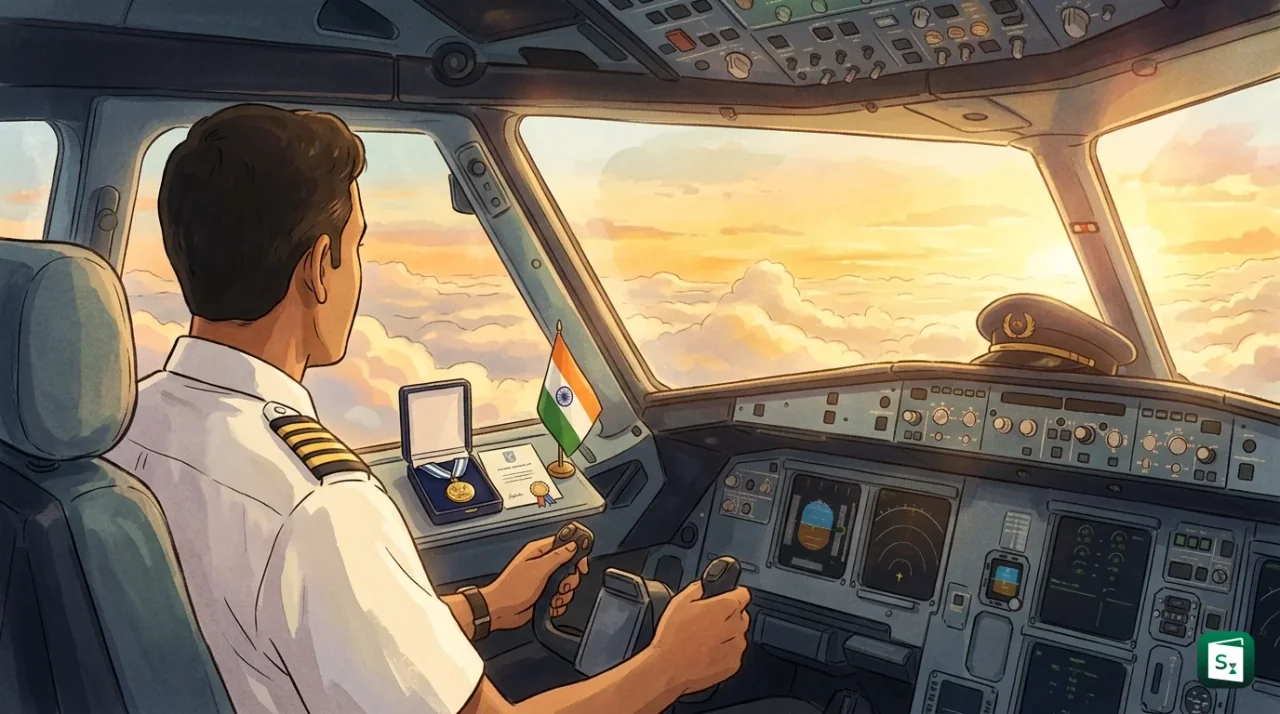
Indian flydubai Captain Smit Machchhar will receive Israel’s Presidential Award for Civilian Heroism, the country’s highest civilian bravery honour, President Isaac Herzog has announced. The award recognises the pilot’s actions on September 30, 2026, when he fought off a mid-air attack by his co-pilot and helped save the 174 people aboard Flight FZ1073. Herzog has said he will present the honour in Jerusalem once Machchhar recovers from his injuries.
Who Is Captain Smit Machchhar?
Captain Smit Machchhar is an Indian commercial pilot who commands Boeing 737 aircraft for flydubai, the government-owned airline of Dubai. A Mumbai-based aviator of Gujarati origin, he has more than 13 years of flying experience and was commanding flydubai Flight FZ1073 on the day of the attack.
Machchhar built his career in the Indian aviation sector before moving to the Gulf. He spent more than 11 years with the Indian carrier SpiceJet, where he rose to the position of Line Training Captain, a senior role that involves training and certifying other pilots. He joined flydubai as a direct-entry captain in June 2022 and now has a flying log of nearly 9,750 hours, most of it on Boeing 737 aircraft.
His experience explains why he could keep his composure under extreme stress. Even after being struck repeatedly and losing consciousness at intervals, he managed to unlock the cockpit door, which allowed others on board to intervene. The Gujarat government later noted that Machchhar’s family roots are in the state, and it described him as a “brave son of Gujarat”.
What Happened Aboard flydubai Flight FZ1073?
On September 30, 2026, flydubai Flight FZ1073 was flying from Dubai to Tel Aviv when its co-pilot attacked Captain Smit Machchhar with an emergency crash axe inside the cockpit and tried to take control of the aircraft. Despite serious injuries, Machchhar unlocked the cockpit door, allowing crew and passengers to overpower the attacker and save the flight.
The Attack Inside the Cockpit
Flight FZ1073 was a Boeing 737 MAX 8 flying from Dubai to Tel Aviv. It carried 174 passengers, most of them Israeli citizens, including 27 children. The co-pilot, an Omani national named Hamam al-Hammami, was alone in the cockpit with Machchhar when the flight was in cruise.
According to Machchhar’s account, the co-pilot said he wanted to pray. As Machchhar turned his attention away out of respect, he was struck hard on the back of his head. He first believed that a part of the aircraft had broken loose and hit him. Within seconds, as the blows kept coming, he realised that the attack was coming from the person who was supposed to be his teammate.
The assault caused the aircraft to lose altitude sharply. Flight-tracking data showed that the Boeing 737 plunged by about 14,000 feet during the confrontation, before the crew regained control. Machchhar suffered serious injuries to his head, neck and hands and drifted in and out of consciousness.
How the Aircraft Was Saved
The turning point was the cockpit door. Fighting through pain and fading consciousness, Machchhar reached the door and unlatched it. Cabin crew members, passengers and off-duty pilots rushed in, restrained the attacker and secured the flight deck.
Two reserve flydubai pilots who were travelling as passengers then took over the controls. A hijack distress signal was sent, and the flight was diverted to Tabuk in north-western Saudi Arabia, where it landed safely. Everyone on board was able to leave the aircraft.
Machchhar was first treated at a hospital in Tabuk, then shifted to Abu Dhabi for further care. A passenger who was a dentist, Dr Shota Musayev, gave him emergency medical help during the flight, using clothing and ice to control heavy bleeding for about 45 minutes. Machchhar is now recovering at a hospital in Abu Dhabi (as of October 2026).
The United Arab Emirates has described the incident as an attempted terrorist act. Its Attorney General, Hamad Al Shamsi, said the co-pilot used a crash axe and tried to seize the aircraft. Investigators are examining the co-pilot’s motive, possible prior planning and whether he had any wider links.
About flydubai: The Airline Behind Flight FZ1073
flydubai is the government-owned low-cost airline of Dubai in the United Arab Emirates. Founded in 2008 as Dubai Aviation Corporation, it began operations in 2009 and now flies an all-Boeing 737 fleet to more than 140 destinations across the Middle East, Africa, Asia and Europe.
The airline is owned by the Investment Corporation of Dubai and is headquartered at Dubai International Airport, where it mostly operates from Terminal 2. Its chairman is Sheikh Ahmed bin Saeed Al Maktoum, and its chief executive is Ghaith Al Ghaith. In 2017, flydubai entered a wide-ranging partnership with Emirates, allowing the two Dubai-based carriers to share routes and flight networks.
| Feature | Detail |
|---|---|
| Full name | Dubai Aviation Corporation (flydubai) |
| Founded | March 2008 |
| Operations began | June 2009 |
| Home base | Dubai International Airport, UAE |
| Parent body | Investment Corporation of Dubai |
| Fleet | All-Boeing 737 (737-800 and 737 MAX) |
| Network | More than 140 routes in about 58 countries |
| Chairman | Sheikh Ahmed bin Saeed Al Maktoum |
| Chief Executive | Ghaith Al Ghaith |
flydubai is a major connector between India and the Gulf. It flies to several Indian cities and to Tel Aviv, which made Flight FZ1073 a busy route carrying a large number of Israeli passengers. The airline has projected an image of affordable travel and, before this incident, had not been linked to any large-scale attack of this kind.
What Is Israel’s Presidential Award for Civilian Heroism?
The Presidential Award for Civilian Heroism is Israel’s highest civilian award for bravery. Established by President Isaac Herzog after the October 7, 2023 massacre, it honours civilians who acted with exceptional courage, at real risk to their own lives, to save human life. Members of the security forces and the police are not eligible.
The award was created to recognise the many stories of ordinary citizens who risked their lives to rescue others during the October 7 attacks and the war that followed. It is granted by the President at a formal state ceremony, after an advisory committee studies each case and recommends names. The committee is chaired by Justice Prof. Elyakim Rubinstein, a former Deputy President of the Supreme Court of Israel.
The medal is a distinct decoration, specially designed by the Jerusalem silversmith Sari Srulovitch. Since its creation, it has been given to civilians who saved lives during the October 7 events and in later incidents, including paramedics and emergency medical workers from organisations such as Magen David Adom and United Hatzalah.
It is important not to confuse this award with the Israel Presidential Medal of Honor, which is a separate civilian honour given for outstanding contribution to the State of Israel. The Civilian Heroism award is specifically about personal bravery in the face of mortal danger.
The Six Israeli Recipients
President Herzog presented the Presidential Award for Civilian Heroism to six Israeli civilians on 8 October 2026 at his residence in Jerusalem, for their role in the Flight FZ1073 incident.
| Recipient | Role During the Flight |
|---|---|
| Tali Manes | Raised the alarm and called off-duty pilots to the cockpit |
| Zvika Manes | Helped restrain the attacker |
| Yaniv Hayoun | Assisted in subduing the attacker |
| Dr Shota Musayev | Gave emergency medical aid to Captain Machchhar |
| Asaf Rajuan | Helped overpower the attacker |
| Or Pardilov | Assisted in securing the flight deck |
It was during this ceremony that Herzog announced that Captain Machchhar would also receive the same award once he recovered. Two days later, on 10 October 2026, the President sent a personal letter to Machchhar, calling him “a hero of Israel, India, and all of humanity” and inviting him to Jerusalem.
Why the Award Resonates with the India-Israel Bond
The honour has drawn fresh attention to the historic relationship between India and Israel. In his letter, President Herzog linked Machchhar’s bravery to Indian soldiers who liberated the city of Haifa in 1918, describing him as a new part of Israel’s history and a symbol of the warmth between the two nations.
India and Israel established full diplomatic relations on 29 January 1992, and the two countries marked 30 years of ties in 2022. Before that, India had a consulate in Mumbai, which served as an early point of contact.
The historical link Herzog referred to is the Battle of Haifa, fought on 23 September 1918 during the First World War. Indian cavalry units, the Hyderabad, Jodhpur and Mysore Lancers of the 15th Imperial Service Cavalry Brigade, helped liberate Haifa from the combined forces of the Ottoman Empire, Germany and Austria-Hungary. 44 Indian soldiers died in the battle. Major Thakur Dalpat Singh, who led the charge, is remembered as the “Hero of Haifa”.
Independent India has kept this memory alive. During Israeli Prime Minister Benjamin Netanyahu’s visit to New Delhi in January 2018, the Teen Murti Chowk war memorial was renamed Teen Murti Haifa Chowk. The memorial, unveiled in 1922, carries three bronze statues representing the three cavalry regiments. The Indian Army’s 61st Cavalry still marks 23 September as its Raising Day, known as Haifa Day. Prime Minister Narendra Modi visited Israel in July 2017, the first such visit by an Indian Prime Minister.
India’s Highest Civilian and Bravery Awards: A Comparison
India’s highest civilian award is the Bharat Ratna, instituted in 1954 for exceptional service in any field. Bravery, however, is recognised through a separate set of honours: the gallantry awards for the armed forces and civilians, and the National Bravery Awards for children.
The Bharat Ratna was instituted on 2 January 1954. It is given for exceptional service in fields such as science, literature, arts and public service, with no distinction of race, occupation, position or sex. Its first recipients in 1954 were C. Rajagopalachari, C.V. Raman and Dr S. Radhakrishnan. The award carries no cash grant and is recommended by the Prime Minister to the President. Under Article 18(1) of the Constitution, a recipient cannot use the award as a title before or after their name.
Below the Bharat Ratna come the Padma Awards, in three grades: Padma Vibhushan, Padma Bhushan and Padma Shri. These are announced every year on Republic Day.
For courage, India has the gallantry awards, announced twice a year on Republic Day and Independence Day and presented by the President. They are divided into wartime and peacetime categories.
| Category | Award | Level |
|---|---|---|
| Wartime gallantry | Param Vir Chakra | Highest |
| Wartime gallantry | Maha Vir Chakra | Second |
| Wartime gallantry | Vir Chakra | Third |
| Peacetime gallantry | Ashoka Chakra | Highest |
| Peacetime gallantry | Kirti Chakra | Second |
| Peacetime gallantry | Shaurya Chakra | Third |
The Param Vir Chakra, India’s highest wartime award, and the Ashoka Chakra, the highest peacetime award, are both given for the most conspicuous bravery or self-sacrifice. The National Bravery Awards, in contrast, are meant for children and are conferred by the Indian Council for Child Welfare in categories such as the Bharat Award and the Geeta Chopra Award.
The comparison shows a shared idea across countries. Like Israel, India keeps its top honour for lifelong achievement, the Bharat Ratna, separate from its honours for physical courage and sacrifice.
Global Tributes and India’s Own Recognition
Captain Machchhar’s action drew praise from leaders around the world. India’s President Droupadi Murmu, Vice-President C.P. Radhakrishnan, Prime Minister Narendra Modi and External Affairs Minister S. Jaishankar all saluted his courage and presence of mind.
Prime Minister Modi said Machchhar’s valour had saved hundreds of lives and averted a great tragedy, and that India was proud of him. Israeli Prime Minister Benjamin Netanyahu called him a true hero and ordered tougher security for Israeli and non-Israeli aircraft. US President Donald Trump also praised the captain, and the Crown Prince of Dubai, Hamdan bin Mohammed Al Maktoum, met him during his recovery.
India’s missions abroad stayed closely involved. The Indian Embassy in Riyadh and the Consulate in Jeddah tracked his health when he was treated in Saudi Arabia, and the Indian Embassy in Abu Dhabi monitored his recovery after he was moved there.
Within India, the Gujarat government announced that it would honour Machchhar with the Vishisht Gujarat Garima Award, along with a cash reward of ₹25 lakh, recognising his bravery and his Gujarati roots.
The recognition also came from outside India’s government. A resolution was introduced in the United States House of Representatives honouring Machchhar for preventing the cockpit takeover. The resolution, moved by Congressman Josh Gottheimer, described the incident as an act of terrorism and a threat to international civil aviation, and called on Saudi Arabia and the UAE to complete a full investigation.
The Road Ahead
Captain Machchhar is recovering at a hospital in Abu Dhabi after treatment for serious head, neck and hand injuries. Doctors and Indian officials have reported that he is making steady progress. The External Affairs Ministry said he is responding well to treatment.
Once he is declared fit, President Herzog plans to present the Presidential Award for Civilian Heroism in Jerusalem. The President has invited Machchhar to visit the city and receive the honour in person, in a ceremony that will bring the two countries’ close ties into focus once again.
The case is also being watched for its wider lessons. It has raised questions about cockpit security, background checks for pilots and how airlines respond when a threat comes from inside the crew itself. Investigators in the UAE continue to examine how the co-pilot planned the attack and whether safety systems need to change.
For Machchhar himself, the ordeal has not dimmed his love for flying. In an interview from his hospital bed, he described his response as a survival instinct and recalled telling himself, “You can’t die like this.” He said he was simply glad that he could do his part.
Key Takeaways
- Israel’s Presidential Award for Civilian Heroism is the country’s highest civilian award for bravery.
- Captain Smit Machchhar, an Indian pilot of flydubai, will receive the award for his role in saving 174 passengers aboard Flight FZ1073 on September 30, 2026.
- The award was established by Israeli President Isaac Herzog after the October 7, 2023 massacre, and is recommended by an advisory committee chaired by Justice Elyakim Rubinstein.
- The flight’s co-pilot, Omani national Hamam al-Hammami, attacked Machchhar with a crash axe before the aircraft was diverted to Tabuk in Saudi Arabia.
- India’s highest civilian award is the Bharat Ratna, instituted in 1954, while bravery is recognised through gallantry awards such as the Param Vir Chakra and the Ashoka Chakra.
- The Gujarat government announced the Vishisht Gujarat Garima Award and a cash reward of ₹25 lakh for Machchhar.