The National Steering Committee (NSC) of the Pradhan Mantri Skilling and Employability Transformation through Upgraded ITIs (PM-SETU) scheme approved an investment of ₹1,194.92 crore for five Industrial Training Institute (ITI) clusters across Maharashtra, Odisha and Jammu & Kashmir on 16 October 2026. With these approvals, the cumulative investment sanctioned under the scheme has climbed to ₹3,687 crore. The move expands PM-SETU’s cluster-based model, which pairs government ITIs with private industry partners to modernise vocational training.
National Steering Committee Approves ₹1,194.92 Crore for Five ITI Clusters
The approvals came at the 6th meeting of the National Steering Committee, held under the chairpersonship of Debashree Mukherjee, Secretary of the Ministry of Skill Development and Entrepreneurship (MSDE). The committee reviewed the progress of the scheme and cleared five Strategic Investment Plans (SIPs), which are detailed project proposals submitted by industry partners for upgrading a group of ITIs. The five new clusters together account for ₹1,194.92 crore.
Each cluster follows the hub-and-spoke model, where one large government ITI works as a central hub and four nearby ITIs function as spokes. The hub and its spokes share advanced infrastructure, modern trades and digital learning systems.
The details of the clusters and their industry partners are given below.
| ITI Cluster | State or UT | Investment | Partnering Industry Body |
|---|---|---|---|
| Kataka | Odisha | ₹240.50 crore | Tata Steel Foundation |
| Pune | Maharashtra | ₹241 crore | BVG India Limited (with BVG Foundation) |
| Chhatrapati Sambhajinagar | Maharashtra | ₹238.01 crore | Belrise Industries Limited |
| Jammu | Jammu & Kashmir | ₹240 crore | Eagle Infra India Limited |
| Srinagar | Jammu & Kashmir | ₹235.41 crore | Inderdeep Infra India Limited |
Along with the investment approvals, the committee reviewed progress under Component II of the scheme, which focuses on the Training of Trainers (ToT). These trainers are the instructors who teach trades to ITI students. As of October 2026, a total of 3,744 trainers have been trained under this programme through National Skill Training Institutes (NSTIs).
Mukherjee also urged the clusters to work towards ISO certification and to include at least one trade aligned with WorldSkills, the global vocational skills competition, in their approved plans.
What Is the PM-SETU Scheme?
PM-SETU stands for Pradhan Mantri Skilling and Employability Transformation through Upgraded ITIs. It is a centrally sponsored scheme of the Ministry of Skill Development and Entrepreneurship (MSDE) that modernises government ITIs with industry support. The Union Cabinet approved it in May 2025, and Prime Minister Narendra Modi launched it on 4 October 2025 at the Kaushal Deekshant Samaroh in New Delhi.
The scheme has a total outlay of ₹60,000 crore, to be spent over five years (2025 to 2030). The cost is shared by the Centre (₹30,000 crore), the States (₹20,000 crore) and the industry (₹10,000 crore). For the central share, 50 per cent is co-financed in equal parts by the Asian Development Bank (ADB) and the World Bank as a result-based loan. This means the funding is linked to measurable outcomes such as training quality and job placements rather than simply being released upfront.
The scheme is implemented by the Directorate General of Training (DGT), which is the technical arm of MSDE and is responsible for curriculum, affiliation and certification of ITIs across the country.
The Two Components of the Scheme
PM-SETU has two distinct parts. Component I covers the upgradation of 1,000 government ITIs by organising them into hub-and-spoke clusters. It includes 200 hub ITIs and 800 spoke ITIs, each upgraded with smart classrooms, modern laboratories, digital content and courses designed with industry input. A hub ITI can receive up to ₹81 crore over five years, while a spoke ITI can receive up to ₹40 crore.
Component II focuses on the capacity building of five National Skill Training Institutes (NSTIs) located in Bhubaneswar, Chennai, Hyderabad, Kanpur and Ludhiana. These are being developed into National Centres of Excellence with global partnerships, mainly to train instructors who can then teach in ITIs.
How the Hub-and-Spoke ITI Model Works
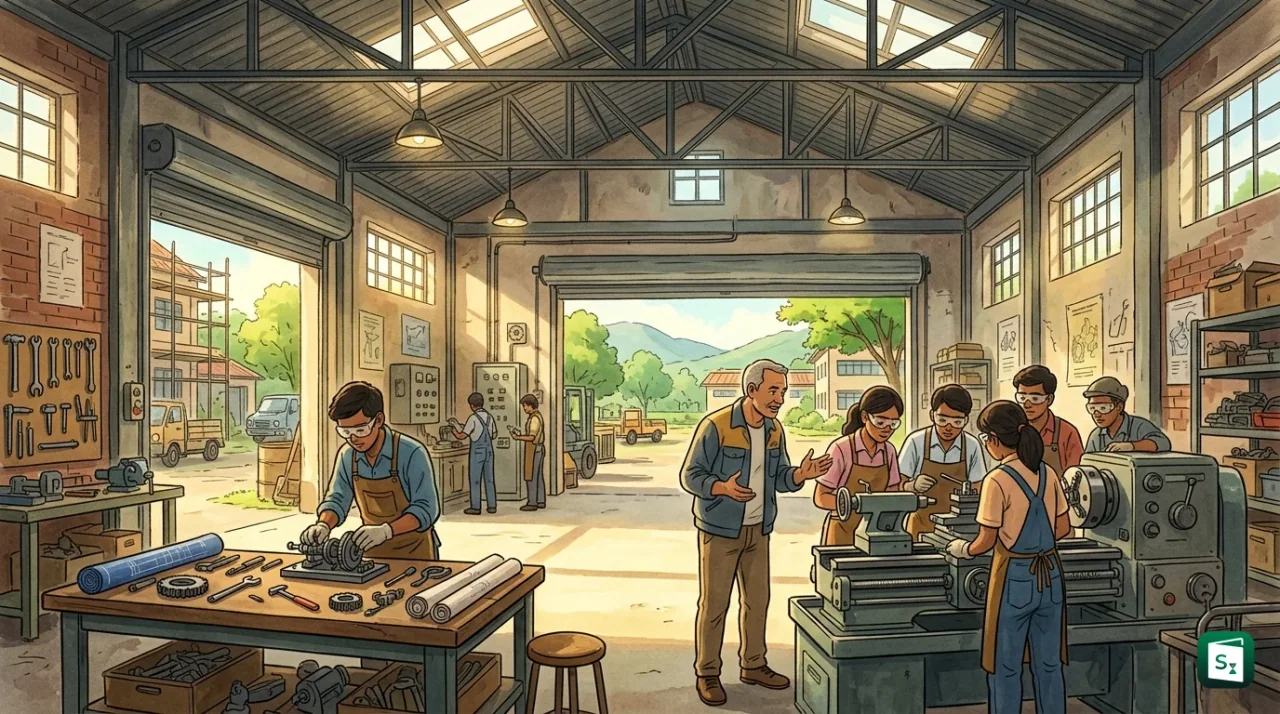
Under the cluster model, one large government ITI is chosen as the hub and four nearby ITIs become its spokes. The hub houses the costly, advanced facilities such as innovation and incubation centres, modern workshops, production units and placement services. The spokes give students in smaller towns access to these shared resources.
The design also upgrades the courses themselves. On average, a hub ITI introduces around four new trades and modernises ten existing ones, while each spoke ITI adds two new trades and improves eight existing ones. The scheme prioritises emerging sectors such as Artificial Intelligence, semiconductors and green energy, so that students train for jobs that are actually growing.
Analogy · A Central Library System Expand analogy
Think of each cluster as a network of local libraries built around one large central library. The central library, or hub, holds the expensive and rare collections, while the smaller branch libraries, or spokes, serve nearby readers. Students anywhere in the network can access the best resources, without every small town needing to build an expensive facility of its own.
Understanding Industrial Training Institutes and Their Certification
An Industrial Training Institute (ITI) is a government or private institution that provides vocational training to students who have completed at least Class 8 or Class 10. ITIs teach practical trades that lead directly to jobs in industry, construction, automotive, electronics and other sectors. The number of ITIs in India has grown from about 9,776 in 2014 to more than 14,688 (as of 2026).
Most ITI courses are run under the Craftsmen Training Scheme (CTS), which the DGT oversees. Courses are offered in both engineering and non-engineering trades and run for one or two years. About 70 per cent of the training time is spent on practical work in workshops, with the rest devoted to trade theory. Courses are aligned with the National Skills Qualification Framework (NSQF), a system launched in December 2013 that organises all qualifications into eight levels based on the skills and knowledge a learner acquires.
A student who passes the final All India Trade Test (AITT) receives the National Trade Certificate (NTC). Apprentices who complete industry training receive the National Apprenticeship Certificate (NAC), while those who complete instructor training get the National Craft Instructor Certificate (NCIC). All these certificates are recognised by the National Council for Vocational Education and Training (NCVET), the country’s overarching skills regulator, which was notified in December 2018 by merging the earlier National Council for Vocational Training (NCVT) and the National Skill Development Agency (NSDA).
| Certificate | Full Form | Awarded For |
|---|---|---|
| NTC | National Trade Certificate | Completing an ITI course under CTS |
| NAC | National Apprenticeship Certificate | Completing apprenticeship training in industry |
| NCIC | National Craft Instructor Certificate | Completing craft instructor training |
Industry Partners, Special Purpose Vehicles and the Funding Model
The most striking feature of PM-SETU is that it hands the daily management of upgraded ITIs to private industry. Each cluster is managed through a Special Purpose Vehicle (SPV), a dedicated company created only for running that cluster and delivering agreed training and placement results. The Anchor Industry Partner (AIP) holds a 51 per cent stake in the SPV, while the Central and State Governments hold 24.5 per cent each. This is why the scheme describes upgraded ITIs as “government-owned but industry-managed”.
To qualify as an anchor partner, a company must be financially strong and credible. The prescribed criteria include an average annual turnover of at least ₹200 crore over the previous three financial years, a positive net worth, and a regular workforce of 500 or more employees. Industry associations, consortia and corporate social responsibility arms of companies can also participate. In the latest round, the partners range from Tata Steel Foundation and BVG India to smaller infrastructure firms, showing that both large conglomerates and mid-sized companies are joining the model.
The presence of industry inside the governance structure changes how ITIs operate. Companies help design courses around the trades they actually need, offer on-the-job training and apprenticeships, and often hire successful trainees directly. Governments continue to provide the bulk of the funding and policy support. A result-linked funding approach pushes every cluster to focus on the final outcome, which is the employability of the student, not just the completion of the course.
Skill India Mission and India’s Demographic Dividend
PM-SETU sits within the wider Skill India Mission, launched by the Prime Minister on 15 July 2015, which is observed as World Youth Skills Day. The mission is anchored by the MSDE, a ministry created in 2014 to bring all skilling programmes under one roof. Its flagship short-term programme is the Pradhan Mantri Kaushal Vikas Yojana (PMKVY), while PM-SETU strengthens the long-term vocational training delivered through ITIs.
The strategic reason behind this focus is India’s demographic dividend. More than 54 per cent of India’s population is below 25 years of age, and over 62 per cent falls in the working-age group of 15 to 59 years. This advantage is expected to last only until around 2040, which gives the country a limited window to convert a young population into a skilled and productive workforce. A large part of this workforce has traditionally lacked formal, industry-ready skills, and that gap is exactly what schemes such as PM-SETU aim to close.
There are early signs of progress. The India Skills Report 2026 placed India’s overall employability at 56.4 per cent, up from 46 per cent in 2020. ITIs have also expanded their reach into new-age trades, with courses in areas such as additive manufacturing, artificial intelligence programming and advanced CNC machining now being offered. Together, these changes are slowly shifting ITIs from being seen as a last option to being aspirational centres of practical learning.
Progress Under PM-SETU and the Way Forward
In its first year, PM-SETU has moved from planning to actual implementation. By October 2026, a total of 850 ITIs had been identified, comprising 172 hub ITIs and 678 spoke ITIs. As many as 36 States and Union Territories have identified their clusters and created dedicated budget heads for the scheme, while 35 States and Union Territories have set up their own State Steering Committees to guide implementation. The scheme has also moved from its initial pilot phase to a planned nationwide rollout across all 200 identified ITI clusters.
Yet the pace of on-ground upgradation remains the key test. Of the 1,000 ITIs targeted, fewer than a hundred have so far been brought into approved clusters, and construction, equipment procurement and course redesign take time. The genuine measure of success will be whether ITI graduates find better-paying jobs and whether industry keeps investing once the novelty of the scheme fades. The government’s own target of a high institutional placement rate is a useful benchmark against which the scheme’s results can be judged in the coming years.
Key Takeaways
- The National Steering Committee of PM-SETU approved ₹1,194.92 crore for five ITI clusters across Maharashtra, Odisha and Jammu & Kashmir on 16 October 2026.
- With these approvals, the cumulative investment sanctioned under PM-SETU has reached ₹3,687 crore.
- PM-SETU (Pradhan Mantri Skilling and Employability Transformation through Upgraded ITIs) was launched on 4 October 2025 with a total outlay of ₹60,000 crore over five years.
- The scheme upgrades 1,000 government ITIs (200 hubs and 800 spokes) and five NSTIs into National Centres of Excellence.
- The five newly approved clusters are Kataka (Tata Steel Foundation), Pune (BVG India), Chhatrapati Sambhajinagar (Belrise Industries), Jammu (Eagle Infra India) and Srinagar (Inderdeep Infra India).
- Each cluster is managed through a Special Purpose Vehicle in which the Anchor Industry Partner holds 51 per cent, while the Centre and States hold 24.5 per cent each.
- As of October 2026, a total of 3,744 trainers have been trained under the Training of Trainers component of the scheme.