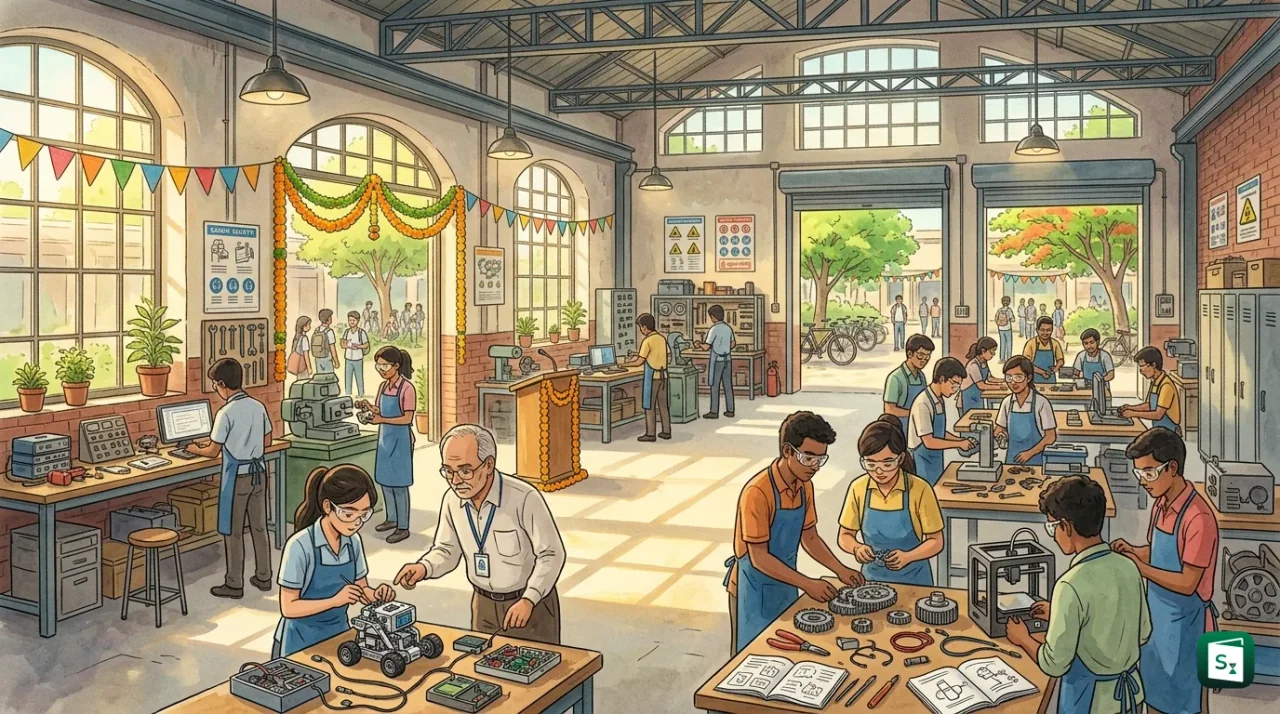
The Pradhan Mantri Skilling and Employability Transformation through Upgraded ITIs (PM-SETU) completed one year of implementation on 4 October 2026, a year after its launch on 4 October 2025 by the Prime Minister. The Ministry of Skill Development and Entrepreneurship (MSDE) has identified 850 government Industrial Training Institutes (ITIs), comprising 172 Hub ITIs and 678 Spoke ITIs, for upgradation in this first year. Backed by a total outlay of ₹60,000 crore, the scheme has moved from pilot preparation to a nationwide rollout across 200 ITI clusters.
What Is the PM-SETU Scheme and Which Ministry Implements It?
The PM-SETU scheme stands for Pradhan Mantri Skilling and Employability Transformation through Upgraded ITIs. It is a Centrally Sponsored Scheme implemented by the Ministry of Skill Development and Entrepreneurship (MSDE) through the Directorate General of Training (DGT). The main objective of the PM-SETU scheme is to transform government ITIs into modern, industry managed training institutions and improve employability through demand driven courses.
PM-SETU is not a Central Sector Scheme. Central Sector Schemes are fully funded by the Union Government. PM-SETU follows a shared funding model with contributions from the Centre, States and industry. This design makes it a Centrally Sponsored Scheme, where States play a direct role in selection and implementation.
The MSDE is the nodal ministry for all national skilling efforts. The Ministry was created in November 2014 to bring skill programmes under one roof. The DGT functions as its apex body for vocational training. The DGT sets common standards, designs curricula for the Craftsmen Training Scheme (CTS), conducts examinations and grants affiliation to ITIs, while day to day administration of ITIs rests with State Governments.
PM-SETU Outlay, Funding Pattern and Launch Timeline
The PM-SETU financial outlay is ₹60,000 crore for five years from 2025 to 2030. The Union Government announced the ITI upgradation plan in the Union Budget 2024-25, with an initial token provision. The Union Cabinet approved the scheme in May 2025 as the National Scheme for ITI Upgradation. The Prime Minister formally launched PM-SETU on 4 October 2025 at the Kaushal Deekshant Samaroh in Vigyan Bhawan, New Delhi.
The total budget is shared among three partners. This joint ownership is central to the scheme. Industry puts in money and also takes responsibility for training outcomes.
| Contributor | Share in ₹60,000 Crore Outlay |
|---|---|
| Central Government | ₹30,000 crore |
| State Governments | ₹20,000 crore |
| Industry Partners | ₹10,000 crore |
Half of the Central share is co-financed through external loans. The World Bank has approved an $830 million loan and the Asian Development Bank (ADB), headquartered in Manila, has approved an $846 million loan for the programme. Together, the two loans cover 50 percent of the Central share. The World Bank programme aims to produce more than a million better skilled workers each year and mobilise at least $680 million in private capital. It also sets a target that at least 25 percent of ITI students should be women over the next five years.
Hub and Spoke Model for Upgrading 1000 ITIs
PM-SETU has two components. Component 1 covers the upgradation of 1,000 government ITIs, made up of 200 Hub ITIs and 800 Spoke ITIs. Component 2 covers capacity augmentation of five National Skill Training Institutes (NSTIs) located in Bhubaneswar, Chennai, Hyderabad, Kanpur and Ludhiana, including the creation of sector specific National Centres of Excellence for Skilling.
Under the hub and spoke model, each Hub ITI is linked on average to four Spoke ITIs. Together they form one ITI cluster. There will be 200 such clusters across the country. The Hub acts as the resource centre. The Spokes extend access to learners in surrounding areas.
| Feature | Hub ITI | Spoke ITI |
|---|---|---|
| Number under scheme | 200 | 800 |
| Core role | Advanced training, shared high cost equipment and mentoring | Foundational training and wider access |
| Key facilities | Smart classrooms, modern labs, innovation and incubation centres, production units, placement cells | Upgraded classrooms, labs and digital learning linked to Hub |
| Extra responsibility | Training of trainers and industry exposure | Feeding trainees into Hub for specialised modules |
Management follows a government owned but industry managed principle. Each cluster is run by a Special Purpose Vehicle (SPV), which is a not for profit company. The Anchor Industry Partner (AIP) holds 51 percent in the SPV, while the Centre holds 24.5 percent and the State holds 24.5 percent. The AIP leads curriculum redesign, brings new equipment, arranges exposure in real production environments and supports placements. Industry partners are selected after they submit a Strategic Investment Plan (SIP) in response to a Request for Proposal.
One Year Milestone: ITI Identification, SIP Approvals and Nationwide Rollout
The first year moved the scheme from institution building to ground implementation. The MSDE constituted a National Steering Committee (NSC) chaired by the Secretary, MSDE, to give policy direction, approve guidelines and monitor progress. States created matching structures. 36 States and Union Territories have identified clusters and opened dedicated State budget heads. 35 States and Union Territories have set up State Steering Committees led by Chief Secretaries. 26 States and Union Territories have started inviting industry participation through Expression of Interest or Request for Proposal.
Against the target of 1,000 ITIs, 850 ITIs have been identified in year one, including 172 Hub ITIs and 678 Spoke ITIs. The NSC has approved the shift from pilot phase to nationwide rollout across all 200 ITI clusters. States can now move ahead based on industry readiness and implementation capacity.
The clearest proof of progress is financial closure on clusters. The NSC has approved SIPs for 14 ITI clusters in 8 States and 1 Union Territory with a combined investment of ₹3,446 crore. Telangana accounts for four of these clusters. The largest single SIP is Kurukshetra in Haryana at ₹320 crore.
| State or UT | Cluster | Anchor Industry Partner | Sector | Value (₹ crore) |
|---|---|---|---|---|
| Andhra Pradesh | Kancharapalem, Visakhapatnam | ArcelorMittal Nippon Steel India | Steel and Metals | 200 |
| Odisha | Keonjhar-Barbil | Jindal Naveen Avsar Ltd | Diversified Manufacturing | 240 |
| Gujarat | Surat | ArcelorMittal Nippon Steel India | Steel and Metals | 240 |
| Telangana | Old City | Apollo MedSkills Ltd | Healthcare and Life Sciences | 241 |
| Telangana | Sangareddy | Neuland Foundation | Pharma and Chemicals | 241 |
| Telangana | Patancheru | Sri Siddharth Infratech and Services | Diversified Manufacturing | 275 |
| Rajasthan | Bhiwadi | H.G. Infra Engineering Ltd | Infrastructure and Construction | 241 |
| Uttar Pradesh | Meerut | National Skill Development Corporation | Skill Development | 240 |
| Telangana | Medchal | Zen Technologies Ltd | Defence and Electronics | 254 |
| Haryana | Kurukshetra | Jindal Naveen Avsar Ltd | Diversified Manufacturing | 320 |
| Maharashtra | Chhatrapati Sambhaji Nagar | Belrise Industries | Automotive | 238 |
| Maharashtra | Pune | BVG Group | Facility Management | 241 |
| Jammu and Kashmir | Srinagar | Inderdeep Infra India Ltd | Infrastructure and Construction | 235 |
| Jammu and Kashmir | Jammu | Eagle Infra India Ltd | Infrastructure and Construction | 240 |
Training of Trainers, New Age Courses and Skill India Linkage
Good buildings alone do not create skills. Teachers and courses matter equally. The DGT has introduced 31 new age courses under the Craftsmen Training Scheme for PM-SETU clusters. These cover areas such as electric vehicles, artificial intelligence, robotics, Internet of Things, drones, 5G, mechatronics, cloud computing and cybersecurity. The regular ITI courses list continues to offer 169 trades, including 86 engineering trades, 78 non engineering trades and 5 courses for persons with disabilities. Training duration ranges from six months to two years. Admissions through the ITI admission 2026 cycle will feed directly into this upgraded pipeline.
Component 2 addresses the shortage of quality trainers. Only about 15 percent of more than 95,000 instructors across India are trained under the Craft Instructor Training Scheme (CITS). PM-SETU will provide pre service and in service training to 50,000 trainers through the five NSTIs. The first Craft Instructors Training Institute was set up in 1948. These institutes were renamed as NSTIs in April 2018 to bring uniformity. Today there are 33 NSTIs, including 19 exclusively for women.
Global partnerships will raise these five NSTIs to world standards. A Memorandum of Understanding has been signed with Singapore for NSTI Chennai, a Joint Declaration of Intent has been exchanged with Germany for NSTI Hyderabad, and a Letter of Intent has been exchanged with France for NSTI Kanpur. These tie ups will support advanced training of trainers, curriculum development and exposure to global practices.
PM-SETU builds on the Skill India Mission, which was launched on 15 July 2015 and is anchored by the MSDE. Its flagship short term programme is the Pradhan Mantri Kaushal Vikas Yojana (PMKVY). ITIs themselves are much older. The Craftsmen Training Scheme began in 1950 to supply skilled workers for domestic industry. The ITI network has grown by nearly 47 percent since 2014 to reach 14,615 institutes with 14.40 lakh enrolment. At the launch event, the Prime Minister also inaugurated 1,200 Vocational Skill Labs in 400 Navodaya Vidyalayas and 200 Eklavya Model Residential Schools to give school students early exposure to 12 key sectors.
Key Takeaways
- PM-SETU stands for Pradhan Mantri Skilling and Employability Transformation through Upgraded ITIs and was launched on 4 October 2025.
- PM-SETU is a Centrally Sponsored Scheme implemented by the Ministry of Skill Development and Entrepreneurship with a total outlay of ₹60,000 crore.
- The scheme targets 1,000 government ITIs (200 Hub and 800 Spoke) and 5 NSTIs at Bhubaneswar, Chennai, Hyderabad, Kanpur and Ludhiana.
- In one year till 4 October 2026, 850 ITIs (172 Hub and 678 Spoke) were identified and SIPs worth ₹3,446 crore were approved for 14 clusters.
- Each cluster SPV gives 51 percent share to the Anchor Industry Partner, with 24.5 percent each to the Centre and the State.
- The World Bank ($830 million) and the Asian Development Bank ($846 million) together co-finance 50 percent of the Central share.