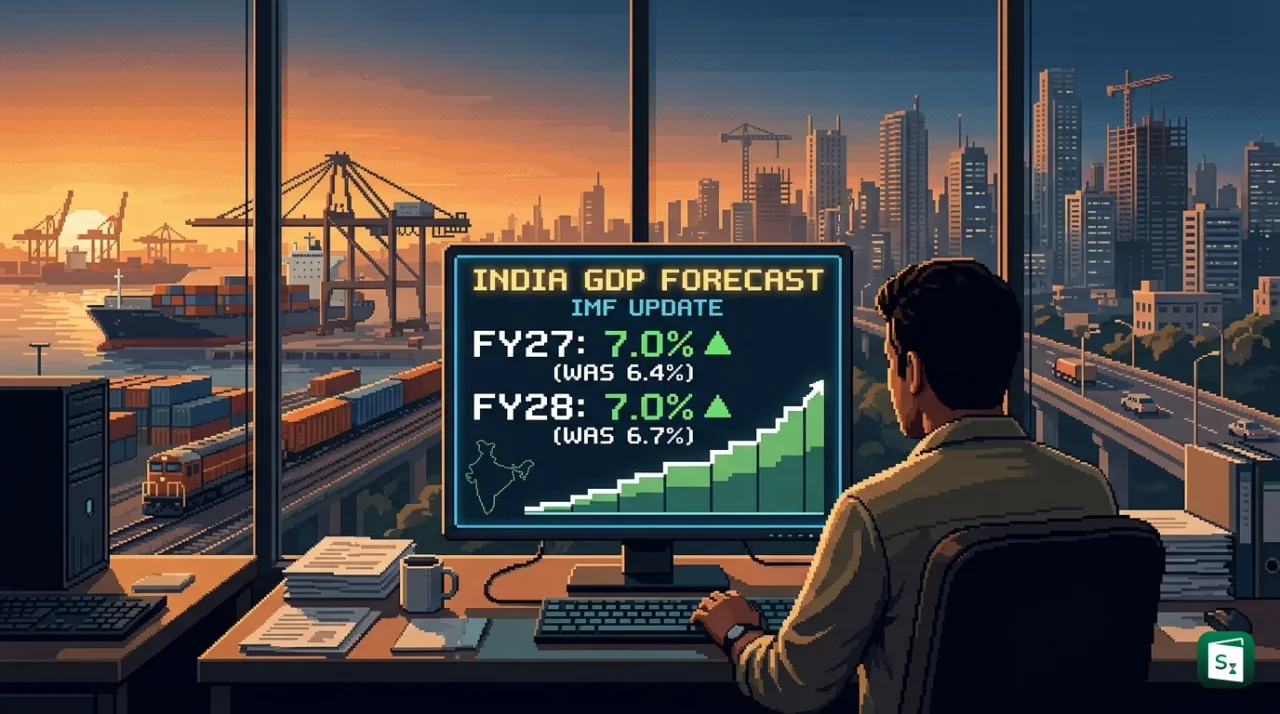
The International Monetary Fund raised its India GDP forecast to 7 percent for both FY27 and FY28 in its World Economic Outlook released on 13 October 2026. The FY27 projection is up from 6.4 percent in July 2026, while the FY28 projection is up from 6.7 percent. The upgrade keeps India as the fastest growing major economy even as global growth slows under high energy prices.
What Is the Latest IMF Forecast for India?
The International Monetary Fund (IMF) projects India’s real GDP growth at 7 percent in FY27 (financial year 2026-27) and 7 percent in FY28 (financial year 2027-28). The October 2026 World Economic Outlook, titled Resilience Under Strain, Urgent Choices, was released on 13 October 2026 during the IMF World Bank Annual Meetings in Bangkok, Thailand. India remains the fastest growing major economy in both years.
The revision is sharp for FY27. The IMF had projected 6.4 percent for FY27 in its July 2026 update. The new forecast is 0.6 percentage points higher. For FY28, the IMF had projected 6.7 percent in July. The new forecast is 0.3 percentage points higher.
| Fiscal Year | July 2026 IMF Forecast | October 2026 IMF Forecast | Change |
|---|---|---|---|
| FY27 (2026-27) | 6.4 percent | 7.0 percent | Up 0.6 percentage points |
| FY28 (2027-28) | 6.7 percent | 7.0 percent | Up 0.3 percentage points |
In India, the financial year runs from 1 April to 31 March. So FY27 covers April 2026 to March 2027. The IMF presents these as calendar aligned growth rates for 2026 and 2027. The upgrade follows strong quarterly data. India’s real GDP grew 7.8 percent in the April to June quarter of FY27, higher than the 6.9 percent in the same quarter last year and above the Reserve Bank of India estimate of 7 percent for the quarter.
Why Did the IMF Raise India’s Growth Projection?
The IMF pointed to stronger than expected momentum in the Indian economy. Domestic demand stayed firm. Services activity stayed robust. Investment demand picked up. These forces offset the pressure from higher global oil prices linked to the conflict in West Asia.
The quarterly GDP data for India explain the confidence. In the first quarter of FY27, real GDP at constant prices was estimated at ₹81.36 lakh crore. Nominal GDP at current prices was estimated at ₹88.27 lakh crore, up 10.3 percent. Real Gross Value Added (GVA), which measures value created across sectors before adding taxes, grew 8.2 percent to ₹73.82 lakh crore.
Manufacturing expanded 9.2 percent. The secondary sector as a whole grew 8.6 percent. Services led the performance with 10 percent growth, driven by financial, real estate, information technology and professional services at 12.1 percent. On the spending side, gross fixed capital formation, which tracks investment in machinery, buildings and infrastructure, rose 11.9 percent. Private consumption grew 7.1 percent while exports rose 12 percent.
The IMF also flagged structural supports. A large domestic market, favourable demographic trends and public spending on infrastructure continue to support growth. Investment linked to artificial intelligence and electronics added fresh demand. Limited pass through of higher input costs to retail prices helped protect consumption.
What Is GDP and How Is India’s Growth Measured?
Gross Domestic Product (GDP) is the total value of final goods and services produced within a country during a specific period. Real GDP growth measures change after removing the effect of price rises. It shows whether actual output has increased. Nominal GDP measures output at current prices. It includes both output growth and inflation.
India publishes GDP data through the Ministry of Statistics and Programme Implementation (MoSPI). The National Statistical Office under the ministry releases quarterly and annual estimates. Growth is reported both as GDP and as GVA. GVA shows earnings from production across agriculture, industry and services. GDP equals GVA plus indirect taxes minus subsidies.
India’s GDP growth rate in the last decade has mostly stayed between 6 percent and 8 percent, except for the pandemic contraction in FY21 and the rebound after it. The current run is strong. Growth for FY24 was revised to 7.3 percent, FY25 to 7.2 percent and FY26 to 7.8 percent. If FY27 reaches 7 percent, it will mark four years in a row of growth at or above 7 percent.
What Is the IMF and How Does It Work?
The International Monetary Fund (IMF) is a global financial institution with 191 member countries that promotes monetary stability, trade growth and financial balance. It provides policy advice, emergency loans and technical training. It was conceived in July 1944 at Bretton Woods and started operations in 1945.
IMF stands for International Monetary Fund. The IMF was conceived in July 1944 at the United Nations Bretton Woods Conference in the United States. Representatives of 44 countries met to build a system for economic cooperation after the Great Depression of the 1930s. The IMF formally came into existence in 1945.
The IMF is headquartered in Washington, D.C., in the United States. It is a specialised agency of the United Nations (UN) with its own charter, staff and budget. The IMF is governed by a Board of Governors with one governor from each member country. Daily work is overseen by a 25 member Executive Board. The Managing Director is Kristalina Georgieva (as of October 2026). She is the first person from an emerging market economy to lead the IMF. The Economic Counsellor and head of research is Silvana Tenreyro, named in July 2026.
The IMF performs three main roles. First, surveillance means it tracks the economic health of members and warns about risks. Second, lending means it gives loans to countries facing balance of payments stress. Third, capacity development means it trains officials and helps improve tax, budgeting and statistics systems. IMF money comes mainly from quotas, which are subscriptions each member pays based on its economic size. Quotas also decide voting power.
For India, the IMF connection is old. India is a founding member. The IMF supported India with loans during the 1991 balance of payments crisis. Today the IMF reviews India every year and publishes forecasts in the World Economic Outlook, the Global Financial Stability Report and Article IV country reports.
Where Does India Stand in the World Economy?
India is the world’s fourth largest economy by nominal GDP (as of 2026). The size of the Indian economy is valued at about $4.18 trillion. IMF projections for 2026 place India at about $4.51 trillion, just ahead of Japan at about $4.46 trillion. The United States and China hold the first and second positions. Germany holds the third position, which India aims to overtake by 2030 with a projected size of $7.3 trillion.
The rank reflects scale, not average wealth. India’s GDP per capita stood at $2,694 in 2024, based on World Bank data. That is far below Japan at $32,487 and Germany at $56,103 in the same year. Per capita income divides total output by population. India, with more than 1.4 billion people, is the most populous country. So total GDP is large while income per person stays modest.
On growth speed, India stands out. The IMF projects India at 7 percent in 2026 against 4.5 percent for China. The gap is 2.5 percentage points. In 2027 the gap widens further. No other major economy is growing as fast. That is why the IMF calls India the fastest growing major economy.
How Do Other Agencies Rate India’s Growth?
The IMF upgrade matches a wave of upgrades by other institutions after the strong first quarter data for FY27. Most forecasters now place FY27 growth at or near 7 percent.
| Institution | FY27 Forecast for India | Note |
|---|---|---|
| IMF (October 2026) | 7.0 percent | Up from 6.4 percent in July |
| Reserve Bank of India (October 2026) | 7.1 percent | Up from 6.7 percent in August, repo rate held at 5.25 percent |
| World Bank (October 2026) | 7.1 percent | Up from 6.6 percent, cited domestic demand and exports |
| Asian Development Bank (September 2026) | 7.0 percent | Up from 6.6 percent in July |
| Organisation for Economic Cooperation and Development | 7.1 percent | Up by 0.8 percentage points |
The Reserve Bank of India (RBI), established in 1935 and headquartered in Mumbai, is India’s central bank. On 7 October 2026, it projected 7.1 percent growth for FY27, with quarterly growth of 7.2 percent in Q2, 6.9 percent in Q3 and 6.8 percent in Q4. The World Bank, headquartered in Washington, D.C. and established in 1944, raised its forecast to 7.1 percent in its India Development Update. The Asian Development Bank (ADB), established in 1966 and headquartered in Manila, Philippines, raised its forecast to 7 percent and cut its FY27 inflation forecast to 5 percent.
All agencies flagged similar risks. Higher crude prices above $80 per barrel, food price pressure and El Nino linked weather disruption could push retail inflation higher. Retail inflation rose to 4.8 percent in August 2026 from 4.5 percent in July. The RBI targets inflation at 4 percent within a band of 2 percent to 6 percent.
What Is the Global Backdrop in October 2026?
The IMF projects global growth to slow from 3.5 percent in 2025 to 3.1 percent in 2026, before recovering to 3.4 percent in 2027. The 2026 forecast is 0.1 percentage points higher than the July estimate. Growth in advanced economies is expected at 2.1 percent in 2026 and 1.9 percent in 2027. Emerging markets carry most of the momentum.
Global headline inflation is projected to rise to 4.7 percent in 2026 on higher energy and food prices, before easing to 4.1 percent in 2027. Oil prices near $105 per barrel and shipping stress linked to the Middle East conflict are key pressures. An investment boom linked to artificial intelligence is supporting growth in technology exporters. It is partly offsetting the drag from conflict affected importers.
The IMF warned that resilience is becoming fragile and uneven. A longer conflict, higher tariffs, cyberattacks on energy networks and extreme weather could keep prices high and slow growth. A sharp fall in technology stock values could also tighten financial conditions. On the positive side, durable trade deals and lower tariffs could lift growth faster than expected.
Key Takeaways
- The IMF raised India’s growth forecast to 7 percent for both FY27 and FY28 in the World Economic Outlook released on 13 October 2026.
- The FY27 forecast was revised up from 6.4 percent and the FY28 forecast from 6.7 percent set in July 2026.
- India’s real GDP grew 7.8 percent in Q1 FY27, with real GVA up 8.2 percent and investment up 11.9 percent.
- The IMF was conceived in July 1944 at Bretton Woods, started in 1945, is headquartered in Washington, D.C. and has 191 members.
- India is the fourth largest economy at about $4.18 trillion, while per capita income was $2,694 in 2024.
- The RBI and the World Bank project 7.1 percent growth for FY27, while the ADB projects 7 percent.
- Global growth is projected at 3.1 percent in 2026 and 3.4 percent in 2027, with global inflation at 4.7 percent in 2026.