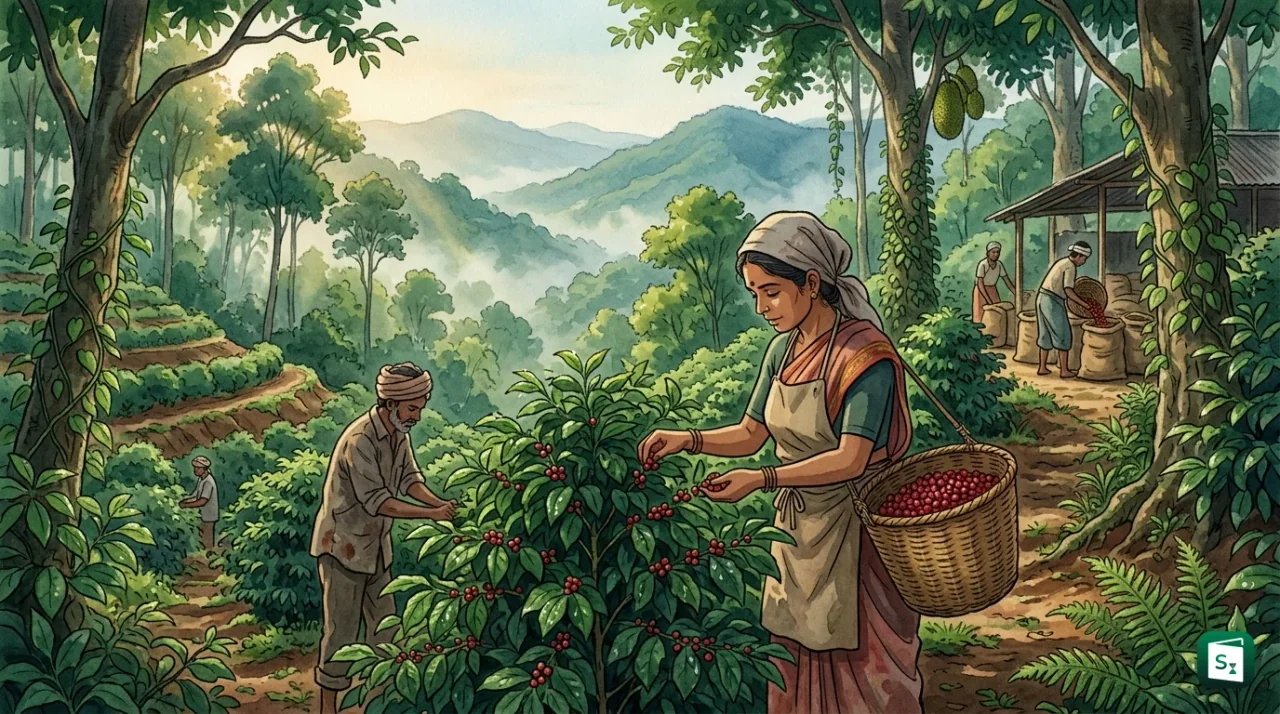
International Coffee Day is observed every year on 1 October to celebrate coffee and the millions of people who grow, process, trade and serve it. The 2026 observance carried the theme “Celebrating Coffee, Honouring the People Behind Every Cup”, with the first United Nations recognised celebration held on 1 October 2026 in Rome and Geneva. For India, the world’s seventh largest coffee producer, the day highlights the livelihoods of more than four lakh growers centred in Karnataka, Kerala and Tamil Nadu.
What Is International Coffee Day and When Is It Observed?
International Coffee Day is a global observance held every year on 1 October to celebrate coffee as a beverage and honour the farmers, workers, traders and baristas behind it. It promotes fair trade, sustainable farming and awareness about the economic and cultural value of coffee worldwide.
The International Coffee Organization describes the day as a celebration of the diversity, quality and passion of the coffee sector. Coffee lovers share their love for the drink, while governments, companies and farmer groups use the day to discuss prices, climate risks, decent work and support for small growers.
The date also marks the start of the coffee year in the international coffee trade, which runs from 1 October to 30 September. Many businesses mark the day with free or discounted cups, tasting sessions, exhibitions and campaigns for ethically sourced coffee. Coffee is the world’s most widely traded tropical product and one of the most widely consumed beverages.
2026 Theme: Celebrating Coffee, Honouring the People Behind Every Cup
The 2026 theme was “Celebrating Coffee, Honouring the People Behind Every Cup”. The focus was simple. Every cup begins far from the table, in the soil, knowledge and labour of farming families, and passes through pickers, processors, transporters, roasters and cafe workers before it reaches the drinker.
The Food and Agriculture Organization of the United Nations (FAO), headquartered in Rome, Italy, facilitated the first United Nations observance in collaboration with the International Coffee Organization. FAO is the UN agency that works on food security, agriculture and rural livelihoods. Events were held in Rome at FAO headquarters and in Geneva at the Palais des Nations with Indonesia, Rwanda and Türkiye, featuring high level remarks, dialogue across the value chain and coffee tasting sessions that showcased different coffee traditions.
The theme linked directly to sustainable development. The United Nations resolution drew attention to four goals where coffee makes a clear contribution, namely an end to poverty, zero hunger, gender equality and decent work with economic growth. Special attention was given to women, who form a large part of the picking and sorting workforce but often face barriers in access to land, finance and training. The year 2026 was also observed as the International Year of the Woman Farmer, which added weight to this message.
Alongside the main theme, the International Coffee Organization ran its 2026 campaign titled “Coffee is Part of the Solution”. Launched in February 2026, the campaign presented coffee as a driver of rural jobs, higher farm incomes and climate friendly practices when farmers get fair prices, training and finance.
From Milan 2015 to United Nations Recognition in 2026
Different countries celebrated their own coffee days for many years. Japan, the United States, Germany, Taiwan and Nepal each had national dates, often around late September. There was no common global date.
That changed at the meeting of the International Coffee Organization in March 2014, when member countries agreed to create a single global celebration on 1 October. The first official International Coffee Day was launched on 1 October 2015 in Milan, as part of Expo 2015, with a photo exhibition on coffee workers and events across member countries.
A second milestone came a decade later. On 10 March 2026, the United Nations General Assembly adopted resolution 80/248 designating 1 October as International Coffee Day. The proposal had been adopted by the FAO Conference at its 44th session in 2025 and was then placed before the General Assembly. The resolution recognises the cultural, social and historical significance of coffee, from its origins in Ethiopia to its present role as a livelihood for communities and a symbol of social life across generations.
With this decision, 1 October 2026 became the first United Nations observance of the day. The General Assembly invited FAO to facilitate the observance in collaboration with relevant bodies, particularly the International Coffee Organization. The UN calendar now lists 1 October as International Coffee Day alongside the International Day of Older Persons.
| Year | Milestone |
|---|---|
| March 2014 | International Coffee Organization members agree on 1 October as common date |
| 1 October 2015 | First official International Coffee Day launched in Milan during Expo 2015 |
| 10 March 2026 | United Nations General Assembly adopts resolution 80/248 designating 1 October as International Coffee Day |
| 1 October 2026 | First UN observance held in Rome and Geneva under 2026 theme |
The International Coffee Organization and Global Coffee Economy
The International Coffee Organization (ICO) is the only intergovernmental body for coffee. It was set up in London in 1963 under the auspices of the United Nations, after the first International Coffee Agreement (ICA) was approved in 1962. The Agreement provides the legal framework for cooperation between producing and consuming countries on prices, statistics, sustainability and development support.
The highest authority in the body is the International Coffee Council, which includes representatives of every member government and meets in March and September. The headquarters is located at 222 Gray’s Inn Road, London. The Executive Director is Vanúsia Nogueira of Brazil (as of October 2026). Member governments represent about 93 percent of world coffee production and about 63 percent of world consumption. India is an exporting member.
The ICO works through successive Agreements. The International Coffee Agreement 2007, agreed in London on 28 September 2007, entered into force in February 2011. The newer International Coffee Agreement 2022 is now under ratification to widen cooperation to private companies, farmer groups and development partners. In 2019, the ICO also created the Coffee Public-Private Task Force after the London Declaration to bring companies and governments together on farmer incomes and sustainability.
The numbers explain why the day matters. Up to 25 million farming households, largely in developing countries, produce around 80 percent of the world’s coffee. About 12.5 million of these are small farming families who depend on coffee as their main cash income. Brazil, Vietnam and Colombia lead global production, while the European Union and the United States are the largest importing and consuming markets. For many low income countries, coffee exports are a crucial source of foreign exchange.
The ICO also holds a high level World Coffee Conference every four to five years. The first four editions were held in the United Kingdom in 2001, Brazil in 2005, Guatemala in 2010 and Ethiopia in 2016. The fifth edition came to Asia for the first time when Bengaluru hosted the 5th World Coffee Conference from 25 to 28 September 2023. Organised by the Coffee Board of India and the Ministry of Commerce and Industry with the Government of Karnataka, the event carried the theme “Sustainability through Circular Economy and Regenerative Agriculture” and drew around 2,000 delegates and more than 17,000 business visitors, with tennis player Rohan Bopanna as brand ambassador.
Coffee in India: Board, Belt and Global Rank
India’s coffee story began with seven seeds of Mocha brought around 1600 AD by the saint Baba Budan to the hills now known as Baba Budan Giris in Chikkamagaluru district of Karnataka. What started as backyard planting grew into commercial estates in the 18th and 19th centuries across the present states of Karnataka, Kerala and Tamil Nadu.
The Coffee Board of India guides the sector today. The Board is a statutory body under the Ministry of Commerce and Industry, set up under an Act of Parliament in 1942 and headquartered in Bengaluru. It handles research through the Central Coffee Research Institute at Chikkamagaluru, extension support to growers, quality improvement, market intelligence and promotion of Indian coffee in India and abroad.
India is the seventh largest producer of coffee in the world with a share of about 3.5 percent of global production. India is also the fifth largest exporter, with a share of about 5.2 percent of global exports. Coffee is largely export oriented for India, as about 65 to 70 percent of the coffee produced is exported and the rest is consumed within the country. Production in 2022-23 touched a record 3,52,000 metric tonnes, comprising about 1,00,000 tonnes of Arabica and 2,52,000 tonnes of Robusta.
Two main types are grown. Arabica is milder and aromatic and grows at higher altitudes. Robusta is stronger, has more caffeine and tolerates heat and pests better. Karnataka grows mostly Robusta and a large share of Arabica, while Kerala grows mainly Robusta. Indian coffee is famous for being grown in shade rather than direct sunlight, and for monsooned coffee, where harvested beans stored on the Malabar coast absorb monsoon moisture to develop a mellow flavour.
Where Is Coffee Grown in India
Where is coffee grown in India. Coffee is traditionally grown in the Western Ghats across Karnataka, Kerala and Tamil Nadu, with new cultivation spreading to Andhra Pradesh, Odisha and the northeastern states of Assam, Arunachal Pradesh, Manipur, Meghalaya, Mizoram, Nagaland and Tripura.
The traditional belt accounts for nearly 96 percent of output. Karnataka leads with about 71 percent of national production, followed by Kerala with about 21 percent and Tamil Nadu with about 5 percent. Kodagu, Chikkamagaluru and Hassan in Karnataka, Wayanad and Travancore in Kerala, and Pulneys, Nilgiris, Sheveroys and Anamalais in Tamil Nadu are the best known tracts. In the non traditional belt, Araku Valley in Andhra Pradesh is widely recognised for tribal grown Arabica.
| Region | States and Tracts | Share and Note |
|---|---|---|
| Traditional | Karnataka (Kodagu, Chikkamagaluru, Hassan), Kerala (Wayanad, Travancore, Nelliampathies), Tamil Nadu (Pulneys, Nilgiris, Sheveroys, Anamalais) | Nearly 96 percent of production, Western Ghats shade coffee |
| Non traditional | Andhra Pradesh (Araku Valley), Odisha | Rapid expansion, mainly tribal small growers |
| Northeastern | Assam, Arunachal Pradesh, Manipur, Meghalaya, Mizoram, Nagaland, Tripura | Small but growing area, about 6,039 hectares |
Domestic drinking remains concentrated in the south. Tamil Nadu drinks the most coffee in India, followed by Karnataka, Andhra Pradesh and Kerala, with South India accounting for about 75 to 80 percent of national consumption.
International Coffee Day, National Coffee Day and Cafe Coffee Day: Clearing the Confusion
Readers often mix three similar names, so the distinction is worth fixing.
International Coffee Day is the global observance on 1 October led by the International Coffee Organization and now recognised by the United Nations. National Coffee Day is a separate country level event. In the United States, for example, National Coffee Day is celebrated on 29 September. Germany marks its Tag des Kaffees on the first Saturday of September. These national days honour local cafe culture and trade, while 1 October is the common date for the whole world.
Cafe Coffee Day is entirely different. It is an Indian coffeehouse company, not a day of observance. Searches for terms like cafecoffeeday or coffee day near me usually point to this brand and its outlets, machines and beans. The brand name comes from the English words coffee day, while the observance is a calendar event fixed by governments through the ICO and the United Nations.
The Way Forward
The United Nations tag gives the day stronger pull, but the test lies in outcomes for growers. Prices remain volatile, rains are shifting with climate change, and young workers are moving away from estates. Stable procurement, crop insurance, replanting support and direct links between farmer groups and roasters can help incomes hold steady.
For India, the path is clear. Research on drought tolerant types, water saving pulping, branding of regional coffees like Coorg, Chikkamagaluru, Araku Valley and Wayanad, and growth of domestic cafe demand can raise value without expanding forest clearances. School tasting programmes, barista training and support for self help groups in tribal belts can widen jobs from bean to cup while keeping shade grown ecology intact.
Key Takeaways
- International Coffee Day is observed on 1 October every year, with the 2026 theme “Celebrating Coffee, Honouring the People Behind Every Cup”.
- The first official celebration was held on 1 October 2015 in Milan during Expo 2015, after ICO members agreed on the date in March 2014.
- The United Nations General Assembly designated 1 October as International Coffee Day through resolution 80/248 on 10 March 2026, with FAO invited to facilitate the observance with the ICO.
- The International Coffee Organization, set up in London in 1963 under the first International Coffee Agreement of 1962, is the only intergovernmental body for coffee.
- India is the seventh largest producer with about 3.5 percent of global output, and the Coffee Board of India, set up in 1942 under the Ministry of Commerce and Industry and headquartered in Bengaluru, guides the sector.
- Karnataka, Kerala and Tamil Nadu contribute nearly 96 percent of India’s coffee, with Bengaluru hosting the 5th World Coffee Conference in September 2023, the first such edition in Asia.