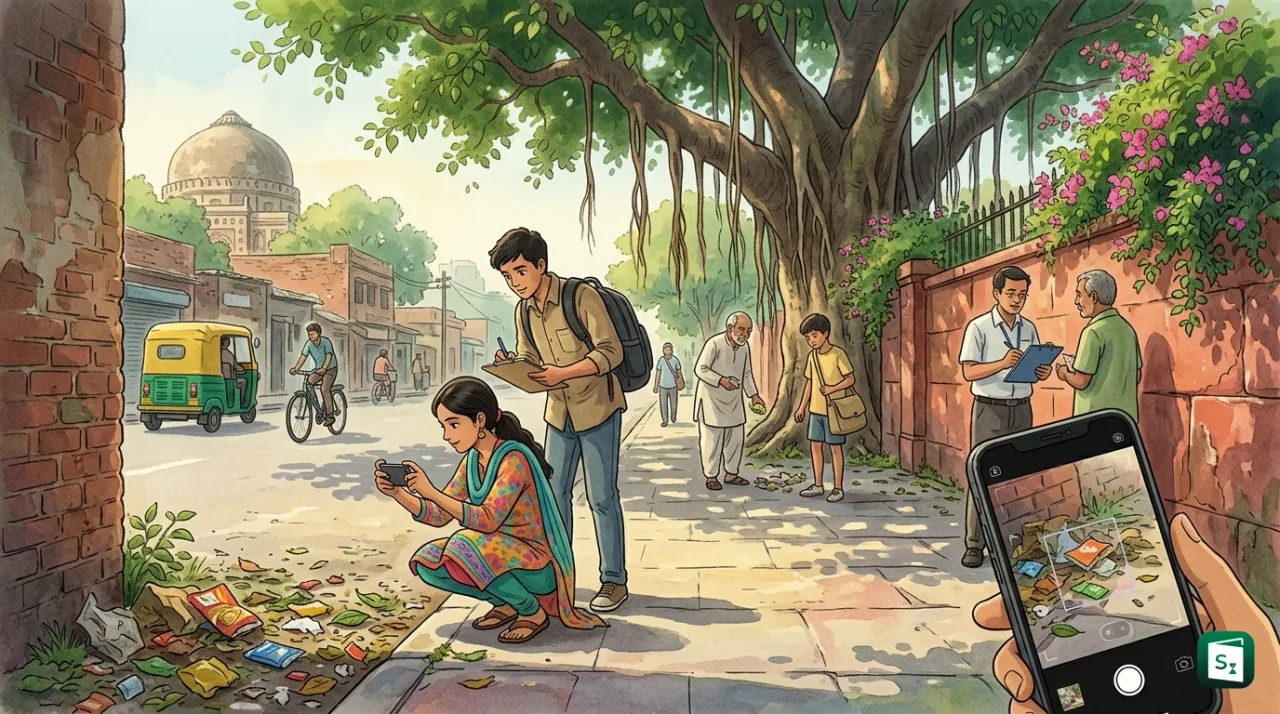
Philip Morris India Trading Private Limited has partnered with global civic technology company Litterati to launch the first phase of Project Unmesha, a 12-month anti littering initiative in Delhi. The announcement was made on 5 October 2026 in New Delhi. The first phase will use community science and AI enabled image recognition to identify litter hotspots, map litter composition and create scientific baselines for cleaner public spaces.
What Is Project Unmesha and Who Are the Partners?
Project Unmesha is the flagship environmental programme of Philip Morris India Trading Private Limited. The programme focuses on environmental stewardship, circularity and climate resilience, with anti littering as a central theme. The Delhi effort is the first phase of a 12-month initiative under this programme.
Philip Morris India Trading Private Limited, known as PM India, is a joint venture between Philip Morris Brands Sarl of Switzerland and two Indian entities, Godfrey Phillips India Limited and K.K. Modi Investment and Financial Services Private Limited. PM India was incorporated on 20 April 2009 and is headquartered in New Delhi, with its corporate office in Gurugram in Haryana. The company handles wholesale trading of cigarettes and other tobacco products, including the Marlboro brand, and its Managing Director is Navaneel Kar (as of October 2026). The project is implemented as part of PM India corporate social responsibility work. Under Section 135 of the Companies Act, 2013, companies that cross set limits on net worth, turnover or profit must spend at least 2 percent of average net profits of the last three years on social activities listed in Schedule VII, which includes environmental sustainability.
Litterati is the technology and implementation partner. Litterati is a global civic technology company founded by Jeff Kirschner. The company has engaged millions of people in more than 100 countries and helped build one of the largest open datasets on litter found in public places. Litterati combines citizen participation, AI driven image recognition and mapping tools to turn individual photos of litter into city level evidence for action.
| Element | Detail |
|---|---|
| Initiative name | Project Unmesha |
| Duration | 12 months, Delhi is first phase |
| Announced on | 5 October 2026 in New Delhi |
| Corporate partner | Philip Morris India Trading Private Limited |
| Technology partner | Litterati |
| Core method | Community science and AI enabled image recognition |
| Immediate goals | Identify litter hotspots, map litter composition, set scientific baselines |
What Is the Meaning of Unmesha?
Project Unmesha draws its name from the Sanskrit word Unmesha, which means opening of the eyes, blossoming and awakening. The term is commonly read as a flash of recognition or the start of new understanding, a shift from ignorance to knowledge. The choice of name signals the intent of the Delhi initiative.
The idea fits the working style of the project. Instead of starting with clean up alone, PM India and Litterati want to first open the eyes of planners, citizens and local bodies to where litter gathers, what it contains and why it repeats in certain spots. Clear measurement comes first. Targeted action on behaviour, bins and recovery systems follows after that evidence is ready.
How Will Community Science and AI Map Litter Hotspots in Delhi?
Litterati will use community science and AI enabled image recognition across selected urban areas in Delhi to locate litter hotspots, study litter composition and fix scientific baselines. A litter hotspot is a street, market edge, park corner or drain side where waste collects again and again. Litter composition means the break up of that waste by object, material and brand, such as plastic bottles, food wrappers or cigarette butts. A baseline is the measured starting point of how much litter is present before any new action begins, so change can be tracked over time.
Community science, also called citizen science, means ordinary residents collect data for research under a set method. Volunteers photograph litter in place using the Litterati app. Each photo carries location and time details. AI models then read the images and suggest tags for object, material and brand. Human checks improve accuracy. All tagged photos flow into maps and dashboards that show block by block patterns.
What Is the Litterati App and How Does It Work?
The Litterati app is a mobile tool that turns a single photo of litter into mapped data for prevention. The user photographs litter before picking it up. The app records the geotag and timestamp automatically. Its AI system, called LitterAI, suggests labels for what the item is, what it is made of and which brand made it. The user confirms or corrects the tags. Analysts then group the data by category, such as drinks or smoking related items, and link it to nearby places like bus stops, schools or shops.
Waste mapping in Delhi will follow a clear sequence. Trained participants will survey fixed sample locations at set intervals. Litterati will process the photos, clean the labels and place the results on a geographic information system. City teams can then see which streets are heavy with plastic, where cigarette waste clusters and how patterns shift with season or footfall. This method costs less than large manual surveys and covers wider areas with fresh data.
| Step | What Happens in Delhi Phase |
|---|---|
| Capture | Citizens photograph litter in place with location and time |
| Recognise | LitterAI identifies object, material and brand in the image |
| Verify | Users and analysts confirm tags and standardise names |
| Map | Data is placed on coverage maps to reveal litter hotspots |
| Measure | Composition shares and density form the scientific baseline for later comparison |
What Did the Earlier CleanWithBittu Drive Achieve?
PM India began its current anti littering push with the CleanWithBittu campaign on World Cleanup Day. Volunteers worked across Delhi, Haryana and Uttar Pradesh to clear public spaces. The drive removed more than 4,000 kg of litter from streets, parks and other open areas.
Segregation after collection added value to the effort. More than 1,600 kg of the collected waste was sent for recycling or composting instead of landfills. The organisers estimated that the effort avoided about 2,200 kg of carbon dioxide equivalent emissions. Carbon dioxide equivalent is a standard way to express the warming effect of different gases in terms of carbon dioxide.
The lesson from that drive shapes Project Unmesha. Large clean ups remove visible waste but do not explain why waste returns to the same points. The new phase therefore moves from collection to diagnosis. It will study littering patterns, local behaviour and gaps in bins and pick up systems, so later pilots on behaviour change, responsible disposal and waste recovery can target the right hotspots.
How Does Project Unmesha Support Swachh Bharat Mission in Delhi?
The Swachh Bharat Mission, launched on 2 October 2014, is the central cleanliness programme of India. It has two arms, Swachh Bharat Mission Grameen for rural areas and Swachh Bharat Mission Urban for cities. The urban mission is run by the Ministry of Housing and Urban Affairs. The second phase, called SBM Urban 2.0, aims for garbage free cities through source segregation, scientific processing and remediation of old dumpsites. National reviews in May 2026 reported that 97 percent of urban wards have door to door collection and waste processing has risen from 16 percent in 2014 to 81 percent in 2026.
Project Unmesha links directly to this framework. The Swachh Bharat Mission places strong stress on citizen participation, responsible disposal and clean public spaces. Litter mapping gives municipal teams street level proof on where participation is weak and where bins, collection routes or awareness drives need repair. The Delhi Municipal Corporation faces a large load. Delhi generates about 13,500 tonnes of waste every day, of which about 40 percent is wet waste, while current processing covers only about 60 percent. Five decentralised fresh waste plants with combined capacity of 6,000 tonnes per day are under construction and are expected to open around December 2026 to January 2027.
Policy timing also helps. The Solid Waste Management Rules, 2026 came into force on 1 April 2026. The rules move cities from two way segregation to mandatory four way segregation at source into wet, dry, sanitary and domestic hazardous waste. They tighten duties for bulk waste generators, apply the polluter pays principle through user charges and push digital tracking through a unified portal. The annual Swachhata Hi Seva campaign, observed since 2017 from 17 September to 2 October, carried the 2026 theme of collective ownership and spread awareness on these new rules. Project Unmesha adds a measurement layer to the same goals by showing which materials and locations break the chain between homes and processing plants.
Is Littering Illegal in India?
Yes, littering is illegal in India under municipal and state waste laws and attracts on the spot fines. In Delhi, municipal laws ban the deposit of rubbish, filth and polluted matter in streets and public places. Civic officers can levy charges from persons found littering and magistrates can try such offences in a summary manner.
Delhi relies on several layers of law. The Delhi Municipal Corporation Act, 1957 and the New Delhi Municipal Council Act, 1994 place a duty on owners and occupiers to store waste correctly and bar the dumping of rubbish in streets, drains and open land. The Delhi Degradable Plastic Bag (Manufacture, Sale and Usage) and Garbage (Control) Act, 2000 bars the throwing of garbage in drains, rivers, river beds and public places except in set receptacles or marked sites. The Solid Waste Management Bye laws of Delhi fix penalties for daily violations. Courts have also directed civic bodies to publish fine schedules, deploy sanitary officers for recovery and appoint magistrates for speedy action in each ward.
| Violation in Delhi | Fine Notified |
|---|---|
| Littering in public place | ₹500 per default |
| Failure to segregate by household | ₹200 per default |
| Open burning of solid waste | ₹5,000 per default |
| Littering of plastic waste | ₹2,000 per default |
| Organising large gathering without waste plan | ₹10,000 per event |
Fines rise by 5 percent each year from 1 January. Councillors in a Municipal Corporation of Delhi meeting on 2 October 2026 discussed raising the penalty for open dumping from ₹500 to ₹10,000 to strengthen deterrence, but segregation at collection and transport remains the main field challenge.
Why Littering Is Harmful for the Environment
Littering is harmful because small waste items choke drains, pollute soil and water and enter food chains. Light plastics fly into drains and add to urban flooding. Food and sanitary waste rot in the open and spread disease. Mixed waste sent to landfills releases methane, a strong greenhouse gas.
Cigarette and tobacco litter shows the scale of the problem. Cigarette butts are among the most littered items in the world. Filters are made of cellulose acetate, a plastic that breaks into microplastics and leaches nicotine, tar, heavy metals and other chemicals into soil and water. Studies estimate that India produced about 113 billion cigarette sticks in 2021 to 2022 and that more than 100 billion butts reach the environment, adding nearly 22,600 tonnes of waste. A country study for 2022 placed total annual waste from cigarette, bidi and smokeless tobacco at about 1,70,330 tonnes, with plastics forming 43.2 percent of that load. Mapping such composition in Delhi helps planners place special bins in smoking zones, plan authorised collection and link clean up costs to producer responsibility ideas already debated under plastic waste rules.
The Way Forward for Scalable Anti Littering Solutions
PM India and Litterati plan to use the Delhi baseline to pilot targeted fixes in identified hotspots. The pilots will test behaviour change messages, better bin placement, clearer disposal guidance and stronger links to recyclers and composters. Measurement will continue during the pilots, so teams can compare litter density and composition before and after action and keep only what works.
The programme aims to build a replicable model for other Indian cities. The model joins four parts, which are steady measurement, citizen led action, small infrastructure repair and stronger waste system links. Transparent dashboards can feed local policy talks and help municipal bodies direct staff and funds to streets that need them most. If Delhi proves that data led clean ups cut repeat littering, the same method can travel to other high footfall markets, transport hubs, parks and water body edges.
Key Takeaways
- Project Unmesha is a 12-month anti littering initiative whose first phase was launched in Delhi on 5 October 2026 by Philip Morris India Trading Private Limited with Litterati.
- Unmesha is a Sanskrit word meaning opening of the eyes, blossoming and awakening.
- The Delhi phase uses community science and AI image recognition (LitterAI) to map litter hotspots, study litter composition and fix scientific baselines.
- The earlier CleanWithBittu drive removed over 4,000 kg of litter, diverted over 1,600 kg for recycling or composting and avoided about 2,200 kg of carbon dioxide equivalent emissions.
- Littering in Delhi attracts a fine of ₹500 under municipal bye laws, while open burning draws ₹5,000.
- The initiative supports the Swachh Bharat Mission (launched 2 October 2014) and the Solid Waste Management Rules, 2026 that mandate four way segregation from 1 April 2026.