The Nagaland State Rural Livelihoods Mission (NSRLM) signed a three year agreement with BRAC International on 6 October 2026 in Kohima to launch SAY SOBLOK. The programme will support 4,000 extremely vulnerable households under the Samaveshi Aajeevika Yojana (SAY) of the Deendayal Antyodaya Yojana National Rural Livelihoods Mission (DAY NRLM). It adapts the national framework to Nagaland to provide coaching, livelihood assets and links to welfare schemes.
What Is NRLM and DAY NRLM?
The National Rural Livelihoods Mission (NRLM) is the central programme for reducing rural poverty by organising poor rural women into community institutions and linking them to livelihoods, credit and entitlements. The Ministry of Rural Development runs the mission. It was launched in June 2011 after restructuring the earlier Swarnajayanti Gram Swarozgar Yojana (SGSY). It was renamed as Deendayal Antyodaya Yojana National Rural Livelihoods Mission (DAY NRLM) in 2015 to 2016 in honour of Deendayal Upadhyaya.
DAY NRLM works by mobilising one woman from each poor rural household into a Self Help Group (SHG), which is a small savings and credit group of 10 to 20 women. These SHGs are federated into higher bodies called Village Level Organisations (VLOs) and Cluster Level Federations (CLFs). The federations give women bargaining power, shared funds and a platform for training. Banks then lend to SHGs under the Self Help Group Bank Linkage Programme, while the mission provides revolving funds, community investment funds and interest subvention to keep loans affordable.
The scale of DAY NRLM is among the largest of its kind in the world. The mission has mobilised more than 10.05 crore rural women into over 90.90 lakh SHGs across 28 states and 6 union territories (as of October 2026). It is a centrally sponsored scheme, which means the Centre and the states share the cost. Implementation is guided by the national mission unit in the Ministry of Rural Development, supported by the National Rural Livelihoods Promotion Society (NRLPS), an autonomous professional body set up in 2013. Each state implements the mission through its own State Rural Livelihoods Mission (SRLM).
What Is Samaveshi Aajeevika Yojana?
The Samaveshi Aajeevika Yojana (SAY) is the inclusive livelihoods programme under DAY NRLM for households that remain outside the SHG system. SAY means inclusive livelihoods scheme. It focuses on extremely vulnerable and deprived households who are often the poorest women, women headed families, households with persons with disabilities and families facing overlapping social and economic risks. These families usually cannot join or benefit from normal SHG savings, bank loans and government schemes because of ill health, lack of documents, social exclusion or irregular income.
SAY corrects this gap by using productive inclusion instead of only welfare transfers. Productive inclusion means giving a family a small asset, skill training and regular guidance so it can earn on its own. The national SAY design asks states to first identify such households through village level mapping, wealth ranking and household surveys. A specially built vulnerability index and mobile tools help rank families by need. Community institutions such as VLOs and CLFs then verify the list to keep selection fair and transparent.
Once selected, families are linked step by step to SHG networks, bank credit, livelihood plans and existing welfare entitlements. DAY NRLM developed a training module called Inspire Change: Vision Building and Inclusive Livelihoods with BRAC International and Trickle Up to train field staff for this work. Similar SAY pilots are already active in states such as Bihar, Maharashtra, Chhattisgarh, Jharkhand, Andhra Pradesh, Tamil Nadu and Telangana. Jharkhand alone has surveyed more than 19,000 households for its state SAY, while Andhra Pradesh has set a target of 10,000 poorest families in 2026.
What Is the Graduation Approach?
The Graduation Approach is a time bound and sequenced method to help the poorest families move from dependence to stable self employment. BRAC, originally the Bangladesh Rural Advancement Committee founded in Bangladesh in 1972, created the method in 2002 through its Targeting the Ultra Poor programme. The method is now used in more than 50 countries through over 100 partner organisations. In Bangladesh alone, more than 2.4 million families have completed the programme.
The approach works on four pillars that are applied together over 12 to 36 months. Livelihood promotion provides a productive asset such as livestock, seeds or stock for petty trade along with hands on training. Financial inclusion encourages savings, access to bank accounts and safe borrowing. Social protection connects families to food support, health care and government safety nets during the early months. Social empowerment builds confidence through weekly coaching visits, life skills training and support from village committees.
| Pillar | What the Family Receives |
|---|---|
| Livelihood promotion | Asset grant, skill training and help to start farm or non farm work |
| Financial inclusion | Savings account, matched savings and link to SHG bank linkage |
| Social protection | Food or cash stipend, health guidance and access to entitlements |
| Social empowerment | Regular coaching, community support and planning for the future |
Research on the Bangladesh programme found that more than 95 percent of participants stayed out of extreme poverty even years after support ended, with higher earnings, higher savings and a shift from daily wage labour to self employment. This record is the reason DAY NRLM has adopted the approach for SAY and why BRAC International provides technical support to eight Indian states under its agreement with the National Rural Livelihoods Promotion Society.
NSRLM BRAC Pact: What Is SAY SOBLOK?
The Nagaland agreement was formalised at a programme at the Hotel Vivor Banquet Hall in Kohima on 6 October 2026. The Memorandum of Understanding (MoU) was signed between the Nagaland State Rural Livelihoods Mission (NSRLM) under the state Department of Rural Development and BRAC International. NSRLM Mission Director Moa Sangtam and BRAC International India Country Lead Shweta S. Banerjee signed the pact. Commissioner and Secretary for Rural Development Thavaseelan K launched the programme, while DAY NRLM National Anchor for SAY Mona Dave explained the national design.
SAY SOBLOK is Nagaland’s adapted version of the national SAY framework. SOBLOK is coined from the Nagamese Creole phrase Sob manu logot dangor kaam kora, which means inclusive and collective growth. The name signals the core idea that growth must include every person and move forward together. The pact runs for three years or 36 months and covers 4,000 extremely vulnerable households across the state.
The Nagaland chapter will give priority to women headed households and households with persons with disabilities, including families facing more than one form of vulnerability. NSRLM will lead field implementation through its staff and community network. BRAC International will provide technical, knowledge and research support, including capacity building, cross learning, best practices, monitoring and evidence generation. Community institutions will drive the work on the ground, so innovations from Nagaland can later guide other states.
How Will SAY SOBLOK Be Rolled Out in Nagaland?
The NSRLM BRAC plan follows a clear sequence that keeps support intensive and personal. The first task is to select districts and blocks using the SAY implementation framework of DAY NRLM. Field teams will then orient NSRLM staff, bring on board technical and research agencies and set up a dedicated Programme Management Unit (PMU). Baseline profiling of participating households is scheduled for March 2027 to record income, assets, health and access to schemes before support begins.
Each family will receive a household specific livelihood plan. A trained coach will visit regularly to help the family choose work that suits its skills, such as livestock rearing, farming, food processing or petty trade. The package combines livelihood assets with financial inclusion, which means opening accounts, promoting savings and linking the family to SHG bank credit and interest subvention. It also ensures access to government entitlements and essential services, along with training in life skills and resilience to handle shocks like illness or crop loss.
NSRLM brings a ready network to this task. The state mission was launched in December 2013 and now works in 11 districts, 74 blocks and more than 1,150 villages. It has mobilised 15,481 SHGs and 1,269 Village Level Organisations, with strong work in bank credit linkage, vulnerability mapping and exclusive SHGs for vulnerable groups. SAY SOBLOK will use these VLOs and CLFs to identify families, verify lists and provide need based support over the full 36 month cycle.
Why Nagaland Needs a Locally Adapted Model
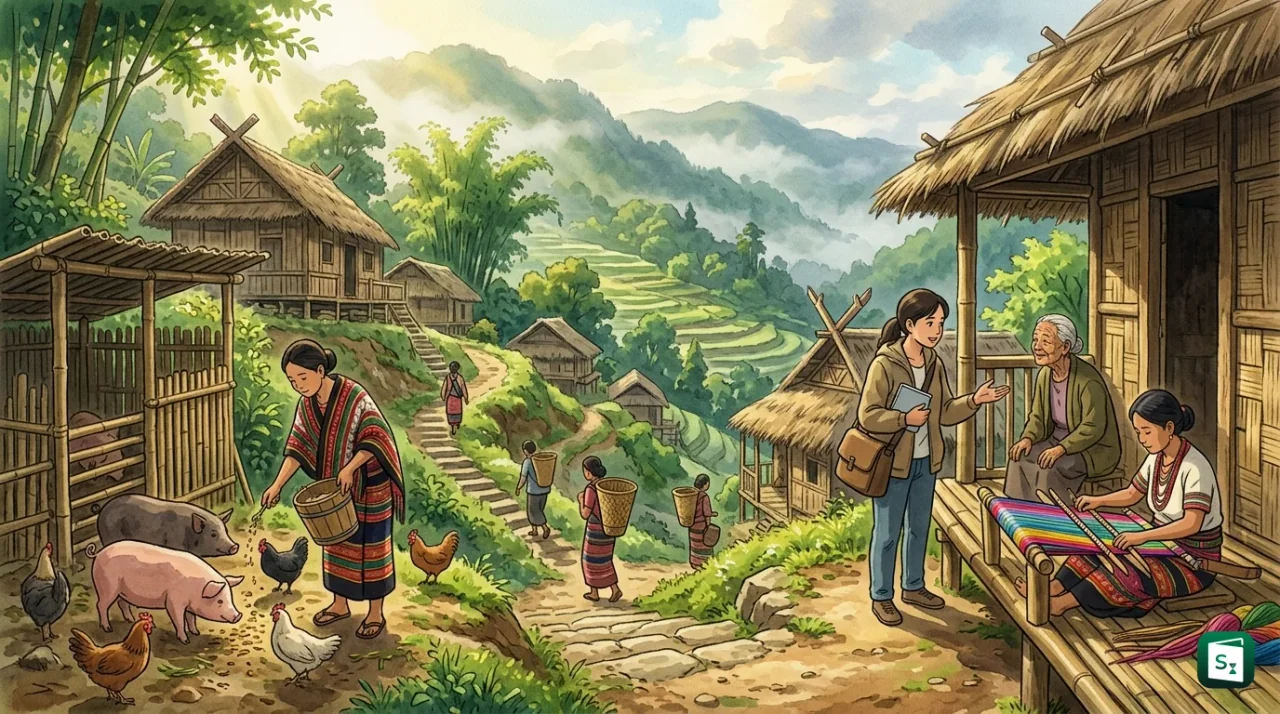
Nagaland’s hill geography, dispersed settlements and largely tribal society create a different type of vulnerability from the plains. Many poor families depend on small jhum plots, daily wage work and forest based activity with thin cash income. Standard SHG rules on regular savings and weekly meetings can leave out a widow caring for children alone, a family supporting a disabled member or a household without steady documents and contacts. SAY SOBLOK is designed for this last mile that mainstream credit often misses.
The focus on women headed families and disability is therefore central and not incidental. Women manage much of farm and home work in Naga villages, yet they face limits in owning assets and accessing loans. A household plan that is built around a woman’s time, health and market access can raise both income and voice within the home and village. Fair selection, choice of livelihood by the family itself and stronger links between the Rural Development department, other line departments and community bodies were stressed at the Kohima launch for this reason. Over 36 months, the aim is steadier and more diverse income, better use of entitlements and stronger capacity to cope with shocks.
Key Takeaways
- NSRLM and BRAC International signed an MoU on 6 October 2026 in Kohima to launch SAY SOBLOK for 4,000 extremely vulnerable households.
- SAY SOBLOK is Nagaland’s 3 year adaptation of the national Samaveshi Aajeevika Yojana under DAY NRLM.
- DAY NRLM was launched in June 2011 by the Ministry of Rural Development and renamed in 2015 to 2016.
- The Graduation Approach was created by BRAC in Bangladesh in 2002 and rests on livelihoods, financial inclusion, social protection and social empowerment.
- SOBLOK comes from the Nagamese phrase Sob manu logot dangor kaam kora, meaning inclusive and collective growth.
- NSRLM, launched in December 2013, has mobilised 15,481 SHGs and 1,269 Village Level Organisations for the rollout.