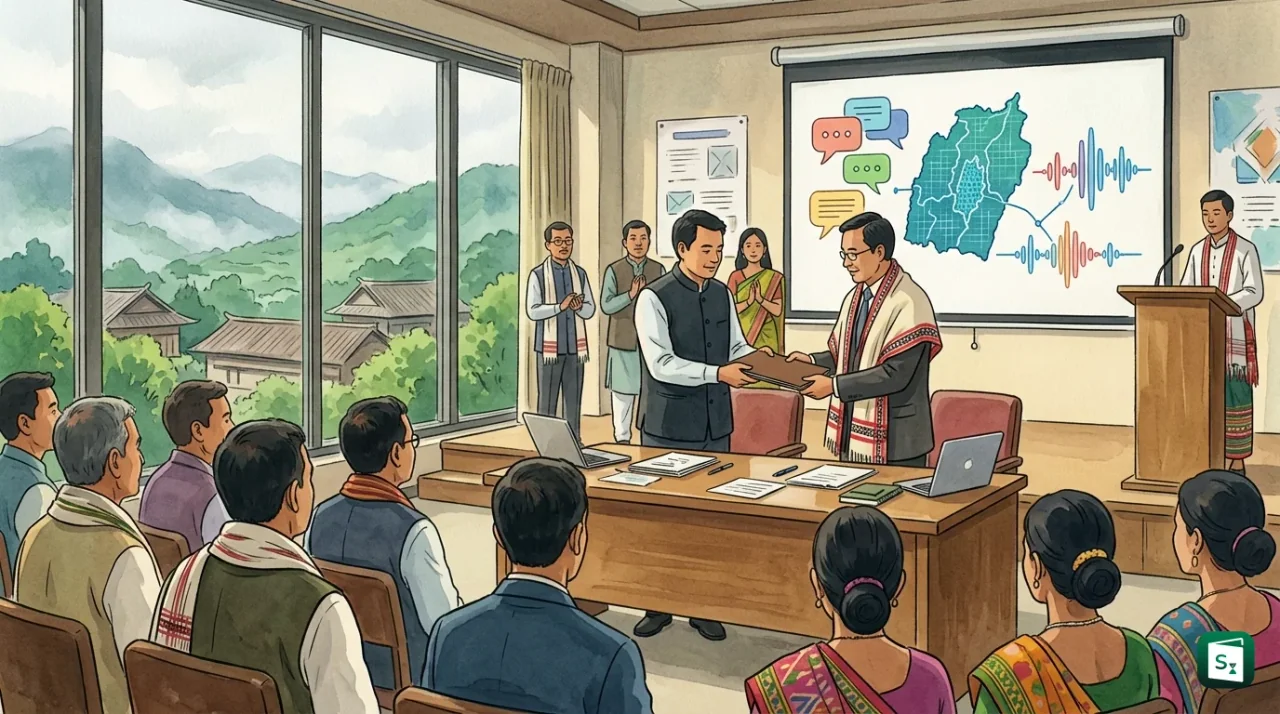
The Digital India BHASHINI Division signed an agreement with the Manipur government on 14 October 2026 at the BHASHINI Rajyam Workshop in Imphal. The pact was signed by Amitabh Nag, CEO of the Division, and Somorjit Salam, Secretary for Information Technology in Manipur. It aims to build language data for local languages and bring government digital services to citizens in their own mother tongue.
What Is BHASHINI?
The BHASHINI platform is India’s national artificial intelligence based language translation system under the National Language Translation Mission. It enables text and voice translation between English and Indian languages. It offers translation, speech recognition, speech synthesis and optical character recognition through open application programming interfaces.
BHASHINI stands for BHASa INterface for India. The name captures its core goal. It works as a language interface that lets Indians use the internet and public services in their own language instead of learning English first.
The Prime Minister launched the Digital India BHASHINI mission in July 2022 at the Digital India Week in Gandhinagar, Gujarat. It functions as the National Language Translation Mission to remove the language barrier in the digital space. The mission follows a voice first approach. Citizens can speak, listen, read and type in their mother tongue to access information.
The Ministry of Electronics and Information Technology (MeitY) is the nodal ministry for the mission. Execution rests with the Digital India BHASHINI Division (DIBD). The Division operates under the Digital India Corporation (DIC), which is a Section 8 company under MeitY. Amitabh Nag is the CEO of the Division (as of October 2026). The structure allows the government, research institutes, startups and industry to contribute models and datasets to a common open platform.
The scale of the platform is large. The BHASHINI ecosystem hosts more than 350 artificial intelligence models and datasets and supports voice services in 22 languages and text translation in 36 languages (as of October 2026). It has already processed more than 4 billion language inferences. These cover machine translation, automatic speech recognition, text to speech conversion, optical character recognition, language detection, transliteration and voice based payments.
BHASHINI App, Portal, API and Language Resources
What is the BHASHINI app?
The BHASHINI app is a public mobile application that lets users translate text and voice between English and Indian languages in real time. Users can type, speak or upload documents and receive instant output in the chosen language. The app also connects to WhatsApp and web portals so citizens can use translation without learning new tools.
How many languages does BHASHINI support?
The BHASHINI platform provides speech based services in 22 Scheduled languages and text translation in 36 Indian and international languages. Voice services include speech recognition and speech synthesis. Text services include translation, transliteration and document conversion. Coverage is expanding as new datasets for tribal and hill languages are added through state partnerships.
Access to these capabilities is provided through three connected layers. The BHASHINI portal (bhashini.gov.in) is the public gateway for citizens, startups and departments to try models and download resources. The BHASHINI dashboard displays datasets, live usage and model performance. The BHASHINI API, listed on API Setu, allows any department or company to plug translation directly into its own app or website. Developers first search for a suitable pipeline, configure it for tasks such as speech recognition plus translation plus speech synthesis, and then run live computation through the pipeline.
| BHASHINI Component | What It Does |
|---|---|
| ULCA (Universal Language Contribution Architecture) | Open repository that standardises datasets and models from institutes such as IIT Madras, IIT Bombay, IIIT Hyderabad and CDAC |
| Bhasha Daan | Citizen crowdsourcing drive where people donate voice recordings, typed text and translations through Suno India, Bolo India, Likho India and Dekho India |
| BHASHINI Udyat and Parikshan | Developer onboarding portal and testing application for trying APIs before production use |
| BHASHINI Mitra and Sahyogi | Partnership models for states, startups and industry to co build and deploy solutions |
This plug and play design is already in use across governance. The eGramSwaraj panchayat portal now works in 22 languages. RailMadad uses transliteration for more than 20,000 station and train names. The PM Kisan, Janmanrega, CPGRAM grievance and National Train Enquiry System platforms use BHASHINI for multilingual alerts, grievance translation and voice help. These examples show why state integration is the next step.
BHASHINI Rajyam Workshop in Imphal: What Happened
The BHASHINI Rajyam Workshop, Manipur Chapter took place in Imphal on 14 October 2026. The Digital India BHASHINI Division organised the workshop jointly with the Department of Information Technology, Government of Manipur. The programme brought together state officials, technical experts, academics and community representatives to plan how language technology can enter everyday governance.
The Manipur Chief Minister Yumnam Khemchand Singh attended the one day workshop. The Chief Minister also inaugurated the eSeva Kendra, Manipur at the Manipur Information Technology Park in Mantripukhri. The eSeva Kendra provides assisted access to digital government services with clear guidance for citizens who need help navigating online platforms and procedures. The Chief Minister stressed that digital services must reach people in remote areas in their own language and urged departments to build locally useful solutions in education, health care and citizen service delivery.
| Event Fact | Detail |
|---|---|
| Workshop name | BHASHINI Rajyam Workshop, Manipur Chapter |
| Date and venue | 14 October 2026, Imphal, Manipur |
| Organisers | Digital India BHASHINI Division under Digital India Corporation and MeitY with Manipur Department of Information Technology |
| MoU signed between | Digital India BHASHINI Division and Government of Manipur |
| Signatories | Amitabh Nag, CEO of the Division, and Somorjit Salam, Secretary for Information Technology, Manipur |
| Key demonstration | Live real time English to Manipuri translation |
The central outcome was the Memorandum of Understanding between DIBD and the Manipur government. The agreement commits both sides to strengthen language technology cooperation, improve language resources and explore multilingual digital services across the state. As the next step, the Division and the state will identify priority use cases, assess language data needs and test integration of BHASHINI tools into relevant government platforms.
Workshop sessions explained the language first digital public infrastructure model. Teams presented datasets, artificial intelligence models, translation plugins and voice tools. A live English to Manipuri translation showed how communication gaps can close in real time. Discussions focused on practical use in school education, health consultations, legal aid and grievance redressal. Officials also underlined the need to build and validate models with correct local data with inputs from language experts and community members.
Why Manipur Matters for Multilingual AI
Manipur is one of the most linguistically diverse states in India. The state is home to 33 recognised linguistic communities living in the central Imphal Valley and the surrounding hills. The valley is largely inhabited by the Meitei community while Naga and Kuki Zo communities live in the hill districts. The state shares an international border with Myanmar and covers 22,327 square kilometres with Imphal as its capital.
The official language and lingua franca of the state is Meitei, also called Manipuri. Manipuri belongs to the Tibeto Burman family of the Sino Tibetan group. The Manipur Official Language Act, 1979 declares Manipuri as the official language of the state. Manipuri was added to the Eighth Schedule of the Constitution in 1992 through the 71st Amendment along with Konkani and Nepali. The Eighth Schedule today lists 22 languages. Inclusion gives a language representation in the Official Language Commission, use in competitive examinations and support for development.
| Language Fact | Detail |
|---|---|
| Official language | Meitei (Manipuri), used for administration and as link language between communities |
| Script | Meetei Mayek, now taught in schools after a shift from Bengali script that began in 2006 |
| Hill languages | Thadou, Tangkhul, Mao, Paite, Hmar, Vaiphei, Zou, Rongmei and others, mostly Tibeto Burman and largely without large digital datasets |
| Governance need | Translation for school content, health information, court documents and grievance petitions for citizens in valley and remote hill areas |
This diversity explains the focus of the agreement. Large models perform well in Hindi and English but remain weak in hill languages because high quality speech and text data are scarce. The MoU therefore places special weight on collecting data through community participation and validating outputs with local experts. Better datasets will make translation, speech recognition and voice synthesis culturally accurate and useful in classrooms, primary health centres and citizen service centres.
BHASHINI MoUs With States: Tripura and Mizoram Set the Path
The Manipur pact continues the BHASHINI Rajyam programme. The word Rajyam points to partnership with states. The programme helps state governments turn language technology into working services. It promotes joint data collection, capacity building and deployment across departments. Two earlier agreements in the North East provide the immediate context for the Imphal pact.
The Government of Tripura signed its agreement with the Division in January 2025 at Pragna Bhavan in Agartala during a state level BHASHINI Rajyam workshop. Tripura became the first North Eastern state and the eighth state in the country to sign such a pact. The plan covers integration with the Chief Minister Helpline, eDistricts, eVidhan, Kisan Sahayata App, Amar Sarkar and crime records systems through translation and voice entry. The focus is on rural and tribal citizens who struggle with English or Hindi software.
The Government of Mizoram signed its agreement on 18 June 2025 in New Delhi. The Mizoram Chapter workshop followed on 12 September 2025 at Aizawl. The Mizoram pact focuses on Mizo and related languages such as Hmar, Lai, Mara, Chakma, Paite, Bru and Ralte. The method is systematic collection of speech and text through citizen contributions and institutional partnerships to train speech recognition and translation models.
| State | MoU Date | Workshop Venue | Language Focus |
|---|---|---|---|
| Tripura | January 2025 | Pragna Bhavan, Agartala | Bengali, Kokborok and other regional languages for e governance integration |
| Mizoram | 18 June 2025 | ATI Auditorium, Aizawl on 12 September 2025 | Mizo, Hmar, Lai, Mara, Chakma, Paite and other hill languages |
| Manipur | 14 October 2026 | Imphal | Meitei (Manipuri) and hill languages across 33 communities for education, health, legal aid and grievance redressal |
The Division also runs supporting models for this state work. The BHASHINI Mitra programme shows how states can co build solutions and share data. The BHASHINI Samudaye idea encourages each state to create its own language mission and own the adoption of tools in citizen services. The Bhasha Daan crowdsourcing platform lets ordinary people record voice and validate text so models for low resource languages improve quickly.
Significance and The Way Forward
The Manipur agreement matters because it moves translation from demonstration to deployment. For the state administration, it offers a low cost way to make orders, scheme details and application forms available in Manipuri and hill languages. For citizens, it means they can file grievances, seek health advice and read school material by speaking instead of typing in English. Voice access is critical in areas with low literacy in English and limited internet familiarity.
For researchers and startups, the pact opens a new pool of validated speech and text data. Institutes such as IITs, IIITs and CDAC build base models on the ULCA platform. Better Manipur datasets will improve accuracy for Tibeto Burman languages that currently have thin coverage. The open API model lets local startups build education apps, telemedicine helpdesks and legal aid chat tools without building translation engines from scratch.
The road ahead is clearly defined. The Division and the Manipur Department of Information Technology will first shortlist priority departments and services. Teams will then map what data exists and what must be collected from schools, hospitals, courts and community groups. Pilot integration will follow in selected platforms with testing by language experts. Success will be measured by simple outcomes. Citizens can complete a service in their mother tongue, staff can process requests faster, and translation errors fall as datasets grow. If the pilots succeed, the model can expand into a full state language mission under the Samudaye framework.
Key Takeaways
- The Digital India BHASHINI Division and the Manipur government signed an MoU on 14 October 2026 at the BHASHINI Rajyam Workshop in Imphal.
- BHASHINI stands for BHASa INterface for India and was launched in July 2022 under the National Language Translation Mission of MeitY.
- The Digital India BHASHINI Division functions under the Digital India Corporation and is led by CEO Amitabh Nag.
- BHASHINI supports voice services in 22 languages and text translation in 36 languages with more than 350 AI models and over 4 billion inferences.
- Manipuri (Meitei) is the official language of Manipur and entered the Eighth Schedule in 1992, while the state has 33 linguistic communities.
- Tripura in January 2025 became the first North Eastern state to sign a BHASHINI MoU, followed by Mizoram on 18 June 2025 before Manipur.