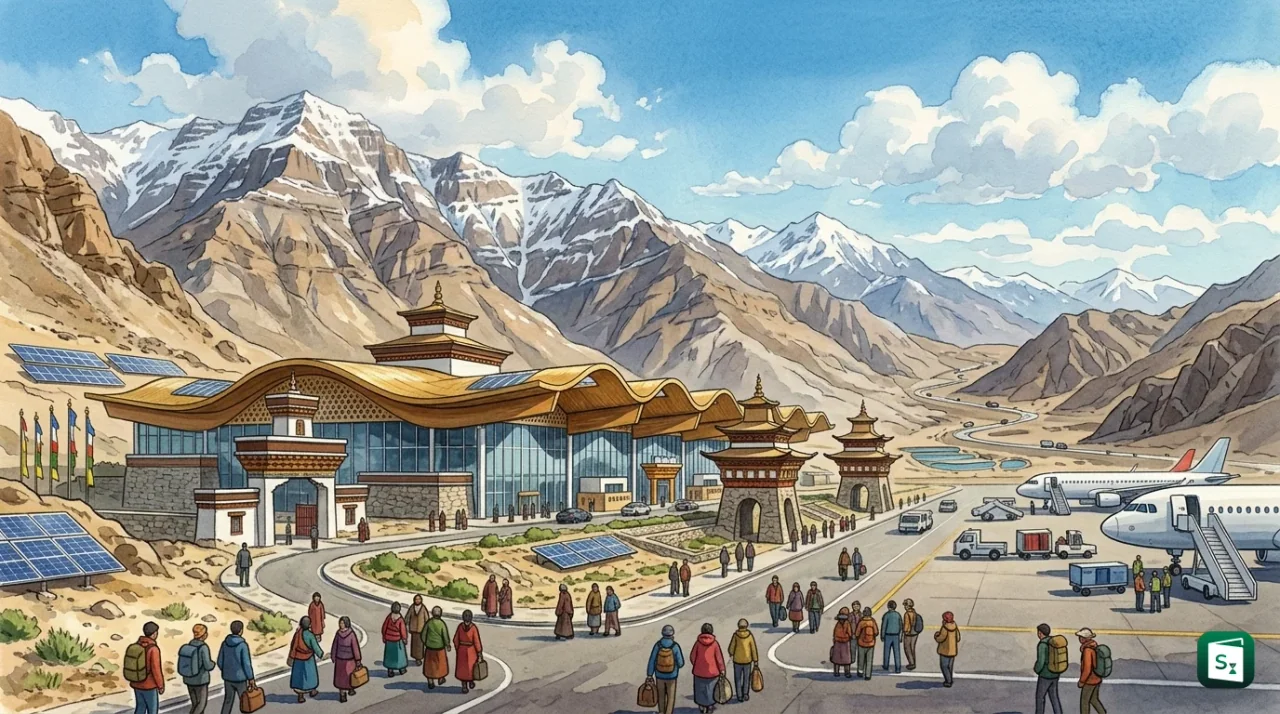
Prime Minister Narendra Modi inaugurated and dedicated five development projects worth around ₹3,350 crore in Ladakh on 15 October 2026 through video conferencing. The package covers the new passenger terminal at Kushok Bakula Rimpochee Airport in Leh, the 298 km Nimmu-Padum-Darcha road, hydropower and transmission works, and water conservation assets. Together, the projects link air connectivity, strategic road access, clean energy, heritage protection and water security in one of India’s most climate sensitive regions.
Where Is Ladakh Located in India
Ladakh is a Union Territory in the northernmost part of India, between the Karakoram range in the north and the Himalayas in the south. Leh is its capital and largest city, with Kargil as the other major town. The region is often called a cold desert because it receives very little rainfall and faces long, freezing winters.
Ladakh is not a state. Parliament passed the Jammu and Kashmir Reorganisation Act in August 2019, and Ladakh became a separate Union Territory without a legislature on 31 October 2019. Before that, it was part of the former state of Jammu and Kashmir. The Union Territory originally comprised Leh and Kargil districts, and the administration has since notified a total of seven districts to bring governance closer to remote valleys such as Nubra, Changthang and Zanskar.
This geography explains the project choices. Leh sits at an altitude of about 3,256 metres (10,682 feet) above sea level. Air pressure is low, winter temperatures fall sharply, and road passes close for months. Any airport, road, power line or reservoir here must work in thin air, frost and short construction seasons. That is why capacity expansion at Leh airport, an alternative all weather road link and decentralised water storage carry unusual strategic weight.
What Are the Five Projects Worth ₹3,350 Crore
The Prime Minister inaugurated and dedicated five major works on 15 October 2026. The five projects strengthen connectivity, improve energy infrastructure, conserve cultural heritage and enhance water security in the region.
| Project | What Was Inaugurated | Cost and Scale |
|---|---|---|
| New Passenger Terminal at Kushok Bakula Rimpochee Airport, Leh | Modern terminal building spread over 23,800 square metres | Built at a cost of about ₹640 crore (announced as part of the ₹650 crore airport component), designed for 35 lakh passengers per year |
| Nimmu-Padum-Darcha Road | 298 km road from Nimmu in Leh to Darcha in Himachal Pradesh through Padum in Zanskar | Built by the Border Roads Organisation (BRO) as a third connectivity axis to Ladakh |
| 9 MW Hanu Small Hydroelectric Project | Small hydropower station in Sham region to harness local hydel potential | Part of the energy package to improve local generation |
| 66 kV Double Circuit Dah-Hanu-Khaltsi Transmission Line | Power evacuation line linking Dah and Hanu stations to the Khaltsi substation | Improves reliability of electricity supply in western Ladakh |
| Project Him Sarovar and Petroglyph Conservation Park | 40 water bodies across 40 villages under Project Him Sarovar, and India’s first Petroglyph Conservation Park at Sindhu Ghat, Leh | Water security work aligned with Mission Amrit Sarovar, plus heritage conservation |
Air India announced that all its flights to and from Leh would operate from the new terminal with effect from 16 October 2026, signalling immediate operational use of the airport asset. Senior Ladakh administration officials joined the virtual event from Leh, while functions were organised across districts to mark the rollout.
Kushok Bakula Rimpochee Airport New Terminal: Capacity, Cost and Features
The Kushok Bakula Rimpochee Airport (IATA code: IXL, ICAO code: VILH) serves Leh, the capital of Ladakh. The airport is owned by the Indian Air Force and operated for civil flights by the Airports Authority of India (AAI), which was established in 1995 and functions under the Ministry of Civil Aviation. At about 3,256 metres above sea level, it is the highest commercial airport in India and one of the highest in the world. The airport is named after the 19th Kushok Bakula Rinpoche, a respected Buddhist monk whose Spituk Monastery stands near the airfield.
The new passenger terminal building covers about 23,800 square metres and is designed to handle 35 lakh passengers every year. The earlier capacity was about 10 lakh passengers per year, so the new facility raises capacity by three and a half times. Official statements place the construction cost at about ₹640 crore for the terminal building, within the broader airport component of around ₹650 crore cited for the Ladakh package. The Prime Minister had earlier laid the foundation stone for the terminal and inaugurated the completed facility in this round.
The building blends modern passenger amenities with elements of Ladakhi culture. It includes 18 check-in counters, an inline baggage handling system, spacious departure and arrival lounges, frisking and waiting areas and food facilities. The design is rated as an energy efficient green building and aims to handle higher daily flight movements, with plans to scale up toward 54 flights a day as airline and slot capacity grows. For travellers, the practical effect is shorter crowding during the summer tourist peak and more reliable winter operations.
What Is Geothermal Heating
Geothermal heating uses the steady heat stored below the earth’s surface to warm a building. Pipes carrying water or a special fluid run underground, where the temperature stays stable through the year. In winter, the fluid absorbs warmth from the ground and a heat pump raises it further to heat indoor air. In summer, the same loop can carry excess indoor heat back into the cooler ground.
The Leh terminal is India’s first airport terminal to use geothermal heating alongside solar energy to suit the harsh climate. This combination lowers diesel and electricity demand for heating in sub-zero months and reduces the carbon footprint in an ecologically sensitive Himalayan zone. For a high altitude terminal that must stay open through freezing weather, ground heat provides stable, low emission warmth that conventional heaters struggle to deliver efficiently.
Nimmu-Padum-Darcha Road: Ladakh’s Third Connectivity Corridor
The 298 km Nimmu-Padum-Darcha road, also called the Zanskar Highway, connects Nimmu in Leh on the Kargil-Leh highway with Darcha in Lahaul and Spiti district of Himachal Pradesh through Padum, the main town of Zanskar valley. The Border Roads Organisation (BRO), which was established in 1960 to build roads in border and high altitude areas, constructed the road and achieved full connectivity on the axis in March 2024.
The road is now the third axis to Ladakh, apart from the Srinagar-Leh and Manali-Leh highways. It is shorter than the other two routes and crosses only one major pass, Shinku La (Shinkun La) at about 16,558 feet. The government has started work on the Shinku La tunnel to provide all weather connectivity. Once the tunnel is completed, the route can remain open even when high passes close under snow.
The strategic value is direct. The alignment lies set back from the border, which helps safe movement of troops, supplies and equipment for the armed forces. For civilians in Zanskar, one of the most isolated valleys in India, the road shortens travel time between Manali and Leh to about 10 to 12 hours in good weather, compared with 14 to 16 hours on the older Manali route. It improves access to hospitals, schools, markets and administrative centres and is expected to support tourism and local trade in apples, apricots, pashmina and handicrafts.
Energy and Water Security: Hanu Hydro Project and Project Him Sarovar
Ladakh has strong hydropower and solar potential but faces thin grids and long winters. Two parts of the new package address this gap. The Prime Minister inaugurated the 9 MW Hanu Small Hydroelectric Project and the 66 kV double circuit Dah-Hanu-Khaltsi transmission line. The line runs for about 63.4 km from the Dah station to the Hanu switchyard and onward to the 66/11 kV substation at Khaltsi (Khaltse) in Leh district.
Small hydro refers to hydropower stations with capacity between 2 MW and 25 MW in India. Such plants use the flow of a local stream with limited storage and suit mountain valleys where large dams are neither feasible nor desirable. The Hanu and Dah projects, developed in the Sham belt of Leh district, use Himalayan nullah flows to generate power close to demand centres. The new transmission line evacuates this power and stabilises supply to nearby villages and army and civil loads. Officials in Sham reviewed the Hanu and Dah works in August 2026 to ensure debris clearance at headworks, fencing of switchyards and full diversion of stream flow into the water conductor system before commissioning.
Water is the second constraint. Ladakh depends on snowmelt and glaciers. Water is abundant for a short summer spell but runs short during the sowing season when farmers need it most for barley, vegetables and fodder. Project Him Sarovar tackles this mismatch by building storage and recharge ponds that hold water when it is available and release it when it is needed.
Under the project, 40 water bodies across 40 villages were developed and dedicated in this round. Types include new earthen ponds, storage tanks and solar powered lift based reservoirs in districts including Leh, Nubra, Sham, Kargil, Drass and Zanskar. The work is aligned with the objectives of Mission Amrit Sarovar, which was launched on 24 April 2022 to develop and rejuvenate water bodies in every district. The national mission had set a target of 50,000 Amrit Sarovars by 15 August 2023 and crossed the target ahead of schedule. In Ladakh, the Him Sarovar structures support irrigation, sustain agricultural livelihoods and strengthen long term water security without large dams.
India’s First Petroglyph Conservation Park at Sindhu Ghat
Petroglyphs are prehistoric images, symbols or carvings etched, pecked or engraved directly onto rock surfaces. Ladakh hosts one of the most extensive collections of such rock art in South and Central Asia, with nearly 400 sites recorded in clusters and in isolation along the Indus and Zanskar rivers. The carvings show ibex, yak, argali, blue sheep, dogs, hunting scenes, warriors, footprints and symbolic marks. Some of the oldest examples carry inscriptions linked to ancient languages and trade routes that once crossed the high Himalayas.
Many isolated carvings face damage from weathering, road construction, rock blasting and unregulated tourism. To protect them, Ladakh created India’s first Petroglyph Conservation Park at Sindhu Ghat in Leh, on the banks of the Indus River. Lieutenant Governor Vinai Kumar Saxena laid the foundation stone on World Heritage Day on 18 April 2026. A memorandum of understanding between the local archives and museums department and the Archaeological Survey of India (ASI), established in 1861 and headquartered in New Delhi, supports long term preservation.
The park collects vulnerable boulders from scattered locations and displays them in a managed, educational setting with an interpretation centre for research and visitors. By June 2026, 31 petroglyphs from Saboo Thang, measuring 4 to 17 feet in circumference and weighing 500 kg to 10 tonnes, had been shifted to the site. The first phase targets 155 petroglyphs. The park model protects the original landscape record while making heritage accessible for responsible cultural tourism.
Why These Projects Matter for Ladakh
The five works address four persistent constraints of high mountain development. The first is access. Leh airport handled about 10.7 lakh passengers in 2025-26, and summer demand regularly strains the old terminal. A 35 lakh capacity terminal eases congestion, supports tourism to Pangong Tso, Nubra valley, Tso Moriri and Hanle, and creates room for more flights and jobs in hospitality, taxis and handicrafts.
The second is strategic mobility. Two highways alone leave Ladakh exposed when passes close or landslides block traffic. A third corridor through Zanskar gives the armed forces and civil administration an alternative route for men and material and reduces travel distance and time.
The third is reliable power and water in extreme cold. Small hydro and a dedicated evacuation line cut dependence on diesel sets and long distance supply. Village ponds store spring melt for sowing months, which directly protects farm incomes in a region with a very short cropping window.
The fourth is balance between growth and ecology. Geothermal and solar use in the airport, run of stream hydro instead of large storage dams, and a conservation park for rock art show a shift toward infrastructure that limits carbon load and heritage loss. Road length in Ladakh has grown from about 1,800 km before 2019 to more than 4,000 km at present, according to the Prime Minister’s address, which places the new assets within a wider push to connect remote valleys while retaining environmental care.
Key Takeaways
- Prime Minister Narendra Modi inaugurated five projects worth ₹3,350 crore in Ladakh on 15 October 2026 via video conferencing.
- The new terminal at Kushok Bakula Rimpochee Airport (IXL) in Leh cost about ₹640 crore and raises capacity from 10 lakh to 35 lakh passengers per year.
- The Leh terminal is India’s first airport terminal to use geothermal heating along with solar energy for operations in extreme cold.
- The 298 km Nimmu-Padum-Darcha road built by the BRO provides a third link to Ladakh and crosses only Shinku La at 16,558 feet.
- 40 water bodies across 40 villages under Project Him Sarovar, aligned with Mission Amrit Sarovar launched in 2022, were dedicated to strengthen water security.
- India’s first Petroglyph Conservation Park at Sindhu Ghat in Leh preserves ancient rock carvings, with 155 petroglyphs targeted in the first phase.