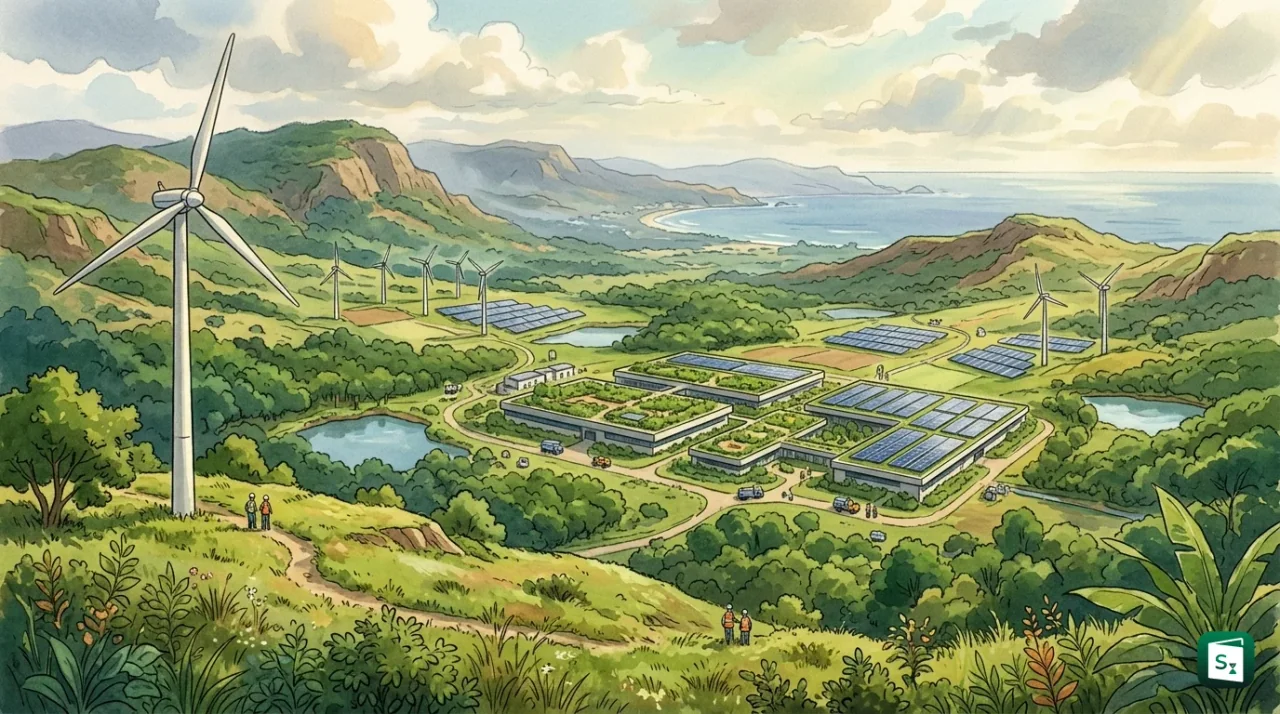
ReNew Wind Energy Pvt Ltd signed a memorandum of understanding with the Maharashtra government on 8 October 2026 to build a 750 MW integrated green data centre park in the Mumbai Metropolitan Region (MMR) with an investment of ₹70,000 crore. The park will come up across Panvel, Khalapur, Taloja and Bhokharpada and is expected to start operations in phases from 2028. The project links clean power directly with digital infrastructure at a time when demand for data centre India capacity is rising sharply.
What Is a Green Data Centre?
A green data centre is a facility that stores, processes and distributes digital data with maximum energy efficiency and minimum environmental impact. It uses efficient cooling and lighting, saves water, reuses waste heat where possible, and powers servers with a high share of renewable energy such as solar and wind.
A standard data centre is a large building that houses rows of servers, storage systems and network equipment. These servers run continuously and generate a lot of heat, so the building needs uninterrupted power supply and powerful cooling round the clock. In a typical facility, cooling and power distribution can consume almost as much electricity as the servers themselves.
A green data centre tackles this problem in three ways. First, it reduces total power demand through efficient building design, higher operating temperatures within safe limits, and use of outside air or liquid cooling. Performance is measured through Power Usage Effectiveness (PUE), which is the ratio of total facility energy to energy used by IT equipment. A PUE close to 1.0 means almost all power reaches the servers, while the average large facility operates around 1.55. Second, it tracks the Renewable Energy Factor (REF), which is the share of total energy that comes from renewable sources. Third, it monitors water use and carbon emissions through related indicators for water and carbon effectiveness.
The Maharashtra project applies this idea directly. The ReNew park must use 51% green power for core data centre operations. This means more than half the electricity for servers and cooling will come from renewable sources, with the balance drawn from the grid. The design also includes dedicated power infrastructure to keep supply stable, which is critical because even a short outage can disrupt banking, cloud and communication services hosted in the facility.
What Did the ReNew Maharashtra Agreement Announce?
The Maharashtra government signed the memorandum of understanding (MoU) with ReNew Wind Energy Pvt Ltd, a wholly owned subsidiary of ReNew Energy Global PLC, on 8 October 2026. The MoU was signed by P Anbalagan, Principal Secretary of the Industries, Investment and Services Department and Chief Executive Officer of Invest Maharashtra, and the state head of ReNew. Invest Maharashtra is the investment promotion agency of the state government that acts as the single point for facilitation of large projects.
The agreement proposes a Green Integrated Data Centre Park with a planned information technology load of 750 megawatts (MW) and a total investment of ₹70,000 crore. The investment covers land and park development, data centre buildings, power systems, cooling, network connectivity and renewable energy linkage. Development will take place in phases, with the first operations expected from 2028.
| Project Feature | Detail Announced |
|---|---|
| Developer | ReNew Wind Energy Pvt Ltd |
| Parent company | ReNew Energy Global PLC, listed on Nasdaq |
| Location | Panvel, Khalapur, Taloja and Bhokharpada in Navi Mumbai and MMR |
| Capacity | 750 MW |
| Investment | ₹70,000 crore |
| Green power use | 51 percent of power for core operations |
| Power reliability | Two incoming feeders from independent sources to the park substation |
| Jobs expected | About 7,000 jobs, including more than 2,000 direct jobs |
| Start of operations | In phases from 2028 |
Under the MoU, the Maharashtra government will help the company obtain permissions, registrations, approvals and clearances as per applicable policies and regulations. The state will also extend eligible fiscal incentives available under the data centre framework. ReNew has linked the project to Maharashtra’s goal of becoming a $1 trillion economy by 2030, with spillover benefits for semiconductors, clean energy, construction and local services.
Where Will the Park Come Up in Mumbai Metropolitan Region?
The Mumbai Metropolitan Region (MMR) is a large urban planning area spread over 6,328 sq. km across Mumbai City, Mumbai Suburban, and parts of Thane, Raigad and Palghar districts. It includes nine municipal corporations such as Greater Mumbai, Thane, Kalyan Dombivali, Navi Mumbai and Panvel, along with nine municipal councils and more than 1,000 villages. The Mumbai Metropolitan Region Development Authority (MMRDA) is responsible for planned development and coordination in this region. The region was first delineated in 1967, and the current regional plan period runs from 2016 to 2036.
The ReNew park is planned across Panvel, Khalapur, Taloja and Bhokharpada in and around Navi Mumbai. These locations sit on the eastern edge of MMR, close to the Jawaharlal Nehru Port, the Mumbai Pune Expressway, the upcoming Navi Mumbai International Airport and large industrial estates. Taloja already hosts a major industrial area of the Maharashtra Industrial Development Corporation, which provides land, water and transmission access. Panvel and Khalapur offer relatively larger land parcels at lower cost than island Mumbai, while remaining within fibre and power corridors that serve Mumbai.
Location matters for data centres because three inputs must come together. The first is fibre connectivity and proximity to submarine cable landing stations, and Mumbai has 12 of India’s 22 such landing stations. The second is reliable high voltage power with space for substations and dual feeders. The third is low risk from flooding and ease of building large floor plates for server halls. Navi Mumbai scores well on all three, which is why it accounts for the largest share of India’s planned data centre capacity.
Maharashtra Green Integrated Data Centre Parks Policy Explained
Maharashtra is the first state in India to create a special policy for Green Integrated Data Centre Parks. The original framework was approved by the state cabinet in October 2024 through a Government Resolution dated 9 October 2024. It allowed three such parks in Mumbai, Navi Mumbai and MMR, each with a minimum capacity of 500 MW and minimum fixed capital investment of ₹30,000 crore. The parks were linked to incentives under the Maharashtra IT and IT Enabled Services Policy 2023.
The government amended the policy through a fresh resolution dated 9 June 2026, based on approval by the Cabinet Sub Committee on 22 April 2026. The change expanded both scale and coverage because three parks in Mumbai alone were considered inadequate to reach the state’s target of 30 to 40 gigawatts (GW) of green energy based data centre capacity by 2047 under the Viksit Maharashtra 2047 programme.
The revised framework raises the number of eligible parks from 3 to 20 and extends coverage from Mumbai region to the entire state. It reduces the mandatory green power share for core operations from 100 percent to 51 percent, which improves viability while retaining the green character. Round the clock renewable supply is difficult without large storage and open access, so the lower threshold allows developers to combine green contracts with grid power in the early years.
| Policy Element | October 2024 Framework | June 2026 Revised Framework |
|---|---|---|
| Number of parks | 3 | 20 |
| Geography | Mumbai, Navi Mumbai and MMR only | Entire Maharashtra |
| Minimum size | 500 MW and ₹30,000 crore investment | Same floor retained |
| Green power condition | 100 percent for core operations | 51 percent for core operations |
| Power tariff support | Concessions as per cabinet terms | Re 1 per unit for 10 years for ₹30,000 crore investment, and for 20 years for ₹60,000 crore and above |
| Capital support | Regular IT policy incentives | 75 percent industrial promotion subsidy on eligible fixed capital for ₹60,000 crore and above |
| Interest support | As applicable | 4 percent interest subsidy on term loans for 10 years, capped at ₹25 crore per year |
| Land use rule | 2 percent land for incubation centre | Requirement removed |
| Investment counting | Only developer investment | Combined investment of owner, developer and units |
The revised incentives apply to future projects and to parks already approved under the earlier resolution, with existing offer letters to be amended. With its ₹70,000 crore commitment, the ReNew park crosses the highest investment slab and becomes eligible for the 20 year power tariff support and the higher capital and interest benefits, subject to fulfilment of conditions.
About ReNew Energy Global
ReNew Energy Global PLC, referred to as ReNew, is an Indian renewable energy company based in Gurugram, Haryana. It is the first Indian renewable energy company to be listed on the Nasdaq stock exchange in the United States. ReNew operates as an independent power producer and also provides solutions in clean energy, storage, green hydrogen, digital energy services and carbon markets.
The company had a clean energy portfolio of 20.5 GW as of 30 June 2026, one of the largest globally, including about 1.7 GW of battery energy storage. Commissioned capacity stood at about 12.6 GW, with the company reporting operating capacity of about 13.5 GW in the first quarter of 2026-27. ReNew operates more than 150 projects across 10 states and employs about 4,500 people. It also has solar manufacturing capacity of about 6.4 GW for modules and 2.5 GW for cells, with another 4 GW of cell capacity expected by December 2026.
In Maharashtra, ReNew has a portfolio of about 2.5 GW and has invested about ₹15,000 crore so far. This includes 1.3 GW of commissioned wind capacity and 376 MW of wind capacity under construction, along with 450 MW of commissioned solar capacity and 273 MW of solar capacity under construction. The background in wind and solar development helps the company arrange renewable power for the data centre park through captive and contracted green supply.
India Data Centre Market and Why Mumbai Leads
The data centre market in India had an installed capacity of about 1.6 to 1.9 GW in mid 2026, with a pipeline of about 2.9 to 4.5 GW expected by 2030. Industry estimates place the national capacity at 5 to 6 GW by 2029, with investment of about $25 billion in construction over the next five years. Growth is driven by cheap mobile data, wider use of cloud services, rollout of 5G networks and rising demand for artificial intelligence computing. The Union Budget for 2026-27 has offered a 20 year tax holiday until 2047 for foreign cloud providers that build in India.
Mumbai remains the anchor of this market with about 47 to 50 percent of national live capacity, or about 766 to 801 MW at the end of 2025. Vacancy in Mumbai is very low at about 2.9 percent, which shows demand is running ahead of supply. Chennai, Hyderabad, Bengaluru and Delhi National Capital Region hold most of the remaining capacity, while Hyderabad and Visakhapatnam are growing fast as new hubs. Navi Mumbai alone accounts for about 30 facilities and nearly one third of tracked capacity in the country.
Mumbai leads for clear physical reasons. The city has dense fibre networks, a large base of banking and financial clients, an installed power base of about 59.2 GW in Maharashtra, and relatively low construction cost compared with Singapore and Tokyo. Its strongest edge is undersea connectivity, since global data flows through submarine cables. This base load of demand and connectivity is the reason large parks of 500 MW and above are first planned in MMR, even after the state policy was extended to other districts.
Significance and the Way Forward
The ReNew park matters for Maharashtra because it combines three goals in one project. It brings large private investment into digital infrastructure, it creates steady demand for renewable power, and it adds jobs in construction, operations, maintenance and support services. The state government expects about 7,000 total jobs from the park, which will support local housing, transport and small suppliers in Raigad and Thane districts.
For the power sector, the project tests whether a data centre can run reliably on a high share of green electricity. The park will need open access contracts, captive solar and wind supply, and grid backup to meet the 51 percent rule at all hours. The requirement for two independent feeders to the park substation reduces outage risk. If this model works at 750 MW scale, it can be repeated in other districts where land and transmission are available.
The next steps are clear. ReNew must secure land parcels, environmental and construction approvals, power evacuation and water linkage in Panvel, Khalapur, Taloja and Bhokharpada. The state must process incentives through Invest Maharashtra and amend the offer letter under the June 2026 framework. Phased commissioning from 2028 will show whether timelines, tariff support and green supply stay aligned.
Key Takeaways
- ReNew Wind Energy Pvt Ltd signed an MoU with Maharashtra on 8 October 2026 for a 750 MW integrated green data centre park with ₹70,000 crore investment.
- The park will come up across Panvel, Khalapur, Taloja and Bhokharpada in the Mumbai Metropolitan Region and start operations in phases from 2028.
- The park must use 51 percent green power for core operations and will have two independent power feeders for reliable supply.
- Maharashtra’s Green Integrated Data Centre Parks policy was launched in October 2024 and amended on 9 June 2026 to allow 20 parks across the state.
- ReNew Energy Global has a portfolio of 20.5 GW as of June 2026 and a 2.5 GW portfolio with ₹15,000 crore investment in Maharashtra.
- Mumbai holds about 47 to 50 percent of India’s data centre capacity, supported by 12 submarine cable landing stations.