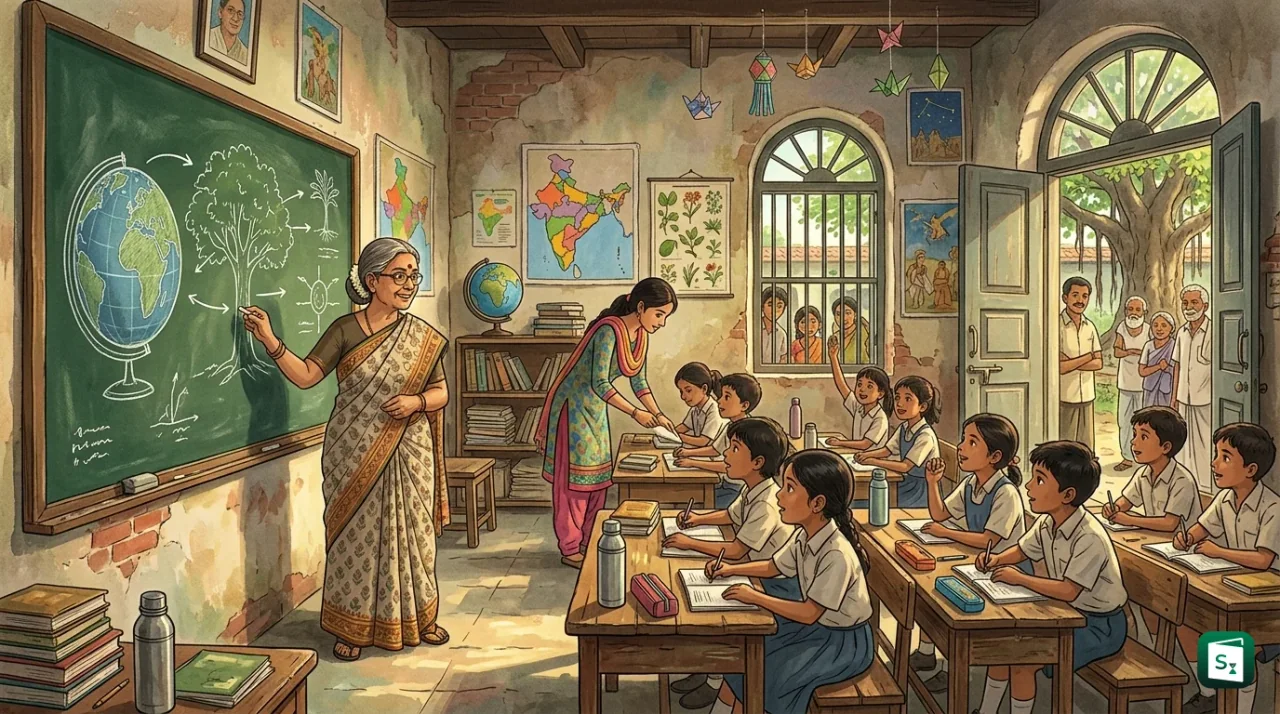
World Teachers’ Day 2026 was observed on 5 October 2026 with the theme “Standing with teachers: 60 years of protecting the profession, advancing its status and shaping our futures”. The United Nations Educational, Scientific and Cultural Organization (UNESCO) leads the global observance, which has been held every year since 1994. The 2026 edition marks 60 years of the 1966 ILO/UNESCO Recommendation concerning the Status of Teachers and focuses on whether teachers today receive the respect, support and working conditions they need.
What Is World Teachers Day and When Is It Observed?
World Teachers Day is a global observance held every year on 5 October to celebrate teachers and to review the rights, responsibilities and working conditions that shape their work. The United Nations Educational, Scientific and Cultural Organization (UNESCO) created the day in 1994. UNESCO, which is headquartered in Paris, France and was founded in 1945, co-organises the day with the International Labour Organization (ILO), the United Nations Children’s Fund (UNICEF) and Education International, the global federation of teacher unions.
The date 5 October is fixed. It marks the anniversary of the adoption of the 1966 ILO/UNESCO Recommendation concerning the Status of Teachers at a special intergovernmental conference held in Paris on 5 October 1966. More than 100 countries now take part in the observance through school functions, public events, policy discussions and award ceremonies. The day both honours the role of teachers in learning and national development and asks governments to measure progress on teacher training, recruitment, pay and professional freedom.
Why 5 October: The 1966 Recommendation Concerning the Status of Teachers
The ILO/UNESCO Recommendation concerning the Status of Teachers (1966) is the only global standard that deals directly with the status of school teachers. Status here means two things together. It means the respect given to teachers by society and the material conditions they work under, including pay, workload, security and benefits compared with other professions. The ILO, which was established in 1919 and is headquartered in Geneva, Switzerland, adopted the text jointly with UNESCO to guide governments in making national laws and policies for teachers.
The Recommendation applies to all teachers in public and private schools up to the end of secondary education. This covers nursery, kindergarten, primary, middle and secondary schools, including technical, vocational and art education. It lays down guidance on teacher preparation and continuing education, recruitment, employment terms, teaching and learning conditions, professional freedom, participation in policy decisions and negotiation of salaries through teacher organisations. Teaching, as defined in the text, is a profession and a form of public service that needs expert knowledge, specialised skill gained through rigorous study, and personal and collective responsibility for pupils.
A second text, the UNESCO Recommendation concerning the Status of Higher-Education Teaching Personnel (1997), extends similar protection to college and university teachers, with strong stress on academic freedom and institutional autonomy. Together the two texts form the backbone of World Teachers Day.
| Instrument | Adopted On | Covers | Core Focus |
|---|---|---|---|
| ILO/UNESCO Recommendation concerning the Status of Teachers | 5 October 1966, Paris | School teachers up to secondary stage, public and private | Rights, responsibilities, training, recruitment, pay, working conditions, professional freedom |
| UNESCO Recommendation concerning Higher-Education Teaching Personnel | 1997 | College and university teaching staff | Academic freedom, autonomy, research, collegial governance |
Monitoring is done by the Joint ILO/UNESCO Committee of Experts on the Application of the Recommendations concerning Teaching Personnel, known as CEART. CEART studies reports from governments and teacher bodies and examines complaints from teacher organisations about non-observance. Its findings go to the ILO Governing Body and UNESCO Executive Board and are shared with member states.
Theme for 2026: 60 Years of Protecting the Profession
The theme for World Teachers Day 2026 is “Standing with teachers: 60 years of protecting the profession, advancing its status and shaping our futures”. UNESCO chose this theme to mark the 60th anniversary of the 1966 Recommendation and to review how far its promise has been fulfilled. The message is direct. Quality education depends on a respected, qualified and supported teaching profession.
UNESCO explains teacher status in three linked parts. Symbolic status means whether society recognises and values teaching. Professional status means whether teachers have autonomy in classrooms, support for training and a real voice in making education policy through dialogue and collective bargaining. Material status means whether salaries, working hours, class sizes and school environments allow teachers to do their job well. When any one part weakens, recruitment and retention suffer.
The 2026 observance comes at a moment when the 1966 Recommendation is being revised to meet new classroom realities. UNESCO points to digital technologies and artificial intelligence, climate disruption, the push for inclusion and gender equality, and migration, displacement and emergencies. These changes were not foreseen in 1966. In 2024 the UN Secretary General’s High-Level Panel on the Teaching Profession called for an updated international instrument for teachers. UNESCO and the ILO then started a joint revision process with an Independent Expert Group, with technical talks centred on equity, digital change, teacher autonomy and academic freedom. Adoption of the revised text is expected at an intergovernmental conference after consultations running through mid 2027. The revision builds on the Santiago Consensus, the outcome document of the first World Summit on Teachers held in August 2025, which called for stronger teacher policies, funding and social dialogue.
Global Teacher Shortage and Challenges to Teacher Status
New UNESCO data released for World Teachers Day 2026 shows the scale of the staffing crisis. The world had about 107 million teachers in 2026. Even then, about 50 million additional teachers are needed by 2030 to ensure universal access to pre-primary, primary and secondary education. Another UNESCO estimate puts the gap for primary and secondary education alone at about 44 million teachers. In simple terms, the world needs one more teacher for every two teachers already working.
Shortage is not only about creating new posts for growing enrolment. About 58 percent of the demand comes from teachers leaving the profession. Annual attrition stands at about 7.2 percent in pre-primary, 4.7 percent in primary and 5.4 percent in secondary education. Low pay, heavy workloads, overcrowded classrooms, limited training and weak career growth push many trained teachers out. Schools in sub-Saharan Africa and South Asia face sharper gaps, where the share of trained teachers remains lower than the global average.
This shortage directly affects Sustainable Development Goal 4 (SDG 4), the global goal to ensure inclusive and equitable quality education and lifelong learning for all by 2030. SDG 4 was adopted in 2015 as part of the 2030 Agenda for Sustainable Development. Without enough qualified, motivated teachers in classrooms, targets on learning outcomes, equity and completion cannot be met. That is why the 2026 theme links protection of the profession with shaping future societies. UNESCO argues that raising teacher status is one of the most effective investments a country can make in education resilience and learning for all.
How the Day Is Observed: Global Celebration and UNESCO-Hamdan Prize
The global celebration for World Teachers Day 2026 took place at UNESCO Headquarters in Paris on 5 October 2026. UNESCO brought together teachers, ministers of education, policy makers and education partners for a full day programme. The morning session hosted the official commemoration and the award ceremony for the ninth UNESCO-Hamdan Prize for Teacher Development. The afternoon session held a high level discussion with ministers and experts on policy steps to raise teacher status. A keynote address by Gert Biesta, Professor of Education at the University of Melbourne, set the frame for debate on the purpose of education and the role of teachers.
A joint message by UNESCO, the ILO, UNICEF and Education International called on governments and partners to stand with teachers by protecting rights, improving pay and conditions, ensuring professional freedom and including teacher unions in policy making. Around the world, schools, universities, teacher associations and governments marked the day with classroom celebrations, debates, exhibitions and media campaigns on teacher issues.
The UNESCO-Hamdan Prize for Teacher Development was created in 2008 with support from the Hamdan Bin Rashid Al Maktoum Foundation for Medical and Educational Sciences. The prize supports SDG 4 and is given every two years. The total amount is $300,000, divided equally among three winners, with each laureate receiving $100,000 and a certificate to expand its work. The laureates of the 2025 to 2026 cycle, announced on 5 October 2026 in Paris, were the Gondar College of Teachers’ Education in Ethiopia, the Guru Belajar Foundation in Indonesia and the Teachers’ Academy Foundation in Türkiye. Their projects, chosen from ten global finalists, show practical models from making low cost Montessori kits in local languages to building teacher leadership and peer learning. The prize recognises such efforts to strengthen teacher training and improve classroom quality.
World Teachers Day and India’s National Teachers Day
India observes its own National Teachers Day on 5 September, which is different from the global World Teachers Day on 5 October. The Indian date marks the birth anniversary of Dr Sarvepalli Radhakrishnan, who was born on 5 September 1888 in Tiruttani in present day Tamil Nadu. Radhakrishnan was a philosopher, scholar and teacher who taught at the University of Mysore and the University of Calcutta, served as Vice Chancellor of Banaras Hindu University and held the Spalding Professorship of Eastern Religions and Ethics at the University of Oxford. He represented India at UNESCO after Independence, became the first Vice President of independent India in 1952 and served as the second President of India from 1962 to 1967. He received the Bharat Ratna in 1954.
When students sought to celebrate his birthday in 1962, Radhakrishnan asked that the day be observed as Teachers Day to honour the whole profession. Since then schools and colleges across India mark 5 September with tributes, cultural programmes and student led activities. The President of India also confers the National Teachers Awards close to this date. The awards were first instituted in 1958 to recognise meritorious teachers in elementary and secondary schools for improving school education and enriching student lives. This Indian tradition complements the global observance by underlining the same idea that teaching deserves public respect and firm policy support.
Key Takeaways
- World Teachers’ Day is observed every year on 5 October and has been held since 1994 under the lead of UNESCO.
- The 2026 theme is “Standing with teachers: 60 years of protecting the profession, advancing its status and shaping our futures”.
- The day commemorates the ILO/UNESCO Recommendation concerning the Status of Teachers adopted on 5 October 1966 in Paris.
- UNESCO data for 2026 records about 107 million teachers worldwide, with 50 million more needed by 2030 for universal school education.
- The ninth UNESCO-Hamdan Prize 2026 went to teacher initiatives in Ethiopia, Indonesia and Türkiye, with each laureate receiving $100,000.
- India observes National Teachers Day separately on 5 September, the birth anniversary of former President Dr Sarvepalli Radhakrishnan.