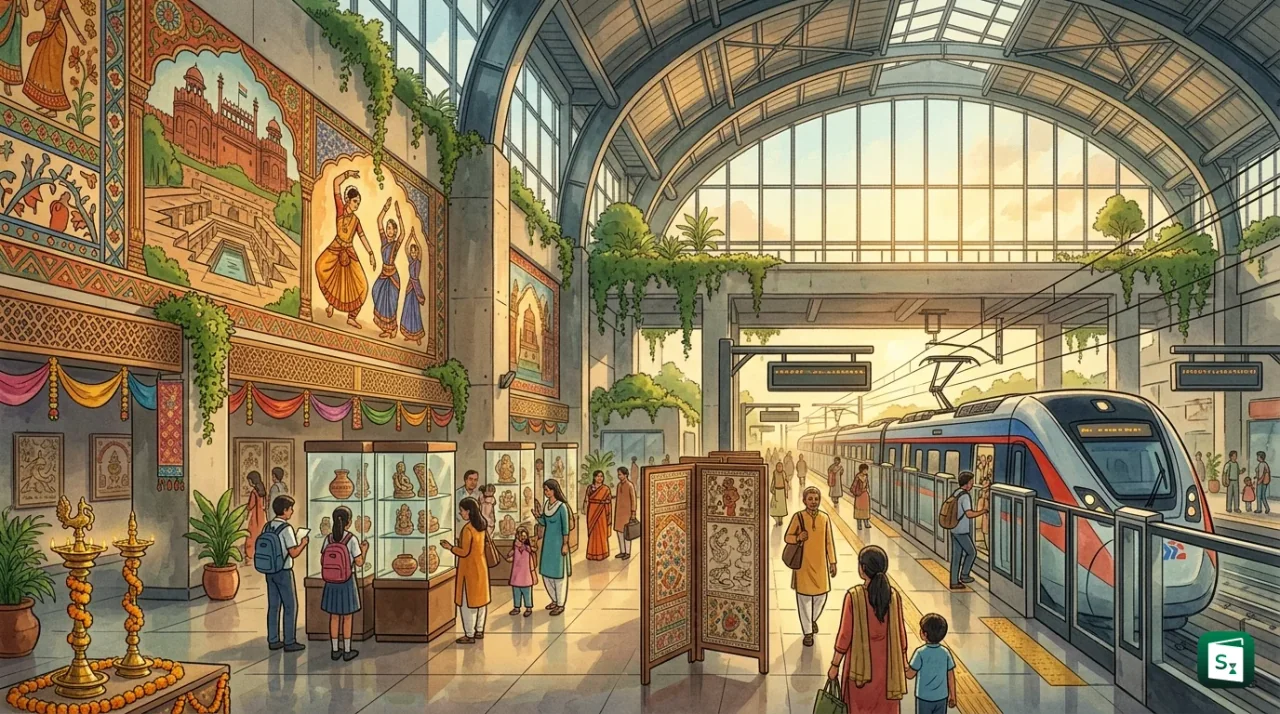
The National Capital Region Transport Corporation (NCRTC) has signed a Memorandum of Understanding (MoU) with the Indira Gandhi National Centre for the Arts (IGNCA) to bring Indian art, culture and heritage to Namo Bharat stations. The agreement, reported on 7 October 2026, will turn station premises into public spaces for exhibitions, literary events, workshops and cultural performances. With nearly 1.1 lakh daily commuters and more than 4.5 crore journeys already completed on the Delhi Meerut corridor, the partnership will place heritage before a very large everyday audience.
What Did the NCRTC IGNCA MoU Announce?
The NCRTC IGNCA agreement links transport infrastructure with cultural outreach. NCRTC will offer space inside Namo Bharat stations for curated programmes, while IGNCA will curate content and expertise on art, culture and heritage for commuters and local communities across the corridor.
The two organisations will explore and support a wide set of public engagement activities inside station premises. The focus is on living culture that people can see, hear and join during their daily travel, not on closed gallery shows for a small audience. Stations will host rotating displays and regular events that change over time to keep repeat travellers engaged.
NCRTC will provide the physical platform for these activities within its stations. IGNCA will bring its research, collections knowledge and network of artists and scholars to design programmes that reflect the diversity of Indian artistic traditions. The partnership also opens the doors for students, artists, cultural practitioners and educational institutions to use stations for learning and participation.
| Initiative Type | What Visitors Can Experience at Stations |
|---|---|
| Art and heritage exhibitions | Curated displays on visual arts, crafts, photographs and heritage themes |
| Literary events and lectures | Talks, poetry readings, book related discussions and awareness programmes |
| Workshops and interactive sessions | Hands on learning with artists, scholars and cultural practitioners |
| Cultural performances | Music, dance, theatre and folk presentations in public station spaces |
What Is NCRTC?
The National Capital Region Transport Corporation (NCRTC) is a government owned joint venture company that builds and operates the Namo Bharat Regional Rapid Transit System in the National Capital Region. NCRTC functions under the Ministry of Housing and Urban Affairs with equity from the Centre and four state governments.
NCRTC is not a private company. It is a government backed implementing agency created to design, develop, finance, operate and maintain the Regional Rapid Transit System (RRTS) in the National Capital Region (NCR). RRTS stands for Regional Rapid Transit System, a dedicated high speed, high capacity rail service that connects regional towns with the national capital. The corporation works under the administrative control of the Ministry of Housing and Urban Affairs.
The idea of a fast commuter rail network for the region dates back to a study commissioned in 1998 to 1999. The National Capital Region Planning Board then included eight RRTS corridors in its Functional Plan on Transport for NCR 2032. A Task Force set up by the erstwhile Planning Commission prioritised three corridors for early work. To execute this plan, a Memorandum of Understanding was signed on 29 June 2011 among the Centre and the governments of Delhi, Haryana, Rajasthan and Uttar Pradesh. The Union Cabinet approved the formation of NCRTC in July 2013, and NCRTC was formally incorporated on 21 August 2013 under the Companies Act, 1956 with an initial seed capital of ₹100 crore.
| Stakeholder in NCRTC | Equity Share |
|---|---|
| Ministry of Housing and Urban Affairs (earlier Ministry of Urban Development) | 22.5% |
| Ministry of Railways | 22.5% |
| National Capital Region Planning Board | 5% |
| Government of Delhi | 12.5% |
| Government of Haryana | 12.5% |
| Government of Rajasthan | 12.5% |
| Government of Uttar Pradesh | 12.5% |
What Is the Namo Bharat Train and RRTS Network?
The Namo Bharat train is a semi high speed regional rail service operated by NCRTC on the Regional Rapid Transit System network. RRTS is a dedicated rail system that links Delhi with nearby cities through fast, frequent and comfortable trains running up to 160 kilometres per hour.
Namo Bharat is the brand name for the trains and services running on RRTS corridors. RRTS stands for Regional Rapid Transit System. It is different from a city metro and from long distance railways. It is built for regional commuters who travel 50 km to 100 km daily between home and work, with fewer stops, higher speed and airline style comfort.
India’s first Namo Bharat corridor connects Delhi, Ghaziabad and Meerut. The Delhi Ghaziabad Meerut RRTS corridor spans 82.15 km from Sarai Kale Khan in Delhi to Modipuram in Meerut and became fully operational in February 2026. The corridor includes the Meerut Metro network, which runs local metro services on the same infrastructure within Meerut city. NCRTC has reported punctuality of more than 99%, effective integration with three metro lines, two railway stations and four bus terminals, and a 35% discount on base fare along with loyalty points for regular travellers.
The trains have a design speed of 180 km per hour and an operational speed of 160 km per hour, with an average speed near 100 km per hour. The full Delhi to Meerut journey takes about 55 to 60 minutes. Services run daily from about 6 am to 11 pm at intervals of 15 to 30 minutes.
| Feature | RRTS or Namo Bharat Rapid Rail | City Metro |
|---|---|---|
| Main purpose | Connects Delhi with regional towns across NCR | Moves passengers within a city |
| Speed | Up to 160 km per hour in operation | Usually 40 to 50 km per hour average |
| Stop spacing | Longer gaps between stations for faster trips | Short gaps with frequent stops |
| Service brand in NCR | Namo Bharat operated by NCRTC | Delhi Metro operated by DMRC and other metro bodies |
Delhi Meerut Route and Station Coverage
The Delhi Meerut route covers three Namo Bharat stations in Delhi and major stations in Ghaziabad and Meerut. The Delhi stations are Sarai Kale Khan, New Ashok Nagar and Anand Vihar. Sarai Kale Khan is the main terminal where all three Phase 1 RRTS corridors are planned to meet, and it offers interchange with the Delhi Metro Pink Line, railways and inter state bus services.
Beyond Delhi, the corridor passes through Sahibabad, Ghaziabad, Guldhar, Duhai, Muradnagar, Modinagar South and Modinagar North before entering Meerut. In Meerut, Namo Bharat stations include Meerut South, Shatabdi Nagar, Begumpul and Modipuram, while the Meerut Metro adds local stations such as Partapur, Rithani, Brahampuri, Meerut Central, Bhaisali, MES Colony, Daurli and Meerut North. In Phase 1, two other corridors were prioritised, the Delhi Gurugram Alwar corridor and the Delhi Panipat corridor, and detailed project reports have been submitted for extensions toward Karnal, Bawal, Behror and the Noida International Airport.
What Is the Indira Gandhi National Centre for Arts?
The Indira Gandhi National Centre for the Arts (IGNCA) is an autonomous research and cultural institution under the Ministry of Culture in New Delhi. IGNCA documents, preserves and promotes Indian arts, culture and heritage through research, publications, exhibitions, training and digital archives.
IGNCA was launched on 19 November 1985 and its Trust was registered in New Delhi on 24 March 1987. The Centre was set up in memory of former Prime Minister Indira Gandhi with a vision that all art forms are linked with nature, society and cosmology. Its headquarters stands at Janpath in New Delhi, close to the Western Court. The Member Secretary serves as the executive head, working under a Board of Trustees and an Executive Committee.
The Centre works through six functional units. Kala Nidhi serves as the multi form library, Kala Kosa studies and publishes fundamental texts, Janapada Sampada researches lifestyle and folk traditions, Kaladarsana converts research into exhibitions and performances, Cultural Informatics uses technology for preservation, and Sutradhara provides administrative coordination. IGNCA also runs nine specialised regional centres across India.
| Regional Centre | Special Focus |
|---|---|
| Varanasi in Uttar Pradesh | Agam Darshan |
| Guwahati in Assam | North East culture |
| Bengaluru in Karnataka | Civilisation and performing arts |
| Ranchi in Jharkhand | Tribal heritage studies |
| Vadodara in Gujarat | Modern art |
| Goa | Inter cultural relations |
| Thrissur in Kerala | Vedic tradition and performing studies |
| Puducherry | Archaeology and epigraphy studies |
| Jammu and Kashmir | Shiva Darshan |
IGNCA has handled several high profile cultural assignments in recent years. These include artworks for the new Parliament building, the Nataraja statue at Bharat Mandapam, the tribal wall at the President’s Secretariat, cultural programmes for the G20 Summit at Bharat Mandapam and digitisation work for Sampurnanand Sanskrit Vishwavidyalaya in Varanasi. The new partnership gives IGNCA one more channel to reach daily commuters who may never visit a museum or archive.
Why the Delhi Meerut Corridor Gives the Partnership Special Meaning
The Delhi Meerut corridor connects two places that hold deep layers of Indian history. NCRTC has noted that Delhi has been at the centre of political and cultural life for centuries, while Meerut and its surrounding region carry memories that reach back to the Mahabharata period and to the First War of Independence in 1857, which began in Meerut. A cultural programme placed on this route does not sit in a neutral space. It sits on a corridor where travellers already move through history every day.
The scale of movement adds weight to the idea. NCRTC has reported about 1.1 lakh commuters daily at present, with numbers rising steadily. The corridor has crossed 4.5 crore commuter journeys in total, after crossing 3.8 crore journeys by August 2026. Such footfall turns stations into important public spaces for the cities and towns they serve. Short exhibitions, talks and performances can reach office goers, students and families who use the system for work and study.
The social design is equally important. NCRTC wants stations to function as vibrant community hubs rather than only boarding points. IGNCA wants heritage to enter everyday life rather than remain inside research rooms. By placing curated art inside transit spaces, the two bodies connect movement across cities with movement across traditions, stories and artistic expression.
The Way Forward
NCRTC has described the MoU as part of a larger plan to make Namo Bharat stations lively and engaging social spaces. The next step is practical rollout. The two organisations are expected to select stations, fix calendars for rotating exhibitions and announce guidelines for artists, schools and colleges that wish to take part. Clear scheduling will matter because stations must balance cultural activity with passenger flow, safety and punctual operations.
If the early programmes draw a good response, the model can grow with the network. NCRTC has submitted detailed project reports for new RRTS links toward Karnal, Bawal, Behror and the Noida International Airport, while work on the Gurugram Alwar and Panipat corridors is part of the long term Phase 1 vision. Each new station would then offer a ready stage for region specific heritage, from local crafts to local histories, without building separate cultural centres from scratch.
Key Takeaways
- NCRTC signed an MoU with IGNCA on 7 October 2026 to host art, culture and heritage programmes at Namo Bharat stations.
- RRTS stands for Regional Rapid Transit System and Namo Bharat is the brand name for its semi high speed services operated by NCRTC.
- The Delhi Ghaziabad Meerut corridor spans 82.15 km from Sarai Kale Khan to Modipuram and became fully operational in February 2026.
- NCRTC was incorporated on 21 August 2013 as a government joint venture under the Ministry of Housing and Urban Affairs.
- IGNCA was established in 1987 as an autonomous body under the Ministry of Culture and is headquartered at Janpath in New Delhi.
- Namo Bharat trains run at an operational speed of 160 km per hour and serve about 1.1 lakh commuters daily, with total journeys crossing 4.5 crore.