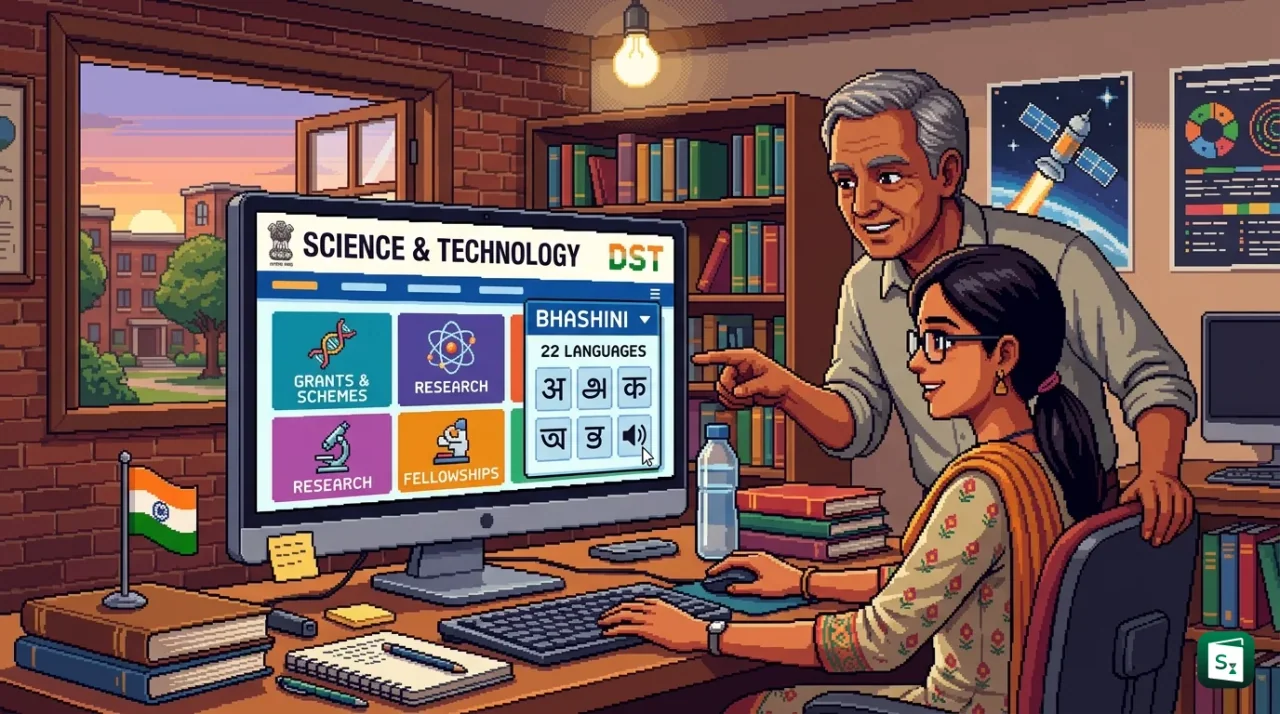
Dr Jitendra Singh launched the redeveloped websites of the Department of Science and Technology at Kartavya Bhawan in New Delhi on 9 October 2026. The two portals, www.dst.gov.in and www.most.gov.in, offer content in 22 languages through BHASHINI integration and act as a single window for research grants, fellowships and schemes. The launch places scientific information within easy reach of students, researchers, startups and citizens across India.
What Was Launched and Who Launched It?
The Department of Science and Technology launched two redeveloped portals on 9 October 2026 at Kartavya Bhawan in New Delhi. The portals are www.dst.gov.in, the website of the Department of Science and Technology (DST), and www.most.gov.in, the website of the Ministry of Science and Technology. Dr Jitendra Singh, Union Minister of State (Independent Charge) for Science and Technology and Earth Sciences (as of October 2026), launched both websites.
Prof Umesh V. Waghmare, Secretary of the Department of Science and Technology, attended the launch with senior DST officials and members of the website development team. The Department of Science and Technology redeveloped the portals jointly with the National Informatics Centre (NIC), along with the project management team and the development agency. Internal divisions of the department curated and checked the content before release.
The Minister described the guiding idea as Science by the People, Science for the People. The aim is to make science available, accessible and affordable. The portals reflect a citizen first approach to governance, where users can find information and opportunities based on their own needs on one common platform.
Department of Science and Technology and Ministry of Science and Technology
The Department of Science and Technology (DST) is the nodal department for organising, coordinating and promoting science and technology activities in India. DST stands for Department of Science and Technology. The Ministry of Science and Technology created the department on 3 May 1971. The Ministry itself was also created in May 1971 to drive scientific growth and social development.
The Department of Science and Technology functions under the Ministry of Science and Technology. The Ministry works through three main wings. The table below sets out their roles and origin.
| Wing | Full Name and Setup Year | Core Role |
|---|---|---|
| DST | Department of Science and Technology, 1971 | Policy formulation, funding research, promoting new areas of science, supporting grants and fellowships |
| DBT | Department of Biotechnology, 1986 | Research and application of life sciences and biotechnology |
| DSIR/CSIR | Department of Scientific and Industrial Research, 1985, with Council of Scientific and Industrial Research | Indigenous technology promotion, industrial research, transfer of technology to industry |
The Department of Science and Technology formulates science and technology policies and handles work linked to the Scientific Advisory Committee of the Cabinet. It supports surveys, futurology studies and research design. It provides grants to research institutions, science academies and professional bodies. It also coordinates areas where many departments and institutions share interest and skills, such as climate research, nano science, supercomputing and geospatial technology.
What Is BHASHINI and How Does It Enable Access in 22 Languages?
BHASHINI, which stands for BHASHa INterface for India, is India’s Artificial Intelligence led National Language Translation Mission under the Ministry of Electronics and Information Technology. Launched in 2022, it provides speech and text translation in 22 Scheduled languages through open Application Programming Interfaces.
The BHASHINI mission operates through the Digital India BHASHINI Division under the Digital India Corporation (DIC) of the Ministry of Electronics and Information Technology (MeitY). The Prime Minister launched Digital India BHASHINI at Digital India Week in Gandhinagar, Gujarat, in July 2022. Its goal is to give easy access to the internet and digital services in Indian languages, including voice based access, and to help create more content in Indian languages.
The platform builds core language technology for speech and text translation for the 22 Scheduled languages listed in the Eighth Schedule of the Constitution. Its open interfaces are listed on API Setu and any application can integrate them. A crowdsourcing initiative called Bhasha Daan invites citizens to donate language inputs to build large datasets for Indian languages. These datasets train translation models for use by government, startups, researchers and industry.
On the new DST and Ministry websites, BHASHINI integration allows a user to read scheme details, fellowship guidelines and research calls in the language of choice. This widens the reach of science to students and citizens who prefer to learn in their mother tongue. It also supports the goal of multilingual e governance, where public services meet people in the language they understand best.
Website Standards and Compliance: What Are DBIM 3.0 and GIGW 3.0?
The redeveloped DST and Ministry websites comply with two national standards for government digital platforms. DBIM stands for Digital Brand Identity Manual. GIGW stands for Guidelines for Indian Government Websites and Apps. The Ministry of Electronics and Information Technology released DBIM 3.0 in March 2025 and jointly developed GIGW 3.0 with the National Informatics Centre, the Standardisation Testing and Quality Certification Directorate and the Indian Computer Emergency Response Team.
DBIM 3.0 provides a common framework for visual identity, information architecture and content presentation across ministries and departments. It ensures that a visitor sees consistent branding, navigation and layout on every government site. GIGW 3.0 sets rules for quality, accessibility, cybersecurity, usability and lifecycle management. The table below summarises the four pillars of GIGW 3.0.
| Pillar | What It Requires on Government Websites |
|---|---|
| Quality | Clear ownership, emblem display, updated content, contact details, links to National Portal and complete titles and metadata |
| Accessibility | Conformance to WCAG 2.1 Level AA, support for screen readers, keyboard navigation and mobile access |
| Cybersecurity | SSL/TLS encryption, security audit, Safe to Host certificate and compliance with CERT-In guidelines |
| Lifecycle Management | Dedicated Web Information Manager, content review cycle, archival policy and monitoring dashboard for non conformity |
The new DST portals apply these rules in practice. The portals include adjustable font sizes, high contrast display modes, link highlighting and controls for letter spacing and line height. The portals support screen readers. Their responsive design keeps text readable on desktops, tablets and mobile phones. A modular Content Management System helps officers update content quickly and add new sections in future. Security controls include SSL/TLS encryption and cybersecurity assessment under CERT-In norms. Content Delivery Network integration supports faster loading and stable service during high traffic periods such as result announcements and application deadlines.
Single Window Access to Research Opportunities and Schemes
The Department of Science and Technology presents the new portals as a single window for science opportunities. The portals serve students, research fellows, researchers, academic institutions, innovators, startups, entrepreneurs, media professionals and citizens. A user can now trace the full journey of an opportunity in one place, from eligibility criteria and application guidelines to calls for proposals, awards, results and official notifications.
The portals use a standard information architecture with sections on About DST, divisions, programmes and schemes, services, opportunities, documents and news and updates. A structured scheme and opportunity finder helps visitors discover research funding, calls for proposals, awards and application forms without opening many separate pages. A central document repository stores guidelines, policy documents, notifications, reports and administrative forms. Reorganised listings of DST divisions, the organisational hierarchy and officers contact details make it easier to reach the right office. A dedicated section on bilateral and multilateral cooperation presents science and technology partnerships for international stakeholders. The news and updates section brings together press releases, calls, results and announcements.
The improved discovery matters because the Department of Science and Technology runs a wide network of grants and fellowships. The flagship Innovation in Science Pursuit for Inspired Research (INSPIRE) programme attracts young talent to science. Its Scholarship for Higher Education (SHE) offers 12,000 scholarships every year at ₹80,000 per year for undergraduate and integrated postgraduate study in natural and basic sciences to top performers in Class 12 board examinations. Its INSPIRE Fellowship supports full time PhD study for up to five years and carries benefits equivalent to national research fellowships. Its MANAK component, which stands for Million Minds Augmenting National Aspiration and Knowledge, invites students of Classes 6 to 10 to propose original ideas and provides ₹10,000 to shortlisted young innovators.
Many of these programmes now sit under the unified Vigyan Dhara scheme. The Union Cabinet approved Vigyan Dhara in August 2024 and the scheme came into force on 16 January 2025. The scheme merges three umbrella schemes on institutional and human capacity building, research and development, and innovation and technology deployment. The approved outlay is ₹10,579.84 crore for 2021-22 to 2025-26, aligned with the vision of Viksit Bharat 2047. The research component aligns with the Anusandhan National Research Foundation (ANRF), established under the ANRF Act of 2023. A clear and searchable website helps applicants track such calls for proposals, deadlines and results on time.
Significance and The Way Forward
The Department of Science and Technology states that the redevelopment goes beyond visual redesign. The project restructures content, improves user experience and creates a durable system for content governance. This forms part of a wider effort to harmonise the digital footprint of the Government of India with common branding, navigation and presentation.
For students and researchers, the gain is practical. Time spent searching across circulars and old pages comes down. Rules, forms and deadlines appear in a predictable format and in a familiar language. For startups and industry, technology flow across domains becomes easier to track. For citizens and media, transparency improves because policies, reports and decisions sit in one searchable repository with review dates.
The portals run on a modular Content Management System that allows quick updates and future expansion. The system can link with external science and technology applications such as project management and funding platforms. Ongoing tasks include regular content review by divisions, security review under CERT-In guidance and conformity assessment for Certified Quality Website status from the Standardisation Testing and Quality Certification Directorate. Through steady updates, multilingual reach and standard design, the websites aim to keep public science resources open and useful to all.
Key Takeaways
- Dr Jitendra Singh launched the redeveloped www.dst.gov.in and www.most.gov.in on 9 October 2026 at Kartavya Bhawan in New Delhi.
- The new portals provide access in 22 languages through BHASHINI, which stands for BHASHa INterface for India.
- The websites comply with DBIM 3.0, released in March 2025, and GIGW 3.0 covering quality, accessibility, cybersecurity and lifecycle management.
- The Department of Science and Technology, established on 3 May 1971, functions under the Ministry of Science and Technology alongside DBT and DSIR/CSIR.
- BHASHINI was launched in 2022 under the Ministry of Electronics and Information Technology and offers open interfaces through API Setu.
- The unified Vigyan Dhara scheme, effective from 16 January 2025, carries an outlay of ₹10,579.84 crore for 2021-22 to 2025-26.