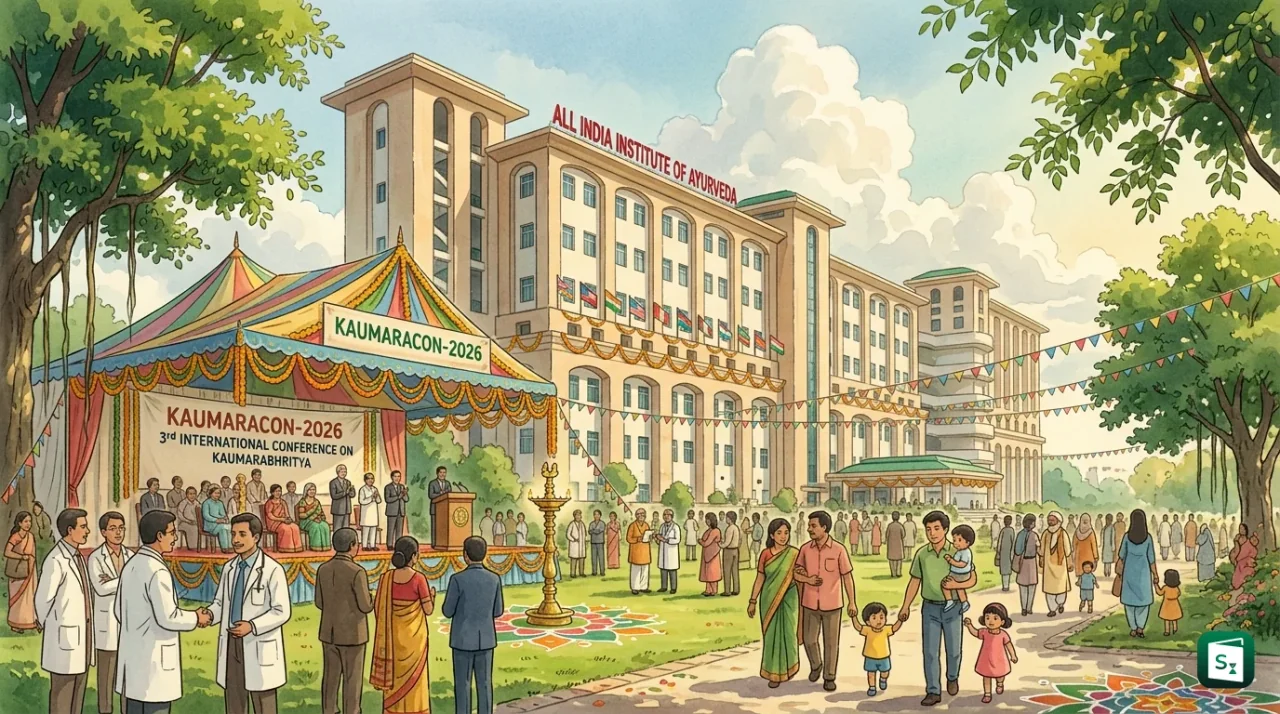
Vice President C P Radhakrishnan inaugurated KAUMARACON 2026, the third international conference on Kaumarabhritya, at the All India Institute of Ayurveda (AIIA) in Sarita Vihar, New Delhi on 15 October 2026. The three day conference, held from 15 to 17 October 2026 alongside the institute foundation day celebrations, focused on the theme of shaping the future of child health through global views, research advances and clinical work in Ayurvedic paediatrics. At the inaugural event, the Vice President launched the AYUSH Start-up Portal, the AyuDIVA facility, the AIIA-iCAINE website, the Vamana App and the Panchakarma Assessment App, and an international academic agreement between AIIA and Maharishi International University (MIU) in the United States was exchanged.
What Is Ayurveda and Kaumarabhritya?
Ayurveda is India’s traditional system of medicine with documented practice of more than 5000 years. It is regarded as an Upaveda of the Atharva Veda and explains health as balance of three body energies called Vata, Pitta and Kapha. Kaumarabhritya is one of its eight branches for child care from conception to adolescence.
The word Kaumarabhritya comes from two Sanskrit words. Kumara means child and bhritya means nurturing or care. The branch is also called Balachikitsa or Balaroga Chikitsa. Classical texts place Acharya Kashyapa as the leading authority in this field, and his Kashyapa Samhita remains the core reference for newborn care, feeding, growth, dentition and management of childhood disorders.
Ayurveda divides its knowledge into eight branches, collectively called Ashtanga Ayurveda. Kaumarabhritya is the branch that covers both childcare and care of the mother before, during and after pregnancy. It gives detailed guidance on breastfeeding, nutrition, immunity, daily routine, sleep and mental development. Preventive practices such as Swarna Prashana, a herbal preparation with processed gold given with honey and ghee to support immunity and intellect, belong to this tradition.
| The Eight Branches of Ayurveda | Focus Area |
|---|---|
| Kaya Chikitsa | General internal medicine for adults |
| Kaumarabhritya | Paediatrics along with obstetrics and gynaecology |
| Shalya Tantra | Surgery with instruments and operative methods |
| Shalakya Tantra | Diseases of eye, ear, nose, throat, teeth and head |
| Bhuta Vidya | Mental health and behavioural disorders |
| Agada Tantra | Toxicology and management of poisons and epidemics |
| Rasayana Tantra | Rejuvenation, immunity and healthy ageing |
| Vajikarana | Reproductive health and healthy progeny |
In practice today, Kaumarabhritya covers growth tracking, nutritional disorders, recurrent infections, skin problems, respiratory issues, digestive complaints and developmental concerns such as attention and learning difficulties. Ayurvedic doctors use herbal and herbo mineral preparations, diet correction, daily routine guidance and gentle child friendly Panchakarma therapies. The approach is preventive as much as curative. It starts with care during pregnancy, continues with newborn rituals such as cleaning, cord care, oil massage and early breastfeeding, and extends through infancy and adolescence.
KAUMARACON 2026: Theme, Venue and Participation
The Department of Kaumarabhritya at AIIA New Delhi organised KAUMARACON 2026 from 15 to 17 October 2026 at the AIIA campus in Sarita Vihar, New Delhi. The conference carried the theme Shaping the Future of Child Health: Global Perspectives, Research Innovations, and Clinical Frontiers in Kaumarabhritya. The theme linked classical Ayurvedic principles for children with present day research, diagnostics and clinical needs.
KAUMARACON 2026 was the third edition in the series. The first two editions were held in 2019 and 2023 at Dr Sarvepalli Radhakrishnan Rajasthan Ayurved University in Jodhpur. The 2026 edition marked a shift to the national apex institute in Delhi and coincided with the decennial celebrations of AIIA. This timing gave the event added institutional weight.
The inaugural programme on 15 October 2026 was attended by Vice President C P Radhakrishnan as chief guest. Prataprao Jadhav, Union Minister of State (Independent Charge) for Ayush and Minister of State for Health and Family Welfare (as of October 2026), attended as guest of honour. Vaidya Rajesh Kotecha, Secretary in the Ministry of Ayush, and Dr Maneesha Upendra Kothekar, Chairperson of the National Commission for Indian System of Medicine (NCISM), were also present. Prof Vd P K Prajapati, Director of AIIA, welcomed the gathering, while Prof Dr Rajagopala S, Head of the Department of Kaumarabhritya at AIIA Delhi, served as organising chairman.
The scientific programme brought together more than 500 participants, including teachers, practitioners, researchers, postgraduate scholars and students from across India. Experts from Brazil, the United States, Germany, Sri Lanka and Nepal joined sessions in online mode. The schedule included a pre conference workshop on Ayurinformatics, which covers computer aided drug design and diagnostics in child care, along with an oration lecture, six main scientific sessions including an international experts session, and 12 parallel sessions. More than 175 scientific papers were listed for presentation on clinical experience, neonatal care, nutrition, neurology, dermatology and respiratory care in children.
All India Institute of Ayurveda and Its Foundation Day
The All India Institute of Ayurveda, known as AIIA, is an autonomous institute under the Ministry of Ayush. The institute was conceptualised in the early 2000s and dedicated to the nation by the Prime Minister on 17 October 2017. AIIA functions at Gautampuri, Sarita Vihar on Mathura Road in New Delhi and is conceived as the apex Ayurveda institute for tertiary care, education and research with modern tools.
AIIA New Delhi provides postgraduate and doctoral education in Ayurveda in affiliation with the University of Delhi. The institute holds NAAC A++ accreditation and its hospital holds NABH accreditation for quality and patient safety. AIIA New Delhi operates with more than 200 inpatient beds and runs more than 45 specialised outpatient departments. Its satellite centre at Goa, inaugurated on 11 December 2022, extends the same model with a 250 bed integrative hospital. The Union Budget for 2026-27 announced three more AIIA type institutions.
The foundation day programme closed the conference on 17 October 2026. AIIA New Delhi celebrated its ninth foundation day in October 2025 and entered its tenth year in 2026, marking the start of its decennial celebrations. The Department of Kaumarabhritya at AIIA Delhi handles 120 to 150 children per day in its outpatient section. The department provides newborn care with a Neonatal Intensive Care Unit (NICU), vaccination support, skin care and mental health services, along with a special outpatient service for cancer care in children. It has set up the KINDER Lab, a facility for neurology, dermatology and respiratory assessment in children, and an Ayurinformatics Lab for artificial intelligence supported formulation work.
The Ministry of Ayush was formed on 9 November 2014 to promote traditional systems of health care. The ministry covers Ayurveda, Yoga and Naturopathy, Unani, Siddha, Sowa Rigpa and Homoeopathy, together shortened as AYUSH. Earlier, the Department of Indian System of Medicine and Homoeopathy was set up in 1995 and renamed as the Department of AYUSH in 2003. The ministry runs the National AYUSH Mission for services and infrastructure, supports research through the Ayush Research Portal, and anchors pharmacovigilance and global outreach, including the WHO Global Centre for Traditional Medicine at Jamnagar in Gujarat.
Digital Launches: Start-up Portal, iCAINE Website and AyuDIVA
The Vice President inaugurated three platforms at the KAUMARACON 2026 ceremony to link Ayurveda with startups and digital systems. The first was the AYUSH Start-up Portal. The portal gives Ayurveda entrepreneurs a single window for registration, information on schemes, and connection with mentors and investors. It supports the AYUSH Startup Challenge process and helps small Ayurvedic treatment makers, clinics and technology firms move from idea to market.
The second launch was the AIIA-iCAINE website. iCAINE stands for the incubation and innovation support system anchored at AIIA for Ayurveda. The website presents incubation calls, facilities, partner details and application steps for students, researchers and early stage firms. It acts as the public face for AIIA led mentoring in product development, quality testing and clinical validation.
The third launch was the Ayurveda Digital Innovation and Venture Acceleration Facility, shortened as AyuDIVA. The facility is designed to speed up digital innovation and venture growth in Ayurveda. It brings academic labs, hospitals and private startups together for pilot testing of devices, software and formulations. The facility also supports training in regulatory needs, good manufacturing practice and evidence generation, which new firms often find difficult to manage alone.
| Platform Launched at KAUMARACON 2026 | Main Purpose |
|---|---|
| AYUSH Start-up Portal | Registration, scheme guidance and investor linkage for Ayush startups |
| AIIA-iCAINE Website | Information and application window for Ayurveda incubation at AIIA |
| AyuDIVA Facility | Acceleration support for digital tools, products and ventures in Ayurveda |
Together, the three launches show a clear policy direction. The Ministry of Ayush wants Ayurveda to grow through organised entrepreneurship and not only through hospitals and colleges. Digital registration lowers paperwork. A visible incubation website builds trust. A dedicated acceleration facility helps ideas pass through testing and quality checks before they reach patients.
Vamana App and Panchakarma Assessment App
The Vice President also launched two clinical support apps at KAUMARACON 2026. The Vamana App focuses on one specific Panchakarma procedure. The Panchakarma Assessment App provides a broader tool to assess patient suitability, plan therapy and record outcomes across Panchakarma treatments.
What is Vamana in Ayurveda?
Vamana is therapeutic emesis and one of the five core Panchakarma therapies in Ayurveda. It uses herbal medicines to induce controlled vomiting under strict medical supervision to clear excess Kapha dosha from the upper body. Doctors prescribe it selectively for conditions such as chronic cough, asthma, skin disorders and digestive heaviness.
The Vamana App is expected to help doctors follow standard steps for this sensitive therapy. Vamana needs careful preparation with oleation and sweating, followed by the main procedure and a graded diet plan for recovery. The app can record patient history, contraindications, dosage details and post therapy response. This reduces reliance on memory and paper notes, which is vital when the therapy is adapted for children.
How Does Panchakarma Assessment Help Treatment?
Panchakarma means five actions. The five classical procedures are Vamana (emesis), Virechana (purgation), Basti (medicated enema), Nasya (nasal therapy) and Raktamokshana (bloodletting). Panchakarma treatment aims to remove accumulated doshas, improve digestion and metabolism, and prepare the body for rejuvenation medicines. Reported benefits include better gut function, clearer skin, improved breathing, reduced stiffness and improved sleep when the therapy is chosen correctly and supervised by a trained doctor.
The Panchakarma Assessment App extends this logic to routine care. Ayurvedic treatment depends on correct assessment of dosha, dhatu (body tissues), digestive strength, age and season. The app guides the doctor through fitness checks, suitability scoring and therapy planning. It also creates a digital record that supports follow up, referral and research. For child care, where doses and procedures differ sharply from adult care, such standard records improve safety and help build reliable clinical data over time.
International MoU with Maharishi International University
An international Memorandum of Understanding (MoU) between AIIA New Delhi and Maharishi International University (MIU) in the United States was exchanged in the presence of the Vice President. The agreement signals closer academic and research cooperation between an Indian apex Ayurveda institute and an American university with active Ayurveda programmes.
MIU is a private nonprofit university located in Fairfield, Iowa in the United States. The university was founded in 1971 by Maharishi Mahesh Yogi and follows a system called consciousness based education, which includes practice of Transcendental Meditation alongside degree study. The university holds accreditation from the Higher Learning Commission in the United States. Its College of Integrative Medicine offers degrees such as a BA in Ayurveda Wellness and Integrative Health and an MS in Maharishi AyurVeda and Integrative Medicine, along with joint fellowship work with American integrative medicine centres.
For AIIA, the MoU opens routes for joint courses, student and faculty exchange, collaborative studies and shared publications in Ayurveda paediatrics and integrative health. For MIU, the tie up gives direct access to clinical training and research exposure at a high volume Indian Ayurveda hospital. The Ministry of Ayush has placed strong emphasis on such global partnerships, alongside work through the WHO Global Centre for Traditional Medicine, to widen scientific evidence and international acceptance of traditional medicine.
Significance for Child Health and Traditional Medicine
The Vice President called for stronger scientific research to prove the safety and effect of traditional practices, build patient trust and widen global use. He noted the vision to develop AIIA at par with the All India Institute of Medical Sciences (AIIMS) in terms of standards and impact. The message was direct. Ayurveda must speak in the language of data, trials and outcomes while retaining its classical roots.
Union Minister Prataprao Jadhav placed KAUMARACON 2026 in the larger journey of the past decade. Ayurveda, once seen mainly as an alternative option, is now being woven into the wider health system through colleges, referral hospitals, insurance linkage and research funding. In February 2026, AIIA was empanelled with 32 general insurance companies through an agreement with the General Insurance Council, which opened cashless facility for eligible Ayurveda care. The Ayush Research Portal and the Traditional Medicine Global Library now give researchers easier access to published work.
AYUSH Secretary Vaidya Rajesh Kotecha pointed to scale. AIIA mentors 105 pharmacovigilance centres for Ayurvedic drugs and maintains more than 97 national and international collaborations. The National Commission for Indian System of Medicine, set up under the NCISM Act of 2020, regulates education and practice in Ayurveda, Unani, Siddha and Sowa Rigpa. Its chairperson attended the conference, which underlines the link between classroom standards, clinical practice and conference research.
For children, the stakes are high. India faces a double burden of undernutrition and rising lifestyle related illness in young age groups. Kaumarabhritya offers a preventive frame that starts before birth and stresses breastfeeding, age wise diet, sleep discipline, immunisation support and early tracking of growth and behaviour. When combined with modern paediatric screening, growth charts and lab tests, this frame can help doctors catch delays early and guide parents with clear diet and routine plans. KAUMARACON 2026 pushed this integrative path by placing neonatal intensive care, Ayurinformatics and child friendly Panchakarma on the same platform.
Key Takeaways
- KAUMARACON 2026, the third international conference on Kaumarabhritya, was inaugurated on 15 October 2026 at AIIA New Delhi.
- The conference theme was Shaping the Future of Child Health: Global Perspectives, Research Innovations, and Clinical Frontiers in Kaumarabhritya.
- The Vice President launched the AYUSH Start-up Portal, the AIIA-iCAINE website, AyuDIVA, the Vamana App and the Panchakarma Assessment App at the event.
- An international MoU between Maharishi International University in the USA and AIIA New Delhi was exchanged during the conference.
- Kaumarabhritya is one of the eight branches of Ashtanga Ayurveda and focuses on child care from conception to adolescence.
- AIIA New Delhi, an autonomous institute under the Ministry of Ayush formed on 9 November 2014, was dedicated to the nation on 17 October 2017.