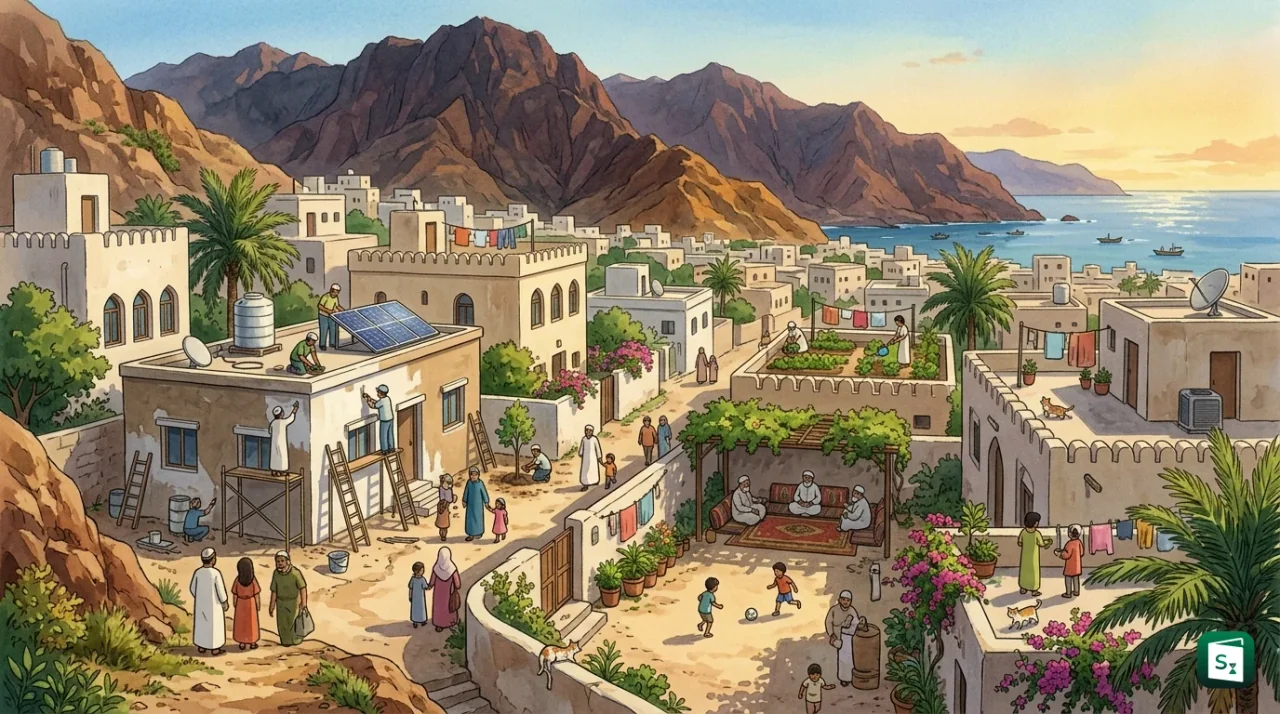
World Habitat Day 2026 was observed on 5 October 2026, the first Monday of October, under the theme Adequate Housing for All. The global observance was hosted by the Sultanate of Oman in Muscat at the Oman Convention and Exhibition Centre from 5 to 8 October 2026. The observance opened Urban October, the month long United Nations campaign for sustainable cities and housing.
What Is World Habitat Day?
World Habitat Day is a United Nations observance held every year to review the condition of towns and cities and to affirm the basic right of every person to adequate shelter. The United Nations also uses the day to remind governments, communities and citizens that all of them share the power and responsibility to shape the future of human settlements.
The United Nations General Assembly created the observance in 1985 through Resolution 40/202. The Assembly fixed the first Monday of October as the date for the observance every year. The first celebration took place in 1986 in Nairobi, Kenya, with the theme Shelter is My Right. Since then, a different host city has led the global observance each year with keynote speeches, roundtables and cultural events focused on a specific theme.
When Is World Habitat Day 2026 Celebrated?
World Habitat Day is celebrated on the first Monday of October every year. In 2026, World Habitat Day fell on 5 October 2026. The fixed date rule links the day to the start of Urban October, which runs from World Habitat Day to World Cities Day on 31 October.
The United Nations follows this calendar strictly so that national events across the world take place in the same week. In 2026, the global observance in Muscat extended from 5 to 8 October to coincide with the Home and Building Expo. Local events in other countries were held on or around 5 October. The 2025 observance had taken place on 6 October 2025 in Nairobi, while the 2024 observance took place on 7 October 2024 in Queretaro, Mexico.
World Habitat Day 2026: Theme, Host and Global Observance in Muscat
World Habitat Day 2026 carried the theme Adequate Housing for All. The United Nations chose this theme to draw global attention to a deepening housing crisis and to push governments toward action instead of diagnosis. The theme also builds on two resolutions adopted at the second session of the UN Habitat Assembly in 2023, namely Resolution 2/7 on adequate housing for all and Resolution 2/2 on transforming informal settlements and slums.
The global observance took place at the Oman Convention and Exhibition Centre in Muscat. The Government of the Sultanate of Oman hosted the event in partnership with UN Habitat, the United Nations Human Settlements Programme. The programme brought together ministers, mayors, civil society groups, academics and private firms to exchange experience, display innovative housing models and form new partnerships. The UN Habitat Scroll of Honour Award, launched in 1989 as the most prestigious global award for human settlements, was presented during the observance to honour outstanding contributions to housing and urban life.
The 2026 observance was the first Urban October under the UN Habitat Strategic Plan 2026 to 2029. The plan places housing, land and basic services at the centre of the work of UN Habitat. The observance also reflected the Baku Call to Action adopted at the thirteenth World Urban Forum in May 2026, which called for a human rights approach to housing.
What Does Adequate Housing for All Mean?
Adequate housing means much more than four walls and a roof. Under international human rights law, the right to adequate housing forms part of the right to an adequate standard of living recognised in the Universal Declaration of Human Rights (1948) and detailed in the International Covenant on Economic, Social and Cultural Rights. The United Nations describes seven conditions that make housing adequate.
| Condition of Adequate Housing | What It Means in Simple Terms |
|---|---|
| Security of tenure | Families have legal protection against forced eviction and harassment |
| Availability of services | Homes have safe water, sanitation, energy, waste disposal and emergency services |
| Affordability | Housing costs do not force families to cut spending on food, health or schooling |
| Habitability | Houses are safe, dry, ventilated and large enough for the family |
| Accessibility | Housing meets the needs of elderly persons, children and persons with disabilities |
| Location | Homes are close to jobs, schools, clinics and transport and away from pollution and hazard zones |
| Cultural adequacy | House design respects local culture, materials and community life |
The 2026 concept note stressed that meeting these conditions needs many types of supply at once. Social housing, public housing, rental housing, cooperative housing and community led models must grow alongside market housing. Upgrading informal settlements, ensuring climate resilience and using enabling laws, reliable data and finance were listed as core requirements.
UN Habitat: Institutional Framework and Headquarters
UN Habitat stands for the United Nations Human Settlements Programme. The United Nations General Assembly mandates UN Habitat to promote socially and environmentally sustainable towns and cities. UN Habitat acts as the focal point for all urbanisation and human settlement matters within the United Nations system.
The roots of UN Habitat lie in rapid and unplanned urban growth in the 1970s. The first United Nations Conference on Human Settlements, known as Habitat I, met in Vancouver, Canada, from 31 May to 11 June 1976 and adopted the Vancouver Declaration and Action Plan. Following that conference, the General Assembly created the United Nations Centre for Human Settlements in 1977 through Resolution 32/162. On 1 January 2002, the Assembly strengthened the body through Resolution 56/206 and raised it to a full programme called UN Habitat.
The UN Habitat secretariat is headquartered in Nairobi, Kenya, at the United Nations Office at Nairobi. The programme works in more than 90 countries, giving policy advice, technical help and field support to governments and communities. The Executive Director of UN Habitat is Anaclaudia Rossbach of Brazil (as of October 2026), an economist with long experience in social housing and informal settlement upgrading. She assumed office on 12 August 2024 after election by the General Assembly for a four year term.
Urban October and World Cities Day Link
World Habitat Day opens Urban October every year. UN Habitat launched Urban October in 2014 to focus world attention on urban challenges for a full month. The month begins with World Habitat Day on the first Monday of October and ends with World Cities Day on 31 October.
The General Assembly created World Cities Day through Resolution 68/239. The first World Cities Day was celebrated in 2014. Like World Habitat Day, a different city hosts the global observance each year around a specific theme. In 2026, the global observance of World Cities Day will take place in Fuzhou, China, under the theme Regenerating the City: Adequate Housing for All. The theme will show how area based regeneration, slum upgrading and community led planning can deliver inclusive and climate resilient neighbourhoods without displacing existing residents.
Recent editions show how the two observances stay linked through housing and crisis themes.
| Year | World Habitat Day Theme and Host | World Cities Day Theme and Host |
|---|---|---|
| 2026 | Adequate Housing for All, Muscat, Oman | Regenerating the City: Adequate Housing for All, Fuzhou, China |
| 2025 | Urban Crisis Response, Nairobi, Kenya | Theme linked to urban resilience and crisis response |
| 2024 | Engaging Youth to Create a Better Urban Future, Queretaro, Mexico | Theme linked to youth and sustainable urban action |
The Global Housing Crisis Behind the 2026 Theme
The United Nations chose the 2026 theme because the world faces a severe housing crisis. UN Habitat estimates that up to 3.4 billion people live without secure, safe and adequate housing. More than 1.1 billion people live in slums and informal settlements. The number stood at about 1.16 billion in 2024, which is over 130 million more than in 2015. That rise came even though the share of city dwellers in slums fell in some regions. Rapid population growth wiped out the gains.
Money pressure makes the crisis worse. About 44 percent of households across the world spend more than 30 percent of their income on rent. In Sub Saharan Africa the figure rises to 55 percent. The global housing deficit grew from 251 million units in 2010 to 288 million units in 2023. UN Habitat calculates that the world must build 96,000 affordable homes every day to meet the 2030 housing demand. Displacement adds fresh strain. Around 133 million people faced displacement in 2024 due to conflict, violence and disasters. Research for the World Cities Report 2026 found that about 64 million people faced eviction between 2003 and 2023.
Adequate housing sits at the centre of two global agreements. Sustainable Development Goal 11 calls for inclusive, safe, resilient and sustainable cities, with access to adequate, safe and affordable housing and slum upgrading by 2030. The New Urban Agenda, adopted at the Habitat III Conference in Quito, Ecuador, in October 2016, sets the 20 year roadmap for planning, managing and living in cities. Progress on both frameworks depends on closing the housing gap. World Habitat Day 2026 therefore called for stronger national urban policies, secure land rights, planned and compact neighbourhoods and large scale finance for low income housing.
Key Takeaways
- World Habitat Day 2026 was observed on 5 October 2026 with the theme Adequate Housing for All.
- The 2026 global observance was hosted in Muscat, Oman at the Oman Convention and Exhibition Centre.
- World Habitat Day was created by UN General Assembly Resolution 40/202 in 1985 and first celebrated in Nairobi in 1986.
- UN Habitat, headquartered in Nairobi, coordinates the observance and works as the UN focal point for sustainable urbanisation.
- World Habitat Day opens Urban October, which ends with World Cities Day on 31 October, to be hosted in Fuzhou, China in 2026.