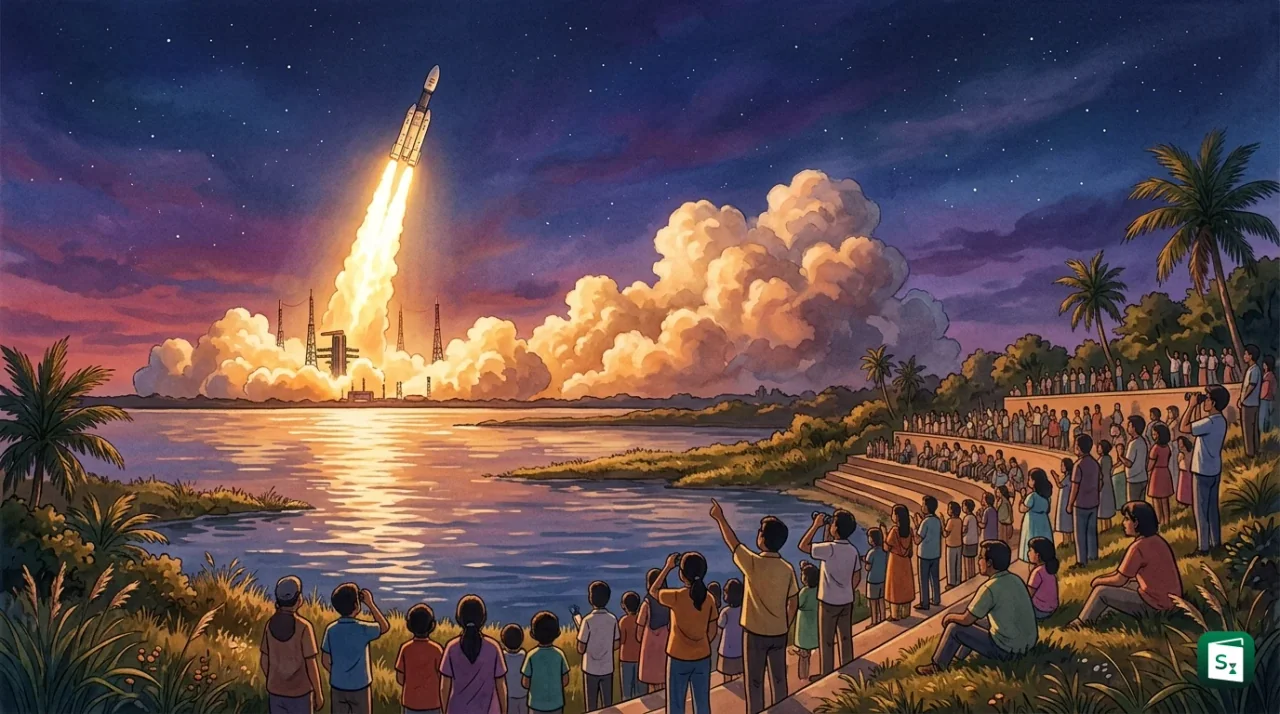
World Space Week 2026 was observed around the world from October 4 to 10 under the theme Rocket Revolution. The United Nations backed observance marks the launch of Sputnik 1 in 1957 and the entry into force of the Outer Space Treaty in 1967. In India, the Indian Space Research Organisation (ISRO) led school lectures, exhibitions and a sounding rocket launch to show how cheaper and reusable rockets are opening space to all.
What Is World Space Week
The World Space Week is an international celebration of space science and technology observed every year from October 4 to 10. The United Nations proclaimed the observance to highlight how space activity improves daily life and to promote wider education and global cooperation in the peaceful uses of outer space.
The celebration is also called Space Week or International Space Week in short. It is described as the largest space event on Earth. Space agencies, companies, schools, planetariums, museums, astronomy clubs and even individuals hold events in the same week. This common time frame creates bigger public impact through synchronised action.
The World Space Week Association (WSWA) states that the 2025 edition saw about 50,000 events in 102 countries. Global coordination is led by the United Nations Office for Outer Space Affairs (UNOOSA), which is based in Vienna, Austria, with support from WSWA. WSWA is a non-government and non-profit body guided by a volunteer board and a network of national coordinators in more than 50 nations. Its stated aims are simple. Teach people about the benefits they get from space, encourage the use of space for sustainable growth, build interest in science, and promote cooperation among nations.
When Is World Space Week Celebrated Every Year
The World Space Week is celebrated every year between October 4 and October 10. The United Nations General Assembly fixed these dates through Resolution 54/68 on December 6, 1999. The first United Nations backed World Space Week was observed in 2000 and has continued annually since then.
The dates were recommended by the Third United Nations Conference on the Exploration and Peaceful Uses of Outer Space (UNISPACE III). The conference met in Vienna in July 1999 and adopted the Vienna Declaration. The declaration asked the General Assembly to declare October 4 to 10 as World Space Week. The aim was to celebrate each year, at the global level, the contribution that space science and technology can make to better lives.
Each year a theme is selected by the WSWA Board of Directors in close coordination with UNOOSA. The theme gives common guidance to all participants. It helps schools, agencies and clubs plan events around one central idea while keeping the focus on peaceful uses, education and sustainable development.
Why October 4 to 10: Sputnik 1 and the Outer Space Treaty
The World Space Week dates honour two turning points in space history. October 4 recalls the start of the space age. October 10 recalls the start of space law. Together they link scientific achievement with the rule that space must remain open and peaceful for all countries.
October 4, 1957: The Launch of Sputnik 1
Sputnik 1 was launched in the year 1957 by the Soviet Union on October 4 from the Baikonur range in present day Kazakhstan. The small aluminium sphere weighed 83.6 kilograms and circled Earth about every 96 to 98 minutes while sending a steady beep beep radio signal for 22 days.
The word Sputnik means satellite or travelling companion in Russian. The satellite was only 58 centimetres in diameter, about the size of a beach ball, with four whip antennas. It carried no scientific instruments except a radio transmitter and a barometric switch. Still, its signal proved that humans could place an object in orbit. The satellite stayed in orbit for three months and burned up on reentry on January 4, 1958, after about 1,440 orbits.
The shock was political as much as technical. The United States had planned a tiny 1.6 kilogram Vanguard satellite for the International Geophysical Year (1957 to 1958). Sputnik, at 184 pounds, looked far heavier and more powerful. Fear of a technology gap, called the Sputnik crisis, pushed the United States to create the Advanced Research Projects Agency (ARPA, later DARPA) in February 1958 and the National Aeronautics and Space Administration (NASA) through the National Aeronautics and Space Act signed on July 29, 1958. NASA began work on October 1, 1958. The Soviet Union followed Sputnik 1 with Sputnik 2 on November 3, 1957, carrying the dog Laika, the first living creature to orbit Earth.
October 10, 1967: The Outer Space Treaty Enters Into Force
The Treaty on Principles Governing the Activities of States in the Exploration and Use of Outer Space, including the Moon and Other Celestial Bodies, usually called the Outer Space Treaty, is the foundation of international space law. The United Nations General Assembly adopted the treaty on December 19, 1966 through Resolution 2222. The treaty opened for signature at London, Moscow and Washington on January 27, 1967 and entered into force on October 10, 1967.
As of October 2025, the treaty has 118 parties and about 20 other signatories. The three depositary governments are the United States, the United Kingdom and the Russian Federation as successor to the Soviet Union. India signed the treaty on March 3, 1967 and ratified it on January 18, 1982.
The core rules of the Outer Space Treaty can be read in a simple form in the table below.
| Principle | What It Means in Simple Words |
|---|---|
| Province of all mankind | Exploration and use of space must benefit all countries, rich or poor |
| Free exploration and use | All states can explore and use space on the basis of equality and international law |
| No national appropriation | No country can claim ownership of outer space, the Moon or any celestial body |
| No weapons of mass destruction in space | States must not place nuclear or other mass destruction weapons in orbit or on celestial bodies |
| Peaceful use of Moon and celestial bodies | No military bases, weapon tests or military manoeuvres on the Moon and other bodies |
| Help to astronauts | Astronauts are envoys of mankind and must get all possible help in case of accident or emergency landing |
| Responsibility and liability | States are responsible for their national space activity, including private activity, and are liable for damage caused by their space objects |
World Space Week 2026 Theme: Rocket Revolution
The World Space Week 2026 theme is Rocket Revolution. The theme celebrates how reusable rockets, lower launch costs and new commercial and university actors have widened access to space. The shift has expanded satellite services, science missions and student opportunities in the growing global space economy.
For many years, reaching orbit depended on a small group of government programmes using rockets built for a single flight. That model was costly and limited the number of launches. The Rocket Revolution describes the change now under way. Rockets can return to Earth and fly again. Commercial launch companies, startups, university teams and new national space programmes have entered the field. Launch prices have fallen and launch frequency has risen. More satellites, science payloads and student experiments can now find a ride to space.
The World Space Week Association says this wider access has stimulated the space ecosystem and created new space applications that help life on Earth, from communication and navigation to weather forecasting and disaster warning. The theme is also meant to inspire students toward science, technology, engineering and mathematics, together called STEM. Model rocket launches, balloon rockets, stomp rockets and classroom challenges let children build, test and recover small rockets during October 4 to 10 and register their events on the official World Space Week map.
Recent themes show how the focus shifts each year while keeping the same goal of public education.
| Year | World Space Week Theme |
|---|---|
| 2026 | Rocket Revolution |
| 2025 | Living in Space |
| 2024 | Space and Climate Change |
| 2023 | Space and Entrepreneurship |
| 2022 | Space and Sustainability |
| 2021 | Women in Space |
| 2020 | Satellites Improve Life |
How India Celebrates World Space Week
The Indian Space Research Organisation leads the national celebration of World Space Week. ISRO stands for the Indian Space Research Organisation. The organisation was established on August 15, 1969, replacing the Indian National Committee for Space Research (INCOSPAR) set up in 1962. ISRO works under the Department of Space, which was formed in 1972, and is headquartered in Bengaluru. The Chairman of ISRO is Dr. V. Narayanan (as of October 2026), who took charge as Secretary, Department of Space in January 2025.
In Kerala, four centres jointly organise the 2026 programme around Thiruvananthapuram. These are the Vikram Sarabhai Space Centre (VSSC), the Liquid Propulsion Systems Centre (LPSC), the ISRO Inertial Systems Unit (IISU) and the Indian Institute of Space Science and Technology (IIST). Their plan includes interactive lectures by scientists for school students in on-campus and online mode from October 6 to 10. Schools register through the VSSC portal. A student video activity called Your Space invites one entry per school on ideas for using space technology for sustainable local development. The Kerala programme closes with a public outreach event on October 10 at the Kerala State Science and Technology Museum in Thiruvananthapuram, with a public lecture on the Rocket Revolution theme and open interaction with ISRO experts.
A special attraction in 2026 is a sounding rocket launch from the Thumba Equatorial Rocket Launching Station (TERLS) of VSSC. Sounding rockets are small suborbital rockets used for upper atmosphere studies and student demonstrations. The launch gives students a chance to watch a real countdown and recovery process at close range.
Outside Kerala, the Satish Dhawan Space Centre (SDSC) SHAR at Sriharikota, the spaceport of India, organised a Rocket Revolution exhibition and expo at six selected locations across Andhra Pradesh, Tamil Nadu and Odisha. At the Sethu Institute of Technology in Madurai, the two day expo drew more than 8,000 school students for drawing, quiz, essay and model displays along with talks by senior scientists. The ISRO Propulsion Complex (IPRC) at Mahendragiri continued its practice of large school engagement, a model that reached more than 10,000 students across 35 institutions in 2025 and drew over 20,000 visitors to its Mega Space Expo. ISRO and the Indian Institute of Geomagnetism (IIG) also held a two day outreach during October 6 to 7, 2026 at Port Blair in the Andaman and Nicobar Islands for about 200 college students and faculty members, with lectures on solar physics, geomagnetism, exoplanets and astrobiology plus a space exhibition. Students across India can also join ISRO Space Tutor webinars and official quizzes on the MyGov platform during the week to earn digital participation certificates.
World Space Week, World Space Day and National Space Day: Clearing the Confusion
Many searches mix three similar names. World Space Week is the official United Nations observance from October 4 to 10. The phrase World Space Day is often used in common talk for October 4, the opening day that marks the Sputnik 1 launch, but the United Nations has declared a week, not a single world day. National Space Day is a separate national observance of India on August 23.
India declared August 23 as National Space Day to commemorate the soft landing of Chandrayaan-3 on the Moon on August 23, 2023. The Vikram lander touched down near the lunar south polar region at a site named Shiv Shakti Point and deployed the Pragyan rover. With this success, India became the fourth country to achieve a soft landing on the Moon and the first country to land near the lunar south pole. The mission was launched aboard LVM3-M4 from Sriharikota on July 14, 2023. The first National Space Day was observed in 2024. The year 2026 marked the third edition, hosted at the Space Applications Centre (SAC) in Ahmedabad under the theme Towards Viksit Bharat: Innovating, Collaborating and Aspiring to Global Space Leadership.
The table below keeps the two official observances distinct for quick recall.
| Feature | World Space Week | National Space Day (India) |
|---|---|---|
| Observed by | United Nations, globally | Government of India, nationally |
| Dates | October 4 to 10 every year | August 23 every year |
| Observed since | 2000, after 1999 UN declaration | 2024, after 2023 declaration |
| Commemorates | Sputnik 1 launch in 1957 and Outer Space Treaty in 1967 | Chandrayaan-3 Moon landing in 2023 |
| 2026 theme | Rocket Revolution | Towards Viksit Bharat: Innovating, Collaborating and Aspiring to Global Space Leadership |
Key Takeaways
- World Space Week is observed every year from October 4 to 10 under the coordination of UNOOSA with support from the World Space Week Association.
- The United Nations General Assembly proclaimed World Space Week through Resolution 54/68 on December 6, 1999, and the first observance was held in 2000.
- The 2026 theme of World Space Week is Rocket Revolution, which highlights reusable rockets, lower launch costs and wider participation by commercial and academic actors.
- Sputnik 1 was launched by the Soviet Union on October 4, 1957 from Baikonur, weighed 83.6 kilograms and reentered Earth on January 4, 1958.
- The Outer Space Treaty was opened for signature on January 27, 1967 and entered into force on October 10, 1967, with India ratifying it on January 18, 1982.
- India observes National Space Day on August 23 to mark the Chandrayaan-3 landing near the lunar south pole on August 23, 2023, which made India the fourth country to soft land on the Moon and the first to land near the south pole.