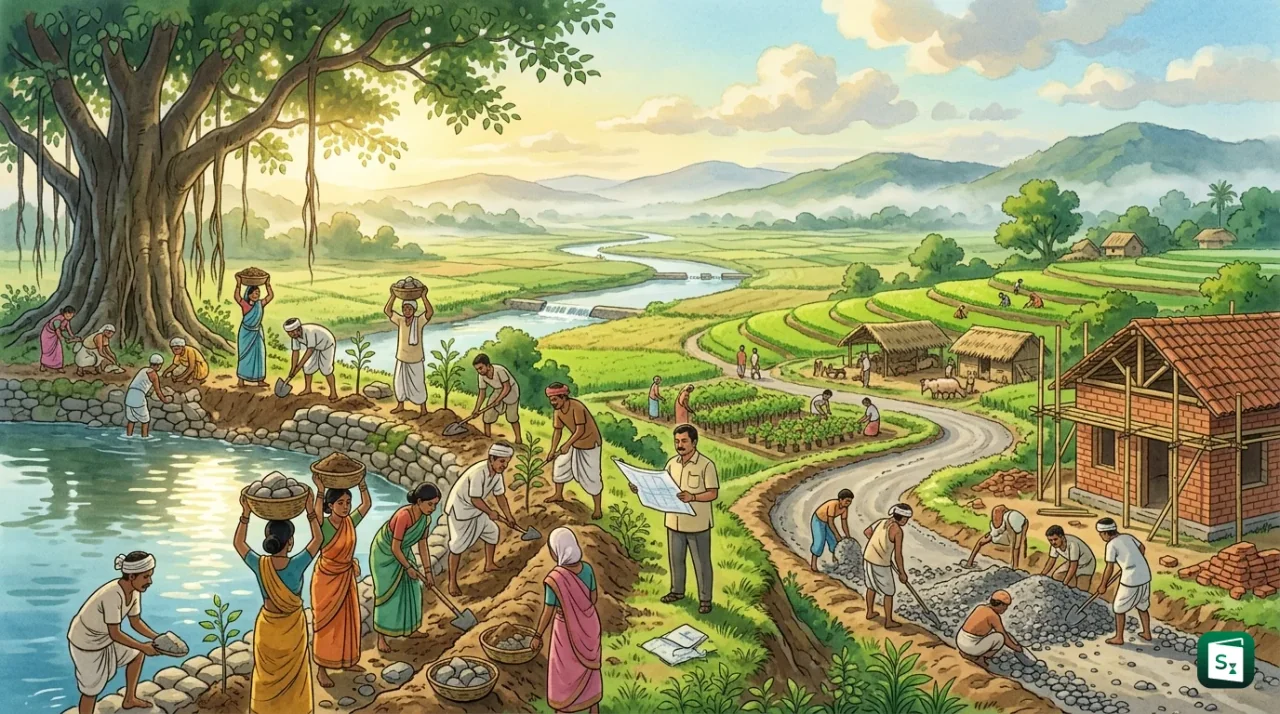
The Ministry of Rural Development notified the Schedule of Permissible Works under the Viksit Bharat Guarantee for Rozgar and Ajeevika Mission Gramin (VB-G RAM G) Act, 2025 on 6 October 2026. The list expands eligible rural works from 266 to 375, a rise of 41 percent across four priority areas. The new framework links guaranteed wage jobs directly to durable water, infrastructure and livelihood assets planned at the village level.
What Is VB-G RAM G?
The Viksit Bharat Guarantee for Rozgar and Ajeevika Mission Gramin (VB-G RAM G) is India’s rural employment guarantee law that replaced the Mahatma Gandhi National Rural Employment Guarantee Act of 2005. It promises 125 days of unskilled manual work each year to every rural household that volunteers for work.
The VB-G RAM G Act, 2025 received Presidential assent on 20 December 2025 and came into force across rural India on 1 July 2026. The Ministry of Rural Development is the nodal ministry for the law. Shivraj Singh Chouhan is the Union Minister for Rural Development (as of October 2026).
The law is designed as more than a wage programme. It connects employment to the national vision of Viksit Bharat 2047 by creating durable village assets. Every work must fit into one of four themes: water security, core rural infrastructure, livelihood related infrastructure, and protection against extreme weather events.
From 266 to 375 Works: What Changed?
The Ministry of Rural Development replaced the earlier list of 266 works with a new Schedule of 375 works. That is an addition of 109 work types, or about 41 percent growth. The expansion is the first full works schedule notified under the VB-G RAM G Act.
The Ministry had earlier issued an interim list of 318 works to start implementation from 1 July 2026. The October notification completes that process. It adds new work categories that were missing or narrow under the previous framework, especially in agro processing, self help group infrastructure and disaster management.
The biggest shift is in livelihood works. Their share has risen from about 1.1 percent earlier to 26 percent now. Water security remains the largest block. A separate disaster preparedness block has been created for the first time.
| Category | Works | Share of total |
|---|---|---|
| Water Security | 128 | 34 percent |
| Core Rural Infrastructure | 111 | 30 percent |
| Livelihood Related Infrastructure | 98 | 26 percent |
| Disaster Preparedness and Extreme Weather Works | 38 | 10 percent |
| Total | 375 | 100 percent |
Four Pillars of Permissible Works
The Ministry of Rural Development has grouped all 375 works under four broad pillars. Each pillar responds to a specific village need. Together they move wage employment away from short term earthwork towards assets that keep giving returns for years.
Water Security: 128 Works
Water security is the largest pillar with 128 works. It covers check dams, canals, flood channels, gully plugs, underground dykes, percolation tanks and rejuvenation of ponds, rivers and old water channels. The list also includes reclamation of waterlogged land, rainwater harvesting, recharge shafts and groundwater recharge structures.
The Schedule adds modern water use systems such as drip irrigation, sprinkler systems and even artificial glaciers for cold hill areas. Repair and upkeep of existing water bodies are also permitted. The idea is simple. More stored water means better irrigation, safer drinking water and crops that survive weak rainfall.
Core Rural Infrastructure: 111 Works
Core rural infrastructure includes 111 works. It covers village roads and pathways, solar street lighting, waste recycling plants and greywater treatment units. Community facilities such as rural libraries, veterinary centres, rural health centres, Common Service Centres, Gram Panchayat buildings and extra classrooms and laboratories in government schools are part of this pillar.
The Schedule also allows repair of Jal Jeevan Mission drinking water supply assets. Jal Jeevan Mission is the central programme that provides tap water to rural homes. For persons with disabilities, the Schedule makes explicit provision for stairs and ramps in government buildings.
Livelihood Related Infrastructure: 98 Works
Livelihood infrastructure has 98 works. These include cleaning, grading and packaging sheds, mini flour mills, market yards, rural haats, warehouses, farm level storage and cold storage chains. Dairy sheds, poultry and piggery shelters, mushroom sheds, fish ponds and aquaculture structures support animal and fish based incomes.
Infrastructure for Self Help Groups (SHGs) is a major addition. SHGs are small village savings and work collectives, mostly of women. The Schedule permits SHG worksheds, SHE Marts for sale of group products, and training and skill centres. Compost and vermi compost units, nurseries and horticulture support units are also included.
Disaster Preparedness: 38 Works
Disaster preparedness is a new and dedicated pillar with 38 works. It covers flood relief shelters, embankment strengthening, flood protection walls, drainage for flood control and restoration of rural roads and community assets after disasters. Forest fire control lines and related management works are also listed.
This pillar matters because floods, cloudbursts and heat stress destroy both crops and village roads in the same season. Employment works can now rebuild protection before the next event and restore assets quickly after one.
Focus on Agriculture, Women, Youth and Vulnerable Households
The Ministry of Rural Development has tagged 181 works for agriculture and allied activities such as animal husbandry, fisheries, horticulture and farm forestry. Of these, 52 works are meant for individual beneficiaries, including small and marginal farmers. Farm ponds, irrigation wells, land levelling, vermi compost pits and shelters for livestock directly raise farm output and cut post harvest losses.
The Schedule earmarks 107 works for Antyodaya and vulnerable households. Antyodaya refers to the poorest families who are served first under welfare policy. Of these, 68 works can be taken up on private land or homesteads of eligible families. Individual assets for women headed households get priority under the Act.
The Schedule lists 36 works each linked to women and youth. Creche sheds at worksites, SHG buildings, skill centres and market links help women stay in work and earn from group enterprises. The law requires at least one third participation of women in employment. Training sheds, nurseries, service centres and small processing units open entry level work and skilling options for rural youth.
How Works Will Be Planned and Tracked
The Ministry of Rural Development has placed planning power with the village itself. Works will be chosen through Viksit Gram Panchayat Plans. A Gram Panchayat is the elected village council. The Gram Sabha, which is the assembly of all registered voters of the village, must approve the plan. This bottom up method ensures that a water scarce panchayat can pick ponds and recharge works while a flood prone one picks embankments and shelters.
All approved assets will be recorded on the Viksit Bharat National Rural Infrastructure Stack. The Stack is a digital record of rural assets built under the mission. It is spatially linked with systems such as PM Gati Shakti, the national platform that maps infrastructure projects on a common geographic base. Digital tracking helps avoid duplication, checks quality and shows gaps for the next plan.
Implementation is backed by large funding. The Centre has allocated ₹95,692.31 crore for the VB-G RAM G Scheme for 2026-27 for the period from 1 July 2026 to 31 March 2027. With state contributions, the total outlay is expected to cross ₹1.51 lakh crore. Existing e-KYC verified job cards remain valid until new Gramin Rozgar Guarantee Cards are issued, and ongoing works as on 30 June 2026 have been carried forward without break.
VB-G RAM G vs MGNREGA
The VB-G RAM G Act repealed the Mahatma Gandhi National Rural Employment Guarantee Act, 2005 from 1 July 2026. MGNREGA had assured 100 days of wage work per rural household each year. VB-G RAM G raises the promise to 125 days per rural household each year.
Funding has also changed. Under MGNREGA, the Centre paid the full unskilled wage cost and most material costs. VB-G RAM G works as a centrally sponsored scheme with a 60:40 Centre to state share for most states and 90:10 for North Eastern and Himalayan states and Jammu and Kashmir. The Centre fixes state wise normative allocations and states bear spending beyond that limit.
| Feature | MGNREGA, 2005 | VB-G RAM G Act, 2025 |
|---|---|---|
| Legal status | Repealed from 1 July 2026 | In force from 1 July 2026 |
| Guaranteed days | 100 days per household per year | 125 days per household per year |
| Permissible works | 266 works | 375 works |
| Main focus | Wage employment with basic asset creation | Wage employment linked to water, infrastructure, livelihood and disaster resilience |
| Planning | Shelf of works at panchayat level | Viksit Gram Panchayat Plans approved by Gram Sabha and mapped on National Rural Infrastructure Stack |
| Funding | Centre bore full wage cost | 60:40 Centre to state share, 90:10 for North Eastern, Himalayan states and Jammu and Kashmir |
| Farm season rule | No fixed pause | States can notify up to 60 days pause in peak sowing and harvest seasons |
The Act allows states to pause works for an aggregate of 60 days in peak farm seasons so that harvest and sowing get enough labour. This pause was a debated provision. Supporters say it protects farmers. Critics say it can reduce workdays if used widely.
Key Takeaways
- The Ministry of Rural Development notified 375 permissible works under the VB-G RAM G Act, 2025 on 6 October 2026.
- The new Schedule marks a 41 percent rise from the earlier list of 266 works.
- The four pillars are Water Security (128 works), Core Rural Infrastructure (111 works), Livelihood Infrastructure (98 works) and Disaster Preparedness (38 works).
- 181 works support agriculture and allied activities, with 52 individual beneficiary works for farmers.
- Works are chosen through Gram Sabha approved Viksit Gram Panchayat Plans and tracked on the Viksit Bharat National Rural Infrastructure Stack.
- The VB-G RAM G Act guarantees 125 days of wage work per rural household per year and came into force on 1 July 2026.