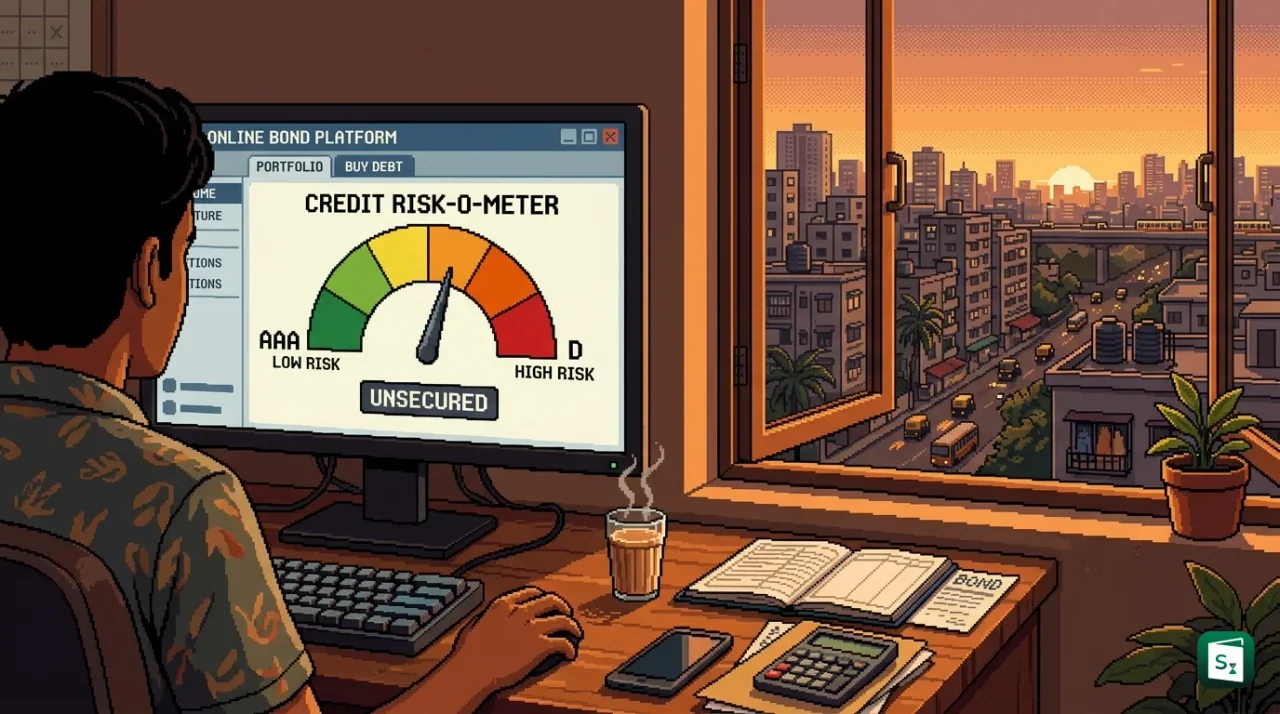
The Securities and Exchange Board of India (SEBI) issued a circular on 7 October 2026 introducing a mandatory colour-coded Credit Risk-o-Meter for debt securities. The six-level meter will translate existing credit ratings from AAA to D into a simple visual scale from green to red. It will appear on offer documents, advertisements and online bond platforms after a 45-day transition period.
What Is SEBI?
The Securities and Exchange Board of India (SEBI) is the regulator for securities and commodity markets in India. It was set up on 12 April 1988 and gained statutory powers under the SEBI Act, 1992 on 30 January 1992. SEBI works under the Ministry of Finance and is headquartered in Mumbai.
SEBI protects investors, regulates stock exchanges, brokers, mutual funds, credit rating agencies and bond market intermediaries, and promotes orderly growth of the securities market. The Chairperson of SEBI is Tuhin Kanta Pandey (as of October 2026), who took charge on 1 March 2025. SEBI issues binding directions through circulars, such as the 7 October 2026 circular on the Credit Risk-o-Meter, and amends master circulars to enforce disclosure standards.
What Is Credit Risk in Debt Securities?
Credit risk is the chance that a borrower will fail to pay interest or return principal on time. In debt securities, it reflects the financial strength of the issuer. A higher credit risk means a higher chance of delayed payment or default and usually demands higher interest.
Debt securities are instruments through which an investor lends money to an issuer in return for regular interest and repayment of principal on maturity. The SEBI circular covers Non-Convertible Securities (NCS), Commercial Papers (CPs), Securitised Debt Instruments (SDIs), Security Receipts (SRs) and Structured Debt or Market Linked Debentures (MLDs). NCS include corporate bonds, which are the most familiar to retail investors, while CPs are short term borrowings with maturity up to one year.
Credit risk is only one part of bond risk. Market risk refers to loss from changes in interest rates and prices, while liquidity risk refers to difficulty in selling quickly without a price cut. A bond can have low credit risk but still fall in price if interest rates rise. The new Credit Risk-o-Meter shows only credit risk, and SEBI requires issuers to state this limit clearly along with the meter.
What Is the Credit Risk-o-Meter for Debt Securities?
The Credit Risk-o-Meter is SEBI mandatory pictorial disclosure that converts a bond credit rating into six colour-coded levels. It was introduced on 7 October 2026 for all listed and proposed listed debt securities. The meter must appear before investment to help retail investors judge default risk quickly.
The framework was first proposed in a SEBI consultation paper on 13 August 2026 after suggestions from market participants. The proposal was reviewed by the Online Bond Platform Provider working group and the Corporate Bonds and Securitisation Advisory Committee (CoBoSAC). The final circular inserts a new Chapter II-C titled Disclosure of Credit Risk-o-Meter for debt securities into the NCS Master Circular dated 15 October 2025, which governs Non-Convertible Securities, Securitised Debt Instruments, Security Receipts, Municipal Debt Securities and Commercial Paper.
The provisions come into force after 45 days from issue, which places the effective date around 21 November 2026. The meter applies to all categories of issuers and to both public issues and private placements. It does not replace the credit rating. It acts as an additional visual layer over the rating to make the same information easier to grasp.
Six Colour-Coded Levels From AAA to D
SEBI standardised credit rating symbols in 2011 to make ratings comparable across agencies. Long term ratings run from AAA to D, with plus and minus modifiers for AA to C to show finer standing within a band. Short term ratings for instruments up to one year run from A1 to A4 and D. The Credit Risk-o-Meter maps this existing scale into six risk bands with fixed colours, definitions and HTML codes.
| Risk-o-Meter Level | Long Term Rating Range | Short Term Symbols | Colour |
|---|---|---|---|
| Lowest Credit Risk | AAA | A1+ | Irish Green (#08A04B) |
| Very Low Credit Risk | AA+, AA, AA- | A1 | Chartreuse (#7FFF00) |
| Low Credit Risk | A+, A, A- | A2 | Neon Yellow (#FFFF33) |
| Moderate Credit Risk | BBB+, BBB, BBB- | A3 | Caramel (#C68E17) |
| Moderate Risk of Default | BB+, BB, BB- | A4+ | Dark Orange (#FF8C00) |
| High to Very High Risk of Default | B+, B, B-, C+, C, C-, D | A4, D | Red (#F70D1A) |
In plain terms, AAA means highest safety with lowest credit risk, while D means the instrument is in default or expected to default soon. Ratings from BBB and above are broadly treated as investment grade, while BB and below signal speculative quality with higher promised yields to compensate for higher default chances. Credit ratings in India are issued with the agency prefix, such as CRISIL AAA or ICRA AA, by SEBI registered Credit Rating Agencies (CRAs) that include CRISIL, ICRA, CARE and India Ratings.
Below the pictorial meter, the issuer must print three facts in text form. These are the name of the CRA, the actual credit rating of the security, and the word unsecured in bold red text if the instrument is unsecured. Where more than one CRA has rated the same security, the meter must reflect the lowest rating, though all ratings can be shown alongside. Where the CRA reports Issuer Not Cooperating (INC) due to inadequate information, the arrow points to INC and the text also records the INC status. For monochrome print ads, a QR code must link to the colour version on the issuer or platform website.
Where Will the Credit Risk-o-Meter Appear?
SEBI has made the Credit Risk-o-Meter a mandatory part of five disclosure points. These are the offer document, the abridged prospectus, the private placement memorandum, all advertisements of the issuer and Online Bond Platform Providers (OBPPs), and the web and mobile platforms of OBPPs.
An offer document is the detailed legal document for a public issue that sets out issuer finances, risk factors and terms of the security. An abridged prospectus is a shorter summary attached to the application form for quick reading. A private placement memorandum serves the same purpose when bonds are sold privately to a select set of investors rather than to the public. An advertisement includes any promotion that mentions the rating of the debt security, in digital, print or other format.
Every display must carry a clear disclaimer that the meter reflects only credit risk assessment and does not constitute investment advice or a recommendation to invest. The standard text also warns that debt investments face market and liquidity risks. For unsecured perpetual bonds such as Additional Tier 1 (AT1) bonds issued by banks, a stronger warning is required. AT1 bonds have no fixed maturity and can be written down fully in stress, so the disclaimer states that they may carry risk of total loss of capital and that investors must read the information memorandum carefully.
Rules for Online Bond Platform Providers
An Online Bond Platform Provider (OBPP) is a SEBI regulated intermediary that lists debt securities online for retail purchase. OBPPs came under a formal regulatory framework in November 2022 under the SEBI Non-Convertible Securities Regulations. Each OBPP must be a company incorporated in India and register as a stock broker in the debt segment of a recognised stock exchange, and then seek authorisation from the exchange to operate the platform. Orders on these platforms are routed through the stock exchange Request for Quote system and settled through clearing corporations, with holdings credited to the investor demat account.
SEBI has added the Credit Risk-o-Meter as item 14 in the minimum disclosure list for each security shown on bond platforms. OBPPs must show the meter on the bond listing and bond details page, in a prominent place before the investment action buttons. On web screens the full meter is displayed, while on mobile screens a condensed strip shows the full spectrum with an arrow on the applicable level and an information icon that opens the detailed view.
OBPPs must derive ratings only from SEBI registered CRAs and must not manually override the mapping. Any change in the meter must be communicated on the platform within 24 hours of receiving the rating update from the depositories NSDL and CDSL after the ISIN database is updated. OBPPs must maintain automated systems for these updates and keep audit trails of all changes. Stock exchanges and depositories must put systems in place, amend rules where needed and publicise the new requirement.
What Is Risk-o-Meter in Mutual Funds and How Is the New Meter Different?
Risk-o-meter in mutual funds is SEBI pictorial label that shows the overall risk of a mutual fund scheme. It has six levels from Low to Very High with the same colour palette from green to red. It is reviewed monthly and shown on scheme documents, fact sheets and advertisements.
The mutual fund Risk-o-meter was introduced in October 2020 and colour shades were standardised in November 2024. It combines credit risk, interest rate risk and liquidity risk of the full portfolio into one scheme level. Debt schemes also carry a Potential Risk Class matrix that shows maximum interest rate risk and maximum credit risk the manager can take.
The new Credit Risk-o-Meter for bonds is narrower. It covers only the credit risk of a single debt security, not the combined risk of a portfolio. The mutual fund label answers which risk band a scheme sits in, while the bond meter answers how strong the specific issuer promise is. Investors should therefore read the bond meter as a first filter and then check maturity, yield to maturity, coupon, security cover and liquidity before deciding.
| Feature | Mutual Fund Risk-o-Meter | Debt Security Credit Risk-o-Meter |
|---|---|---|
| Covers | Entire scheme portfolio | Single bond or debt instrument |
| Risks captured | Credit, interest rate and liquidity risks combined | Credit risk only |
| Levels | Low, Low to Moderate, Moderate, Moderately High, High, Very High | Lowest Credit Risk to High to Very High Risk of Default |
| Review | Monthly based on portfolio | Updated within 24 hours of rating change |
Why the New Disclosure Matters for Corporate Bonds in India
Corporate bonds in India have grown sharply as companies raise funds outside bank loans. The outstanding corporate bond market rose from about ₹17.5 lakh crore in FY15 to ₹53.6 lakh crore in FY25, with record fresh issuances of about ₹9.9 lakh crore in FY25. Lower face values, now moving toward ₹10,000 for many listed bonds, and app based OBPPs have brought these instruments to first time retail buyers who earlier found bond documents hard to read.
A letter rating such as AA- or BBB+ means little to a new investor, while a red or green meter gives an instant signal. Bonds of public sector units, large banks and top corporates usually sit in the lowest or very low risk bands, while high yield offers around 9 percent to 12 percent typically sit lower on the safety scale to compensate for higher default risk. The meter, along with the bold red unsecured tag and the INC flag, makes that trade off visible before the buy button.
The reform also tightens accountability. Because OBPPs must update the meter automatically from depository feeds without manual edits, a downgrade will show up quickly across platforms. The limit is equally clear. The meter does not measure interest rate movements, resale liquidity or structural features such as call options in market linked debentures. Investors must still read the rating rationale, issuer financials and offer terms alongside the colour signal.
Key Takeaways
- SEBI introduced the mandatory Credit Risk-o-Meter for debt securities through a circular dated 7 October 2026 effective after 45 days.
- The meter maps AAA to D ratings into six colour-coded levels from Lowest Credit Risk in Irish Green to High to Very High Risk of Default in Red.
- The meter must appear on offer documents, abridged prospectuses, private placement memoranda, issuer advertisements and OBPP web and mobile platforms.
- Where multiple ratings exist, the meter reflects the lowest rating, and unsecured instruments must be marked in bold red text.
- OBPPs must update the meter within 24 hours of rating changes received from NSDL and CDSL with no manual override.