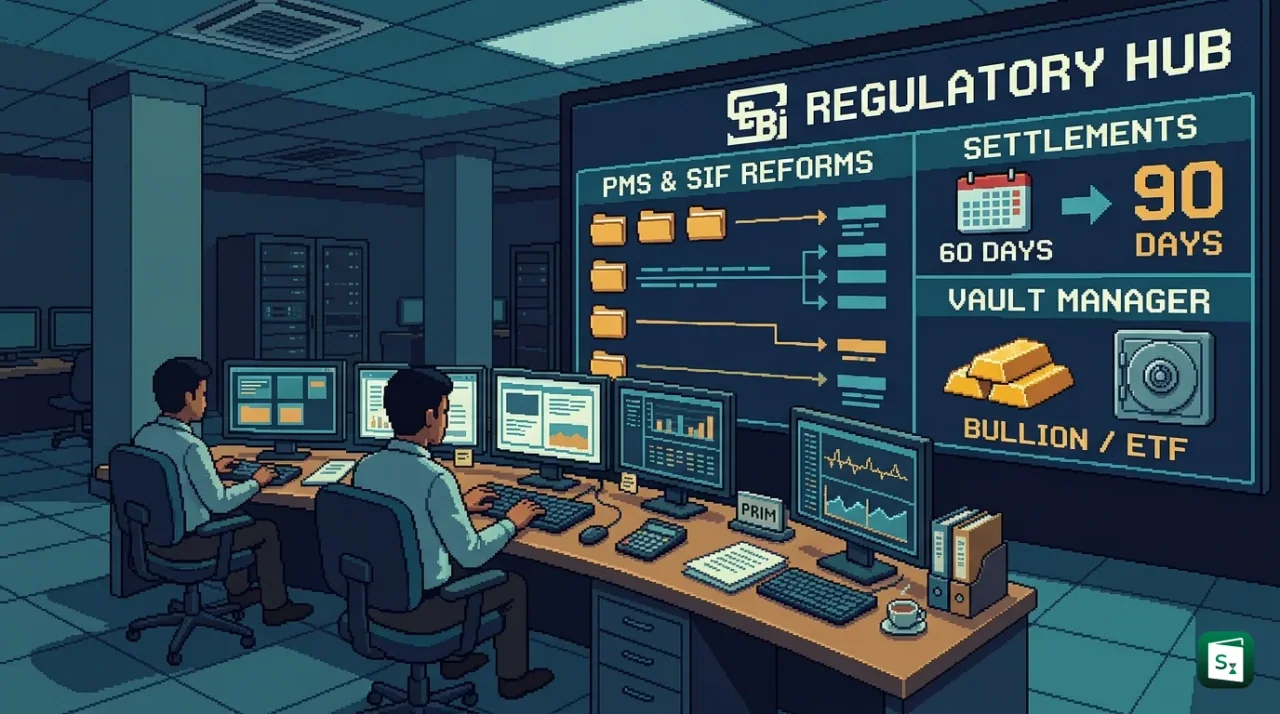
The Securities and Exchange Board of India approved a wide package of market reforms at its 215th board meeting in Mumbai on 24 September 2026. The package rewrites the Portfolio Managers Regulations with a new mutual fund only route called PRIM and overhauls the settlement system with a formula based calculation. It also tightens vaulting rules for gold and silver Exchange Traded Funds while easing bond listing norms.
What Is SEBI?
The Securities and Exchange Board of India (SEBI) is the regulator for securities and commodity markets in India. It was formed as a non statutory body on 12 April 1988 and became a statutory body on 30 January 1992 under the SEBI Act, 1992. It is headquartered in Mumbai.
SEBI works under the administrative domain of the Ministry of Finance. Its stated mandate is to protect the interests of investors in securities and to promote the development of the securities market while regulating it. The body has quasi legislative, quasi judicial and quasi executive powers. This means SEBI can frame regulations, conduct investigations and enforcement, and pass orders in disputes.
SEBI has its head office at Bandra Kurla Complex in Mumbai, with regional offices in New Delhi, Kolkata, Chennai and Ahmedabad. The Chairperson of SEBI is Tuhin Kanta Pandey (as of September 2026). The board includes members nominated by the Union Government, officials from the Finance Ministry and a member from the Reserve Bank of India.
PMS Regulatory Architecture and PRIM Framework
The SEBI Board approved the Securities and Exchange Board of India (Portfolio Managers) Regulations, 2026 to replace the 2020 regulations. The rewrite aims to develop the industry, ease compliance and simplify language. The rulebook has been cut from 70 pages to 33 pages, with word count down from 19,486 to 11,308 and provisos reduced from 47 to four.
What is PMS investment?
Portfolio Management Services (PMS) is a professional service where a registered portfolio manager handles a client’s securities portfolio for a fee. In India, PMS mainly offers discretionary service where the manager takes investment decisions for the client, and the client’s money stays in the client’s own demat account.
The PMS industry has grown fast. Assets Under Management rose to ₹42.61 lakh crore as of 31 May 2026 from ₹18.07 lakh crore in April 2019. Client numbers rose to 2.19 lakh in the same period, while registered portfolio managers rose to 515 from 226 in 2020. The review followed industry feedback collected through the Association of Portfolio Managers in India and a consultation paper issued on 23 July 2026.
The centrepiece is PRIM, short for Portfolio Managers Route for Investment in Mutual Fund Units. PRIM is a mutual fund only route that lets portfolio managers invest client funds only in direct plans of mutual funds of Indian Asset Management Companies. This includes open ended schemes, Exchange Traded Funds (ETFs), index funds and Specialised Investment Funds (SIFs). An existing portfolio manager can offer PRIM as a separate investment approach. A new applicant that wants to operate only in PRIM securities can seek a separate PRIM registration with lighter entry norms.
| Norm | General PMS | PRIM route |
|---|---|---|
| Minimum ticket size | ₹50 lakh per client | ₹25 lakh per client |
| Minimum net worth for manager | ₹5 crore | ₹2 crore |
| Fixed management fee | As per agreement and disclosure | Capped at 1 percent of client AUM, with performance based fee also permitted |
| Exposure to affiliated AMC schemes | General diversification norms apply | Capped at 25 percent of client AUM |
SEBI has also introduced the concept of Independent Fund Managers (IFMs). An IFM meets the same qualification, experience and certification norms as a principal officer and can manage client portfolios in association with a registered portfolio manager. The registered portfolio manager retains full responsibility for the IFM’s actions. One portfolio manager can work with several IFMs, but an IFM can associate with only one portfolio manager at a time.
Ease of compliance measures include a relaxed dealing room requirement for managers with AUM of less than ₹100 crore, a standardised Investment Management Agreement (IMA) for easy understanding, and embedded authority to operate the client’s demat and trading account for PMS transactions. Eligible Fund Managers can now manage and advise eligible funds investing in overseas securities under conditions set by SEBI.
PMS Access to Direct Mutual Funds and Specialised Investment Funds
SEBI has allowed PMS providers to build client portfolios using only direct mutual fund schemes under PRIM. A direct plan is bought directly from the Asset Management Company without a distributor, so it carries a lower expense ratio than a regular plan which includes distributor commission. PMS managers using PRIM must keep PRIM activity and clients separate from their Mutual Fund Distributor activity, except for accredited investors. Accredited investors are experienced investors recognised on the basis of income, net worth and financial knowledge.
Specialised Investment Funds form a new category placed between mutual funds and PMS. SEBI notified the SIF framework on 27 February 2025, effective from 1 April 2025. SIFs offer more flexible strategies than plain mutual funds but retain mutual fund style transparency. The general minimum investment threshold for SIFs is ₹10 lakh aggregate per investor at PAN level across all strategies of an SIF. Under the PRIM route, however, the minimum ticket is higher at ₹25 lakh, since PRIM follows PMS style ticket norms.
| Feature | PMS | Mutual fund | SIF |
|---|---|---|---|
| Minimum investment | ₹50 lakh in general PMS, ₹25 lakh in PRIM | Often starts at ₹500 through SIP | ₹10 lakh in general, ₹25 lakh when accessed via PRIM |
| Portfolio style | Customised to client mandate | Pooled and uniform for all unit holders | Pooled but with advanced strategies |
| Ownership | Securities held in client’s demat | Units of scheme held by investor | Units of investment strategy held by investor |
| Manager choice | Direct agreement with portfolio manager | Choice of scheme managed by AMC | Choice of strategy managed by AMC under SIF licence |
Discretionary PMS can now invest up to 10 percent of a client’s Assets Under Management in investment grade unlisted debt with prior client consent. Unlisted debt refers to debt securities that are not listed on a stock exchange. Investment grade means a credit rating that signals relatively low default risk. The move gives managers limited room to seek higher yield while keeping exposure capped and consent based.
SEBI has also widened the PMS investment universe in other ways. Portfolio managers can now take part in Initial Public Offerings (IPOs), primary market debt issuances and exchange traded derivatives within stated limits. An IPO is the first public sale of shares by a company. These permissions let managers enter positions at listing stage and use listed derivatives for hedging and positioning, instead of operating only in secondary market stocks.
New Settlement Framework With Formula Based Calculation
The SEBI Board approved the Settlement of Administrative and Civil Proceedings Regulations, 2026 to replace the 2018 regulations. Settlement lets an entity facing enforcement proceedings close the case by paying an amount and accepting other terms, without admission or denial of guilt. The new rules will come into force on the day after 30 days from notification. The aim is to make outcomes simpler, more predictable and less dependent on discretion.
Settlement terms will now have three clear parts. These are the settlement amount, disgorgement of wrongful gains where applicable, and remedial and regulatory terms. Remedial and regulatory terms were earlier called non monetary terms and can include disclosures or corrective steps.
The settlement amount will follow a stated formula. The base amount is linked to the minimum penalty prescribed for the violation under securities laws, with a multiplier based on the type of applicant.
| Component | What it captures |
|---|---|
| Base Amount | Minimum penalty for the violation, adjusted for applicant type |
| S | Stage of proceedings |
| R | Regulatory action factor |
| G | Gravity of default |
| A | Aggravating factors |
| M | Mitigating factors, subtracted in the total |
| Legal Costs | Fixed legal cost added at the end |
In formula form, this is Base Amount multiplied by the sum of S, R, G, A minus M, plus legal costs. Wrongful gains, loss avoided or loss caused to investors will not form part of the base. Where such amounts are quantified in the SEBI report, show cause notice or order, they will be disgorged separately. SEBI has said this removes double counting of the same amount in the settlement calculation.
The process timelines have been liberalised. SEBI will ordinarily issue a settlement notice before issuing a show cause notice, giving the entity 60 days to apply. No such notice will be issued where prosecution or an interim order is planned. After a show cause notice is served, the time to apply rises from 60 days to 90 days. Interest on disgorgement will be charged at 9 percent per year from the date of violation to the date of application for matters pending before the Board, with higher rates after final orders in other matters.
A fast track route will handle less serious matters quickly. Cases where the calculated settlement amount does not exceed ₹10 lakh will move directly from the internal committee to a panel of whole time members, without reference to the High Powered Advisory Committee. Specified disclosure related violations will also qualify for a violation based fast track where SEBI issues a notice inviting settlement for the stated amount. For adjudication proceedings, remedial terms will ordinarily not be imposed, though quantified gains will still be disgorged and disclosures may be sought.
SEBI will also provide a one time 90 day window from commencement of the 2026 regulations for entities that did not apply earlier, or whose applications under the 2018 regulations were rejected, withdrawn or returned. Such applicants must pay an additional 20 percent over the settlement amount and meet stated conditions. Cases involving misrepresentation of financial statements or diversion of funds can now be settled with strict remedial terms, including disclosures and return of diverted funds.
Vault Managers, NCD Listing and Illiquid Stock Option Scheme
The SEBI Board approved amendments to the SEBI (Vault Managers) Regulations, 2021. Vault managers are registered custodians that store and safeguard physical bullion backing market products. Till now the rules mainly covered physical gold backing Electronic Gold Receipts (EGRs), which are certificates traded on stock exchanges and backed by stored gold.
The scope will now cover bullion backing SEBI specified bullion related instruments, including gold ETFs, silver ETFs and physically settled bullion derivatives. SEBI will define Bullion and Bullion related instruments and replace the EGR specific term Gold Standards with Bullion Delivery Standards. The change creates a product neutral framework for all specified bullion products.
| Vault norm | Earlier position | Revised position |
|---|---|---|
| Coverage | Only EGR vaulting | EGRs plus bullion backing ETFs and derivatives |
| Minimum net worth | ₹50 crore | ₹75 crore |
| Safekeeping | Basic storage and insurance norms | Stronger norms for theft, burglary, fire, fraud, terrorism and cyber attacks, plus segregation and reconciliation |
Vault managers must now ensure instrument wise and entity wise segregation of stored bullion, along with clear reconciliation, insurance and governance systems. They must appoint a compliance officer to monitor compliance, handle investor grievances and report non compliance to SEBI through quarterly reports. SEBI has said the reform responds to the sharp rise in physical bullion held for ETFs and derivatives, much of which was held through private contracts outside uniform vaulting standards.
On debt listing, SEBI eased the retrospective listing rule for Non Convertible Debentures (NCDs). An NCD is a fixed income debt paper that cannot be converted into shares. Earlier, an issuer listing NCDs for the first time faced a requirement linked to listing of all outstanding unlisted NCDs. The Board has now relaxed this mandatory listing condition to reduce burden on first time bond issuers and encourage wider bond market participation.
SEBI also approved a fourth settlement scheme for illiquid stock option cases. These cases relate to trades in illiquid stock options on the BSE, where many entities faced action for artificial or non genuine trades that created false volumes. Past settlement schemes allowed such entities to close proceedings on payment of specified amounts. The new scheme opens another chance for eligible entities left out of earlier rounds to settle on set terms.
Key Takeaways
- SEBI approved the Portfolio Managers Regulations, 2026 at its 215th board meeting on 24 September 2026 to replace the 2020 regulations.
- The new PRIM route lets PMS providers invest only in direct mutual fund plans, ETFs and SIFs with a ₹25 lakh ticket and ₹2 crore manager net worth.
- Discretionary PMS can invest up to 10 percent of client AUM in investment grade unlisted debt only with client consent.
- The 2026 settlement framework uses a formula based settlement amount and offers fast track settlement for cases up to ₹10 lakh.
- The settlement application window after show cause notice was extended from 60 days to 90 days, with a one time 90 day window for pending cases on payment of an extra 20 percent.
- Vault manager minimum net worth was raised from ₹50 crore to ₹75 crore to cover bullion backing ETFs and derivatives.