The Geographical Indications Registry in Chennai has granted a Geographical Indication tag to Mandar, the traditional cylindrical drum of Jharkhand. The recognition, announced in late September 2026, honours an instrument that anchors Karma, Sarhul, Jhumair and other tribal celebrations across the Chotanagpur plateau. The tag gives Jharkhand’s Mandar makers legal protection, market identity and a place alongside Sohrai painting in the state’s growing GI list.
What Is Mandar?
The Mandar is a traditional double headed percussion drum from Jharkhand and the musical heartbeat of tribal life in the state. Munda, Oraon, Ho, Santhal and other communities play the Mandar at harvests, weddings, religious rites and dances such as Karma, Jhumair, Sarhul and Domkach.
The Mandar belongs to the membranophone family, which means sound is produced by vibrating stretched skin membranes. The player usually hangs the drum around the neck or holds it horizontally and strikes both heads by hand to create deep, rolling rhythms. One head gives a bass tone and the other gives a sharper tone, so a skilled player can draw out speech like patterns, calls for dance steps and moods that range from festive to devotional.
In village life, the Mandar is more than an instrument. It sounds at the akhra, the central dancing ground of the village, where youth gather through the night during Karam and Sarhul. It leads wedding processions, accompanies Jhumair songs during the harvest season and supports martial dances such as Paika and Chhau. Folk belief in the region holds that the drum first served to scare wild animals from forest settlements with its loud dumdum sound, and later became refined into a concert instrument. Researchers note that the Mandar is closely related to classical drums such as the mridangam in the east and the pakhawaj in the west.
How the Mandar Is Made and Played
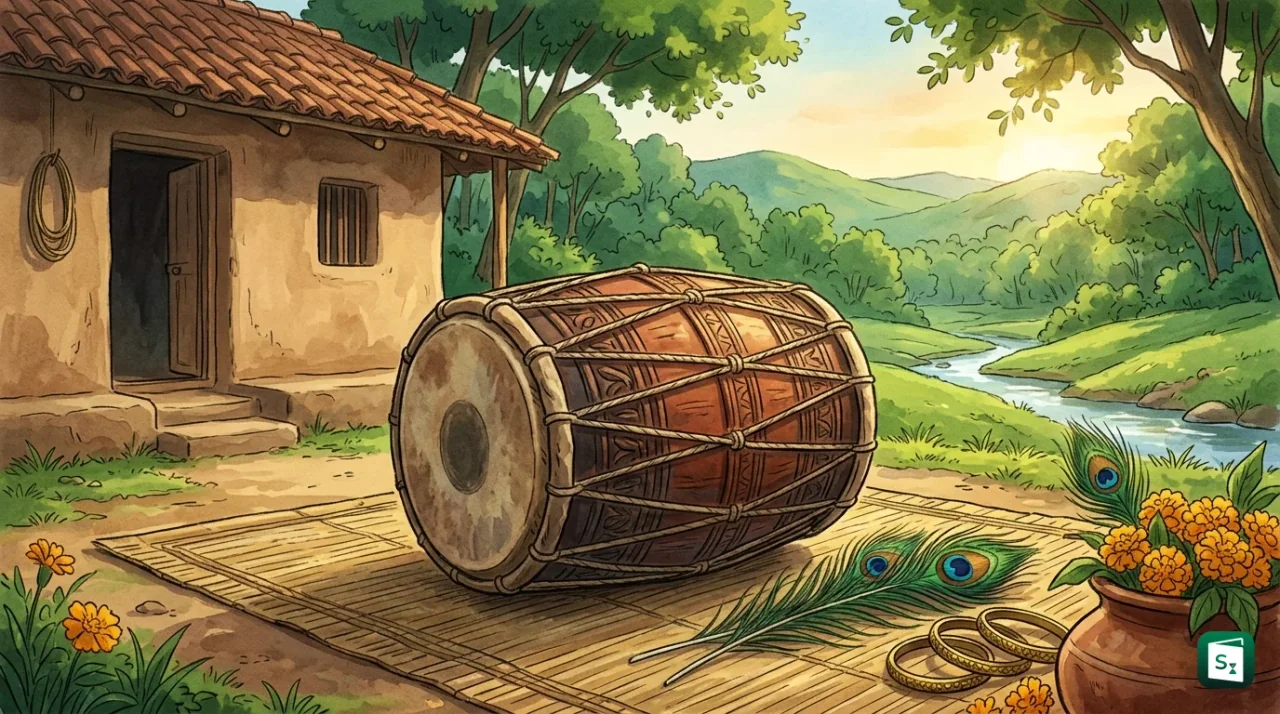
The Mandar has a distinctive cylindrical wooden or clay body that bulges slightly in the middle. The GI application highlights this shape, the use of locally sourced red soil, traditional hand building methods and a warm acoustic quality as proof of its link to Jharkhand.
Artisans shape the shell from seasoned wood or baked red clay found in the Chotanagpur region. Both open ends are covered with animal hide, usually goat skin, and laced together with rope or leather straps that run along the body. The two playing faces differ in size. The larger head produces a deep bass note and the smaller head gives a high, ringing note. A black tuning paste, prepared from grain, iron filings and other natural materials, is often applied to one head to sharpen the tone. Makers tune the drum by tightening or loosening the side ropes and by drying the skin in the sun, a skill passed down within artisan families.
The size varies from small handheld versions for solo singers to large drums for dance troupes. Unlike factory made drums, each Mandar is shaped and tuned by ear. That hand craft gives it a soft but carrying sound that blends with flutes such as the bansi, cymbals such as kartal and jhanj, and kettle drums such as nagara and dhak.
The table below captures how the Mandar differs from the more widely known dhol and dholak.
| Feature | Mandar | Dhol and Dholak |
|---|---|---|
| Core material | Wooden or red clay shell, one variant made largely from soil | Wooden shell |
| Shape | Straight cylinder with gentle central bulge | Dhol is barrel shaped, dholak is tapered |
| Playing method | Played only by hand, hung from neck or held sideways | Dhol often played with sticks, dholak by hand |
| Sound character | Deep but soft and melodic, suited to folk songs | Louder and sharper, suited to open processions |
| Cultural home | Tribal akhra, Karma, Sarhul, Jhumair in Jharkhand | Weddings and folk events across north India |
What Is a GI Tag in India?
A Geographical Indication tag is a legal sign that links a product’s quality, reputation or character to its place of origin. In India it is granted under the Geographical Indications of Goods Act of 1999 and allows only authorised makers from that region to use the registered name.
The full form is Geographical Indication. The idea comes from the Trade Related Aspects of Intellectual Property Rights (TRIPS) Agreement of the World Trade Organization (WTO). To meet that global commitment, Parliament passed the Geographical Indications of Goods (Registration and Protection) Act, 1999. The Act received assent on 30 December 1999 and came into force on 15 September 2003. The Geographical Indications Registry operates from Guindy, Chennai under the Controller General of Patents, Designs and Trade Marks, and has jurisdiction across India.
A GI is given after a detailed application, examination, public advertisement and hearing process. Any association of producers, weavers, artisans or government bodies can apply. Applicants must prove that the product has special traits due to soil, climate, traditional skill or long history in that area. Once granted, registration is valid for ten years and can be renewed. Only registered authorised users can use the GI name and logo, and they can take legal action against copies or misuse.
The benefits are direct. A GI stops cheap imitations, builds a premium brand for village products and helps artisans charge fair prices. It also helps buyers identify genuine handloom, handicraft, food and farm goods. Well known examples include Darjeeling Tea, the first Indian product to receive the tag in 2004, Banarasi Silk, Tirupati Laddu and Kolhapuri Chappal. India has crossed 800 registered GI products (as of August 2026), with more than 600 added since 2014. At the GI Samagam held in New Delhi in January 2025, the government set a target of 10,000 GI registrations by 2030.
How Mandar Secured the GI Tag
The Geographical Indications Registry in Chennai granted the Mandar tag in late September 2026 after a five year legal and documentation effort. The application for the folk instrument was filed in 2021 and the final hearing took place in New Delhi in January 2025.
The case was prepared and argued by Dr Satyadeep Singh, an Intellectual Property expert and visiting faculty member at the National University of Study and Research in Law (NUSRL), Ranchi. NUSRL Ranchi is the state law university of Jharkhand, established in 2010 and located in the state capital Ranchi. Dr Singh handled the filing, replies to examination queries, supporting records and oral arguments before the Registrar. He has earlier guided GI recognition for Sohrai Khovar painting, the first product from Jharkhand to receive the tag, and for Kesariya Kalakand of Koderma.
The application showed that Mandar making uses local red soil and wood, community based craft skills and tuning methods unique to Jharkhand. It described the shell shape, skin fitting, rope lacing and the distinct bass and treble tones that suit tribal songs and dances. The file also traced continuous use over more than a century through colonial and official records.
The historical evidence included the 1915 writings of anthropologist Sarat Chandra Roy, a pioneer of tribal studies in Chotanagpur, and the 1931 work of Tarak Chandra Das. It relied strongly on the 1940 book The Blue Grove by W. G. Archer, who lived in the region and studied Oraon song, dance and folklore. Further proof came from the Patna Museum Annual Report of 1920, the Union government publication Folk Dances of India (1956) and the Bihar District Gazetteer for Ranchi. Together these records describe the Mandar as central to the music, dance and social life of indigenous communities in what is today Jharkhand.
Jharkhand GI Tag List: Where Mandar Fits
The Mandar joins a fast expanding Jharkhand GI portfolio rooted in tribal art, handloom, craft and food. The state’s first GI recognition went to Sohrai Khovar painting in 2020. Sohrai and Khovar are mural traditions painted by tribal women on mud walls during harvest and wedding seasons using natural soils and colours. Koderma’s Kesariya Kalakand, a saffron flavoured milk sweet, received the tag in the same cycle.
In June 2026 the Geographical Indications Registry granted tags to 11 traditional products from Jharkhand in one sweep. The list covered handloom textiles, crafts, paintings, jewellery and cuisine and placed eastern India at the front of GI registrations for 2025 to 2026. The National Bank for Agriculture and Rural Development (NABARD) supported the documentation, producer organisation and value chain work for several of these products. NABARD is the apex rural development bank of India, established in 1982 and headquartered in Mumbai.
| Product | Craft Type |
|---|---|
| Sohrai Khovar painting | Tribal mural art, first Jharkhand GI in 2020 |
| Mandar folk drum | Tribal percussion instrument, recognised in September 2026 |
| Kuchai Silk Saree and Bhagaiya Silk | Organic tussar silk woven from cocoons reared on asan and arjun trees, Jharkhand supplies about 40 percent of India’s tussar |
| Munda Jewellery | Traditional tribal ornaments of the Munda community |
| Jharkhand Bamboo Craft | Utility and decorative goods from local bamboo |
| Dokra Craft | Lost wax metal casting by tribal artisans |
| Jadopatia or Jadupatua painting | Scroll painting of Santhal storytellers |
| Baroni or Jadopatia linked paintings, Tumka Chadar, Bhoya Saree, Pancho Saree and Tussar Silk and Sarees | Handloom textiles of tribal weavers |
| Kesariya Kalakand of Koderma | Milk based sweet flavoured with saffron |
The Mandar is notable within this list because most GI tags cover farm goods, textiles or food. Musical instruments form a small and distinct GI category. Other instrument examples at the national level include the Bihu Pepa of Assam. The Mandar tag therefore puts Jharkhand’s folk music on the same protected platform as its paintings and silks.
Why the Recognition Matters
The GI tag gives Mandar artisans a legal identity that factory copies cannot use. Only makers from the registered territory who follow the documented craft can sell products as Jharkhand Mandar. That protection helps village artisans secure better prices at fairs, rural marts, buyer seller meets and exhibitions such as Saras Mela.
The tag also supports livelihoods in a craft that is largely informal and family based. With a registered logo and story, artisan groups, self help groups and farmer producer organisations can build common brands, seek export orders and link music tourism with craft sales. Visitors who come for Karma dances, Sarhul processions or Chhau performances can now identify an authentic instrument with confidence.
Culturally, the recognition records the knowledge of soil selection, hide curing, rope tuning and rhythm teaching as heritage worth preserving. It encourages younger members of Munda, Oraon, Santhal, Ho and other communities to learn both playing and making. In a period when electronic music and mass produced drums are entering village markets, formal recognition helps the handmade Mandar retain its place at the centre of community life.
Key Takeaways
- The Mandar of Jharkhand received a GI tag from the Geographical Indications Registry, Chennai in late September 2026.
- The Mandar is a double headed cylindrical percussion drum made with red soil, wood and leather and played by hand at Karma, Sarhul, Jhumair and Domkach celebrations.
- The GI application was filed in 2021, argued by Dr Satyadeep Singh of NUSRL Ranchi, with final hearing in New Delhi in January 2025.
- Historical proof included records from 1915, 1931, 1940, the Patna Museum Report of 1920 and the Folk Dances of India (1956).
- Sohrai Khovar painting, recognised in 2020, was the first GI product from Jharkhand, followed by Kesariya Kalakand and 11 products in June 2026.
- GI protection in India is governed by the Geographical Indications of Goods Act, 1999, valid for ten years and renewable, with India crossing 800 registered GIs and targeting 10,000 by 2030.