Tata Projects Ltd and Canada based MDS Aero Support Corporation signed a Memorandum of Understanding (MoU) in Mumbai on 28 September 2026 to jointly develop advanced aero-engine testing infrastructure in India. The pact combines local infrastructure execution with global gas turbine testing technology at a time when demand for jet engine testing facilities in India is rising fast. It aims to give India home grown test beds to validate and certify military and civil jet engines instead of sending them abroad.
What Does Tata Projects Do? Overview of Tata Projects Limited
Tata Projects Limited is a technology driven Engineering, Procurement and Construction (EPC) company that designs and builds large and complex infrastructure. EPC means one contractor handles engineering design, purchase of materials and equipment, and actual construction up to commissioning. The company covers the full project life cycle from concept to operations and maintenance for sectors such as rail and metro systems, airports, power transmission, water systems, refineries, semiconductor plants, gigafactories and data centres.
Tata Projects was founded in 1979 by J. R. D. Tata and is part of the Tata Group. The Tata Group operates in more than 100 countries across six continents and reported combined revenue of $180 billion in 2024-25 with over 10 lakh employees. Tata Projects itself is an unlisted public company. Tata Projects is not a listed company on stock exchanges, so the answer to is Tata Projects listed is no. The registered office of Tata Projects moved from Hyderabad to Mumbai with effect from 1 June 2025.
The company has built a strong record in mission critical work. Tata Projects delivered Phase 1 of the Noida International Airport, major metro packages in Delhi, Mumbai, Pune, Chennai and Lucknow, sections of the Dedicated Freight Corridor and the Mumbai Trans Harbour Link. In advanced technology, Tata Projects is building the Micron semiconductor assembly and test facility in Sanand, Gujarat and the Tata semiconductor fabrication support works in Dholera and Assam. This background in cryogenic engine test stands, semi-cryogenic test facilities and tri-sonic wind tunnels for strategic programmes explains why Tata Projects will lead the civil and physical infrastructure part of the new aero-engine testing plan.
Tata Projects and MDS Aero MoU: Agreement Snapshot and Signatories
The Memorandum of Understanding (MoU) between Tata Projects and MDS Aero Support Corporation was formalised in Mumbai on 28 September 2026. An MoU is a written understanding that records the intent of two sides to work together. It is not a final construction contract but sets the framework for joint design, bidding and delivery of future test facilities in India.
MDS Aero Support Corporation is a Canada based specialist in gas turbine engine testing solutions with headquarters in Ottawa, Canada. MDS Aero was founded in 1985 and has delivered testing projects in more than 27 countries. The company designs turnkey test solutions for full engines and engine parts across aviation, defence and industrial uses. MDS Aero has been recognised as one of Canada’s Best Managed Companies since 2012. MDS Aero already has a support office in Bengaluru, India and is serving as the lead technology provider for an advanced twin-cell aero-engine development test facility in India for next generation military propulsion systems.
The division of work under the Tata Projects MDS Aero MoU is clear. Tata Projects will handle the heavy infrastructure and MDS Aero will handle the testing technology and integration.
| Partner | Responsibility under the MoU |
|---|---|
| Tata Projects | Civil and structural works, mechanical electrical and plumbing (MEP), high air pressure systems, heating ventilation and air conditioning (HVAC), high temperature exhaust systems, cooling water systems and site infrastructure |
| MDS Aero | Design, engineering, supply, integration, commissioning and lifecycle support of gas turbine engine test facilities and test systems |
Tata Projects was represented by Rajiv Menon, President and Chief Growth and Strategy Officer (as of October 2026), who said the pact brings together complementary strengths to build the backbone of India’s aerospace ecosystem. MDS Aero was represented by Joe Hajjar, Chief Revenue Officer, who said the combination of local execution and global testing expertise will support India’s aerospace growth and strengthen aerospace and technology ties between Canada and India.
What Is an Aero Engine and How Does Jet Engine Testing Work?
An aero engine is the power plant that gives thrust to an aircraft by pushing air or exhaust gases backward at high speed. Most modern aero engines are gas turbine engines. Common types include turbofan engines used in passenger jets and fighters, turbojet engines used in older fighters and missiles, turboprop engines used in small transport aircraft and turboshaft engines used in helicopters.
A jet engine works by taking in air, compressing it, mixing it with fuel and burning it, and then forcing the hot gases out through a turbine and nozzle. The compressor raises the pressure of incoming air. Fuel is added in the combustor and ignited. The hot gases spin the turbine, which in turn drives the compressor and fan. The high speed exhaust creates forward thrust. Thrust is measured in kilonewton (kN) or pound force (lbf). Fighter engines typically produce 50 to 130 kN of thrust, while large passenger engines can cross 300 kN.
What Is an Engine Test Bed and Test Cell
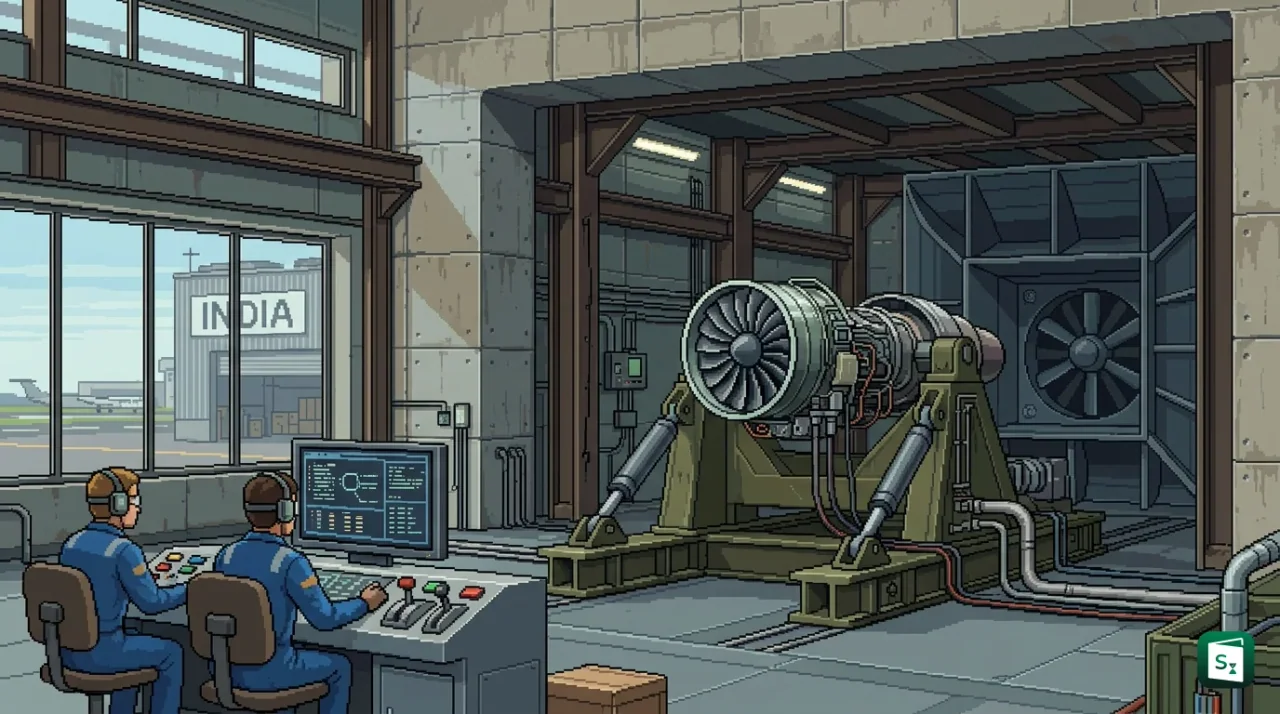
An engine test bed is the rigid stand and connected systems on which an engine is mounted for ground trials. An engine test cell is the full enclosed facility that houses the test bed. The cell provides clean and steady airflow to the engine inlet, holds the engine safely on a thrust frame, measures thrust with a load cell, and carries hot exhaust away through an augmenter and exhaust stack with cooling air and noise control.
The control room sits outside the cell behind protective walls. Engineers run the engine through takeoff, cruise and landing cycles and record temperature, pressure, fuel flow, vibration and thrust through a data acquisition system. Tests include sea level acceptance runs, endurance runs, performance calibration and, in advanced altitude cells, simulation of high altitude pressure and cold with compressors and vacuum systems. A good cell prevents re-entry of exhaust into the inlet and gives stable and repeatable results for development, production and maintenance, repair and overhaul (MRO) testing.
Aero-Engine Testing Infrastructure Explained
Aero-engine testing infrastructure is the set of buildings, machines and software used to prove that an engine is safe, powerful and durable before it flies. Engine makers and overhaul shops use these facilities to develop new designs, validate changes, certify compliance with airworthiness rules and check every repaired engine before return to service. MDS Aero specialises in turnkey delivery of such infrastructure, which means design, supply, installation, commissioning and long term support under one responsibility.
The systems in a modern jet engine testing facility work as one integrated unit. Air inlet systems with screens, flow straighteners and silencers deliver smooth air. The test stand holds the engine and allows quick change of engine types. Fuel, oil, starting air, hydraulics and cooling water keep the engine running. Sensors and the data acquisition system collect steady state and fast changing data, while the facility control system manages safety interlocks, fire suppression and exhaust handling.
| Type of Test Facility | What It Tests |
|---|---|
| Sea level test cell | Full engine performance at ground level for production acceptance and MRO checks, with thrust up to 150,000 lbf class in large cells |
| Altitude test cell | Engine behaviour at simulated height and speed using vacuum chambers, air supply compressors and temperature conditioning for Mach and cold tests |
| Component rig | Fans, compressors, combustors and turbines tested alone for aerodynamic and mechanical performance |
| Special purpose rig | Icing, bird strike, hail, rain ingestion and acoustic tests for certification |
MDS Aero has shown this capability at global scale. MDS Aero acted as prime contractor for the large indoor test bed for Rolls-Royce in Derby, England, with a footprint of about 7,500 square metres. That facility tests engines such as the Trent XWB for the Airbus A350, the Trent 1000 for the Boeing 787 and the next generation UltraFan. For India, the same approach links aero-engine manufacturing with testing. When test cells sit close to factories and MRO shops, design faults are found early, certification time falls and overhaul turnaround improves. This link matters for jet engine manufacturers in India and for aero-engine companies that want to build, assemble or service engines domestically.
Why India Needs Domestic Jet Engine Testing Facilities
India designs and builds aircraft but still depends on foreign ground for final proof of its jet engines. The Gas Turbine Research Establishment (GTRE), a laboratory of the Defence Research and Development Organisation (DRDO) in Bengaluru, leads military engine development. DRDO functions under the Ministry of Defence and was established in 1958. GTRE has long used test chambers in Russia, France and the United States for high altitude, afterburner and flight trials. That dependence creates delay, high logistics cost and limits control over sensitive design data.
The strain is visible in the Kaveri engine programme. The original Kaveri was meant for the Light Combat Aircraft Tejas. The dry variant, called the Kaveri Derivative Engine, produces about 49 to 51 kN of dry thrust and is now aimed at the Ghatak stealth Unmanned Combat Aerial Vehicle. Ground runs and high altitude simulation in Russia were completed, but further slots were hard to secure and one engine waited nearly three years for a high altitude test window. In February 2026, Defence Minister Rajnath Singh witnessed a full afterburner test of the Kaveri derivative at GTRE Bengaluru. With a new afterburner module and improved single crystal blades and thermal coatings, the engine touched 80 to 83 kN in afterburning mode, closer to the class of the GE F404 engine used in Tejas Mk1A.
| Engine Programme | Thrust Target | Planned Use |
|---|---|---|
| Kaveri Derivative Engine (dry) | 49 to 51 kN | Ghatak stealth drone |
| Afterburning Kaveri (Kaveri 2.0) | 80 to 83 kN | Possible future fighter use after qualification |
| AMCA engine with Safran partnership | 110 to 120 kN | Advanced Medium Combat Aircraft stealth fighter |
To close the gap, GTRE issued a Request for Information in March 2026 for a National Aero Engine Test Complex with altitude simulation up to 15 km and speeds above Mach 2, plus rigs for compressors, combustors and turbines. GTRE is also commissioning a 130 kN twin-cell test bed at Rajanukunte near Bengaluru, started in late 2023, with two independent cells so two engines or configurations can be tested in parallel. Domestic aero-engine manufacturers in India, jet engine overhaul shops and DRDO labs would all gain from added capacity of this kind. The Tata Projects and MDS Aero plan fits directly into this national push by adding private capacity for development, production and MRO testing on Indian soil.
India Canada Cooperation and the Way Forward
The Tata Projects MDS Aero pact also carries diplomatic weight. India Canada ties passed through strain in 2023 and 2024 and have moved toward repair since late 2025. Canadian Prime Minister Mark Carney visited India from 27 February to 2 March 2026, when both sides committed to a renewed strategic partnership, an India Canada Defence Dialogue and a maritime security partnership. In October 2026, both sides held the fifth round of talks in Ottawa on the proposed Comprehensive Economic Partnership Agreement (CEPA), with energy, critical minerals, aerospace and artificial intelligence as priority areas. A Canada uranium supply deal worth about $2.6 billion between Cameco and the Department of Atomic Energy was also concluded during this reset phase.
For India, local test infrastructure supports Make in India and self reliance in defence. It cuts waiting time for foreign slots, protects proprietary data, speeds certification of the Kaveri family and the future AMCA engine, and builds skills in high pressure air systems, acoustics, data systems and safety. For Canada, the pact gives its firms a delivery partner that understands Indian construction, approvals and supply chains. For airlines and MRO firms, more cells in India mean faster turnaround of civil engines as passenger traffic grows. India is counted among the fastest growing civil aviation markets in the world, so civil testing demand will rise alongside military demand.
The next steps will show the real value of the MoU. The partners will need to convert the understanding into specific project bids, including support for public test complexes and private MRO test cells. Success will depend on clear technical specifications, cost control, skilled operators and long term maintenance. If executed well, the collaboration can turn testing from India’s weakest link in propulsion into a domestic strength.
Key Takeaways
- Tata Projects Ltd signed an MoU with MDS Aero Support Corporation of Canada in Mumbai on 28 September 2026 to build aero-engine testing infrastructure in India.
- Tata Projects, founded in 1979 and headquartered in Mumbai, will lead civil works, MEP, HVAC, high pressure air, exhaust and cooling water systems.
- MDS Aero, founded in 1985 in Ottawa with projects in more than 27 countries, will provide design, integration, commissioning and lifecycle support for gas turbine test facilities.
- An engine test bed is the stand that holds the engine while an engine test cell is the full controlled facility that supplies airflow, measures thrust and handles exhaust and data.
- The Kaveri Derivative Engine produces 49 to 51 kN for the Ghatak drone, while the afterburning version touched 80 to 83 kN in the February 2026 GTRE test.